Bill Ackman literally gave a 44-minute masterclass that explains money better than any business school.
1. Starting early is the single biggest advantage you have. If you save $10,000 at age 22, never add another penny, and earn 10% a year, you have $600,000 by retirement. wait until 32 to start, and the same money only grows to $232,000. The decade you lose at the beginning costs you more than any decade later because compounding does its heaviest lifting at the end.
2. The return rate matters even more than most people grasp. That same $10,000 at 22 earning 10% becomes $600,000. At 15% it becomes over 4 million. At 20%, the rate Warren Buffett has achieved, it becomes 25 million. Einstein called compound interest the most powerful force in the universe. Ackman's lecture is essentially a demonstration of why.
3. Avoiding losses matters as much as chasing returns. if you reach for a 20% return but lose half your money every 12 years from bad decisions or a rough patch, your 25 million collapses to 1.8 million. Buffett's rule one is never lose money. Rule two is never forget rule one. the math of recovery is brutal, so protecting the downside is not caution, it is strategy.
4. Debt is safer, but the upside is capped. Equity is riskier, but the upside is unlimited. In the lemonade stand example, the lender who put up $250 earns a steady 10% and gets paid back first if the business fails. the equity investor who put up $500 earns over 100% if it succeeds but gets wiped out if it fails. The equity holder earns more precisely because they took the risk the lender refused.
5. The risk that matters is permanent loss, not price movement. most people think risk is the stock price bouncing up and down every day. Ackman says ignore that. the real risk is whether you will permanently lose your money. Short-term volatility is noise. the question that matters is whether you get your capital back with a return over the long run.
6. Avoid startups and complicated businesses. You do not need 100% a year to build a fortune. you need 10 to 15% over a long period. so skip the lemonade stands and unknown ventures. Invest in public companies that are established, liquid, and have to clear real hurdles before going public. If you cannot understand how a business makes money, avoid it no matter how good its track record. Ackman cites Enron, a business almost nobody actually understood.
7. Invest in a business you could own forever. if the stock market closed for 10 years, you should not be unhappy holding it. Coca-Cola is his example. easy to understand, sells a syrup and earns a profit on every drink, the population keeps growing, and it is nearly impossible to disrupt with new technology. McDonald's is another. People have to eat, the food is cheap, and they keep growing. find a business you would be comfortable holding through anything.
8. You want products people are loyal to and will pay a premium for. People buy generic flour and sugar without caring about the brand. but they want the Hershey bar, the Cadbury bar, the see's candy specifically. you do not want to sell a commodity that anyone can sell cheaper. You want something unique that customers refuse to substitute even at a 20% discount.
9. Low debt is a safety feature. In the lemonade stand example, $250 of debt was manageable. But if it had been $1,000 and the business hit a rough patch, it could have gone under and wiped out the shareholders. Find companies with little debt or so much profit relative to their interest payments that a bad year cannot sink them.
10. Barriers to entry protect your returns. You want a business that is hard for someone to compete with tomorrow. Coca-Cola's market presence is so strong that you expect to get a Coke at any restaurant. Pepsi has coexisted with it for decades, but neither can put the other out of business. If a competitor can show up next year with a better version and steal the customers, the business is not worth owning long term.
11. The best businesses are immune to outside factors you cannot control. Coca-Cola has survived 120 years through world wars, nuclear weapons, and every kind of crisis, and each year it makes slightly more money. You want companies that do not depend on commodity prices, interest rates, or currency moves. A business that keeps earning regardless of what is happening in the world is the kind you hold forever.
12. Low capital intensity is one of the most underrated qualities. The worst businesses require massive reinvestment to grow. The auto industry has to build enormous factories and buy machine tools before selling a single car, and those tools wear out. GM's stock barely moved over 40 to 50 years for exactly this reason. Coca-Cola, by contrast, sells a formula and collects a royalty. American Express takes a few percent of every dollar spent on its card. a business that earns a royalty on other people's capital is one of the best things you can own.
13. Pay down debt and build a cushion before you invest. If you have high-interest credit card debt, paying it off is a guaranteed return equal to the interest rate. same logic, to a lesser degree, with student loans at 6 or 7%. and you want 6 to 12 months of expenses in the bank so that losing your job tomorrow does not force you to sell. You can only handle market volatility if you do not need the money.
14. Be a buyer when everyone is selling and a seller when everyone is buying. The natural human tendency is the opposite, a lemming-like instinct to sell in a crash and buy in a bubble. people sold into the 1987 crash when they should have been buying. The only way to resist this is to be financially secure enough that the money at risk does not affect your life, so you can withstand the swings without panicking.
15. The stock market is a voting machine in the short term and a weighing machine in the long term. Ben Graham's idea, which Ackman repeats. short-term prices reflect the whims and emotions of investors. long term, prices reflect the actual value of the underlying businesses. If you buy good businesses at reasonable prices and hold them while they grow, you make money over time as long as you are never forced to sell at the wrong moment.
16. A stock is just a bond where you do not know the coupon. Flip a price-to-earnings ratio over, and you get an earnings yield. A stock at 10 times earnings is a 10% earnings yield, which you can compare directly to a 3% treasury. the difference is the bond's coupon is fixed and the stock's coupon, its earnings, moves up and down. Ackman wants an earnings yield higher than a treasury that will also grow over time, so he does not need to be right about explosive growth to earn a good return.
In 2000, Lee Kuan Yew gave a 2-hour masterclass on leadership worth more than an MBA.
He built Singapore into a First World nation in one generation
His frameworks:
- Why IQ alone destroys leaders
- Trustees, not owners
- How trust is built in crisis
12 lessons on how to lead:
Here is a completely free Computer Science curriculum for those with the discipline to go through it independently.
The curriculum follows the same degree requirements as an undergraduate computer science major and consists of courses from Harvard, MIT, and Princeton, among other colleges.
The curriculum has four major sections:
1. Introduction: Students can review this section and decide whether this fits them.
2. Core: This section corresponds to the first three college years.
3. Advanced: This section corresponds to the final year of a Computer Science curriculum in college.
4. Final Project: Students can validate, consolidate, and display their knowledge by completing this project.
Assuming you spend around 20 hours per week, you can finish in two years.
I won't lie: completing a curriculum like this alone will be hard. Having the support of professors and other students is very important, but if you have the discipline and the will, this material is amazing.
The link to the repository is on the screenshot and its ALT description.
Studied 8 high potential small caps with strong fundamentals from different sectors, having capabilities to make it big in the future.
1. Lemon Tree
2. Allcargo Logistics
3. KSB
4. Apcotex
5. Sapphire Foods
6. MonteCarlo
7. AnandRathi
8. Tinna Rubber
All superb companies
My experience of #Vipassana
I was fortunate to experience a 10-day Vipassana workshop recently. Sharing my learnings & experience since many folks asked me how it went. So here goes (1/n)
List of Strong growth potencial Stocks💪, Some of which should be part of ur
Portfolio 🤞🏻🥂
LaurusLabs
JubilantIngrevia
IEX
GlobusSpirits
SonaCom
BorosilRenew
Mastek
KIMS
Easemytrip
Praj
KprMills
ShivalikRasayan
These small/mid cap can turn to mid/large cap in upcoming years.
Bank FD rate: 6%
Tax Slab: 30%
Net Post Tax: 4.2%
Inflation: 5.6%
Post inflation return: -1.4%
Just because 'you think' your capital is secured, does not make FD's risk free.
#Investment#investing
Boss is always Boss @Mitesh_Engr
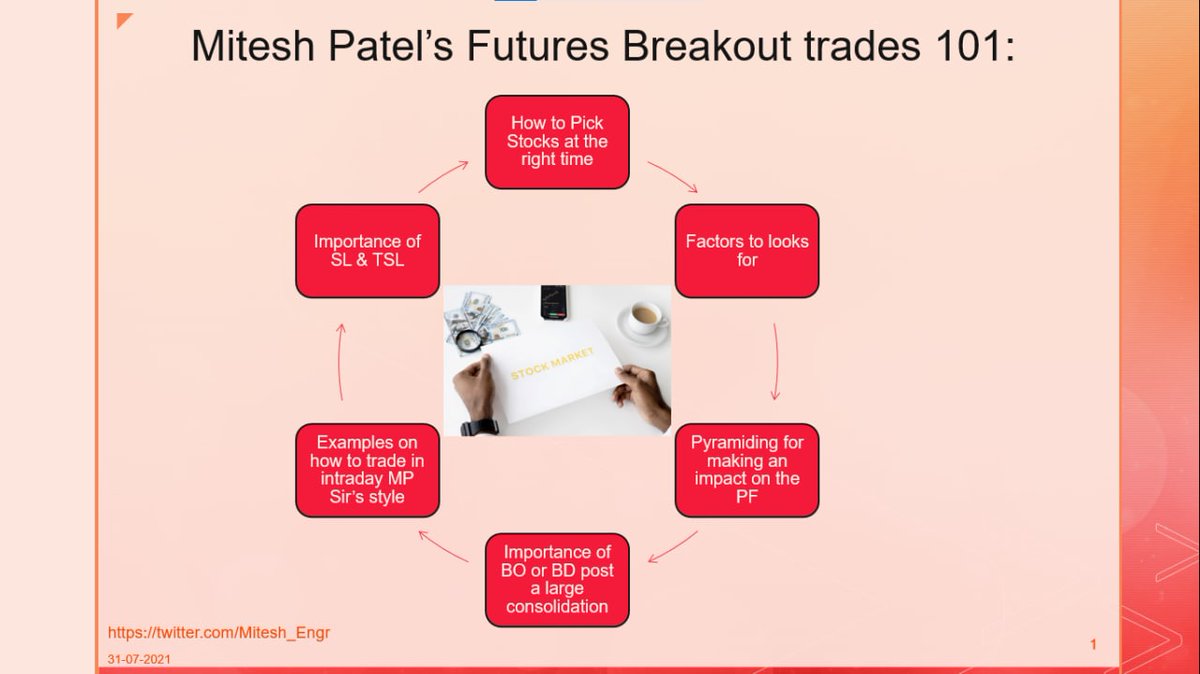
Mitesh Sir's FUTURES BREAKOUT TRADES 101:
• How to pick stocks at right time?
• What to look for?
• Importance of BO post consolidation
• How to manage SL
• How to get huge profits
• Multiple Examples
In collaboration with @niki_poojary
🧵A curated list of Ultimate Python resources! 🧵
(Getting started with #Python or a senior Python developer, you wouldn't wanna miss this) 😄
A thread.
🧵👇
I made another DNS tool! this one shows you what's going on behind the scenes when you make a DNS query
try it here with any domain you want: https://t.co/CVbUZJXVal