R1 Day100 #100DaysOfCode coding a Netflix clone takes to another level of react. There's still lots to learn in react. Done with 100days and got a new frontend developer job too.🎊🎉🙏
#womenwhocode#FrontEndDevelopment#reactjs
The ultimate Full-stack AI Engineering roadmap to go from 0 to 100.
Bookmark this.
This is the exact mapped-out path on what it actually takes to go from Beginner → full-stack AI engineer.
> Start with coding fundamentals.
> Learn Python, Bash, Git, and testing.
> Every strong AI engineer starts with fundamentals.
> Learn how to interact with models by understanding LLM APIs.
> This will teach you structured outputs, caching, system prompts, etc.
> APIs are great, but raw LLMs still need the latest info to be effective.
> Learn how LLMs are usually augmented with more info/patterns.
> This will teach you the basics of fine-tuning, RAG, prompt/context engineering, etc.
> Strong LLMs are useless without context. That’s where Retrieval techniques help.
> Learn about vector DBs, hybrid retrieval, indexing strategies, etc.
> Once retrieval is solid, move into RAG.
> Learn to build retrieval + generation pipelines, reranking, and multi-step retrieval using popular orchestration frameworks.
> Now, step into AI Agents, where AI moves from answering to acting.
> Learn memory, multi-agent systems, human-in-the-loop design, Agentic patterns, etc.
> Learn how to ship in production with Infrastructure.
> This will teach you CI/CD, containers, model routing, Kubernetes, and deployment at scale.
> Focus on observability & evaluation.
> Learn how to create eval datasets, LLM-as-a-judge, tracing, instrumentation, and continuous evaluation pipelines.
> Security is crucial.
> Learn how to implement guardrails, sandboxing, prompt injection defenses, and ethical guidelines.
> Finally, explore advanced workflows.
> This covers voice & vision agents, CLI agents, robotics, agent swarms, and self-refining AI systems.
This is the actual journey to becoming a full-stack AI Engineer and not just "use” AI, but designing full-stack AI systems that can survive in production.
If you need specific resources, I wrote a detailed article that provides a structured learning roadmap for AI engineers in 2026.
It covers prompting, RAG, fine-tuning, agents, MCP, evals, and inference, with guidance on what to prioritize and in what order.
Read it below.
@sridharfyi $40k on LLM API credits, premium compute, and evaluation infra. Building agentic systems means heavy token burn during R&D.
$40k to hire ONE exceptional, senior contractor. Need a killer engineer
$20k for niche community sponsorships & outbound for our first 100 design partners
API Gateway :Microservices architecture, clients should not have to know where every internal service lives. It acts as the single entry point between clients and backend services. Its most important job is request routing:
1. /users/* user service
2. /orders/* order service
System Design Playbook
(𝙂𝙄𝙑𝙀𝘼𝙒𝘼𝙔 𝘼𝙇𝙀𝙍𝙏.)
>System design fundamentals.
>Condensed notes to read for system design interview.
>Must know concepts from real-world software engineering case studies.
To get it for free:
1 Retweet & Follow @systemdesignone
2 Reply "Playbook"
Then I'll DM you the details.
Push-based systems come up in 90% of system design interviews.
Here's the exercise you should be able to solve:
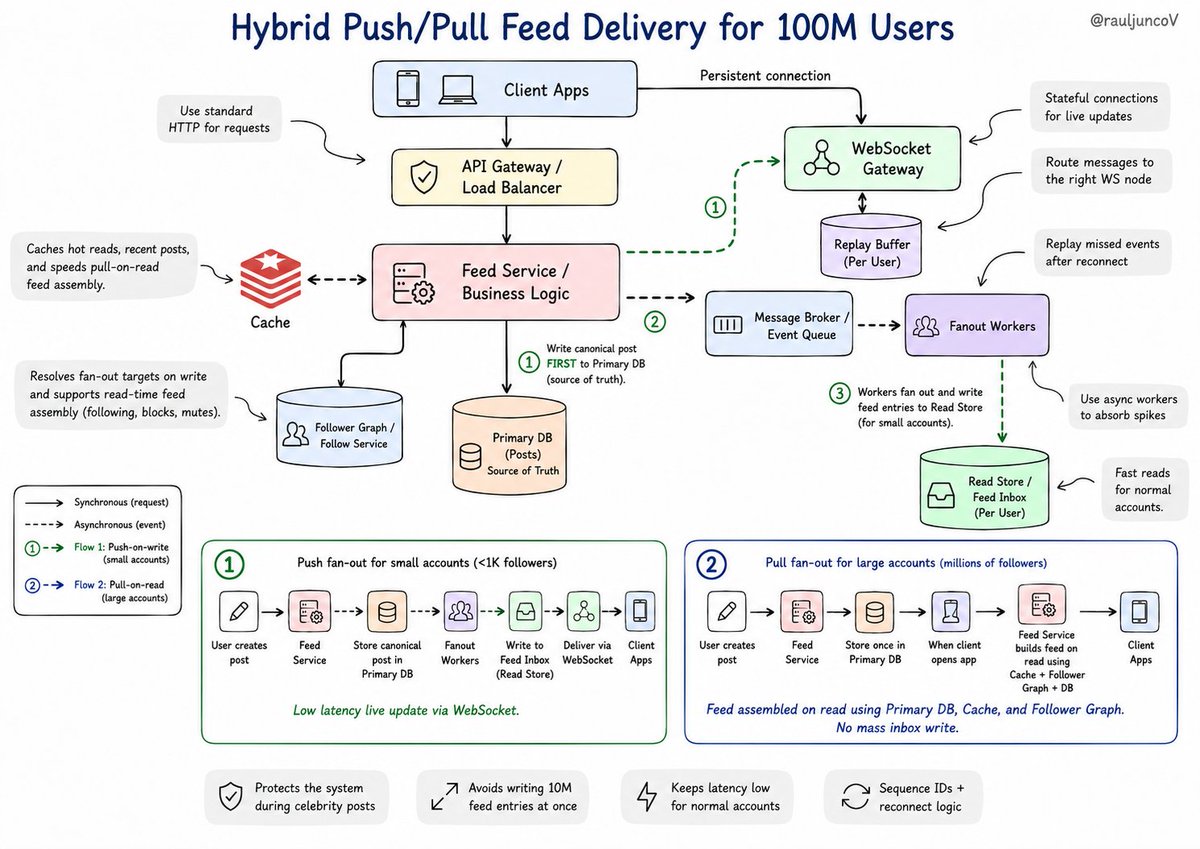
Design a notification system for 100M users. Some have 50 followers. Some have 10M.
The instinct is to hold a WebSocket connection open to every active user and push updates as they arrive. Clean mental model. It collapses the moment a celebrity posts.
When someone with 10M followers posts, you push to 10M open connections simultaneously. Your message broker saturates. Your WebSocket servers fall over. The system fails at the exact moment it needs to work.
That's the fan-out problem. And it kills more interview answers than any other mistake.
The production answer: push and pull aren't binary. You pick based on follower count. Users with fewer than 1,000 followers get push fan-out. Each follower gets notified immediately.
Users with millions of followers get pull fan-out. Their feed assembles on read. Nobody gets a push. Followers see the post when they open the app.
Twitter built exactly this: push-on-write for small accounts, pull-on-read for large ones.
But fan-out is only half the problem.
Push means stateful connections. Your servers now need to know which connection lives on which machine. You can't route blindly. Most teams reach for Redis pub/sub here; the WebSocket server subscribes, the backend publishes, the message finds the right node.
Add a 3-second network drop and you have another layer: what did the client miss? Now you need sequence IDs, a message buffer, and reconnect logic that replays missed events.
"Push-based" became push with a pull fallback, a message broker, sticky routing, and a replay buffer.
Most engineers stop at the first diagram.
The ones who get the offer keep pulling the thread until the system breaks.
Google CEO Sundar Pichai on current frontier model's ability to break the security of almost all current software.
"These models are definitely, like really gonna break pretty much all software out there, maybe already, we don't know."