Bruno Fernandes equals the record for the most assists in a Premier League season set by Thierry Henry and Kevin De Bruyne. 💫
Great company, amazing milestone. @B_Fernandes8 👏
Code is actually the right abstraction.
Too often I see the future of software engineering diminished down to, effectively, writing and reviewing markdown files.
Yes, it will be hard to review thousands of lines of agent code. But maybe the takeaway is that you want less code?
Rather than just giving up ("well I guess we won't read the code, or we'll read this lossy markdown summary") this should be a signal forcing you to think about better systems.
- How can we make our codebase more verifiable? For example, fast/robust/stable tests, or moving to a typed language.
- How can we deslop or improve the architecture/abstractions of the code generated by agents? For example, spending more time up front on the codebase architecture/types before yolo generating all of the code.
- How are we going to maintain and evolve this codebase over time? The slop compounds. One great solution here is... you guessed it, learning from the past decades of software engineering! For example, you might just have the wrong abstraction entirely, leading to a ton of duplicated code.
I think the markdown folks *are* right in some ways. If you are using skills every day, for many different prompts and workflows, isn't that effectively "coding with markdown"? Kinda.
There's been plenty of ink spilled on the merits and benefits of skills. To me, skills make your style of working legible for agents. They don't replace code and that's not really the point.
In reality, there's this messy and constantly re-evolving future in which both of these things are true:
1. Skills (and markdown) are important for how you give input to the agents and ensure high-quality code & systems are created
2. Looking at the actual code will not be replaced by markdown summaries or a collection of spec documents that ignore the lower level details of the code
In summary: reality has a surprising amount of detail (and nuance)!
🚀 DeepSeek-V4 Preview is officially live & open-sourced! Welcome to the era of cost-effective 1M context length.
🔹 DeepSeek-V4-Pro: 1.6T total / 49B active params. Performance rivaling the world's top closed-source models.
🔹 DeepSeek-V4-Flash: 284B total / 13B active params. Your fast, efficient, and economical choice.
Try it now at https://t.co/GCdiMzk1Dl via Expert Mode / Instant Mode. API is updated & available today!
📄 Tech Report: https://t.co/drlDrxkYtp
🤗 Open Weights: https://t.co/T13Y8i7SDM
1/n
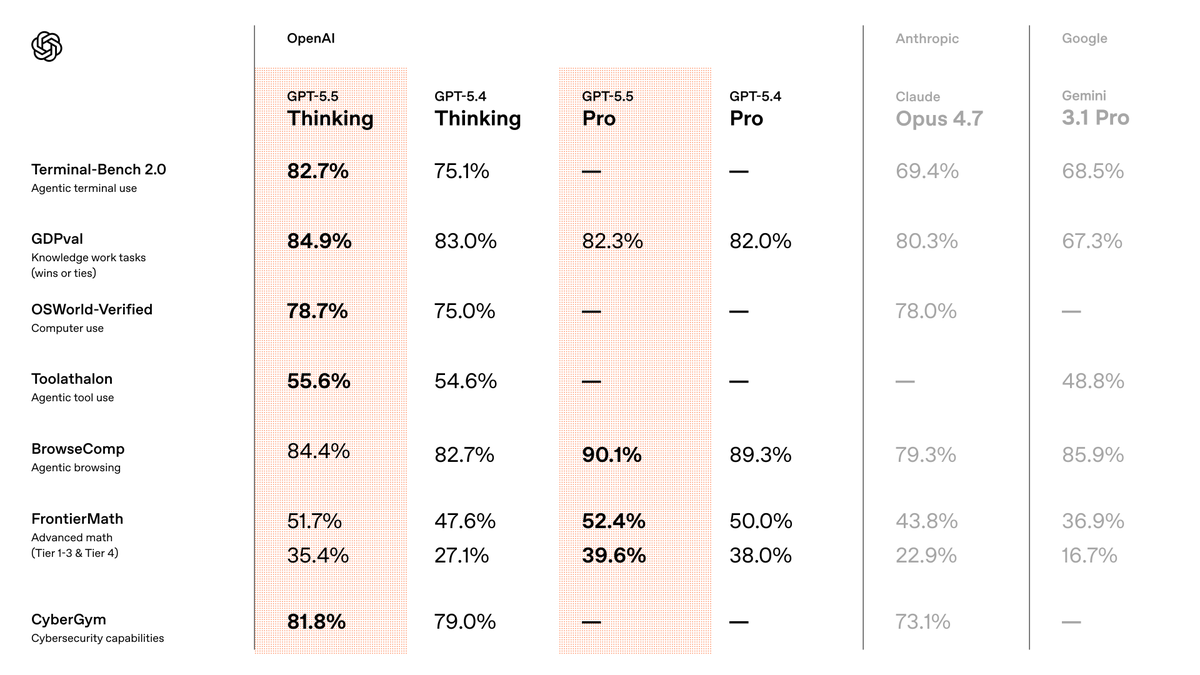
GPT-5.5 delivers this step up in intelligence without compromising on speed.
GPT-5.5 matches GPT-5.4 per-token latency in real-world serving, while performing better across nearly every evaluation we measured.
It also uses significantly fewer tokens to complete the same Codex tasks, making it more efficient as well as more capable.
When this latest conflict in the Middle East is over, historians will look back at the UK and ponder over several things.
They’ll wonder why, in the first week of the war, the UK media, almost overwhelmingly, spent it attacking the Prime Minister.
And why our patriotism was hijacked by the right-wing media to lambast our own government.
How every channel was able to find ‘experts’ and historians to make fools of themselves and display extremely anti-British behaviour.
And they wonder why the leader of His Majesty’s Opposition spent days of her life working against the country.
Oh, and lastly, why the leader of a tiny minority party was in the USA, engaged in treason and traitorous behaviour with a foreign despot, to undermine our government.
We're in such a messed up time, a branch of reality fabricated by the far-right and their pet media outlets.
Whether you like Starmer or not, this is not the time to go after him. All that's unfolding is a crooked legacy being built around those who'd prefer to sell their souls and work against the country in a time of war.
✌️🖖
Ever since Carrick took over at United, life has been grand. The weather is great, everytime I approach the lights they immediately turn green, I charge my phone and in just half an hour its at 100. Both my appetite and quality of sleep have improved & I'm generally happier.
It is hard to communicate how much programming has changed due to AI in the last 2 months: not gradually and over time in the "progress as usual" way, but specifically this last December. There are a number of asterisks but imo coding agents basically didn’t work before December and basically work since - the models have significantly higher quality, long-term coherence and tenacity and they can power through large and long tasks, well past enough that it is extremely disruptive to the default programming workflow.
Just to give an example, over the weekend I was building a local video analysis dashboard for the cameras of my home so I wrote: “Here is the local IP and username/password of my DGX Spark. Log in, set up ssh keys, set up vLLM, download and bench Qwen3-VL, set up a server endpoint to inference videos, a basic web ui dashboard, test everything, set it up with systemd, record memory notes for yourself and write up a markdown report for me”. The agent went off for ~30 minutes, ran into multiple issues, researched solutions online, resolved them one by one, wrote the code, tested it, debugged it, set up the services, and came back with the report and it was just done. I didn’t touch anything. All of this could easily have been a weekend project just 3 months ago but today it’s something you kick off and forget about for 30 minutes.
As a result, programming is becoming unrecognizable. You’re not typing computer code into an editor like the way things were since computers were invented, that era is over. You're spinning up AI agents, giving them tasks *in English* and managing and reviewing their work in parallel. The biggest prize is in figuring out how you can keep ascending the layers of abstraction to set up long-running orchestrator Claws with all of the right tools, memory and instructions that productively manage multiple parallel Code instances for you. The leverage achievable via top tier "agentic engineering" feels very high right now.
It’s not perfect, it needs high-level direction, judgement, taste, oversight, iteration and hints and ideas. It works a lot better in some scenarios than others (e.g. especially for tasks that are well-specified and where you can verify/test functionality). The key is to build intuition to decompose the task just right to hand off the parts that work and help out around the edges. But imo, this is nowhere near "business as usual" time in software.
Tech isn't "disruptive" if it doesn't disrupt something: PC disrupted mainframes because it took market away from it. Laptops disrupted PC, mobile disrupted laptops. Subvocal tech like https://t.co/7yKmcxJr9E is the missing link for in-ear, always-on AI devices to disrupt mobile.
Software development is undergoing a renaissance in front of our eyes.
If you haven't used the tools recently, you likely are underestimating what you're missing. Since December, there's been a step function improvement in what tools like Codex can do. Some great engineers at OpenAI yesterday told me that their job has fundamentally changed since December. Prior to then, they could use Codex for unit tests; now it writes essentially all the code and does a great deal of their operations and debugging. Not everyone has yet made that leap, but it's usually because of factors besides the capability of the model.
Every company faces the same opportunity now, and navigating it well — just like with cloud computing or the Internet — requires careful thought. This post shares how OpenAI is currently approaching retooling our teams towards agentic software development. We're still learning and iterating, but here's how we're thinking about it right now:
As a first step, by March 31st, we're aiming that:
(1) For any technical task, the tool of first resort for humans is interacting with an agent rather than using an editor or terminal.
(2) The default way humans utilize agents is explicitly evaluated as safe, but also productive enough that most workflows do not need additional permissions.
In order to get there, here's what we recommended to the team a few weeks ago:
1. Take the time to try out the tools. The tools do sell themselves — many people have had amazing experiences with 5.2 in Codex, after having churned from codex web a few months ago. But many people are also so busy they haven't had a chance to try Codex yet or got stuck thinking "is there any way it could do X" rather than just trying.
- Designate an "agents captain" for your team — the primary person responsible for thinking about how agents can be brought into the teams' workflow.
- Share experiences or questions in a few designated internal channels
- Take a day for a company-wide Codex hackathon
2. Create skills and AGENTS[.md].
- Create and maintain an AGENTS[.md] for any project you work on; update the AGENTS[.md] whenever the agent does something wrong or struggles with a task.
- Write skills for anything that you get Codex to do, and commit it to the skills directory in a shared repository
3. Inventory and make accessible any internal tools.
- Maintain a list of tools that your team relies on, and make sure someone takes point on making it agent-accessible (such as via a CLI or MCP server).
4. Structure codebases to be agent-first. With the models changing so fast, this is still somewhat untrodden ground, and will require some exploration.
- Write tests which are quick to run, and create high-quality interfaces between components.
5. Say no to slop. Managing AI generated code at scale is an emerging problem, and will require new processes and conventions to keep code quality high
- Ensure that some human is accountable for any code that gets merged. As a code reviewer, maintain at least the same bar as you would for human-written code, and make sure the author understands what they're submitting.
6. Work on basic infra. There's a lot of room for everyone to build basic infrastructure, which can be guided by internal user feedback. The core tools are getting a lot better and more usable, but there's a lot of infrastructure that currently go around the tools, such as observability, tracking not just the committed code but the agent trajectories that led to them, and central management of the tools that agents are able to use.
Overall, adopting tools like Codex is not just a technical but also a deep cultural change, with a lot of downstream implications to figure out. We encourage every manager to drive this with their team, and to think through other action items — for example, per item 5 above, what else can prevent a lot of "functionally-correct but poorly-maintainable code" from creeping into codebases.
We’re excited to launch the Codex app, a command center for building with agents.
It gives you a focused space to manage multiple agents at once, run work in parallel, and collaborate with agents over long-running tasks.
https://t.co/ldE9k0uL5z
As a DB nerd I was excited to read the @OpenAI post on using a single-leader Postgres cluster (https://t.co/UtbSVjphTO). We're huge fans of scaling "up" rather than "out", with a 384 core, 6TB RAM self-healing database cluster running https://t.co/G1VI5WII6w, powered by @sqlite!
I’ve seen a lot of people misunderstand what we’re saying. Our claim is that in a world of full automation, inequality will skyrocket (in favor of capital holders).
People aren't thinking about the galaxies. The relative wealth differences in a thousand years—or a million—will be downstream of who owns the first dyson swarms and space ships. And space colonization isn't bottlenecked by people’s preference for human nannies and waiters.
So even if you can make 10 million dollars a year as a nanny in the post-abundance future, or get a 10 million dollar charity handout, Larry Page’s million cyborg heirs can own a galaxy each.
You might think this is fine! Why is inequality intrinsically bad, especially if absolute prosperity for everyone goes up? Fair enough, but to me quadrillion fold differences in wealth between humans seem hard to justify in a world where AIs are doing all the work anyways - these disparities in wealth are not incentivizing hard work or entrepreneurship or creativity, which is what we use to justify inequality today.
Just to recap, full automation kills the corrective mechanism on runaway capital accumulation - which is that you need labor to actually make productive use of your capital, thus driving up wages.
Some people asked: why assume AGI leads to full automation? Maybe people will still prefer human nannies and waiters. Even if true, we think labor's share of GDP—which has been roughly 2/3 for centuries—would still likely collapse toward zero, massively increasing inequality. Here's why.
It sometimes happens that when machines are only slightly better than humans, people sometimes pay a premium for the human version. But once machines become much better, that preference disappears. When carriages were not much faster than being carried on a litter, the rich sometimes preferred the litter. Now they prefer the car. They might still have a chauffeur—but once self-driving vehicles are allowed to move far faster, human-driven cars may be relegated to a slow lane.
If the economy grows 100x, wages must also grow 100x for labor's share to stay at 2/3. But prices are relative—so this means human labor becomes 100x more expensive compared to AI-produced goods. A human-cooked meal costs 100x what the robot version does. For labor share to hold steady as that ratio grows to 1,000x, then 10,000x, the preference for human-made goods would have to become increasingly fanatical. And there's a second problem: the higher wages rise, the greater the incentive to develop machine substitutes for whatever services humans still provide. The premium on human labor is precisely what incentivizes its own replacement.
Just to clarify a few other things:
- “Piketty’s long run series are disputed.” We spend a long chunk of the essay explaining why Piketty is wrong about the past! But we’re arguing that the assumption he makes (specifically that labor and capital are substitutes) would be true of a world with advanced enough automation. We spend so much time rebutting his claims about the past because the wronger you think he was about the past, the more you think will change once his assumption comes true.
- “A capital tax would lower growth.” Yes, as we point out, capital taxes incentivize consumption now instead of saving and investing for the future, at the margin. But if capital is the only factor of production, then it’s hard to come up with an inequality-capping tax that doesn’t lower growth.
- “Capital can escape, both across time and space. This makes a wealth tax impractical.” We agree! As we say in the essay and in the tweet summary below, it would be really hard to implement Pikkety’s flagship solution (a high and progressive global wealth tax). You could go Georgist and try to tax land, but the natural resource share of income is only 5% and is likely to stay low until we hit “technological maturity” for reasons we explain in the essay. We don’t see any easy ways to avoid (literally) skyrocketing inequality - in fact, that’s what inspired us to write the essay and explain this problem in the first place.
Also, to address a subtext: I think the currently proposed California wealth tax is a very bad idea for many reasons. This essay is about inequality under full automation, not about how California can make its healthcare expenditures more sustainable.
New blog post w @pawtrammell: Capital in the 22nd Century
Where we argue that while Piketty was wrong about the past, he’s probably right about the future.
Piketty argued that without strong redistribution of wealth, inequality will indefinitely increase. Historically, however, income inequality from capital accumulation has actually been self-correcting. Labor and capital are complements, so if you build up lots of capital, you’ll lower its returns and raise wages (since labor now becomes the bottleneck).
But once AI/robotics fully substitute for labor, this correction mechanism breaks.
For centuries, the share of GDP that goes to paying wages has been 2/3, and the share of GDP that’s been income from owning stuff has been 1/3.
With full automation, capital’s share of GDP goes to 100% (since datacenters and solar panels and the robot factories that build all the above plus more robot factories are all “capital”).
And inequality among capital holders will also skyrocket - in favor of larger and more sophisticated investors. A lot of AI wealth is being generated in private markets. You can’t get direct exposure to xAI from your 401k, but the Sultan of Oman can. A cheap house (the main form of wealth for many Americans) is a form of capital almost uniquely ill-suited to taking advantage of a leap in automation: it plays no part in the production, operation, or transportation of computers, robots, data, or energy.
Also, international catch-up growth may end. Poor countries historically grew faster by combining their cheap labor with imported capital/know-how. Without labor as a bottleneck, their main value-add disappears.
Inequality seems especially hard to justify in this world. So if we don’t want inequality to just keep increasing forever - with the descendants of the most patient and sophisticated of today’s AI investors controlling all the galaxies - what can we do? The obvious place to start is with Piketty’s headline recommendation: highly and progressively tax wealth. This might discourage saving, but it would no longer penalize those who have earned a lot by their hard work and creativity. The wealth - even the investment decisions - will be made by the robots, and they will work just as hard and smart however much we tax their owners.
But taxing capital is pointless if people can just shift their future investment to lower tax countries. And since capital stocks could grow really fast (robots building robots and all that), pretty soon tax havens go from marginal outposts to the majority of global GDP. But how do you get global coordination on taxing capital, when the benefits to defecting are so high and so accessible?
Full automation will probably lead to ever-increasing inequality. We don’t see an obvious solution to this problem. And we think it’s weird how little thought has gone into what to do about it.
Many more thoughts from re-reading Piketty with our AGI hats on at the post in the link below.