#Thread for #Entrepreneur
Dear entrepreneur always remeber these Roles:
You're product is not the first product ever made
You're business is not the first business ever created
You're not the best first CEO/Manager ever existed
#Onekatweets#Entrepreneurship#founders#Business
This Chinese guy created agents in Claude Code for landing pages and single-handedly serves 47 small businesses a month, taking $400 from each.
He built a system of 7 agents on Claude Sonnet 4.6 that analyzes Google Maps in small towns, finds small businesses without websites there, and over 1 weekend takes each one to a finished mockup with video and cold message.
No assistant, no sales team, no SDR. Just him, a MacBook, an iPhone, and 1 API key.
And traditional web design agencies keep teams of 8 people on salary for the same order flow, while his expenses are only tokens and subscriptions to Lovable, Higgsfield, and Calendly.
7 agents work through 1 orchestrator on Claude Code Router. Usage is about 3 million tokens a day, the average API bill is about $480 a month.
All 7 go through MCP servers and write shared state to the file system, without shared state in memory and without race conditions, and 1 of them lives right in the iPhone and picks up positive replies from the subway, a taxi, or on walks.
And here is the system prompt he put into the orchestrator before launch:
"You are the orchestrator of a solo agency that sells ready-made websites to local businesses. You delegate read-only tasks to 6 sub-agents and own all writes.
sub-agents:
// Scout (walks through Google Maps in selected cities, looks for narrow niches: 5+ years on the map, fewer than 50 reviews, no website or a website from 2014, but high ratings)
// Diagnoser (for each lead writes a 50-word diagnosis, hero angle, tone matched to the industry, and a cold message under 70 words)
// Builder (generates a landing page mockup in Lovable through MCP only for the top 5 leads per day, with the sharpest diagnoses and the biggest gap)
// Filmer (pulls 5 screenshots of the mockup and through Higgsfield renders a 10-second vertical video 1080x1920 with a soft zoom)
// Pitcher (sends a personalized cold message through the right channel for the niche: email to roofers, SMS to tradesmen, IG DM to salons, LinkedIn to realtors)
// Checker (runs every message through evals for personalization, absence of AI markers and buzzwords before sending)
// Mobile (lives in the iPhone, handles positive replies in real time, books Zoom calls in Calendly through MCP while the owner is on the go).
You never let 2 sub-agents touch 1 lead. You stop and request approval from the human only when a deal exceeds $3,000 or the reply rate in a niche for the day drops below 12%."
Meaning the system knows what it is and within what boundaries it is allowed to act.
It knows it is supposed to find leads on its own.
It knows it is supposed to take each one to a mockup, video, and cold message without intervention.
It knows the human only steps in when a deal goes above $3,000 or the reply rate stops converging.
→ The system runs 24 hours a day
→ Scout goes through about 220 local businesses on Google Maps per day and leaves 30 new leads in the queue
→ Diagnoser outputs 30 structured diagnoses + briefs + cold messages per day
→ Builder assembles 3 to 5 finished landing pages in Lovable for the sharpest leads
→ Filmer renders a 10-second vertical video in Higgsfield for each one
→ Pitcher sends 30 personalized messages per day across 4 channels with a reply rate of about 14%
→ Checker runs every message through evals before sending
And only when a deal breaks $3,000 or the reply rate for the day drops below 12% does the orchestrator wake the owner.
And when the owner at that moment is sitting in the subway or a taxi, the Mobile agent in his iPhone picks up 1 move on its own: replies to a fresh positive reply from a dentist, books a Zoom through Calendly synced to the local time of the client, and puts the lead back in the queue. The owner only has to tap "approve" and in just 10 minutes join the call.
Here is what the system writes in his log during 1 of the Saturdays:
"scout report: 218 businesses checked in Austin, Denver, and Miami, 34 without a website, 19 with a website from 2014, 6 with an active redesign request in reviews. passing top 30 to diagnoser."
"pitcher: 30 cold messages sent across 4 channels, 14 replies, 5 positive, 3 Zoom calls booked for Sunday. passing to closer."
"builder: landing page for Westside Cosmetic Dentistry built in Lovable, 5 sections, mobile, soft beige. URL placed at /Users/dev/maps-agency/clients/westside/v1. filmer launching Higgsfield."
"eval flag: deal with The Lotus Salon at $3,400 exceeds the approved limit of $3,000. sending for manual review."
He has no server of his own and no separate backend.
Just a local file sandbox at /Users/dev/maps-agency, an MCP router, 1 API key to Claude, and the same key forwarded to Claude Code on his iPhone.
Out of everything I have seen this year, this is the cleanest one-person agency for selling websites to small businesses: $480 a month on the API, about $18,800 into the account, and between them 7 prompts, 1 file system, and 1 phone in the pocket.
I've spent 2.54 BILLION tokens perfecting OpenClaw.
The use cases I discovered have changed the way I live and work.
...and now I'm sharing them with the world.
Here are 21 use cases I use daily:
0:00 Intro
0:50 What is OpenClaw?
1:35 MD Files
2:14 Memory System
3:55 CRM System
7:19 Fathom Pipeline
9:18 Meeting to Action Items
10:46 Knowledge Base System
13:51 X Ingestion Pipeline
14:31 Business Advisory Council
16:13 Security Council
18:21 Social Media Tracking
19:18 Video Idea Pipeline
21:40 Daily Briefing Flow
22:23 Three Councils
22:57 Automation Schedule
24:15 Security Layers
26:09 Databases and Backups
28:00 Video/Image Gen
29:14 Self Updates
29:56 Usage & Cost Tracking
30:15 Prompt Engineering
31:15 Developer Infrastructure
32:06 Food Journal
Every startup founder should bookmark these free Y Combinator resources before building anything👇
1. https://t.co/lO7mIUKiI3
The complete collection of YC startup advice, essays, and guides.
2. https://t.co/RvRF16ijqF
Free startup course that teaches idea validation, MVP, growth, and fundraising.
3. https://t.co/TDO3bBe5sa
Find serious cofounders based on skills, goals, and interests.
4. https://t.co/SjbwK0cBp4
Startup ideas YC wants founders to build right now.
5. https://t.co/Gh9wsUgRsV
Watch lectures and insights from YC partners and successful founders.
6. https://t.co/Xz9ZTZncaI
Apply to YC and learn how their funding and selection process works.
@ycombinator
In 1999, Buffett explained why most people never get rich.
He proves you are walking around with a $500,000 asset right now.
Save this rare footage of this before you lose it.
ELON MUSK: WE ARE REALLY TRYING TO BRING THE WORLD TOGETHER INTO A COLLECTIVE CONSCIOUSNESS
𝕏 is kind of a global town square where people can say what they want to say with words, pictures, video
Where there's a secure messaging system we've recently added the ability to do audio and video calls
So really trying to bring the world together into a collective consciousness
And that's different from just saying, 'What is the most dopamine-generating video stream that one could make?' Which I think can be a little bit of brain rot
If you're just watching videos that cause dopamine hits one after another but lack substance, then I think that's not a great way to spend time
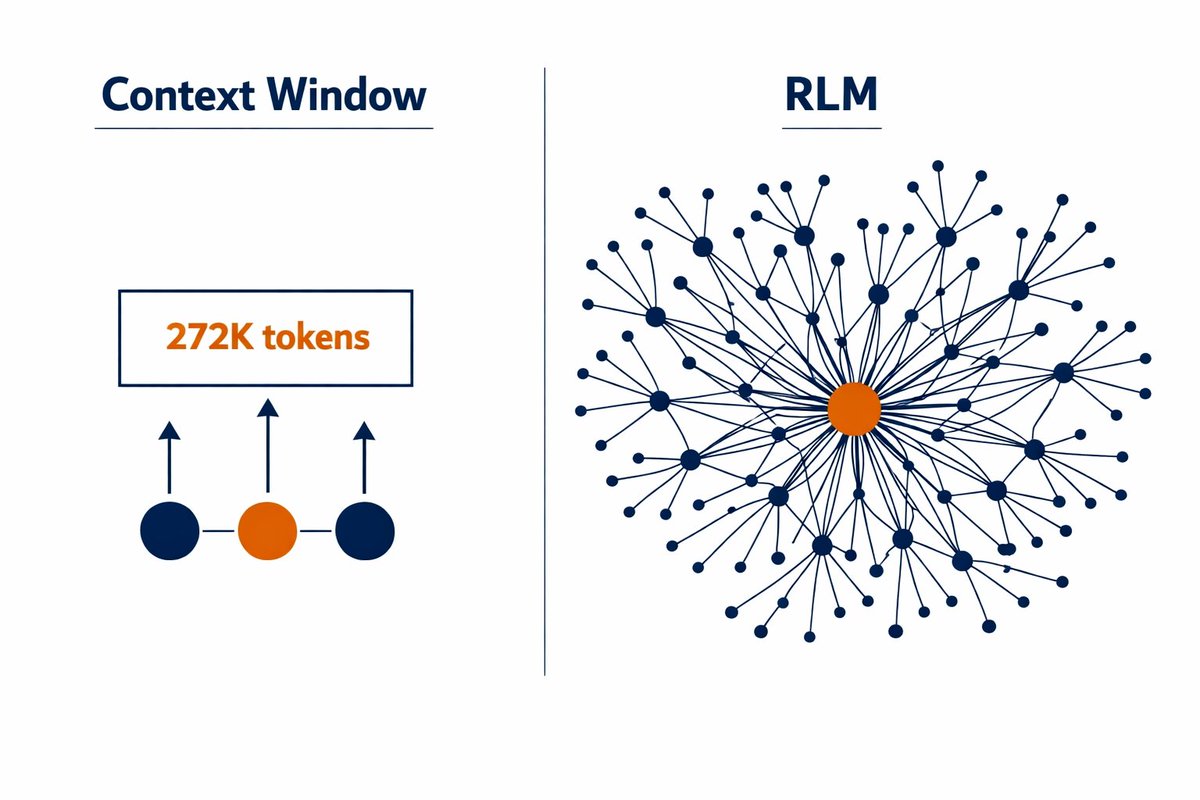
DeepMind just did the unthinkable.
They built an AI that doesn't need RAG and it has perfect memory of everything it's ever read.
It's called Recursive Language Models, and it might mark the death of traditional context windows forever.
Here's how it works (and why it matters way more than it sounds) ↓
I'm Boris and I created Claude Code. Lots of people have asked how I use Claude Code, so I wanted to show off my setup a bit.
My setup might be surprisingly vanilla! Claude Code works great out of the box, so I personally don't customize it much. There is no one correct way to use Claude Code: we intentionally build it in a way that you can use it, customize it, and hack it however you like. Each person on the Claude Code team uses it very differently.
So, here goes.
In 2015, Elon Musk explained exactly how he predicts the future.
His frameworks:
• First principles
• Capital sequencing
• Critical path focus
• Usefulness optimization
10 foundational lessons from his Stanford talk:
1. First principles thinking is your superpower
Elon Musk on building his first startup Zip2
In 1995, when he was just 23 years old, Elon dropped out of Stanford’s PhD program in physics to start Zip2 with his brother Kimbal Musk.
Elon personally wrote the first national maps, directions, yellow pages and white pages on the Internet that summer in C with a little C++.
In this CBS interview, a 27 year old Elon describes living in a $200/month office with a leaky roof:
“We found that an office was actually cheaper than apartment in Silicon Valley and we got this dinky little office that had a leaky roof. It was just the nastiest place you could imagine. I lived in it too and showered at the YMCA. This lasted for about three or four months, and the reason we chose this office — in addition to it being really cheap — was that there was an internet service provider on the floor below. So we were able to get really cheap internet access by drilling a hole in the floor and connecting to their server directly.”
In February 1999 — less than a year after this interview — Compaq would purchase Zip2 for $307 million in cash.
The interviewer also asks Elon what he thinks the future of the Internet will be, to which Elon responds:
“I think the internet is the superset of all media. It is the be all and end all of media. One will see print, broadcast, radio — essentially all media — folding into the internet. What the internet amounts to is it’s the first two-way communication medium that is intelligent. It allows consumers to choose what they want to see, when they want to see it.”
Niko mbioni kuzindua Mfuko wa Ubunifu (Startup Fund) wenye thamani ya shilingi bilioni 25 kusaidia wana teknolojia, akili bandia (AI), fintech, na wabunifu wa kiteknolojia hapa Tanzania na Afrika.
Tutatoa michango na uwekezaji kusaidia vijana wabunifu wenye mawazo ya kubadilisha dunia.
Andaieni mawazo yenu — muda umefika!
#Ubunifu #Teknolojia #AI #Fintech #Tanzania #AfricaRising
The most valuable trait of an entrepreneur:
A sense of urgency.
Most people walk slow, think slow, move slow, make decisions slow.
They lolly gag around life.
No energy. No excitement.
Those people never end up making it happen.
They end up working for the man, clocking in at 9am and clocking out at 5pm.
Doing the absolute bare minimum to get paid next Friday and not get fired.
Never making moves to chase additional opportunities, never taking a stab at entrepreneurship.
“If you have money for a Rolls-Royce, go and build an industry.” ~ Aliko Dangote
Aliko Dangote sent a strong message to wealthy Nigerians who prioritize private jets and luxury cars over creating real opportunities:
“If you have money for a Rolls-Royce, you should go and put up an industry in your locality. Sometimes it pains me when I go to a local airport and can’t even find parking space everybody has a private jet. Those private jets should be industries so that we can create jobs.” ~ Aliko Dangote
Sega invested $5 million in Nvidia in 1996, converting the final payment from a failed contract to develop a graphics chip for the Sega Dreamcast console.
Sega sold its shares shortly after Nvidia went public, realizing a return of $15 million—a 3x return in about four years.
Jensen says that if Sega had kept its investment, it would be worth around $1 trillion today.
Epic story.
Stripe offered to acquire us for $1.2 billion when we had $2M in revenue.
Today, we've raised $330M at an $8B valuation and reached $1B ARR.
We could've died three times during this journey.
This is the story I've never told anyone before:
Easiest ways to get rich:
1. Sell men lust
2. Sell women beauty
3. Sell parents peace
4. Sell kids dreams
5. Sell the rich safety
6. Sell the broke hope
Same game. Different packaging.