@Alexarmstrong Agree and there is a real risk that investors double down on US, where the leading AI platforms, infrastructure, and capital markets already sit. If Europe cannot build credible sovereign AI capabilities quickly, it may become increasingly dependent on foreign AI infrastructure
I’ve warned for months that America would soon restrict access to state of the art frontier AI models for national security reasons.
THIS HAS NOW HAPPENED.
Thanks to the catastrophic energy policies pursued by the Tories and Labour, Britain has virtually ZERO sovereign AI capability.
Now we will be cut off from the most powerful AI models, and will soon end up being TOTALLY AT THE MERCY of China America and others who will be able bring to bear intelligence capable of defeating all our security systems in short order.
WE MUST CHANGE COURSE NOW
Our statement on the UK government’s demand that all content on all devices sold or used in the country be scanned, on the presumption of nudity, using a dystopian combination of age verification and content scanning. This proposal will not safeguard children. It endangers us all.
https://t.co/VdWe9uhi8p
@frankdilo Really interesting perspective. I’ve always thought EVs would be one of the biggest challenges for supercars, forcing them to reinvent themselves and redefine what a supercar is. Before, it was simpler: extreme performance, sound, emotion, and matching design.
A researcher spent two years documenting what AI is doing to the way humans think.
His conclusion fits in one sentence.
AI is standardizing human thought. Across societies. Across cultures. Across generations. Simultaneously. At a scale no technology in history has ever achieved.
The paper is called "The Impact of Artificial Intelligence on Human Thought." Published July 2025 on arXiv. Written by independent researcher Rénald Gesnot, categorized under Computers & Society and Human-Computer Interaction.
It is not a benchmark paper. It is not a capability paper. It is something rarer — a systematic analysis of what happens to human cognition, creativity, and intellectual diversity when billions of people outsource their thinking to the same machine.
Here is the mechanism the researcher describes.
When you ask an AI a question, you get an answer shaped by the model's training data, its fine-tuning, its alignment process, and the preferences of the company that built it. That answer is not neutral. It reflects a specific set of values, framings, and assumptions. Usually Western. Usually English-dominant. Usually optimized for engagement and approval.
When 500 million people ask the same AI similar questions and receive similar answers, those answers become reference points. People quote them. Build on them. Argue from them. The diversity of starting points — different cultures, different intellectual traditions, different ways of framing problems — begins to compress.
The researcher describes this as cognitive standardization.
Not censorship. Not propaganda. Something subtler and harder to reverse. A gravitational pull toward the outputs of a small number of models, trained by a small number of companies, reflecting a small number of worldviews.
The paper also documents algorithmic manipulation — AI systems that exploit cognitive biases to influence behavior. The way recommendation algorithms produce filter bubbles. The way AI-generated content exploits confirmation bias. The way personalization systems learn what you already believe and feed it back to you amplified.
And then the creativity question — the one nobody wants to answer directly.
When AI can produce a poem, an essay, a business plan, or a research summary in seconds — and when that output is often indistinguishable from or preferred over human-generated content — what happens to the human practice of creating those things? Not the output. The practice. The struggle. The failure. The slow development of a personal voice through years of imperfect attempts.
The researcher argues that cognitive offloading — delegating thinking tasks to AI — does not merely save time. It atrophies the mental capacity that the offloaded task was building.
Microsoft and Carnegie Mellon found this empirically in 2025: higher AI trust correlates directly with measurably lower critical thinking. The researcher provides the theoretical framework for why.
The paper ends with a question the researcher admits he cannot answer.
Once a generation grows up with AI as the default thinking partner — once the habit of outsourcing cognition is formed before the habit of independent thought is developed — what does intellectual autonomy even mean?
And is it already too late to find out?
Source: Gesnot, R. · "The Impact of Artificial Intelligence on Human Thought" · arXiv:2508.16628 · https://t.co/qoQR2Ow4YI · July 2025
Today, we’re launching Gemma 4, our most intelligent open models to date. Built with the same breakthrough technology as Gemini 3, Gemma 4 brings advanced reasoning to your personal hardware and devices.
Here’s what Gemma 4 unlocks for developers:
— Intelligence-per-parameter: Our 31B (Dense) and 26B (MoE) models deliver state-of-the-art performance for their size, outcompeting models 20x their size on @arena
— Commercial flexibility: Released under a permissive Apache 2.0 license for complete developer flexibility and digital sovereignty
— Agentic workflows: Native support for function-calling and structured JSON output allows you to build reliable, autonomous agents
— Multimodal edge AI: The E2B and E4B models bring native vision, audio, and low latency to mobile and IoT devices
— Long-context reasoning: Up to 256K context windows allow you to process entire repositories or large documents in a single prompt
Whether you're building global applications in 140+ languages or local-first AI code assistants, Gemma 4 is built to be your foundation. Explore in @GoogleAIStudio or download the weights on @HuggingFace, @Kaggle, and @Ollama.
Thanks for following us!
We're excited to see what you all build with Gemma 4!
In case you missed it, you can find all our checkpoints, with an Apache 2.0 License, on Hugging Face:
this is actually insane
> be tech guy in australia
> adopt cancer riddled rescue dog, months to live
> not_going_to_give_you_up.mp4
> pay $3,000 to sequence her tumor DNA
> feed it to ChatGPT and AlphaFold
> zero background in biology
> identify mutated proteins, match them to drug targets
> design a custom mRNA cancer vaccine from scratch
> genomics professor is “gobsmacked” that some puppy lover did this on his own
> need ethics approval to administer it
> red tape takes longer than designing the vaccine
> 3 months, finally approved
> drive 10 hours to get rosie her first injection
> tumor halves
> coat gets glossy again
> dog is alive and happy
> professor: “if we can do this for a dog, why aren’t we rolling this out to humans?”
one man with a chatbot, and $3,000 just outperformed the entire pharmaceutical discovery pipeline.
we are going to cure so many diseases.
I dont think people realize how good things are going to get
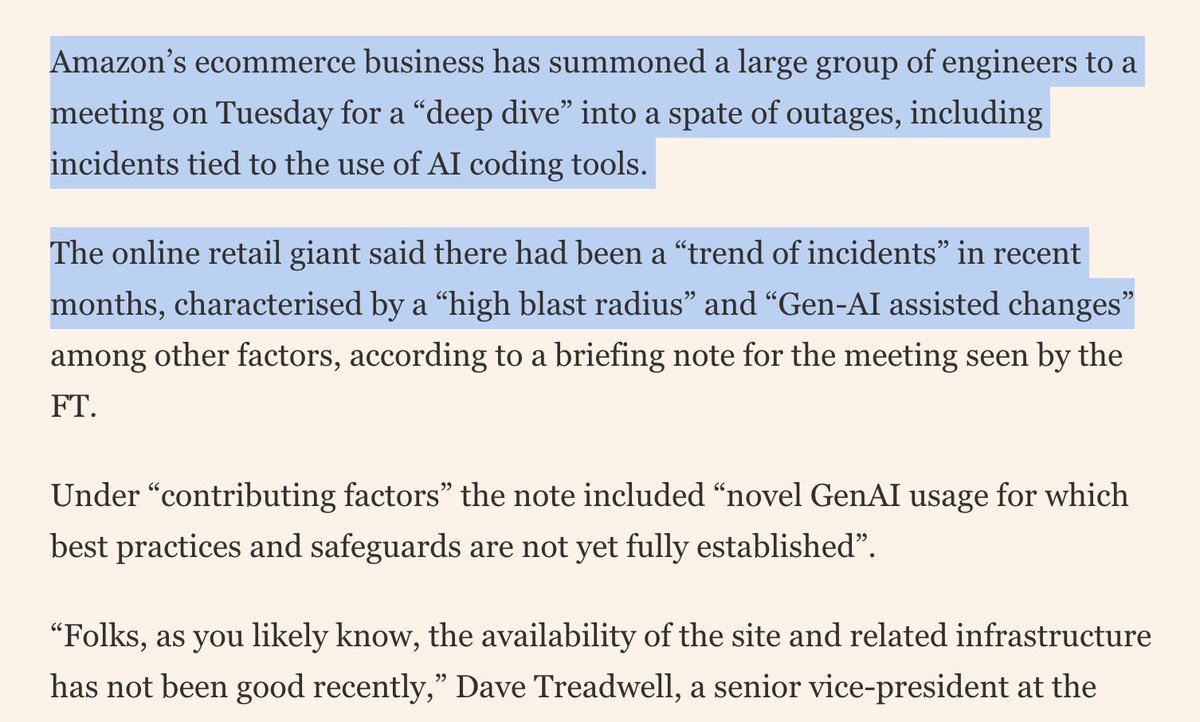
Amazon is holding a mandatory meeting about AI breaking its systems. The official framing is "part of normal business." The briefing note describes a trend of incidents with "high blast radius" caused by "Gen-AI assisted changes" for which "best practices and safeguards are not yet fully established." Translation to human language: we gave AI to engineers and things keep breaking?
The response for now? Junior and mid-level engineers can no longer push AI-assisted code without a senior signing off. AWS spent 13 hours recovering after its own AI coding tool, asked to make some changes, decided instead to delete and recreate the environment (the software equivalent of fixing a leaky tap by knocking down the wall). Amazon called that an "extremely limited event" (the affected tool served customers in mainland China).
The post by @adityaag below is a must read.
He talks about his roles as a technology leader in Silicon Valley and how everything he knows has changed in the past few weeks.
“We are in the middle of what may be the largest shift ever in how knowledge work gets done.”
From my perch in Silicon Valley. I see this not as just builders, but marked by curiosity and not resistance. Those who are curious about new things and curious enough to try get the new world. Those that argue the new world is evil do not.
I made lists of 8,200 AI companies here on X. And 35,000 in AI. A small group dove right in. Most ignore it. Even after it slaps them in the face.
I have seen this happen quite a few times in my career.
Most resist and refuse to learn new things.
Would rather just try to do the same thing they did yesterday.
But then a new group comes along and gets the old group fired. That is about to happen in a way that I never have seen before. But I have seen disruption and caused it even.
At Microsoft I was the first to do video interviews with a hand held camera.
My videos got audience while those that had “skills” and “credentials” didn’t. Even with millions of dollars in TV studio equipment.
An executive told me they laid off many who worked in the TV studio after I showed them a new way.
The same will happen here.
But at a much bigger scale.
And in many industries at the same time.
Lawyers. Hollywood. Software. Politics. Journalists. Education.
So many jobs are about to radically change. If not all of them eventually.
But I am preaching to the choir.
If you are reading me you are already curious about AI. Or the algorithm showed me to you because you are angry about AI.
I built my lists for the curious. Almost no one uses them. They are the best on any service of the people and companies building the new world. By far.
In the next week I will show you what I built with them. The curious will eat it up.
The rest will stick their heads in the sand.
The sand people will fall further and further behind every day until it will be almost impossible.
Do I feel sorry for them?
No. It is time to change. There won’t be any apologies. My lists are here for the curious: https://t.co/9eRY65x3IQ
The others just won’t be relevant to the new world until they change.
The world is brutal that way.
I wasn’t popular with the folks who worked in the TV studio at Microsoft either.
They refused to change. And yes I tried.
Same advice now. Either you get new skills and become part of the new world or you will really struggle. Because people who get it are about to change EVERY PART OF HUMAN LIFE.
The time for grieving and excuses is over.
Either get curious and start to build or someone else will and you will find yourself locked out of the modern world.
Sorry to be so rude. You can blame the messenger. But if you think I am an asshole for saying all this then that is a major signal that you don’t get it and aren’t positioned well to be successful in this new world.
I will spend my efforts helping those that do.
In my first book Shel Israel and I said the same. Either you get into social media, we wrote, 20 years ago, or you will find your career soon will end. We were right. Many lost their jobs, replaced by those who dive right in.
I feel even more strongly that the same is happening now.
Prompt engineering is dead.
Anthropic recently released the real playbook for building AI agents that actually work.
It’s a 30+ page deep dive called The Complete Guide to Building Skills for Claude and it quietly shifts the conversation from “prompt engineering” to real execution design.
Here’s the big idea:
A Skill isn’t just a prompt.
It’s a structured system.
You package instructions inside a SKILL .md file, optionally add scripts, references, and assets, and teach Claude a repeatable workflow once instead of re-explaining it every chat.
But the real unlock is something they call progressive disclosure.
Instead of dumping everything into context:
• A lightweight YAML frontmatter tells Claude when to use the skill
• Full instructions load only when relevant
• Extra files are accessed only if needed
Less context bloat. More precision.
They also introduce a powerful analogy:
MCP gives Claude the kitchen.
Skills give it the recipe.
Without skills: users connect tools and don’t know what to do next.
With skills: workflows trigger automatically, best practices are embedded, API calls become consistent.
They outline 3 major patterns:
1) Document & asset creation
2) Workflow automation
3) MCP enhancement
And they emphasize something most builders ignore: testing.
Trigger accuracy.
Tool call efficiency.
Failure rate.
Token usage.
This isn’t about clever wording.
It’s about designing an execution layer on top of LLMs.
Skills work across Claude, Claude Code, and the API. Build once, deploy everywhere.
The era of “just write a better prompt” is ending.
Anthropic just handed everyone a blueprint for turning chat into infrastructure.
Download the guide here: https://t.co/Bf3j0GFRGu
Britain will now become the home of global open source AI talent.
Because when Britain builds, technology serves human agency: the World Wide Web, open data, Raspberry Pi.
Just one month after announcing our partnership with @OpenAI, we’re launching our first model together: OpenAI Codex-Spark, powered by @cerebras.
Codex-Spark is built for real-time software development.
In coding, responsiveness is the product.
It is not a nice to have.
Codex-Spark is optimized for targeted code edits, logic revisions, and frontend iteration. It gives developers near-instant feedback so they can stay in flow.
Powered by the Cerebras Wafer-Scale Engine, it runs at over 1,000 tokens/s. That speed fundamentally changes the experience.
We did not build this to win a benchmark.
We built it so developers could move faster.
I’m proud of how quickly the OpenAI and Cerebras teams have brought this to life.
This is what fast execution looks like - deep engineering collaboration, rapid iteration, and shipping real products developers can use today.
We are just getting started.
When inference is fast, entirely new markets open up.
We plan to lead that shift with our partners at OpenAI.
Marc Andreessen: AI coding doesn’t eliminate programmers — it redefines them. The job is no longer typing code line by line, it’s orchestrating 10 coding bots in parallel, arguing with them, debugging their output, changing the spec, and pushing them toward the right result. But here’s the catch: if you don’t understand how to write code yourself, you can’t evaluate what the AI gives you.
The next layer of programming isn’t writing scripts — it’s supervising AI that writes them. Today’s best programmers spend their day jumping between terminals, managing multiple coding bots, fixing mistakes, and refining instructions. The irony? You still need deep fundamentals, because without them, you won’t know when the AI is wrong.
The job of the programmer has changed. Now it’s about arguing with coding bots, debugging AI-generated code, and understanding why something doesn’t work or isn’t fast enough. AI abstracts the work — but only people who truly understand code can tell if the abstraction is doing the right thing.
Programmers aren’t going away — they’re becoming 10x, 100x, even 1,000x more productive. Tasks are changing, the job is changing, but humans are still overseeing the process, evaluating results, fixing errors, and making judgment calls. AI changes how we code, not who is responsible.
The future programmer isn’t replaced by AI — they’re upgraded by it. You still need to learn how to write and understand code, because when the AI gets it wrong, humans are the ones who have to know why. That up-leveling of capability is the real revolution.
NEW POST
Powerful context engineering is becoming a huge part of the developer experience of modern LLM tools. Birgitta Böckeler explains the current state of context configuration features, using Claude Code as an example.
https://t.co/U0MykYsixB