Lecturer in Business and Economics at @UCLSSEES. Previously at @Kingspol_econ and @CambridgeCBR. political economy, corporate political activities, lobbying.
Some weird stuff just happened. I was about to write a post about how good the usage limits are on @cursor_ai and @bot. After using @bot every day, I’ve only reached 1% of my weekly limit.
I put the text into @bot for a quick grammar check, and it started non-stop generating different versions of the post. I asked it to stop, but it just kept going. It also started producing weird text that I had never entered. I eventually had to delete the bot to make it stop.
Fall terms coming up. How should we modify university teaching to both use AI effectively and ensure students actually learn/don't just cheat their way through? I wrote eight rules I've been using; hopefully useful for you as well. 1/3
I guess @cursor_ai knows I’m the user. I see their ads all over my social media. But honestly, the ads are informative, I’m learning a lot. Not persuasive, just a good way of keeping users informed.
Hackathons until now: you go, sit down for X hours, build something, if good win prize.
Hackathons in August 2026: https://t.co/6I9873r3ol
(I would love to participate, but I hate running... If you do a Crossfit or olympic weightlifting hackathon, I am game. But you guys should sign up! It's a fantastic idea)
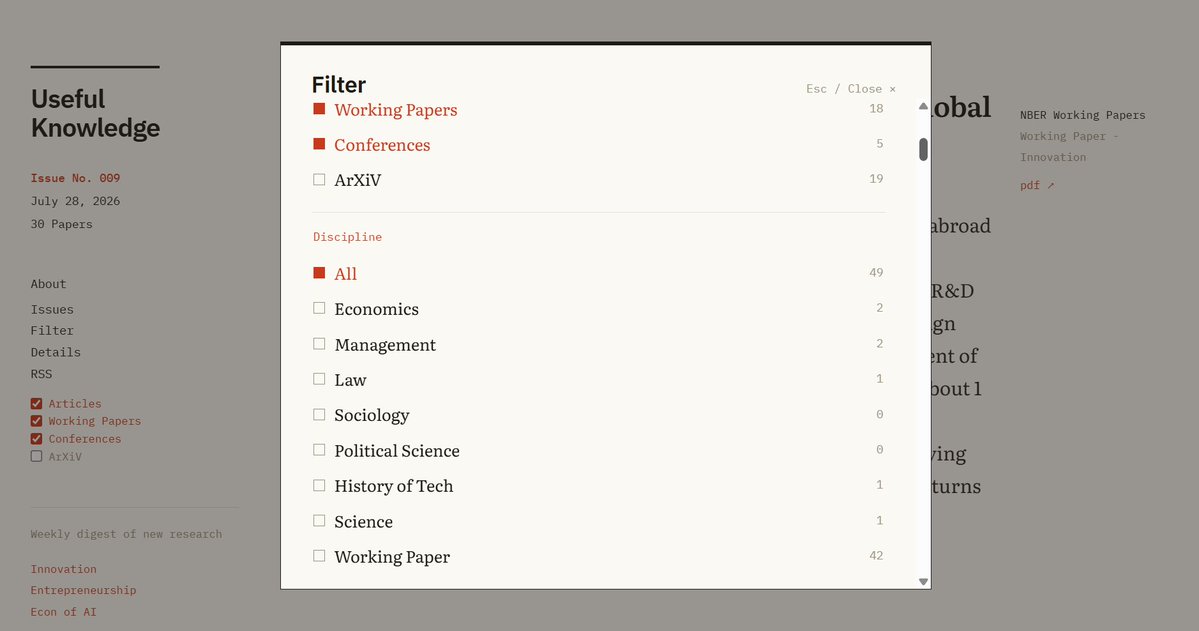
A cool new project of mine: how to keep up with new literature on innovation, entrepreneurship, and econ of AI? These areas are very interdisciplinary, and working papers play a huge role. Subscribing to dozens of weekly journal emails makes no sense. Let's fix this with AI. 1/x
I'm often amazed by AI capabilities, thinking that the smart people behind AI labs deliberately designed the models to have these features. Then you come across posts like these. They're just as amazed by what the models can do.
chatgpt work is remarkable, and "work" undersells it.
from my phone i sent:
"use all my chat history to figure out ideas for a long weekend trip with 8 friends, plan the best three options, make a full-stack site where the 9 of us can coordinate on what we would want to do in each place and decide where to go, and then after we get to group agreement make reservations. draft an email in my gmail i can send out to my friends when the site is ready."
it...just worked.
Announcing OpenWorker! An open-source agent that doesn't just chat with you, but delivers finished work -- like hand you a polished document, send a slack message, or update a calendar entry.
Ask it to prepare a customer brief, untangle your calendar, draft a report, or triage a Slack alert. It works across your files and everyday tools, produces the deliverable, and checks in before doing anything consequential.
OpenWorker runs on your Mac, with Windows support coming soon. It does not lock you into any one model. Bring your own API key and run it with GPT 5.6 Sol, Claude Fable, Gemini 3.6, an open weight model (like Kimi, GLM, DeepSeek, Inkling), or Ollama to keep your data local. Your data does not leave your machine except through an LLM provider and integrations that you choose.
@rohitcprasad and I are building OpenWorker because AI coworkers are an important way to get work done, and we want there to be an open, privacy-preserving, model-independent option. Check it out and let us know what you think!
Try it out: https://t.co/P0mGnI1o31 (requires your own API key)
Source code: https://t.co/NYCiTD6hSq
Introducing Cursor Router, our intelligent model router that selects the right model for the task at hand.
Router delivers frontier-quality results at 60% lower cost.
Project APE update! 🚨
"Verifying the Verifiers: Towards Autonomous Policy Evaluation", new paper with @OlafWillner
Reminder: Project APE is an experiment in building a system that learns how to do policy evaluation autonomously. The potential upside is that we could then scale up our understanding of what policies to, cheaply and reliably in many countries.
Premise for this paper: With *generation* of plausible-looking research becoming cheap, *verification* is a key bottleneck.
But can we automate verification, cheaply and reliably?
We need to verify the verifiers, somehow.
A thread on what we did so far... 👇
📣 Open for applications
CIRN Intesa Sanpaolo Visiting Fellowship
Are you an early career postdoctoral scholar whose research focuses on Italy?
Join us for a Fellowship on the theme of 'Italian Ecologies' in 2027
Find out more at https://t.co/57ghZ5RluQ
⏳ Apply by 18 Sept
BREAKING:
Introducing All Access from @every, our new membership tier for the best builders in AI
All Access subs get the Builder Pack which includes $7,000 in credits and free usage to the models + tool stack we use @every. All Access subscribers get:
- $1,000 in Codex / @ChatGPTapp for Work credits
- 12 months free of @Cursor_AI Pro+
- $4,000 in @PostHog credits including self-driving to automatically fix bugs and identify issues in your production app
- 1 year free of @Framer
- 6 months free of @NotionHQ
And much more! (Did I mention $1,000 in Codex credits? It's time to build!)
Get all access: https://t.co/3HlZawcc9N
Why All Access and the Builder Pack
This is the best time in history to build something.
For a long time, it’s been possible to one-shot impressive demos, but they’d fall flat the minute they hit production. But the release of GPT-5.6-Sol and Fable 5 heralds a new era: Everyone can build, launch, and maintain the software that they’ve always dreamed of. Everyone is a builder now.
There’s just one catch: Building with AI is very expensive. (Ask me how I know.) (Alright, I’ll tell you. I accidentally used 2 billion tokens overnight this week on a big GPT-5.6-Sol run. Worth it.)
This is unique in the history of technology. For most of the personal computing era, a billionaire and a solo builder could buy essentially the same top-of-the-line Mac. AI changes that: The more tokens you can afford, the more you can make.
And we want to make that accessible to more people. That’s why the main feature of our new All Access plan is the Builder Pack: more than $7,000 in credits and discounts on the full stack we use to run Every, from idea to production—Codex, Claude, PostHog, Render, Gemini, FLORA, and more.
Early-bird membership is only $500/year for the next 24 hours—and the Codex credits alone are worth $1,000.
(I could’ve used it for my overnight run this week.)
Now we’re handing it to you.
Get all access: https://t.co/3HlZawcc9N
Meet the Builder Pack
It's got more than $7,000 in offers from 10 of the AI products we use to write, design, build, and run @Every:
BUILD
- $1,000 in Codex credits plus one month of ChatGPT for business
- Twelve months free of Cursor Pro+
- One month free of @Claudeai Max
- Three months free of @Google AI Pro
DESIGN
- One year free of @Framer Pro
- One month free of @floraai Max
HOST
- $300 in @render credits
IMPROVE
- $4,000 in PostHog credits
- Six months free of @Notion Business
- Six months free of @AgentMail
We rely on these every day, and we tried to put together a package that helps you comprehensively for each part of the process of building and running software in AI.
What comes with All Access
- Everything in an existing paid Every membership: our daily writing, guides, camps, and software like @usemonologue, @CoraComputer, @SparkleApp, and @TrySpiral
- The Builder Pack, with more than $7,000 in partner offers
- Unlimited email accounts use of Cora and unlimited Spiral usage
- Members-only programming with me and the Every team and me
Get All Access: https://t.co/3HlZawcc9N