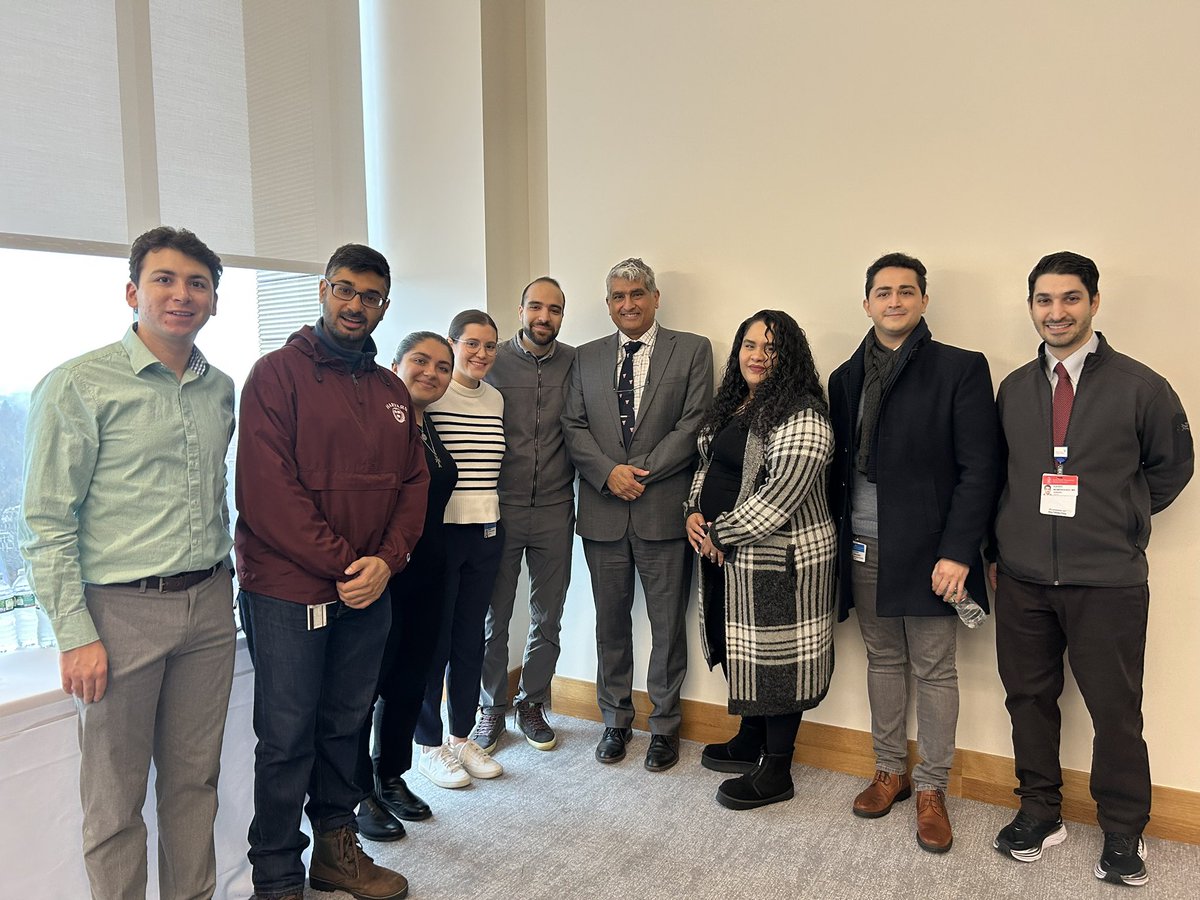
Delighted to announce that Dr. Ara Nazarian (@NazarianLab) has been inducted into the @AIMBE College of Fellows, a top honor for medical and biological engineers. He holds the Augustus White, III Chair in Orthopaedic Surgery at @BIDMChealth. @HarvardMed#EngineeringExcellence
I’d like to recognize my mentor Ara Nazarian who was announced today as the Augustus A. White III, MD, PhD Chair holder in Orthopedic Surgery at @BIDMChealth@harvardmed@harvardortho 👏🎉 Thank you for always leading @NazarianLab with passion, strong vision, and a good laugh!
We are delighted to announce the establishment of the Augustus A. White III, MD, PhD Chair in Orthopedic Surgery at @BIDMChealth with @NazarianLab as the inaugural Chair holder. @harvardmed@harvardortho
How can we enable AI models to solve complex scientific tasks, in an autonomous self-improving manner? Agentic modeling is key! Multi-agent, multimodal AI frameworks allow us to integrate diverse types of data, like images, text, graphs, protein sequences & more. By understanding and producing diverse modalities, such frameworks transcend traditional AI systems reliant on pre-trained knowledge.
In a new paper published in @digital_rsc we introduce ProtAgents, a multi-agent AI framework for protein discovery combining physics and machine learning. The model evolves the established paradigm by autonomously planning, soliciting new data from physics simulations, and reasoning over intermediate results.
➡Flexible Platform: ProtAgents is a platform for de novo protein design that utilizes multiple AI agents with distinct capabilities (general-purpose intelligence to specialized).
➡Autonomous Planning: Agents autonomously plan their tasks, independently driving the design process without relying solely on pre-trained knowledge or preconceived workflows.
➡Collaborative AI Agents: Multiple AI agents work collaboratively in a dynamic environment to address complex protein design tasks.
➡Soliciting New Data: Agents can solicit and integrate new data from physics simulations, ensuring a data-driven approach to protein design.
Some key features are:
✅Comprehensive Approach: ProtAgents overcomes traditional model limitations by incorporating out-of-domain knowledge and enabling comprehensive data analysis.
✅Diverse Problem-Solving: Demonstrated through examples, ProtAgents excels in designing new proteins, analyzing protein structures, and obtaining first-principles data via physics simulations.
Targeted Mechanical Properties: The system's concerted effort allows for the automated and synergistic design of de novo proteins with specific mechanical properties.
✅Flexibility and Autonomy: The flexibility in agent design and their capacity for autonomous collaboration open new avenues for materials discovery and design.
✅Advancing Scientific and Engineering Applications: ProtAgents showcases the potential of LLMs in addressing multi-objective materials problems, driving advancements in both scientific research and engineering applications.
The principles and methodologies employed by ProtAgents are not limited to protein design. By leveraging the flexibility of AI agent development and the robust capabilities of LLMs, this platform can be adapted to address a wide range of complex, multi-objective problems across various scientific and engineering disciplines. This extension of ProtAgents to other fields in science paves the way for transformative advancements, potentially changing how complex issues are approached and solved in modern science and technology.
Paper: Alireza Ghafarollahi and Markus J. Buehler, ProtAgents: protein discovery via large language model multi-agent collaborations combining physics and machine learning, https://t.co/oj15ZyG9jk
Code: https://t.co/iy1VpLDhnA
Check out mistral.rs, our #Rust-based open source inference engine allowing for fast #LLM serving for a variety of architectures including X-LoRA mixture-of-expert (MoE) models, Llama-3, Mistral/Mixtral, Gemma & many others. Built on the @huggingface #Candle framework for #Rust w/ custom CUDA kernels in the backend (as well as support for Metal, Apple Accelerate, and Intel MKL for CPU use), you can easily create a REST API OpenAI compatible server or run via Python bindings. Key features include:
✅Prefix caching, continuous batching
✅Flash Attention V2
✅Device offloading
✅GGUF or Hugging Face models
✅2, 3, 4, 5, 6 and 8 bit quantization
✅X-LoRA MoE non-granular scalings for fast inference
✅Grammar support
✅Continuous batching
✅LoRA support with weight merging
✅@llama_index integration
...and much more.
Incorporation into our GraphReasoning multi-agent modeling framework & @llama_index allows you to combine in-context learning with adversarial agentic strategies, to dive deep into complex scientific analyses, such as to predict material behaviors, generate hypotheses, analyze papers and data, develop new research concepts, and much more.
Check out mistral.rs: https://t.co/73C6dCzhdW
Join our Discord here: https://t.co/GVmlZZYljA
@RustTrending@rustlang
Metal-coordination bonds, a highly-tunable class of dynamic non-covalent interactions are pivotal to the function of a variety of protein-based natural materials like mussel byssal thread fibers or abrasion resistant arthropod mandibles. However, little is known about their fundamental behavior and what design principles are used in biological materials to create tunable, strong and tough materials. How is it possible to create resilient materials out of highly fluctuating bonds?
In a new paper published in @ACSBiomaterials led by @eesha_khare, and in collaboration with Kerstin Blank @SingleMolecules, @KaplanLab_Tufts and Niels Holten-Andersen, we study the intriguing mechanics of this class of bonds, focused specifically on size effects and a careful analysis of mechanisms using a joint computational-experimental analysis. We specifically explore an intriguing feature of biology's use of metal-coordination bonds, bond clustering, rather than relying on individual bonds. The work uncovered key binding motifs to produce strong, tough, and self-healing bioinspired materials for many potential applications in engineering.
We rationally designed a series of elastin-like polypeptide templates with the capability of forming an increasing number of intermolecular histidine-Ni2+ metal-coordination bonds. Using single-molecule force spectroscopy and steered molecular dynamics simulations, we show that templates with three histidine residues exhibit heterogeneous rupture pathways, including the simultaneous rupture of at least two bonds with more-than-additive rupture forces. The methodology and insights developed improve our understanding of the molecular interactions that stabilize metal-coordinated proteins and provide a general route for the design of new strong, metal-coordinated materials with a broad spectrum of dissipative timescales.
A highlight of this work was the amazing collaboration between four labs. Thank you Kerstin for hosting Eesha at the Max Planck Institute for Colloids and Interfaces where she did the experimental work!
Paper: https://t.co/kDwnEjiXyZ
Khare, E., Gonzalez Obeso, C., Martín-Moldes, Z., Talib, A., Kaplan, D. L., Holten-Andersen, N., Blank, K. G., & Buehler, M. J. (2024). Heterogeneous and Cooperative Rupture of Histidine–Ni2+ Metal-Coordination Bonds on Rationally Designed Protein Templates. ACS Biomaterials Science & Engineering. American Chemical Society https://t.co/Eaoy2kQqt6
@ACSpressroom@maxplanckpress@MIT_CEE@MITMechE@mit_dmse
I am excited to share that I will be pursuing my PhD at Massachusetts Institute of Technology (MIT) in the Department of Civil and Environmental Engineering. A heartfelt thank you to @NazarianLab@ProfBuehlerMIT and #ProfDonElmore, friends & family for supporting this journey!