i can help explain!
the male mosquitos don’t bite at all (only the females do), and the males they are releasing in huge numbers are inoculated with a bacteria that makes them completely unable to reproduce. the idea is that female mosquitos who mate with them will have no offspring, creating a much smaller next generation (the same number of female mosquitos are mating, but now only a small fraction can possibly have offspring)!!!
the fact that mosquitos are so deadly is the reason why they are doing this, because their hope is that it will result in less disease transmission going forward
@NControver38654@elonmusk If SpaceX manages to bring down orbital launch costs sufficiently, it could allow for the profitably construction of industry, including data centers, outside Earth. The ecological benefits of such would be immeasurable.
Northern European societies are considered “anthropologically feminist” in that they historically permitted women more privileges (ie property owning, political power, etc.). Thus in modern high female labor participation economies, fewer feel the pressure to choose between motherhood and working. Less historically “feminist” societies hold stigmas against working mothers which causes most women to just forgo having children all together.
Sam Altman Overdosed on GLP-1s
"Taking enough of it makes you have not a desire for anything else. Few days laying in a hospital bed staring at a white ceiling thinking nothing, not wanting anything." — @sama
@Yozarian22@dioscuri Cavalier-Smith’s archezoa hypothesis and Baum’s phagocytosing archaeon model (PhAT) both posit that nucleus, cytoskeleton, and phagocytosis evolved first, with mitochondrial endosymbiosis as a downstream event.
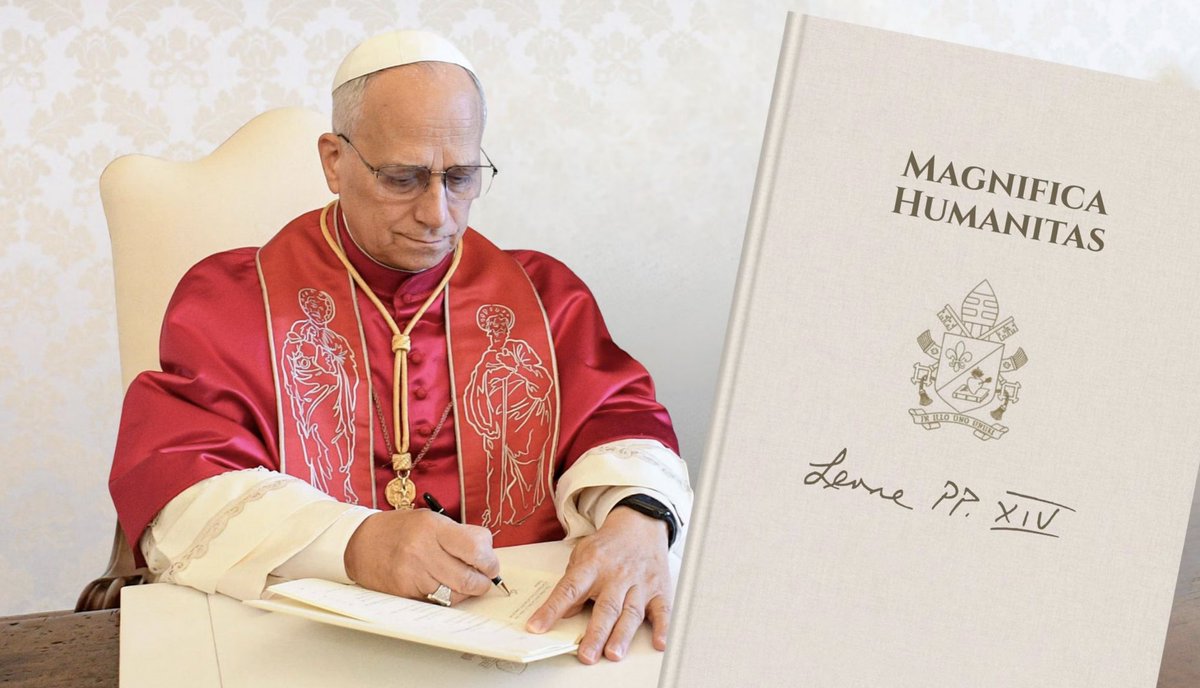
JUST IN: Vatican announces that Pope Leo XIV’s first encyclical — titled Magnifica Humanitas, on the safeguarding of the human person in the age of AI — will be presented at 11:30am on Monday, May 25, in the Vaticanʼs Synod Hall, in the presence of the Holy Father.
Speakers at the presentation will include:
Cardinal Víctor Manuel Fernández, Prefect of the Dicastery for the Doctrine of the Faith;
Cardinal Michael Czerny, Prefect of the Dicastery for the Service of Integral Human Development;
Professor Anna Rowlands, Political Theology, including Catholic Social Teaching, and theological ethics of human migration, Department of Theology and Religion, Durham University, United Kingdom;
Christopher Olah, co-founder of Anthropic (USA) and head of interpretability research for artificial intelligence;
Dr. Leocadie Lushombo, Political Theology and Catholic Social Thought, Jesuit School of Theology / Santa Clara University, California.
Concluding remarks will be delivered by thel Secretary of State, Cardinal Pietro Parolin.
The presentation will also include an address by Pope Leo XIV.
Magnifica Humanitas was signed and dated on May 15, the 135th anniversary of the promulgation of Pope Leo XIII’s Encyclical Letter Rerum Novarum.
Congrats to Aime!! He said his left forearm is basically broken 😂
Final scores:
→ F.03: 12,732 packages (2.83 seconds/package)
→ Aime: 12,924 packages (2.79 seconds/package)
This is the last time a human will ever win
Last year I nearly shut down Blueprint.
My reasoning was that in the grand game of existence, getting our societal goals right is the only thing that matters. In the long arc of time, it wouldn't matter if I built a longevity company.
I wanted to invest all of my energy into Don't Die. Maybe I'm naive, however it seems obvious to me that when your species is giving birth to superintelligence, your sole concern becomes survival.
Not because you're scared or fear what may come, but because you realize that superintelligence is big. Bigger than any of us can imagine and happening faster than our intuitions allow us to model. This is a hard concept for Homo sapiens to understand because we are not good at understanding our limitations of knowing.
In the void of not knowing, the one thing that we each know to be true is that none of us want to die right now. When tomorrow arrives, that will be true about the next day too. Don't Die is not about immortality. It's about the most basic observation of intelligent life, we want one more breath.
Just as Homo erectus, a million years ago, with an axe in their hand, was unable to articulate our modern world, we are once again Homo erectus relative to AI. We may experience a million years of relative progress in the next 10, 20 or 50 years.
Given this, Kate and I have cycled through this problem hundreds of times over the past few years. How can we get the world aligned around Don't Die? Committed to the idea that in spite of our many differences, we share a planet and a common interest in tomorrow.
Basically, how can we make existence profitable and die unprofitable.
We saw the problem as two-fold. One practical and one spiritual.
Practically, we need things to work in the world: clean water, transportation, energy, security, stable institutions, communications and health care.
Spiritually, we need purpose, existential explanations, and hope. We also need progress and adventure: solve aging, abundant AI, creative joy and expression and things to build.
We decided to build on both fronts. Blueprint would be the practical, a company aligned to Don't Die. A group of humans that labor together to help other humans thrive as their sole objective. To hold ourselves to a standard of making existence profitable and die unprofitable, for ourselves.
To never let profit corrupt this goal. Sounds simple until you take stock of how many companies make their living on making humans die. Sometimes this is done openly and other times it's hidden in a mesh of poorly aligned incentives that are invisible.
This is not an esoteric philosophical argument, death is measurable in a biological system. You can get clever and find arguments ("does this mean we shouldn't have children?") but we know death and life when we see it.
On the spiritual side, we think that 2027-28 is the breakout time for Don't Die. Maybe we're off by a year or two, but we think it's soon. We believe that AI will create several societal shocks, none of which we will predict accurately, but will leave the world feeling unmoored.
Hopefully it won't be catastrophic, but will be a cold water dunk we need to awaken us to the realization that no one really wants to die right now and that our current societal systems that profits from death are ill suited for this moment.
That in our most sober moments, when at funerals, or after a near-death experience, we see clearly, even if for a few minutes.
Above all, we care about life more than anything else. All else fades away in those moments. We see with crystal clarity that all the other stuff that had us entranced wasn't that important after all.
I write this for two reasons.
First, to invite you to build Don't Die in the practical world. Capitalism (profit and loss) is a good system that has done society well. In whatever you're building, align your and your organization's efforts with a loyalty to acting in people's best long term interests. Don't do things that cause other people to die, commit self harm, or create societal harm. This doesn't mean being paternalistic, it means using your best judgement about how you'd want someone else to treat you if the roles were reversed.
Second, to ready yourself for the new philosophy that will be arriving shortly. One that prioritizes our shared existence and vitality above all other goals.
Don’t Die is the foundation. Immortalism is what we’re going to build. Again, not for selfish reasons, but because we understand that we are warriors and caretakers of intelligent life in this part of the galaxy and we take on this responsibility with honor and nobility.
I’ve always believed the No.1 application of AI should be to improve human health.
That work started with AlphaFold, and now at @IsomorphicLabs with the mission to reimagine drug discovery and one day solve all disease!
We are turbocharging that goal with $2.1B in new funding.
"He is a Swedish analytic philosopher who spent the better part of two decades at Oxford, and his influence on how Silicon Valley, governments, and AI laboratories think about the future of machine intelligence is arguably greater than that of anyone who has actually built in the space."