Depending how good your Chinese is, @emilygsands (and I) were interview by ZDNet China on everything @stripe and AI (5k+ words): https://t.co/kHB3BfSske
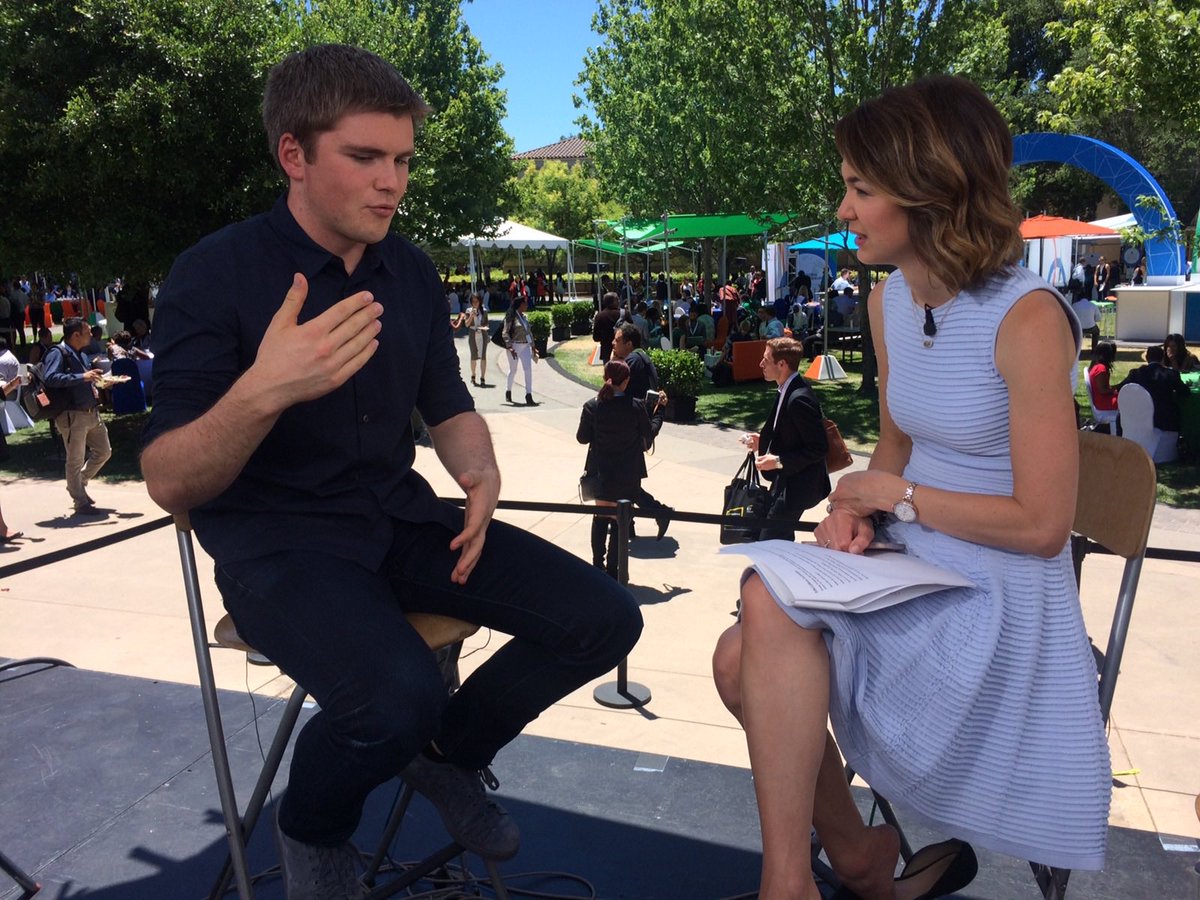
Here's a small part (in English), which includes my use of "jazz hands" to illustrate a point on agentic commerce and fraud.
Stripe just dropped a product that let's anyone sell to AI Agents.
AI Agents are a new channel for commerce.
- Agentic commerce converts 2x to 6x higher
- 1 in 6 Black Friday purchases was AI assisted
Now they can have AI checkouts.
Agentic Commerce Deep Dive
Most people talk about “3P commerce” as if it’s one thing. It’s a SPECTRUM! $AMZN and $SHOP are two ends of the spectrum, everything else sits in the middle:
$AMZN Platform is the merchant of record (“MoR”); platform handles everything - refunds, chargebacks, unified payment, and tax. Merchants do NOT own any of the customer relationships.
$SHOP Merchant is the MoR; everything is handled by the merchant — they choose their own PSP, manage fulfillment, and process returns independently. Merchants own 100% of the customer relationships.
Everything else falls somewhere in between:
$ETSY / $EBAY: Platform is the MoR (centralized payment); but for returns, buyers first contact sellers — if no response within 2–3 days, the platform steps in.
Taobao / $PDD: Merchant is the MoR; but platforms are highly hands-on — they provide escrow / collect-and-pay services, and mediate disputes.
Why this matters: Agentic Commerce is, by nature, 3P e-commerce.
Where these systems sit on the spectrum determines:
1️⃣ how successful the business can be (think the many "failed ones" e.g. $Meta);
2️⃣ how much control merchants retain over traffic/data (real long-term impact on merchants);
3️⃣ how much disruption hits the payment stack (👋 Stripe).
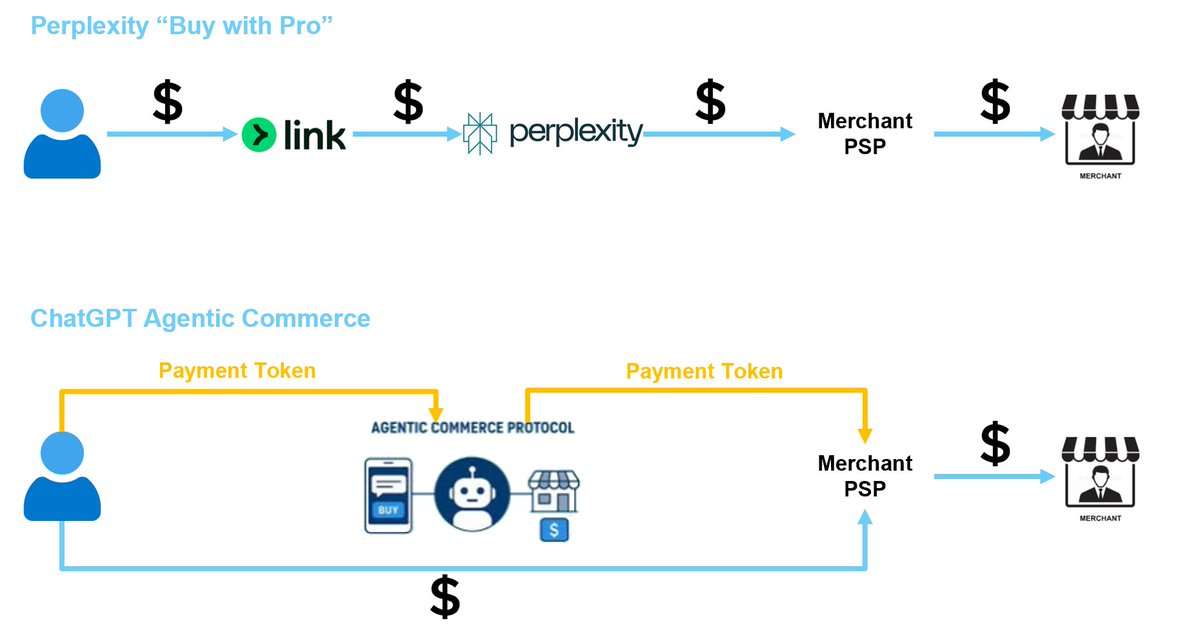
🔴Perplexity “Buy with Pro” vs. ChatGPT Agentic Commerce ("ACP")
Surprise! The two are very different — in Perplexity “Buy with Pro,” Perplexity is the MoR (it shows up on your credit card bill), whereas ChatGPT made it clear that merchants remain the MoR. In both cases, merchants can retain their existing PSPs.
Most people don’t appreciate this, but it’s a BIG deal that $Etsy isn’t using Stripe for payment processing, yet can still participate in ACP.
In Perplexity's case, Perplexity acts as the MoR, while the merchant is just the fulfiller. That means Perplexity takes on wayyyy more responsibility than OpenAI does. $$ first go through Perplexity; Stripe (via Link) processes your card for Perplexity’s checkout; then Perplexity places the order with Walmart using Walmart’s PSP. Given Perplexity is on the hook, the biz model is most similar to $eBay/ $ETSY (refer to analysis above).
In OpenAI's case, OpenAI packages the payment credential in a shared token → $Etsy receives the token and passes it to their PSP → $Etsy's PSP unwraps the token, retrieves the credential, and processes the payment. $$ flows directly from user to merchant's PSP. Given merchants are directly on the hook, the biz model is most similar to $SHOP.
Recommend read: Simon Taylor’s https://t.co/Jnk9uUiNvZ
For merchants, ACP is better if you care about owning payments, tax, refunds, fraud, CRM, and first-party data — while still getting agentic distribution. For platforms, ChatGPT’s approach is far easier to scale, since it carries little to no liability.
Long story short — OpenAI’s agentic commerce passes my first test. This is the right approach, IMHO.
---
More on the topic / full article: https://t.co/TfkJ8QTmVH
You can now subscribe to a print edition of @WorksInProgMag!
For those who aren't familiar, Works in Progress is a sister initiative alongside @stripepress.
Stripe's mission is to increase the GDP of the internet. We want to enable more successful entrepreneurship in the world and to help effective business models accelerate the adoption of new technologies. We mainly do that by building programmable financial infrastructure, but we think that economic growth and dynamism is also the product of ideas. (We subscribe to the Mokyr explanation of the industrial revolution.) Stripe Press publishes books on the topic of economic and technological advancement; Works in Progress, a magazine, publishes shorter-form pieces on the same topic. The success of good ideas can never be taken for granted: the preconditions that give rise to successful and innovative economies are historically anomalous, and we shouldn't be complacent.
Like everything, Works in Progress started as an experiment, but we've been very pleasantly surprised at the results thus far, and have high hopes for the next couple of years.
You may already be familiar with many of the WiP authors, including @salonium, @SCP_Hughes, @s8mb, and @bswud. If you're interested in writing for them, you should get in touch.
I like exercise names like “Romanian deadlift” or “Bulgarian split squat.” The addition of an Eastern European country adds a certain gravitas. I’m gonna invent something called the “Moldovan pushup”
hi. we’re having a sale on our merch store rn through monday @ https://t.co/IP9TDyTESa
&& we just launched a new plushie, kaiju wumpus (limited quantities).
The world of video games is becoming multi-platform, mainstream, and endlessly creative. Today we’re revealing Discord's next chapter and a new look as the social platform for all of gaming where friends talk, play, and hang out together.
More here: https://t.co/NoV9Iix54x