The most important briefings of the day.
Karl Deisseroth, professor of bioengineering and of psychiatry and behavioral sciences, shares the news of his Nobel Prize with his kids.
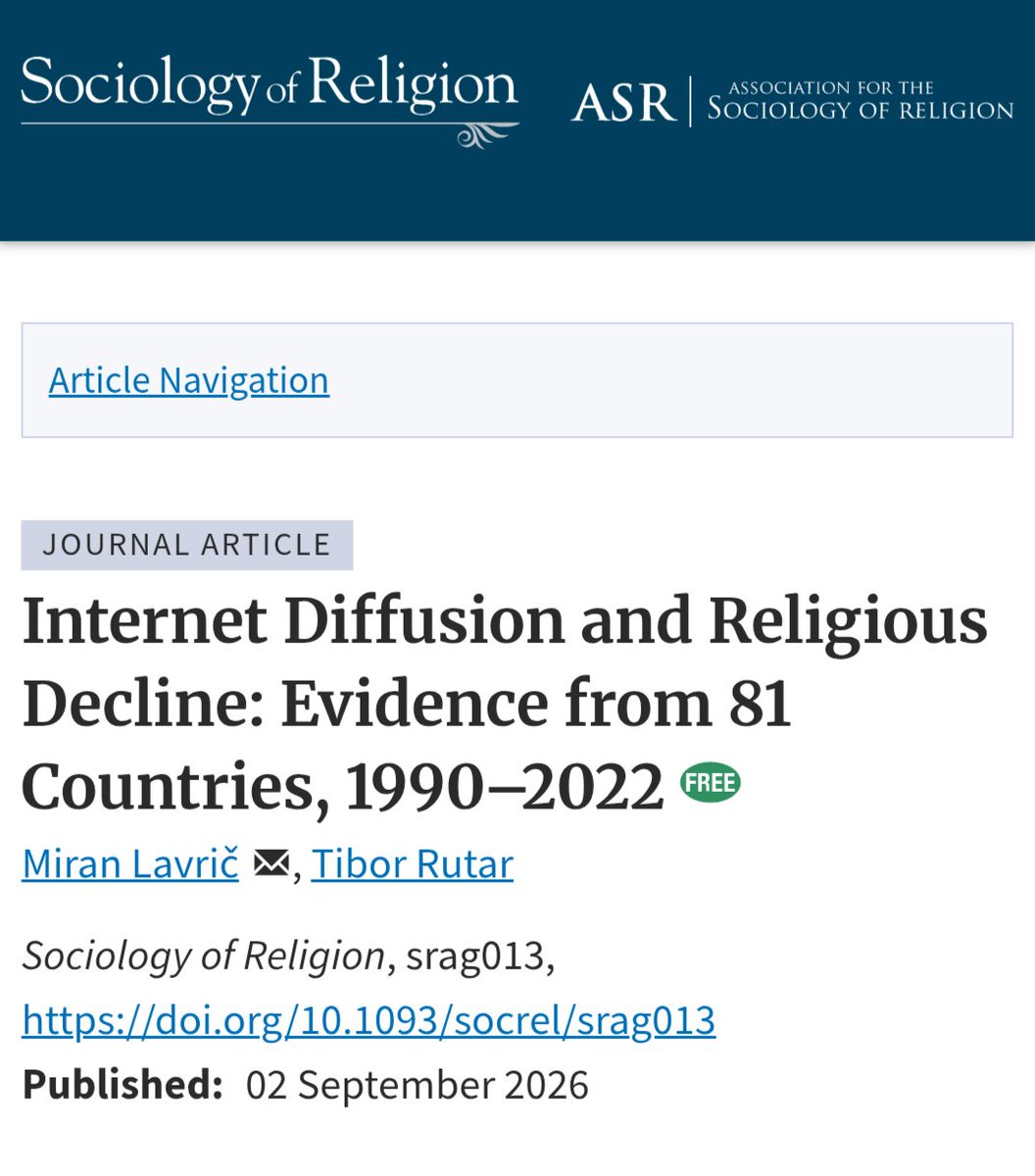
Well, we finally have a really rigorous answer to the question:
Did the Internet kill religion?
Yeah, it did.
When Internet penetration rose, religiosity declined in a dataset of 81 countries.
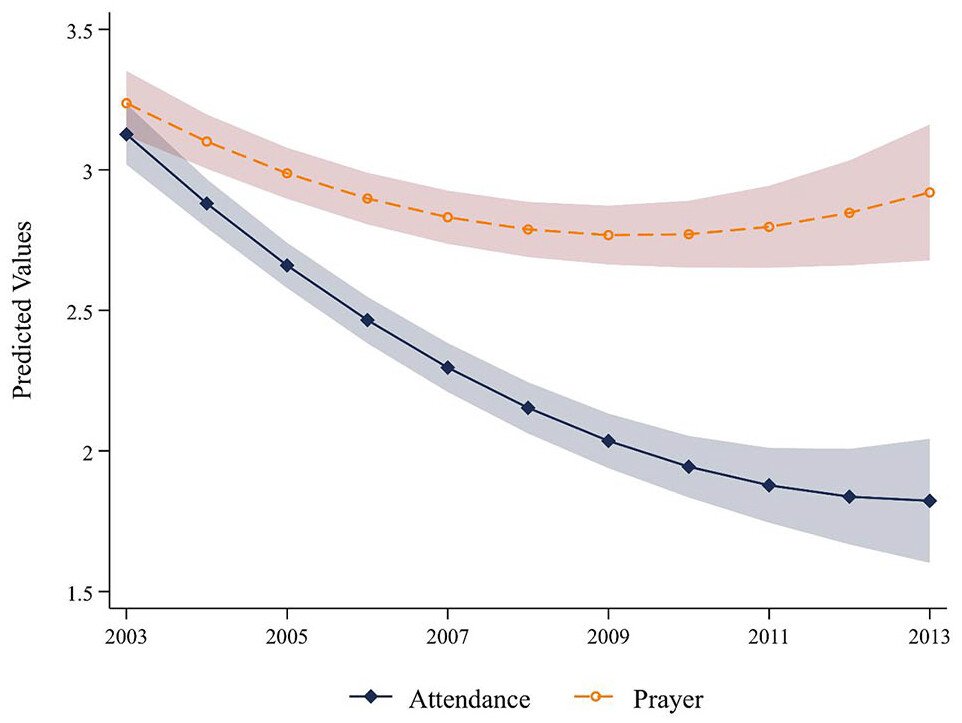
Secularization in the US has plateaued. Burge accurately called it five + years ago, but most other public-facing secularization theorists insisted it wasn't happening. There's no evidence of revival among Gen-Z, Catholics, or anyone , but nones have hit a (probably temp) ceiling
Americans are relying less on religion, more on logic and science, in making moral decisions (except for Evangelicals) | The Moral Reasoning Gap in American Christianity, by @ryanburge https://t.co/j04cj0Xobd
🔴 New Article 🔴
“Holes in Sacred Umbrellas” by Katie E. Corcoran & Christopher P. Scheitle
Can just one non-religious friend shift your worldview? This study explores how friendship networks influence the dynamis of atheistic worldviews
🔗 Read here: https://t.co/IN55RXvvpn
I analyzed the voting patterns of 22 Protestant denominations between 2008 and 2024.
Here's the change in Republican vote.
Biggest swings to the right:
Natl. Baptist Convention
Seventh Day Adventist
ABCUSA
Free Will Baptist
Biggest swings to the left:
Non-denominationals.
A study I'm particularly excited about and have been working on a long time is finally live: https://t.co/Dv2ui0o19R
We follow people from adolescence into adulthood and show why they are leaving *organized* religion.
Press release summarizing it: https://t.co/1MhpG0ma42
This is important. The reason we obsess over evangelical politics is because they’re a large constituency with predictable voting patterns that influence election outcomes. They’re not any more “political” than anyone else, and less politically active than their main detractors.
1/ Social psychologists long ago proved something utterly terrifying
People will disregard WHAT THEY SEE WITH THEIR OWN EYES to conform to what other people say
In a classic 1951 experiment by Solomon Asch, people looked at a picture of three lines & were asked to choose which
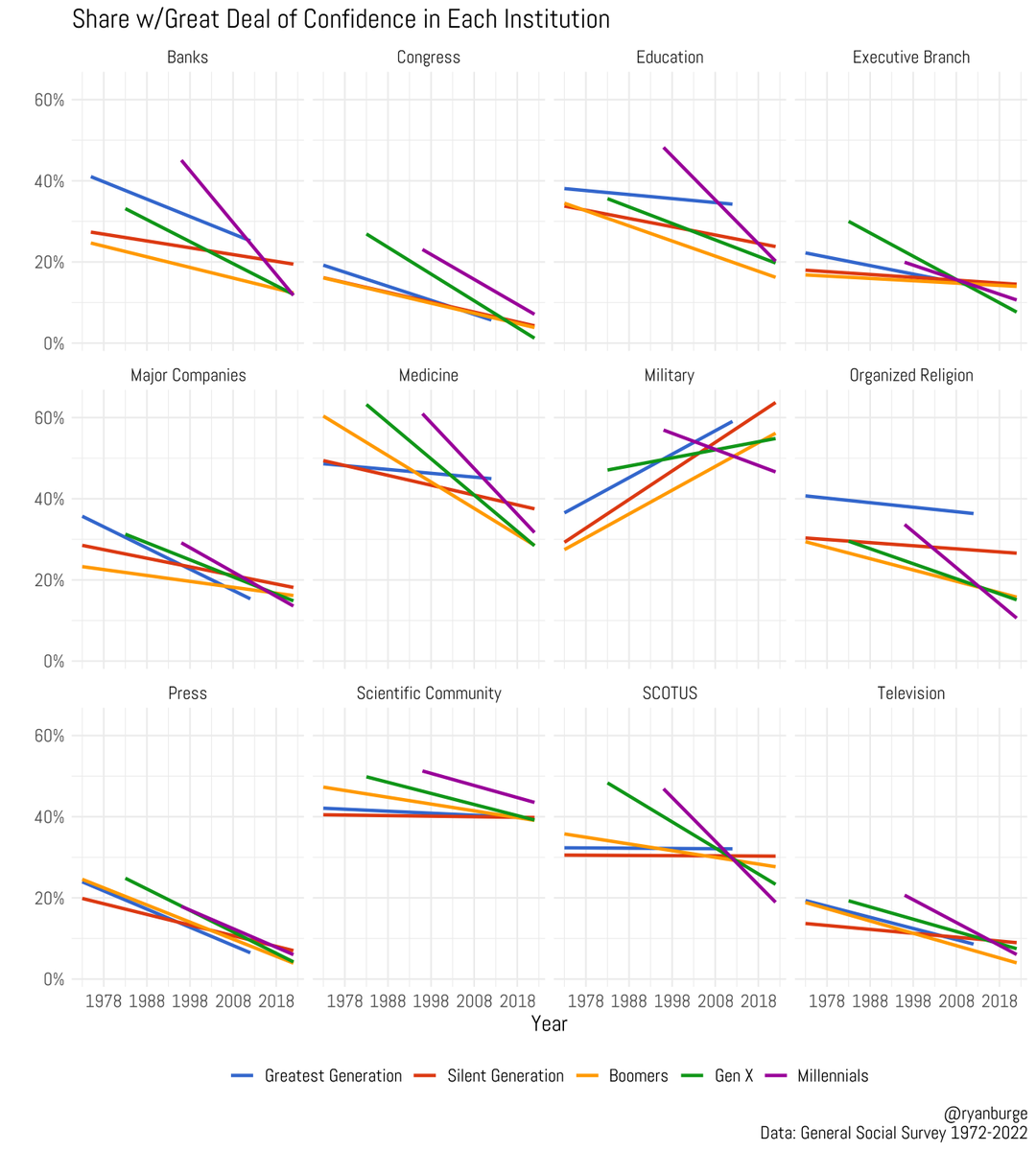
We don't trust anything.
Literally almost every institution in the United States is less trusted today than twenty or thirty years ago.
It's true of older Americans. It's true of younger Americans, too.
The only exception is the military. Older folks trust them more now.
I think we may have entered a new phase in American religious demography.
The nones rose for three decades with almost no interruption.
The next three decades will not see the same trend lines.
The nones will likely increase but at a much slower pace.
There's a huge education gap when it comes to trust.
Among college educated folks, they are just as trusting today as they were decades ago.
It's those without a college degree who have lost faith in their fellow man.
Silents: 47% to 32%
Boomers: 36% to 22%
Gen X: 30% to 25%