The team is way too big to tag everyone, I'm just so grateful to work alongside so many people that really care about the work they're doing here @tryramp – and who constantly push things from good to great to incredible 🙏
It's Day 124 for me here @tryramp and today we're launching Stack by Ramp! The Brand Experience team had a chance to collaborate across Brand & Product on this one, I've shared some more details below ⬇️
In these close collaborations we were able to unify our brand and product experiences. Making sure that how we show up in the wild looks and most importantly, *feels* consistent with the actual product experience we're delivering to our customers 💖
Introducing Stack.
The AI operating system that lets accounting firms take on more clients without hiring. Learns your firm's process, runs the close, posts the journals. Fully auditable.
We’re living through the biggest shift in accounting since the spreadsheet.
@gabriell_lab Unsolicited feedback, but these icon animations are too slow.. They're nice and smooth, but the likelihood someone hovers on a row item for that long is unlikely.
People are finally starting to realize that good visual design or UX isn't enough these days.
You have to tap into emotion, shape how people feel about your product or brand through a variety of levers #brandexperiencedesign
@Ryo_Saeba_3 I came up with this idea 6 weeks ago for the vending machines and posted it on IG and it went mildy viral! Glad @biccameraE took the idea and actually implemented it 🤣
Original video: https://t.co/Z9JP1dJ17L
I sat down with @columnfive and talked about all things Brand Experience Design and how you win in the age of AI by designing for how people feel.
SPOILER: You should be sweating the small stuff ✨
https://t.co/1CGdmrLiRX
Yea, that could be one way to learn the tool that helps you create well designed products! But you’d first have to be able to identify what is a “well designed thing” and that comes from time spent interacting with people, content (not social media), history, books, and various artifacts. Then you start to recognize how intentional some decisions were and it just gives you a more holistic perspective on things, rather than just using a skill/.md file or viewing Pinterest or Arena.
Things like this can help teams move faster and raise the bar on visual craft, but they also invite laziness.
The kind that overlooks the small details shaping how people think, talk, and feel about your product. This is where the best products will differentiate from the pack.
🚨 Someone reverse-engineered the design systems of Apple, Spotify, Airbnb, and 30+ billion-dollar companies.
Packed each one into a single file. Free.
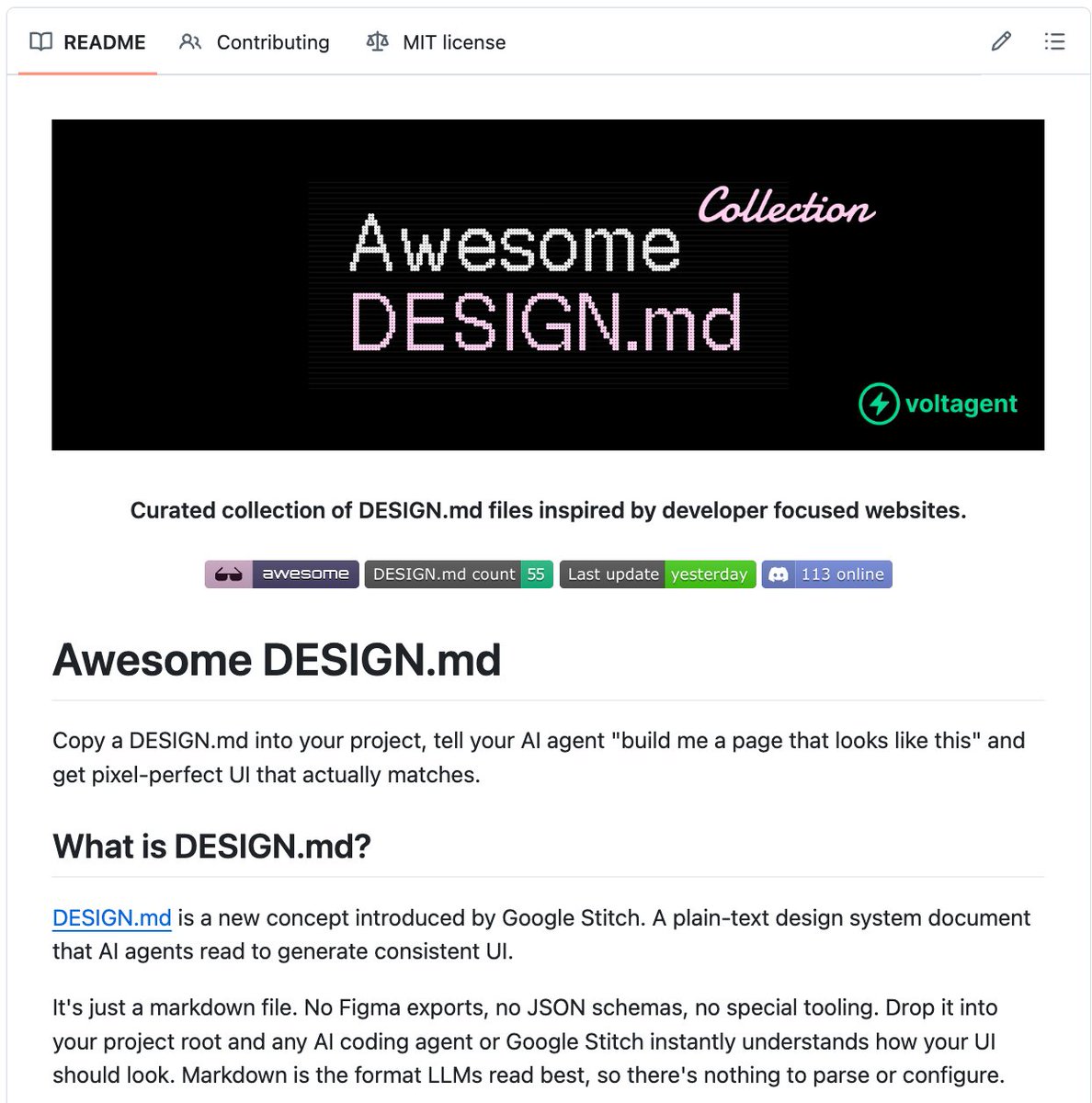
It's called Awesome Design MD.
Drop one file into your project. Your AI agent builds UI that looks like Spotify. Or Apple. Or Airbnb. Instantly.
Not screenshots. Not Figma links. A single DESIGN .md file that captures every color, font, spacing value, button style, and layout pattern from a real website. In a format AI agents read and reproduce.
Here's the difference:
Tell Claude Code "build me a landing page" and it gives you generic UI.
Tell Claude Code "build me a landing page" with Spotify's DESIGN .md in your project and it gives you Spotify.
Here's what's inside:
→ Apple. Premium white space, SF Pro typography, cinematic imagery.
→ Spotify. Vibrant green on dark, bold type, album-art-driven layout.
→ Airbnb. Warm coral accent, photography-driven, rounded UI.
→ Linear. Ultra-minimal, precise spacing, purple accent.
→ SpaceX. Stark black and white, full-bleed imagery, futuristic.
→ BMW. Dark premium surfaces, precise German engineering aesthetic.
→ NVIDIA. Green-black energy, technical power aesthetic.
→ Uber. Bold black and white, tight type, urban energy.
→ Sentry, PostHog, Raycast, Cursor, ElevenLabs, and 20+ more.
Here's how to use it:
→ Pick a design system from the collection
→ Copy the DESIGN .md file into your project root
→ Tell your AI agent to use it
→ Get UI that matches the design language of a billion-dollar company
That's it. One file. Your AI agent now has the design taste of a $200/hour design consultant.
Designers charge $5,000+ for a custom design system. Companies spend $50,000+ building one from scratch.
This is free. 31 design systems. Copy. Paste. Ship beautiful UI.
Works with Claude Code, Cursor, Codex, and any AI coding agent that reads project files.
100% Open Source. MIT License.