It’s hard not to get addicted to this.
From side conversations with @MEBirnbaum to an incredible result for patients. So proud of the Kelonia team for all the hard work it took to make this real.
Next month at #ASH25, we will present first-in-human data of KLN-1010, our novel in vivo CAR-T therapy, from our ongoing Ph 1 inMMyCAR study in a late-breaking oral session. https://t.co/73jxrwsErf
These are the days that make the long hours worth it. Excited to see a technology I invented take this big step toward benefitting patients.
Grateful to the whole team at Kelonia for building what was once just cool tech into a real drug that could bring CAR-T to everyone.
The first patient with multiple myeloma has been dosed in the inMMyCAR study, our first in-human Ph 1 clinical trial of our in vivo gene therapy, KLN-1010.
Learn more about the inMMyCAR clinical trial and our unique gene delivery platform: https://t.co/P43q5xaWP5
Thrilled to share our study, online today @ImmunityCP : thymic mimetic cells are evolutionarily ancient, with conserved and species-specific elements in humans, zebrafish, and mice. https://t.co/0p4081pbdx 1/n
Um..🤯. Freeze dried tissue preserves chromatin for centuries!
“…we dehydrated the tissue first. The architecture was fine….Ran over it with a car, had a former Astros starting pitcher throw a fastball at it, fired a shotgun at it. Still fine.”
Lots of good answers to this, but for me it has to be high-quality single-molecule protein sequencing methods. From basic science to the clinic, there’s so much we could learn from knowing what’s going on at the protein level in and out of cells
15 years ago, we didn't have AI, single cell, CRISPR, RNA tech, or broad delivery tech (LNP, VLP, etc.) All of these will continue to mature and advance, but...
What will be the biggest biotechnologies 15 years from now?
@UrnovFyodor @Oncology_at_AZ @statnews I believe it was expression a dominant negative TGFBRII. A little bit of detail in slide 14 (from AACR 2023) here: https://t.co/rcDYjPDgFO
It’s been really cool to see the confluence of technology development and molecular insights that have enabled such detailed studies of viral molecules directly on viruses, performed safely and efficiently. Can’t wait for future progress in this space
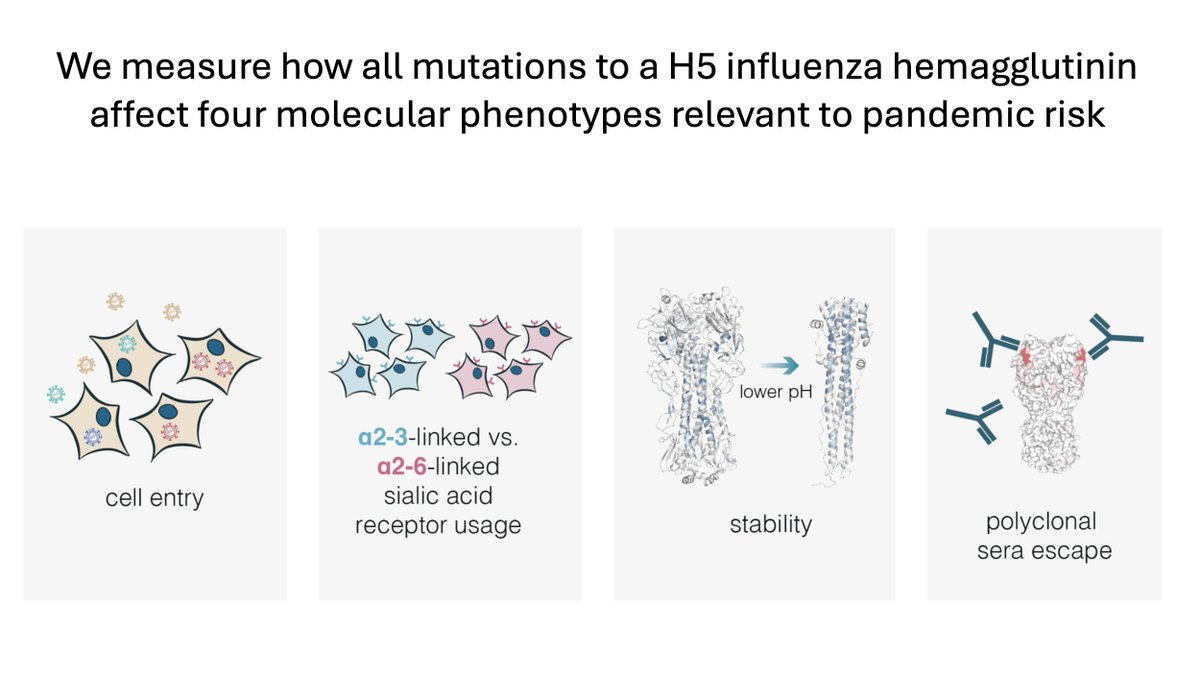
In new study led by @bdadonaite, we measure how all mutations to H5 influenza HA affect four molecular phenotypes relevant to pandemic risk:
https://t.co/QOjVTF4h9L
Results can inform surveillance of ongoing evolution of H5N1.
Excited to share some of my PhD work was pre-printed! Using single-cell sequencing, we took a deep look at a library of CAR signaling architectures to try to identify signal-intrinsic drivers of CAR-T function🧵👇 @MEBirnbaum@kochinstitute@MITdeptofBE
https://t.co/DHbwlFQlnB
We’ve entered into a #research collaboration and #license agreement with Astellas Pharma subsidiary, Xyphos Biosciences, to develop innovative universal, off-the-shelf in vivo #CART#celltherapies for cancer.
Learn more: https://t.co/mtINcvKO8w #biotech
There’s a frequent perception among recent entrants to drug discovery world that if we could just find drug candidates faster, this will be a useful accelerant to the overall process. The issue is: this thinking is mostly (but not entirely) incorrect. 🧵 1/
@Mykalt45 2 main theories have always stuck out to me:
1) There’s a T cell component that other modalities miss, and flu/cy conditioning takes care of this
2) CR requires eliminating all pathogenic cells, and leaving even a few enables relapse- flu/cy + CAR clears better than other tx
@RNAiAnalyst Looks like they’re reporting whole liver editing here, so it’s possible that distribution to hepatocytes vs other cells is different. They report hepatocyte editing as an estimate based on liver cellular composition on a subsequent slide
Can confirm - I used to get off the T early because it was faster to walk… What doesn’t make the headline is that wait times were often 10-15 minutes before getting on a standing room only train going slower than walking speed
Tracks that opened for passenger service to Union Square in March 2022 and to Medford in December — and were shut down for repairs in recent months — are now so defective, the @MBTA says, that trains are moving slower than many people walk. https://t.co/hDlxydxhjK via @taydolven
@BowTiedBiotech Definitely plenty of potential but there’s a lot to do to get there - need an order of magnitude more well-curated positive and negative data from diverse cohorts to approach decent prediction