If money wasn’t a problem, I’d probably spend my whole life studying.
A master’s in philosophy, then astrophysics, physics, ancient history, psychology… Whatever makes me understand this weird existence a little better.
Not for a career, not for a degree.
Just because there’s so much to know and one lifetime already feels too short.
@DarioAmodei A China não concordará , abrindo a possibilidade de eles ultrapassarem os modelos americanos enquanto vocês se afudam em burocracia, patetico isso
Today, we are introducing Orbis 1.0, our first Live Model!
Create living worlds and stream them in real time, with persistent memory, interactivity, and physics-grounded generation of unbounded length.
Try it now at https://t.co/j0hbKpBPnK
API available via @reactorworld
Dynamic version: https://t.co/MS8Fk9HPO7
Stable version: https://t.co/0MR3JpCWUr
Introducing TimesFM-3, a state-of-the-art time series foundation model that enables accurate multivariate time series forecasting in a single forward pass, significantly outperforming other forecasting models across major benchmarks.
More on the blog →https://t.co/uSlnIdUJ4Q
A Luneburg lens bends an Electromagnetic wave without a curved boundary. Instead its dielectric constant changes continuously from the centre to the edge. This forces different parts of the wavelength to travel at different speeds.
Here, we solve the full 2D TM EM wave equation on an unstructured triangular mesh using the Finite Element Method (FEM).
Our general-purpose coding agent just scored 100% on the ARC-AGI-3 interactive reasoning benchmark.
NVIDIA AVO completed all 183 levels across all 25 public environments, figuring out what to do with no instructions, explicit rules, or stated goals.
We ran the largest open experiment on how frontier models do AI research.
100+ autonomous runs across 10+ models, sandboxed on 8xH200s for up to 8 days, iterating on the nanoGPT optimizer track.
Best runs closed 82% of the gap to a record built by dozens of humans over months.
We can finally talk about it:
We found a way to extract hidden reasoning of frontier models using a vulnerability in the APIs of every frontier AI company.
We verified that our reasoning token count matches billed API thinking tokens 1:1 for most of the prompts we queried.
For anyone with endless ideas, this agent age is nirvana as those ideas are met with endless execution, endless exploration. I've never had has much fun working with computers as I do right now. What a time to be alive.
@Pokedeckstore @bigRD73@jun_song Definitely doesn’t need 2 subscriptions.
Grok 4.5 is the new member of the Cursor family and they doubled the limits by 100% permanently
I used 1 billion tokens in less than a month and the limit is still at 70%.
Best IDE of the last month.
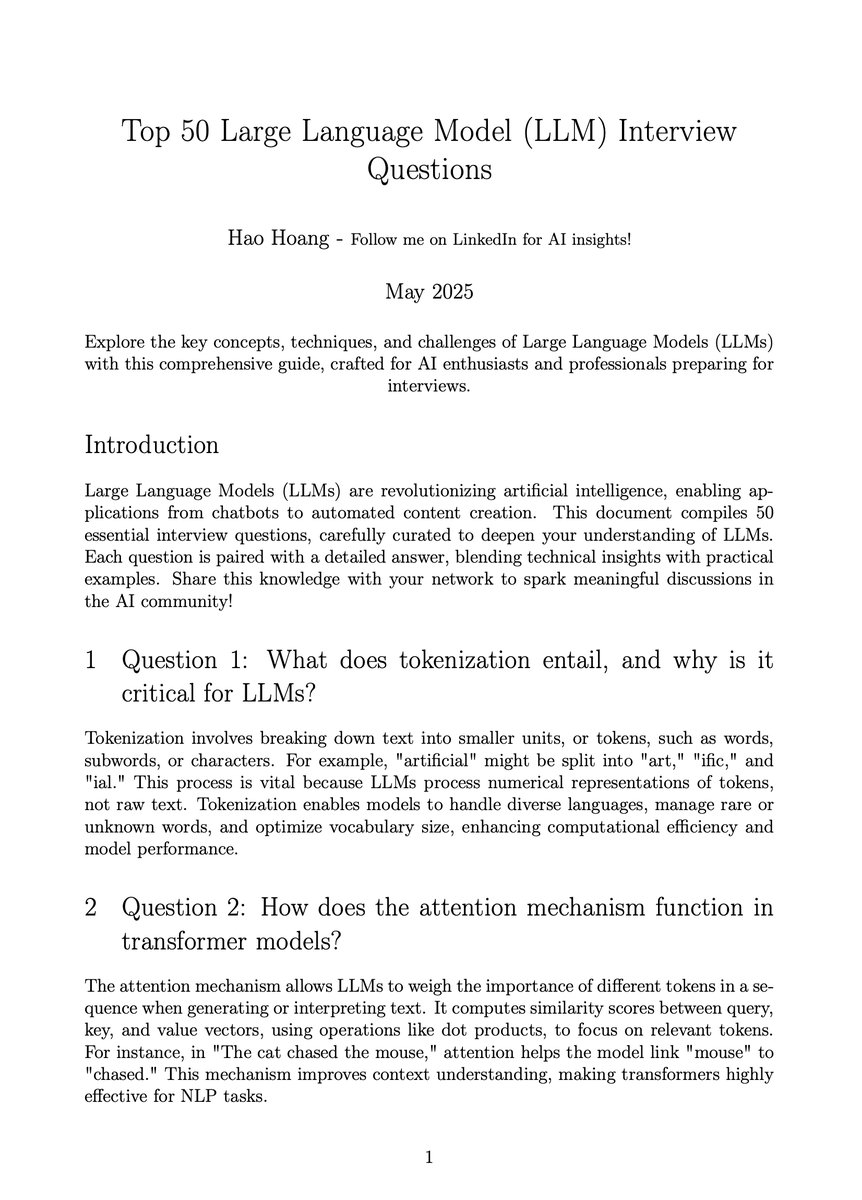
These are literally the kind of LLM interview questions most candidates wish they had seen earlier.
A curated list of 50 LLM interview questions - shared by Hao Hoang.
What's covered:
Fundamentals:
→ Tokenization and why it matters
→ Attention mechanisms in transformers
→ Context windows and their tradeoffs
→ Embeddings and initialization
→ Positional encodings
Fine-tuning & Efficiency:
→ LoRA vs QLoRA
→ PEFT to prevent catastrophic forgetting
→ Model distillation
→ Adaptive Softmax for large vocabularies
Generation & Decoding:
→ Beam search vs greedy decoding
→ Temperature, top-k, top-p sampling
→ Autoregressive vs masked models
Advanced Concepts:
→ RAG (Retrieval-Augmented Generation)
→ Chain-of-Thought prompting
→ Mixture of Experts (MoE)
→ Knowledge graph integration
→ Zero-shot and few-shot learning
Math & Theory:
→ Softmax in attention
→ Cross-entropy loss
→ KL divergence
→ Gradient computation for embeddings
→ Vanishing gradient solutions in transformers
I will put the link in the comments.
we built pdf-inspector so agents can process PDFs without waiting on OCR. it classifies any PDF in ~20ms and extracts clean markdown locally
→ 200 PDFs processed in 2.8s
→ top quality in extracting tables + graphs
→ built in rust
→ open source
https://t.co/Wjp9kpTHXJ
Some still don't know: Google's 2017 normalized quadratic Transformer [TR1] is based on the principles of the 1991 unnormalized linear Transformer [ULTRA]. In 1991, KEY/VALUE was called FROM/TO. ULTRA’s computational costs scale linearly in input size, rather than quadratically! The 1993 paper on a recurrent ULTRA extension [FWP2] introduced the attention terminology: learning "internal spotlights of attention" by gradient descent. See the T in ChatGPT! Details and references: https://t.co/6NEFdgghAw
Today we’re open-sourcing Numbat, an agent-detection and response layer that is designed to work across agent harnesses.
Numbat gives security teams visibility into agent activity, with controls to block selected actions before execution.
Read more: https://t.co/LVhkCJ2sMt







![SchmidhuberAI's tweet photo. Some still don't know: Google's 2017 normalized quadratic Transformer [TR1] is based on the principles of the 1991 unnormalized linear Transformer [ULTRA]. In 1991, KEY/VALUE was called FROM/TO. ULTRA’s computational costs scale linearly in input size, rather than quadratically! The 1993 paper on a recurrent ULTRA extension [FWP2] introduced the attention terminology: learning "internal spotlights of attention" by gradient descent. See the T in ChatGPT! Details and references: https://t.co/6NEFdgghAw](https://pbs.twimg.com/media/HLV_NoKXwAEgLgm.png)


