My entire life changed when I realized that nobody was thinking about me.
It completely rewired my brain.
I wonder how many extraordinary people waste their lives fearing the judgement of people who were never even thinking about them in the first place. Fearing a spotlight that was never even on. Performing for an audience that was never even there.
Because the truth is that you aren't afraid of failure. At least not really. You're afraid of other people seeing you fail. You're afraid of what they'll think of you.
But nobody is thinking about you. Everybody's too busy thinking about themselves.
So, that thing you've always wanted to do? Just go do it.
I might never look the source again. It was nearly a half century ago that I stopped looking at assembly because I trusted the compiler to get it right. This feels like that.
This is exactly right. Source code is on the verge of becoming like assembly.
The next step is getting rid of “source code” entirely and just making an efficient binary directly with AI.
Only if education could be this interactive ❤️🔥
I've had a looong wish to build something genuinely useful through vibe coding, and I finally did it.
A 3D human anatomy application built with @threejs using GPT 5.6 Sol.
It all started with a single design image that I created using GPT Image 2.0. I then used it to generate every 3D organ image, one by one.
Next, I converted each of those images into 3D models using @tripoai (and no, they didn't sponsor this 😄).
After that, I opened Codex, wrote a master prompt based on the design, and gave it the prompt, the design image, and all the 3D models.
Codex built the first version beautifully, but there was one big problem.
Every single 3D model was nearly 120-150 MB. That obviously wasn't practical for the web and was giving a performance of 16fps.
After a few iterations, Codex optimized each model down to roughly 2–5.5 MB while preserving the visual quality, reducing the total asset size from ~900 MB to just 28.6 MB. And each model loads on demand.
Along the way, Codex also generated those anatomical illustrations showing where each organ sits in the human body, and even created the interactive hotspot markers that explain different parts of every organ. It handled all of that.
The process wasn't exactly one shot, but it also wasn't difficult. You just have to do it step by step.
It genuinely felt like building something that could make learning anatomy much more engaging.
The inspiration came from @DilumSanjaya's 3D animal plant cell project. I remember seeing it and thinking, "I want to build something like this one day."
And I did it :D
Live: https://t.co/gIFgkj8UVB
Code: https://t.co/nijvyWcyxO
I’ve been using Grok Build and Claude Code side by side…here are some things you should know
Grok 4.5 with Grok Build is going to save you so much time, like really a lot and it’s really powerful
Claude models may be slightly powerful than Grok but in real-world use cases Grok absolutely really wins it….in most cases you wouldn’t even notice that difference in performance and with Grok you actually have more benefits and you can get more things done with it……you can try this yourself
I used both models in parallel. Grok doesn’t wait around asking too much stuff and complicating it, circling around simple things like Claude does, and it proactively does the very thing you asked it to do all while being very cautiously
In simple Claude thinks too much wasting too many tokens and time while deciding if it should do the task or not, even for simple ones…..meaning its flashy policies uses your tokens to decide whether it should perform a task for you or not every single time
Claude models maybe known for its safety but that comes with excessive unnecessary cost and large wait times and however after yesterday’s incident I am little skeptical about that (it included my personal details and pushed it to GitHub for some reason)……later I had Grok clean it up
I been using been using Grok Build in always approve mode all month. I can say it’s really safe in all of my use cases. I never really had any issues even with it touching all my system files making ton of edits and I also made it do lot of boring tasks which it does pretty quickly all while being cautiously
And the Grok STT is a game changer…it’s incredibly accurate compared to any other models I’ve used. I really hate typing and only prefer yapping
Again, Elon saw what nobody else saw coming by reasoning from first principles
The model moat is evaporating quickly. Infrastructure is becoming the real moat
As Elon has said, in a couple of months coding will become a commodity offered by every major AI company. While everyone else fought over temporary intelligence leads and a few extra benchmark points, Elon bet massively on enormous data centers, energy, and training clusters
Even people like Dario looked at the scale and thought, “Is he insane?” Only to later beg Elon for access to more GPUs to serve inference to their own customers
Let others fight for the temporary leads, chasing benchmark points... see where it goes
You can quickly catch up with intelligence if you got the cluster
The real advantage is not intelligence alone. It is having the infrastructure to train it, improve it and run inference at massive scale
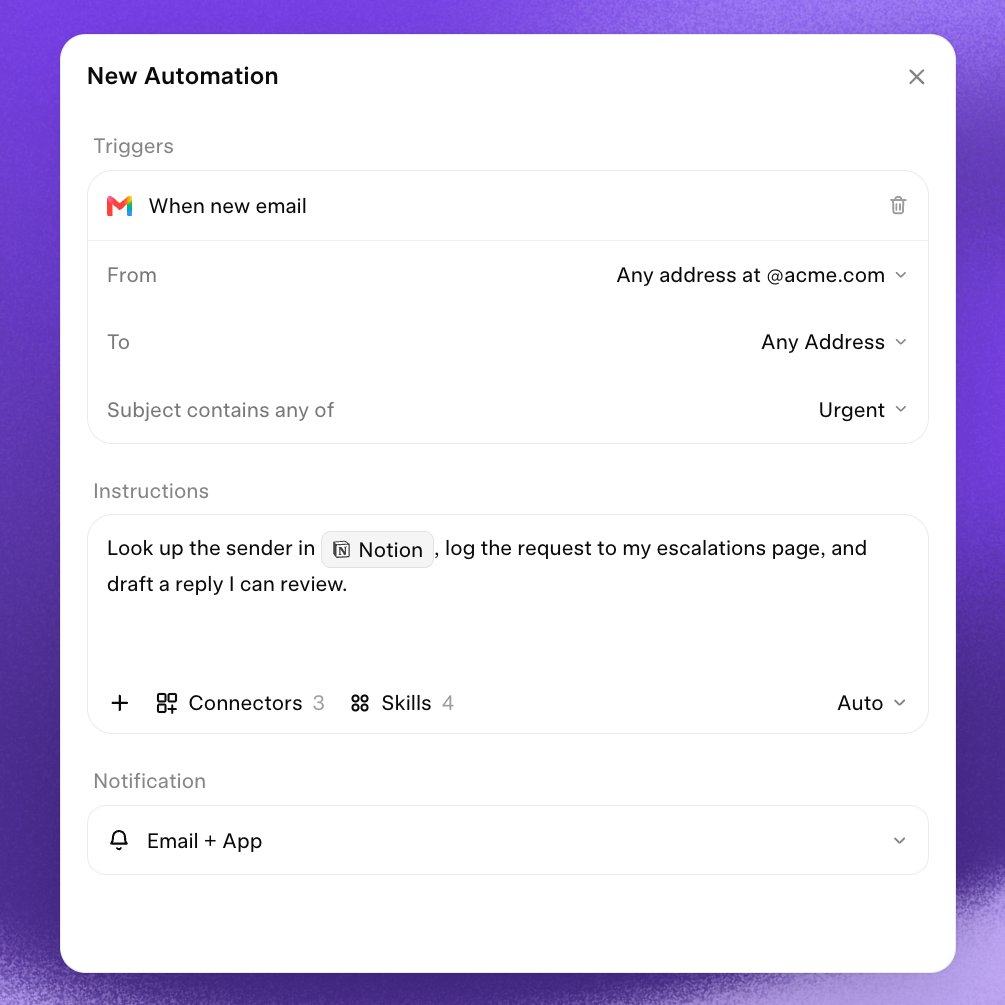
The most powerful part of Grok Automations is email triggers
Grok can automatically act the moment an incoming email matches filters such as the sender, recipient or subject
The email itself becomes context for the task, so Grok can immediately:
• Summarize an important message
• Research the topic and prepare a brief
• Draft a reply
• Extract details from an invoice or document
• Flag something urgent the moment it arrives
• Use connected tools and files to complete the next steps
You can also schedule automations to run once, daily, on weekdays, weekly, monthly or yearly
Describe the job once, attach files, add connectors and skills, and every run uses the same instructions with fresh, current information
Each run becomes a complete saved Grok conversation that you can open, review and continue from wherever the automation stopped
You can also receive the result through an app notification, email, both or neither
You can even create the entire automation directly from chat by simply telling Grok what you want it to do and when
This is much more than scheduled reminders
Grok can now watch for events, understand the context, use your connected tools, complete real work and report back automatically
Describe it once and Grok keeps working for you
We're starting to leave the territory where you'd test an LLM by e.g. "create an svg of pelican on a bicycle". As one idea to generalize it, I was interested what Opus 5 would do if I gave it the first paragraph of the Lord of the Rings, a 1M token budget (~$10) and asked for three js render of it. Opus went off for ~2 hours and wrote 5500 lines of code that (procedurally) rendered the story. It's kind of janky but fun. But it's a bit mindboggling that the LLM has to place and orchestrate various polygon assets in (x,y,z) coordinates and write code that animates it all, and that it even does anything at all.
I also like this kind of examples because no one in their right mind would ever spend the time to write something this custom but LLMs have all the stamina and patience in the world, so it's an example where we go from "no one would ever do this" to "sure, why not, it's ~free". There might be a lot more. But I'm excited about creating hyper custom worlds that you can imagine dropping players into, e.g. here to participate in the LoTR story as a spectator NPC, or one of the characters, or etc. Something like an ephemeral GTA of X on demand.
Last thought is that the domain of worlds/games exposes a weakness in LLMs: they can't easily audit their work because they aren't able to efficiently and natively perceive videos or play games within them. Here, Opus 5 had to very slowly and painstakingly take screenshots at different points, and it messed up a few times and created a bunch of jank. An example of raw capability (multimodal, gameplay) that I think is still quite lacking.
The new education stack:
1. Find a problem you care about.
2. Learn only the things that helps you fix it.
3. Use AI to accelerate the work responsibly and diligently.
4. Build something REAL.
5. Let reality grade you.
The greatest AI skill you can learn right now is Reverse Prompting
It’s simple: ChatGPT5.6, Fable, and Grok 4.5 are now smarter than humans. That means you need to have your agent prompting YOU more than you prompt it
You have your AI ask YOU questions to see what it can do for you
Makes every AI agent you use so much more powerful
An exercise you can do right now:
Open up any AI/OpenClaw/Hermes. Brain dump everything about yourself and your career/goals/ambitions. Then use this reverse prompt:
"Based on what you know about me and my goals, what is more information I can provide to you in order for you to be able to help me achieve my goals faster and take as much off my plate as possible"
Then once you enter that, prompt this:
"What tasks can you do for me right now to get us closer to our ambitions and goals?"
Guarantee you come up with 100x more things to do with your AI than you thought of before
The more questions you ask your AI, the more you'll learn and the more you'll get done.
You don’t prompt. You give information, then allow your agent to guide you to somewhere interesting.
This is how you use AI in 2026
You can now host frontier AI on average hardware
Deepseek v4 Flash has arrived and it BEATS Fable on some benchmarks
O and you can run some versions of it on 96gb Mac Studio or even a DGX Spark
$4,000 hardware now gives you unlimited super intellgence
This rocks the AI industry to the core. Frontier labs won't be able to get away with charging exorbitant prices for intelligence (cough Fable)
The more these labs battle, the more we as the consumer win
Never been more important to get into local AI, especially as the hardware only gets more and more unavailable
xAi dropped Grok Voice Think Fast 2.0 today...
its UNREAL
cost, speed, intelligence.
Watch how fast I can spawn agents and prompt them. It handles hermes, browsers, windows management, and even playing music effortlessly.
og grok voice struggled here.
the best part is its ability to summarize the wall of text agents give you. They have finally dethroned gpt-realtime as the best voice agent.
Its live in my mac app CNVS right now so you can VIBE code like tony stark and jarvis.
Microsoft open-sourced a 4B model that turns any image into a production-ready 3D asset in 3 seconds.
It’s called TRELLIS.2, a fully textured, physically accurate 3D models with PBR textures out of the box.
→ Full PBR (base color, roughness, metallic, opacity)
→ Handles hair, cloth, glass, non-manifold geometry
→ Exports .glb ready for Unity/Unreal/Blender
→ Runs locally, ships in 3 seconds
It's not a demo or a research preview. The full training codebase is public.
You can fine-tune it on your own asset library and get a model that generates in your studio's exact style.
100% Open Source
Grok 4.6 drops around August 7 with major SFT & RL upgrades. 🚀
Built by a team that writes mostly Rust every day, on top of a model already exceptional at hard Rust tasks.
This should be the go-to LLM for serious Rust development. 🦀
$31 MILLION HOTEL. EVERY PIPE AND WIRE MAPPED IN ADVANCE. BUILT BY TYPING SENTENCES INSTEAD OF PLACING THEM BY HAND.
A 190-room hotel needed its ductwork, plumbing, electrical, and fire suppression modeled and coordinated before construction could start.
The design team connected Kimi K3 to their modeling software through MCP, then had it read photos of the blueprints alongside plain English descriptions of each system and build the model directly instead of placing every component by hand.
Old process: 3 engineers, 6 weeks, around $47,000.
New process: 1 engineer confirming the AI's output, 9 days, roughly $10,500 combined, engineer's time plus AI compute.
Coordinated models finished this way cut change orders by 60 to 80 percent once construction begins.
See the article below for a smaller example of the Kimi K3 + Blender MCP workflow.
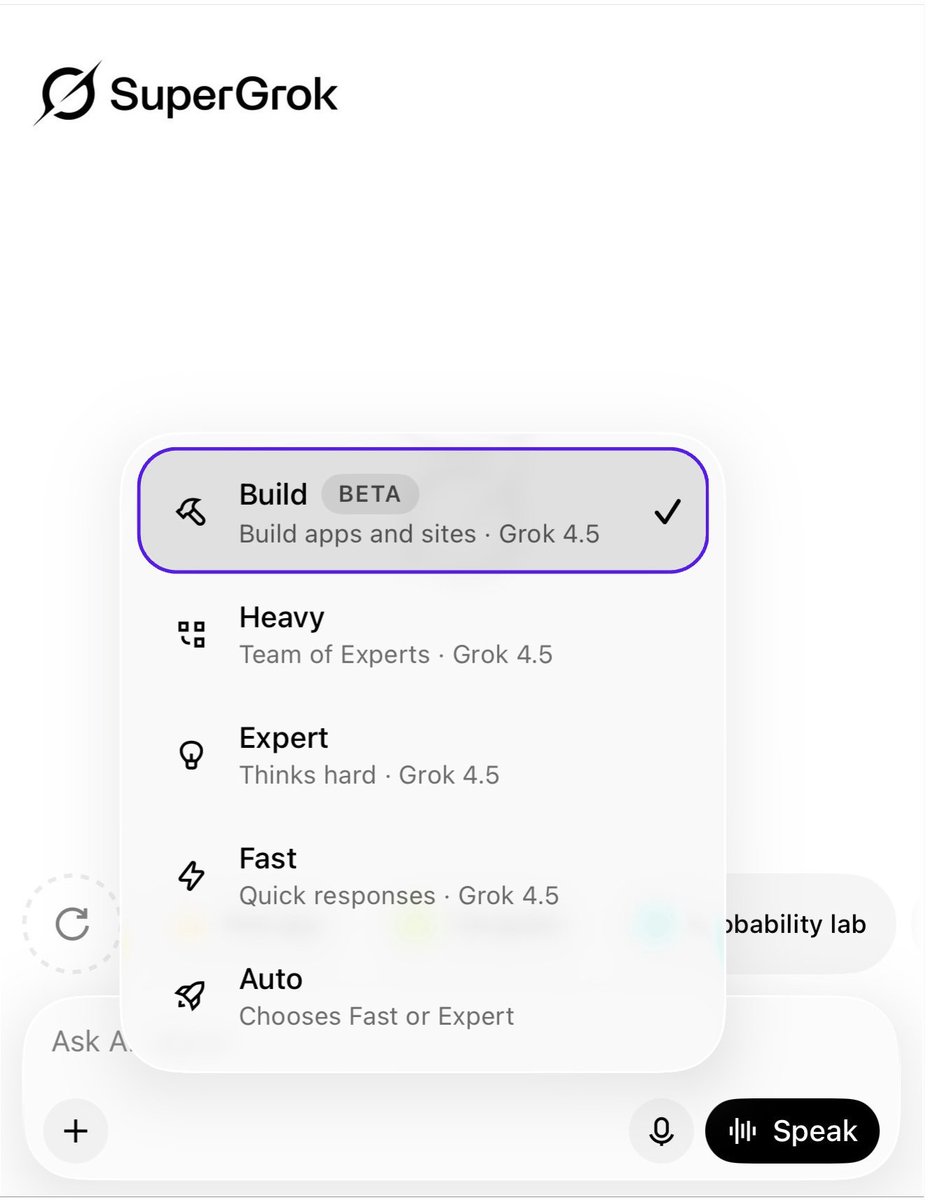
SpaceXAI has just introduced the powerful new Grok App Builder, turning a simple conversation into a complete app-building platform powered by Grok 4.5
Describe what you want and Grok writes the code, creates a working version live inside the conversation and continues refining it with you
Change the layout, add features or completely restyle it without installing anything, configuring a development environment or touching the code
You can build:
• Websites and landing pages
• Apps, planners, trackers and calculators
• Games and interactive 3D worlds
• Live dashboards with charts and business data
Once it is ready, publish it through a https://t.co/zkwzDeqC15 link or connect your own custom domain and share it with anyone
Available in Early Beta for SuperGrok Heavy subscribers on https://t.co/DcQuOOTQOt, iOS and Android
No laptop or coding setup required
Just describe, build, refine and publish - all directly from Grok
Grok is turning every device into a complete software studio
Exclusive Private Tour of Boring Company.
Huge thanks to @boringcompany for inviting me out to their Vegas facilities for a behind-the-scenes look of everything they're building.
A lot of people are sleeping on this company!
Thanks to @Rebellionaire for sponsoring this video.