Long COVID doesn’t fit neatly into one medical specialty.
Dr. Robert Groysman explains why its multiple mechanisms can require clinicians to look beyond the boundaries of a single area of training.
Watch the full episode: https://t.co/gjzE0Qj6cx
COVID-19 may trigger the same immune pathway as lupus
A new study sheds light on the immune cells responsible for producing autoantibodies in people with COVID.
Read more: https://t.co/aPomhDbFw4
Aimee Knight’s dad went from active and independent to needing significant oxygen support.
Her family crossed state lines for another treatment path, and over time, his pulmonary function tests began to improve.
Watch: https://t.co/BChpIs2ADE
What happens when symptoms point to vein compression but the scan is read as normal?
Dr. Brooke Spencer explains the subtle imaging findings that can be missed and why some patients remain stuck between persistent symptoms and “normal” scans.
Watch: https://t.co/LfSLpmNe2i
Another important paper from @resiapretorius and @dbkell.
✓Fibrinaloid microclot complexes emerge as heterogeneous inflammatory structures rather than a single type of clot.
✓Proteomics may be the biggest story. The proteins trapped within these structures are themselves prone to forming amyloid. The authors propose this may create a chain reaction, with one amyloid-forming protein encouraging others to join the complex
✓Scientists need a common way to measure this biology. Without it, they can't tell if they're finding the same thing across patients. I wonder - would imaging flow cytometry offer one promising path toward standardized measurement? Anything that could move studies into the clinic could be meaningful.
✓IMO integrating this biology with immune dysregulation feels like a natural next step. The interaction between vascular biology, innate immunity, and chronic inflammation deserves much deeper study.
✓Reinforcement of systems-levels approaches: Biology now includes vascular injury, inflammation, protein misfolding, immune activity, and tissue injury.
Studying these processes together may accelerate patient subtyping and prospective clinical studies that test this biology in patients. And biomarker development
This is why we launched the @CODA_research Vascular Initiative and this is what we can do: Move science from the lab to doctors and patients. Effective tests, effective treatments.
https://t.co/8H2FEcNJ4k
Yes, @DrOzCMS. We will double down on our commitment to finding cures so no more families have to face this devastating disease.
My thoughts and prayers are with Will's family.
I am so happy to be involved in this wonderful initiative of @CODA_research. Together with leading researchers and clinicians in the field we will bring together a competent team of people to find ways to study and to treat damaged blood vessels, and the accompanying inflammatory, immune and clotting-related pathologies that so many patients with complex diseases suffer from.
Summer’s scan was called “normal.” Years later, Dr. Spencer reviewed it and saw significant iliac vein compression. Her patients had been describing the same symptoms she was experiencing. Watch the full episode here: https://t.co/Ttp80LswXX
Summer sent countless patients for iliac vein stents. Then her own name was on the schedule. Within days, symptoms she’d lived with for nine years began improving.
Watch tomorrow, July 22, at 2 PM CT / 3 PM ET: https://t.co/qxPMtXStGc
There has been a discussion on X lately about biomarkers for #LongCOVID, so I thought I would share some blood markers available that might point to immune, clotting and endothelial dysfunction. Encouragingly, all of them are available at specialised pathology labs worldwide.
These are also the molecules we keep finding trapped in fibrinaloid microclot complexes across our various (proteomics) analyses: fibrinogen, von Willebrand factor, Factor VIII, serum amyloid A, complement proteins (C3, C4, C5, C1q, factor B), platelet factor 4, P-selectin, myeloperoxidase, neutrophil elastase, transforming growth factor beta-1, endothelin-1, vascular endothelial growth factor, Serum Amyloid A, and many more. We also know that many of our collaborators have also find these molecules in the soluble fraction of plasma, when when they have done proteomics and ELISA tests.
We have known for a while that these proteins are present in both the soluble and the insoluble fraction of plasma, mostly, we have just been searching inside the insoluble fraction of blood plasma for possible dysregulated inflammatory molecules that might in future, be targeted by treatment regimens. What is new in our approach, is that we have only recently started looking at post-translational modifications (PTMs), on proteins and we have found that some are extensively modified: glycated, oxidised, deamidated, citrullinated.
What is PTMs? A post-translational modification (PTM) is a small chemical change made to a protein after it has been built, that slightly alters the protein without changing its underlying identity.
A simple way to picture it: the protein is the basic product, and PTMs are the stickers, tags and add-ons attached to it afterwards. The item is still the same item, but the additions can change how it looks and behaves, whether other things can grab onto it, and how long it lasts.
In the body, these tags get added in response to conditions like inflammation, high blood sugar or oxidative stress. Common examples are sugar molecules stuck on (glycation), oxygen damage (oxidation), or other small chemical groups. The protein's amount in the blood can look completely normal, while these tags quietly change how it works, which is exactly why a routine test can read "normal" and still miss the problem.
Also note that much earlier work by well-known researchers in the fibrinogen field has found post-translational modifications on fibrinogen in various inflammatory diseases.
More to come from our research group! Please, in the mean time see a the table below. These might be some valuable biomarkers that might to used in clinical investigations and might assist clinicians to target some symptoms.
@dbkell and I have also discussed possible devices like capillaroscopy for detecting vascular damage. @ImmunoFever has recently discussed the applications in numerous posts.
Lastly, this is in no way suggesting that these are the only biomarkers, it is just a small snapshot molecules our lab is finding and studying. There are numerous more biomarkers that can be looked at for neuro-immunology, muscle and many more systems.
38. We are also working with NS that work in CCI and tethered cord that shows the tissue removed in tethered cord is diseased. #MESpine2024
We are characterizing the tissues to uncover why they are diseased.
A drug’s FDA-approved use is only part of the story. @jfvaughnmd09 explains how side effects can reveal what medicines may be doing elsewhere in the body. Watch full interview: https://t.co/1ZwVz2oTks
GLP-1s are famous for weight loss. But @jfvaughnmd09 explains how tiny doses have helped some severely underweight patients absorb nutrients, gain weight, and even come off tube feeds. Full interview here: https://t.co/1ZwVz2pra0
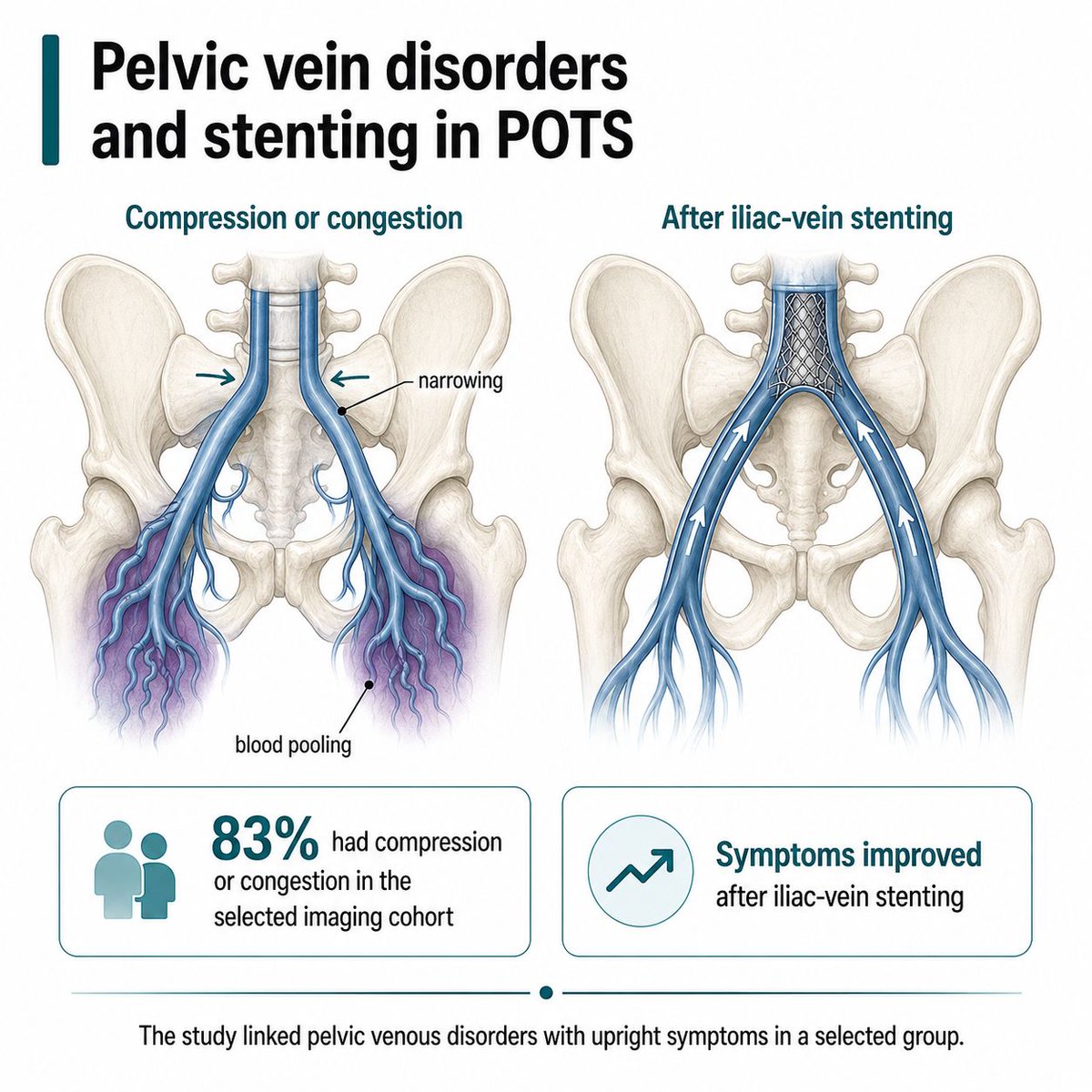
In a selected group with POTS or other upright symptoms plus signs of pelvic vein disease, 83% had pelvic vein compression or congestion. In a larger, partly overlapping group of 271 women, symptoms and quality of life improved after stenting.
IBS is often dismissed as stress or anxiety. But Zach Spiritos explains why inflammation, mast cells, immune changes, and nervous system clues may point to something deeper. Watch full interview here: https://t.co/1ZwVz2pra0
What if the gut symptoms many Long COVID patients experience are not just IBS, anxiety, or “functional” problems? In this episode, Dr. Vaughn interviews gastroenterologist Zach Spiritos about the overlooked connection between Long COVID, mast cell activation, gut barrier dysfunction, food reactions, dysautonomia, and chronic GI symptoms. They discuss why traditional scopes and imaging often fail to explain what patients are feeling, how COVID may disrupt the gut and immune system, and why symptoms that are often dismissed as stress or anxiety may have a deeper biological explanation. This conversation also explores IBS, MCAS, motility issues, microscopic colitis, inflammatory bowel disease, GLP-1 medications, probiotics, prebiotics, and why asking “why did this happen?” may be one of the most important questions in medicine. Learn more about the Microvascular Research Foundation and how you can help at https://t.co/g7fjN4sTlC
The Gut Symptoms Doctors Keep Missing in Long COVID https://t.co/XAJZ2z3I5v via @YouTube