@GrafYves@_Adrian I have every confidence that Saylor will arrive at a brilliant multi-product strategy after having exhausted every suboptimal tactic for making single-product STRC work.
@EthanKasner_ I would think holding $STRD would be cleaner play than $STRC. The higher yield support sustained div payments in a BTC down turn. MSTR and STRK have way too much direct exposure to BTC, so they will not hold much value in a serious bear market for BTC.
@MSTR_simulator The problem with creating a credit that functions like a demand deposit account is that much higher liquidity management is required. DDAs offer lousy asset liability matching against long duration BTC. Ignore Banking 101 at your peril.
@_Adrian@Strategy@Strive Thus, we see buyback have the least impact of three possible interventions to return STRC to par.
A priori we should not expect buybacks from cash to have much impact. Structural risk is not changed, only perceived risk is in question.
@_Adrian@Strategy@Strive Selling BTC to build USD Assets also lowers BTC Floors, but will mute improvement to BTC Ratings. So an intermediate reduction of risk for preferreds.
...
@jonwillbanks They can issue $STRD at around 13.5% yield. This is cheaper than boosting the yield 1% on around $9B on existing STRC just to open the ATM window.
How much value does daily dividend payout add to $STRC and $STRD?
In short, it makes a much bigger impact for quarterly STRD/K/F than for semi-monthly STRC.
Let's do the math...
@jonwillbanks So STRJ stops the hemorrhaging from STRC to SATA. The market becomes more savvy about relative risk and recognizes why STRC is worth a lower yield than STRJ. Ultimately, STRC returns to par on the strength of superior safety, i.e., lower BTC floor. Meanwhile, STRJ funds BTC buy.
@jonwillbanks Now suppose Strategy were to make a junior clone of STRC, call it STRJ, and start with $13.5 div. Immediately, simple folks comparing SATA to STRJ will prefer the higher div of STRJ. But savvy folks will know that it is less risky. ...
@jonwillbanks I do like putting all the DC on the same div schedule. It will help people do fair comparisons between them. Otherwise, few will do the math needed to make the comparison fair.
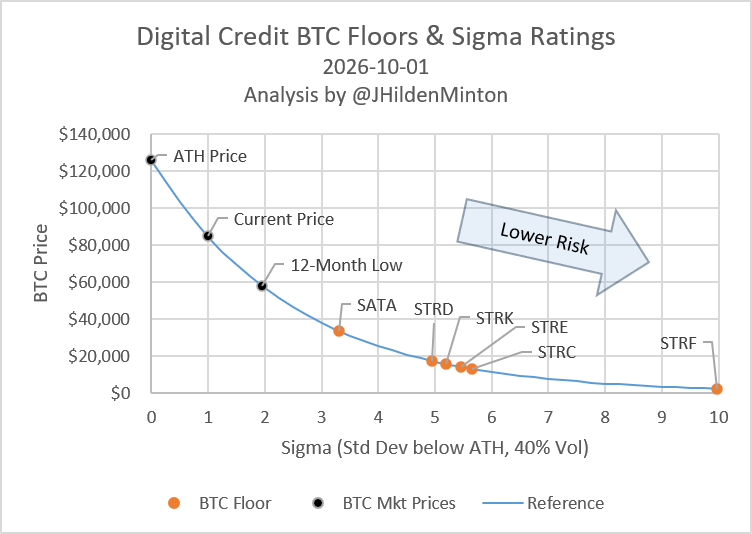
@BTCoptioneer $ASST fails before $MSTR fails. BTC falls to the BTC floor for $SATA, $33.5k, before hitting the floor for $STRD, $17.5k.
So long as BTC does not pullback more than about 65%, both survive.
Until then, ASST grows faster on higher amplification.
@jonwillbanks@SullyMichaelvan I like both $STRK and $STRD. I model total returns at about 24% and 21%. Both have appreciation upside, but STRD offers a stronger mix of income to appreciation. STRD outperforms for BTC appreciating less than 14% per year, otherwise, higher BTC return drives STRK to outperform.
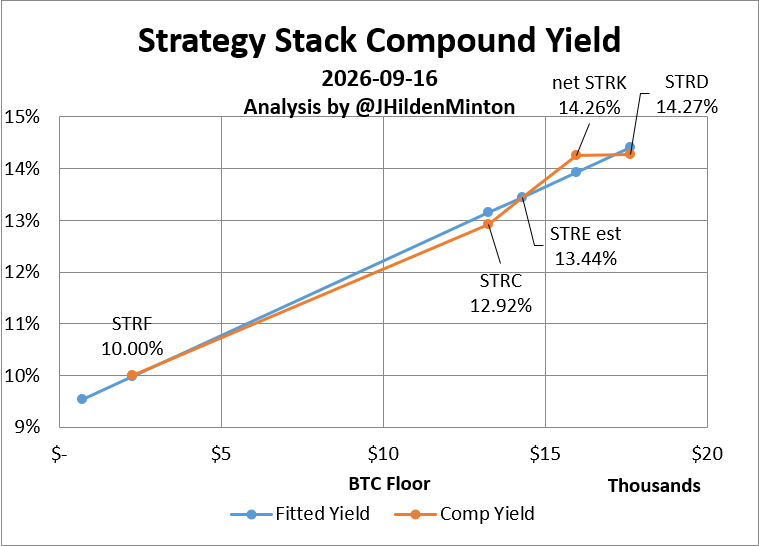
Strategy may move $STRC $STRF $STRK $STRD to daily payout. I decided to update my models to account for compounding. Here are my latest estimates. Enjoy!
Commentary on market experience:
Sigma 0: 0% pullback, all time high $126k
Sigma 1: 33% pullback, where we are currently
Sigma 2: 55% pullback, 12-month low of $57k
Sigma 3: 70% pullback, it happens, high stress
Sigma 4: 80% pullback, also happens, could wipe out $SATA
@jonwillbanks@SullyMichaelvan $STRC and $SATA are the gateway drugs, but we do need the whole market for digital credit to become more sophisticated.
The average retail investor is clueless about the huge BTC coverage (safety) advantage that $STRK and $STRD hold over $SATA.
https://t.co/BqvcmwQLTM