High cortisol adds 5 years to your face.
It destroys insulin, gives you a puffy face and belly, and even shrinks your brain.
Here are the 6 tips to fix it (according to science):
1. Stop working out at 7 pm.
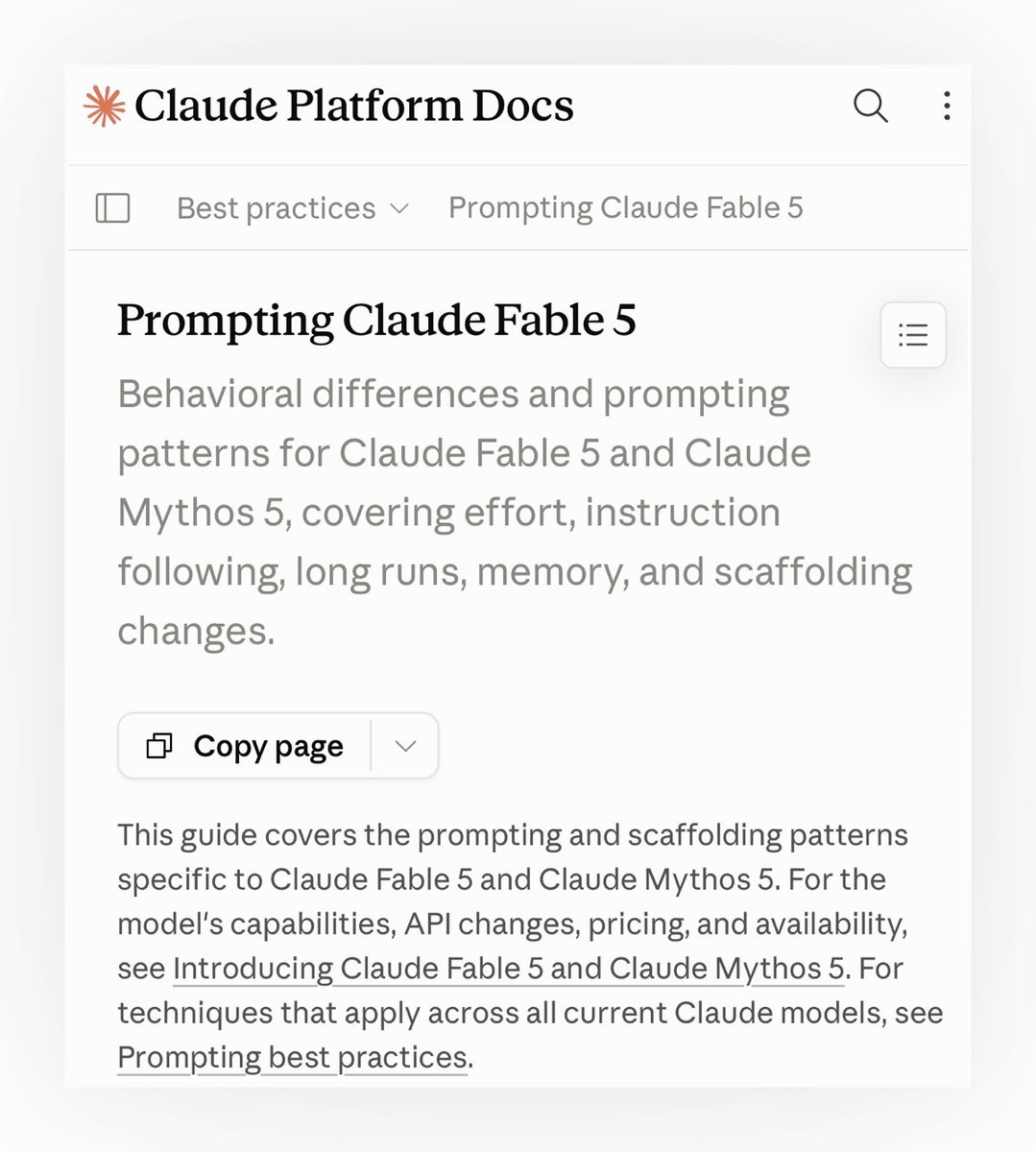
Anthropic just dropped the official guide to prompting Claude Fable 5.
And it’s completely different from how you prompt Opus.
3 things you need to know:
1. You can now tell Claude how hard to think.
Set “Effort” to minimal, medium, high, or extreme in your prompt.
Extreme = take your time and think deeply.
minimal = quick answers, no reasoning.
Opus never had this. Fable 5 does. use it.
2. Give Fable 5 the whole problem at once.
Stop breaking your prompts into small pieces. Fable 5 is built to work on long, complex tasks in one go. the more space you give it, the better it does.
3. Your old “be concise” prompts don’t work anymore.
Fable 5 defaults to detailed answers. if you want short responses, you have to say exactly how short. use word limits or show it an example of the length you want.
That’s it. if you’re using Fable 5 with old prompts, you’re getting worse results than you should.
my wife thinks i'm obsessed...but I will keep repeating this.
Claude Fable 5 + SEO is going to create more “self made millionaires” this year than the last decade combined.
don't bookmark this if it crosses your timeline.
just paste this entire thing into Claude Fable 5.
thank me later.
Cardio sessions are making your belly fat worse.
Long runs spike cortisol, break down muscle, and tell your body to store fat around your waist.
Here are 9 ways to lower cortisol and finally burn fat: 🧵
1. Lose your breath 3x/week (takes 10 minutes)
LLM Knowledge Bases
Something I'm finding very useful recently: using LLMs to build personal knowledge bases for various topics of research interest. In this way, a large fraction of my recent token throughput is going less into manipulating code, and more into manipulating knowledge (stored as markdown and images). The latest LLMs are quite good at it. So:
Data ingest:
I index source documents (articles, papers, repos, datasets, images, etc.) into a raw/ directory, then I use an LLM to incrementally "compile" a wiki, which is just a collection of .md files in a directory structure. The wiki includes summaries of all the data in raw/, backlinks, and then it categorizes data into concepts, writes articles for them, and links them all. To convert web articles into .md files I like to use the Obsidian Web Clipper extension, and then I also use a hotkey to download all the related images to local so that my LLM can easily reference them.
IDE:
I use Obsidian as the IDE "frontend" where I can view the raw data, the the compiled wiki, and the derived visualizations. Important to note that the LLM writes and maintains all of the data of the wiki, I rarely touch it directly. I've played with a few Obsidian plugins to render and view data in other ways (e.g. Marp for slides).
Q&A:
Where things get interesting is that once your wiki is big enough (e.g. mine on some recent research is ~100 articles and ~400K words), you can ask your LLM agent all kinds of complex questions against the wiki, and it will go off, research the answers, etc. I thought I had to reach for fancy RAG, but the LLM has been pretty good about auto-maintaining index files and brief summaries of all the documents and it reads all the important related data fairly easily at this ~small scale.
Output:
Instead of getting answers in text/terminal, I like to have it render markdown files for me, or slide shows (Marp format), or matplotlib images, all of which I then view again in Obsidian. You can imagine many other visual output formats depending on the query. Often, I end up "filing" the outputs back into the wiki to enhance it for further queries. So my own explorations and queries always "add up" in the knowledge base.
Linting:
I've run some LLM "health checks" over the wiki to e.g. find inconsistent data, impute missing data (with web searchers), find interesting connections for new article candidates, etc., to incrementally clean up the wiki and enhance its overall data integrity. The LLMs are quite good at suggesting further questions to ask and look into.
Extra tools:
I find myself developing additional tools to process the data, e.g. I vibe coded a small and naive search engine over the wiki, which I both use directly (in a web ui), but more often I want to hand it off to an LLM via CLI as a tool for larger queries.
Further explorations:
As the repo grows, the natural desire is to also think about synthetic data generation + finetuning to have your LLM "know" the data in its weights instead of just context windows.
TLDR: raw data from a given number of sources is collected, then compiled by an LLM into a .md wiki, then operated on by various CLIs by the LLM to do Q&A and to incrementally enhance the wiki, and all of it viewable in Obsidian. You rarely ever write or edit the wiki manually, it's the domain of the LLM. I think there is room here for an incredible new product instead of a hacky collection of scripts.
the Anthropic engineer who built Claude Cowork, Boris Cherny, just dropped a masterclass on how to actually use it properly.
Automate your workflow and stay ahead.
Bookmark this and watch it now.
@NousResearch .. looking to get help with this issue.. "Hermes is hard-routing all my model requests to https://t.co/JN3MNcrpOy instead of OpenRouter, even though my config.yaml has provider: openrouter and base_url: https://t.co/xlkebEpu9i. I have OPENROUTER_API_KEY in my .env. How do I force Hermes to use OpenRouter? Getting 401 auth failed because it's sending my OpenRouter key to GMI Cloud's endpoint." .. Should be quick fix. I just need the right command. Cant wait to fully use Hermes Agent.
😱 WAIT! WHAT?
GREG ISENBERG just dropped a masterclass on replacing your entire marketing team with digital employees.
Marketing team: $25K/month
Digital employees: $47/month
Same output. Better performance. Runs 24/7
Here's the complete breakdown👇
My Grandparents Were Married For 60 Years.
One Day I Asked My Grandfather:
“What’s The Secret To Loving The Same Woman For A Lifetime?”
He didn’t laugh.
He didn’t say “communication.”
He didn’t say “date nights.”
He looked at my grandmother, who was in the kitchen, and said:
“You don’t love the same woman.”
That confused me.
He said, “She changes every few years. And if you don’t update the way you love her, you lose her.”
He told me the girl he married at 22 wasn’t the same woman at 30.
Motherhood changed her.
Loss changed her.
Time changed her.
“At 40,” he said, “she needed respect more than romance.
At 50, she needed partnership more than passion.
At 60, she needed presence more than promises.”
And every time she changed, he had a choice:
Complain that she’s “not like she used to be.”
Or learn her again.
He said the biggest mistake men make is this:
They fall in love once.
Then stop paying attention.
“Loving a woman for a lifetime,” he told me,
“is deciding to stay curious about her.”
Not assuming you know her.
Not freezing her in the version you met.
He leaned back and said something I’ll never forget:
“If you stop studying her, someone else eventually will.”
Sixty years.
Not because it was easy.
Because he kept relearning her.