This is the most rigorous Bitcoin paper
I've read. I've been studying —
and testing — it for 20 days.
https://t.co/mCfJQpJTbE
Dr. Santostasi and Dr. Perrenod gave us the ruler —
and the imagination to see the oscillator.
Together: the most falsifiable framework
in crypto economics.
The Power Law isn't just a model —
it's the most precise ruler we have
for measuring where Bitcoin stands.
Most models describe the past.
The Power Law keeps passing tests
it was never designed for.
"Isn't β=5.69 just curve-fitting?"
Fair question.
So I ran a test the paper didn't.
━━━━━━━━━━━━━━━━━━━━━━
Materials & Methods
━━━━━━━━━━━━━━━━━━━━━━
Data: Daily closing price and non-zero balance
address count (BitcoinMagazinePro,
2010-08-17 to 2026-06-04, n=5,771).
Model: log₁₀P(t) = log₁₀A + β·log₁₀(t)
where t = days since Genesis Block (2009-01-03).
Out-of-sample design:
The power law was fitted exclusively on data
up to the freeze date, with zero observations
from the test period used in estimation.
Two freeze points were tested:
① Freeze at 2016-07-08 (2nd halving)
Training: n=2,153 | Test: n=3,617 (10 years)
② Freeze at 2020-05-10 (3rd halving)
Training: n=3,555 | Test: n=2,215 (6 years)
Residuals computed as:
ε = log₁₀(P_observed / P_predicted)
normalized by in-sample σ.
Mean residual and area integrals
(trapezoidal rule) applied to test period only.
The out-of-sample test was my idea.
Computation and analysis executed with
Claude Opus 4.8 (Anthropic).
━━━━━━━━━━━━━━━━━━━━━━
Froze the power law using data up to 2016 only (β=5.717).
Then measured the following 10 years it had never seen.
Result: mean residual −0.05σ. Effectively zero.
Frozen at 2020 instead → next 6 years, −0.13σ.
Same story.
The line drawn in 2016 ran straight through the next decade.
That's not fitting. That's forecasting.
The Power Law: powerful because it can be broken —
and hasn't been.
Knowing where we are won't tell us when things will happen — but it tells us exactly what to do now.
Buy Bitcoin Now.
@Giovann35084111@moneyordebt@ScientificBTC@saylor@natbrunell
#Bitcoin #PowerLaw
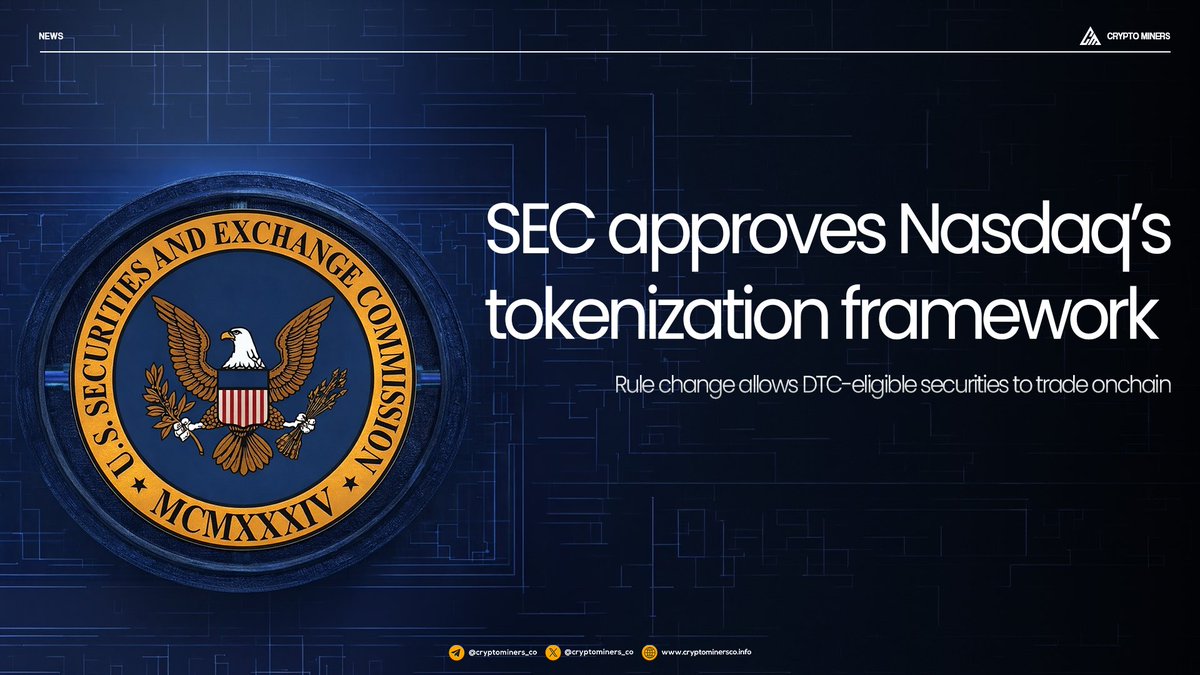
SEC approves Nasdaq rule for tokenized securities trading
The SEC has approved @Nasdaq’s proposed rule change (SR-NASDAQ-2025-072), enabling trading of tokenized, DTC-eligible securities on the exchange.
The framework allows blockchain-based settlement for traditional assets such as equities and ETFs, with implementation tied to DTC infrastructure readiness.
This 𝗖𝗟𝗔𝗨𝗗𝗘.𝗺𝗱 file will make you 10x engineer 👇
It combines all the best practices shared by Claude Code creator:
Boris Cherny (creator of Claude Code at Anthropic) shared on X internal best practices and workflows he and his team actually use with Claude Code daily. Someone turned those threads into a structured 𝗖𝗟𝗔𝗨𝗗𝗘.𝗺𝗱 you can drop into any project.
It includes:
• Workflow orchestration
• Subagent strategy
• Self-improvement loop
• Verification before done
• Autonomous bug fixing
• Core principles
This is a compounding system. Every correction you make gets captured as a rule. Over time, Claude's mistake rate drops because it learns from your feedback.
If you build with AI daily, this will save you a lot of time.
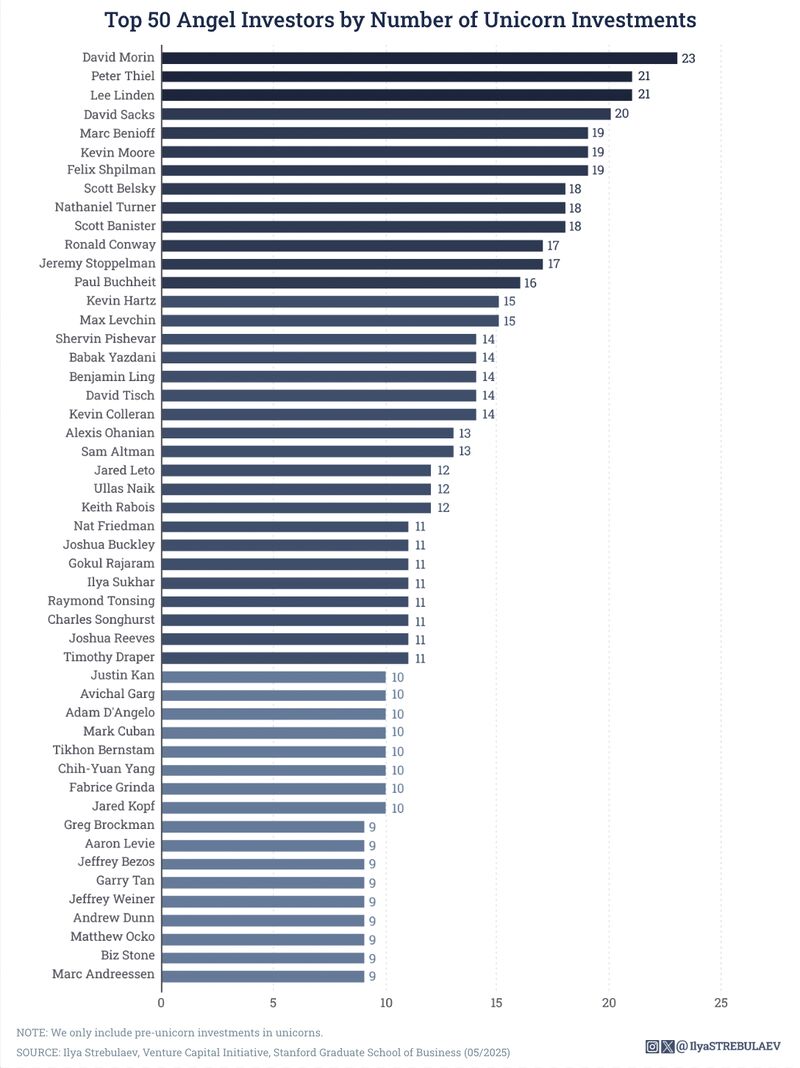
A Stanford professor analyzed 1,000's of angel investments to find out who's had the MOST unicorns.
The results are fascinating.
- David Morin tops the list with 23 unicorns
- Peter Thiel and Lee Linden follow with 21 each
- David Sacks at 20
- Marc Benioff at 19
A few things that stand out:
1) Almost every top angel was a founder or exec at a large tech company first. The clear signal here - they were mostly operators who earned their access.
2) Many co-invested together repeatedly. Thiel, Sacks, and Levchin all overlapped at PayPal and went on to back the same unicorns (Facebook, Airbnb, Palantir Technologies, SpaceX).
3) No women appear in the top 50. Sad.
4) The entry threshold to make this list is 9 unicorns (nuts!). The average unicorns across the top 50 is 13 (more nuts!).
I share this for folks to have inspiration to angel invest themselves!
There has NEVER been a better time - we are at a major tech inflection point.
If you're thinking about angel investing and forming angel syndicates, you should check out Verivend. Automated capital calls, one-click funding for co-investors, real-time visibility into who's in. Seamless software with a great team to hold your hand through it.
Try it yourself: https://t.co/qZ4U3OB2AY
Full credit to Ilya Strebulaev and his team at the Stanford for this research.
SpaceX and xAI are in advanced merger talks that could be announced as soon as this week.
What this means is that Musk is consolidating his empire by combining his rocket company with his AI startup.
This would bring together Starlink satellites, the Grok AI model, the X platform and SpaceX's launch infrastructure all under one roof.
The deal would work like this, xAI shareholders would exchange their shares for SpaceX stock in what's basically a stock for stock merger.
Two Nevada entities were already set up on January 21 to facilitate the transaction and both companies have already informed some of their investors about the plans.
Neither company has officially confirmed it yet.
However, Musk apparently responded positively to merger posts on X, which crypto traders are reading as a soft confirmation.
Here's why this matters.
SpaceX is valued at around $800 billion as the world's most valuable private company.
xAI just hit a $230 billion valuation after raising $20 billion in funding.
Combined, you're looking at over a trillion dollar enterprise before an IPO.
SpaceX has a blockbuster IPO planned for 2026, potentially raising $50 billion.
This could beat OpenAI and Anthropic to the public markets.
The merger would simplify the IPO structure and create a more compelling story for investors.
You'd have a vertically integrated AI infrastructure company that owns both the hardware (rockets and satellites) and the software (Grok AI).
The strategic logic is straightforward.
xAI needs computing power and infrastructure to compete with OpenAI and Google.
SpaceX is building a constellation of one million satellites that Musk wants to turn into orbital data centers powered by solar energy.
This would solve AI's energy problem.
By merging them, xAI gets the infrastructure it needs to deploy AI computing in space.
SpaceX gets the AI expertise to actually build and operate it.
It's vertical integration at maximum scale.
There's also a Pentagon angle. xAI has a $200 million defense contract to supply Grok to US military networks.
This is part of the Defense Department's AI acceleration strategy.
Combined with SpaceX's dominant position in military space contracts, a merged entity becomes critical national security infrastructure.
That could actually strengthen the company's moat and government support.
The timeline is aggressive.
Musk said last week at Davos that space based AI will be cost effective within two to three years.
With a potential merger announcement this week and an IPO as early as June 2026, you could see actual orbital computing capacity launching within two years.
The risk is complexity.
Merging two massive companies right before an IPO is tricky.
Regulatory approval could be slow.
Integrating xAI's Colossus supercomputer in Memphis with SpaceX's satellite infrastructure is an engineering challenge.
But if it works, Musk basically owns the entire AI infrastructure stack from the models to the compute to the distribution network.
53 banking associations just wrote themselves a $6.6 trillion protection bill.
They called it the CLARITY Act.
Here is what they do not want you to understand.
Banks pay depositors 0.1% interest. Stablecoin issuers hold Treasury bills earning 4.5%. If stablecoins could pass that yield to users, banks lose the deposit war. They cannot compete. The math is fatal.
So they made competition illegal.
The Kansas City Fed calculated what happens if stablecoins pay competitive rates. Banks lose 25.9% of deposits. $1.5 trillion in lending capacity vanishes. The entire community banking model collapses.
Their solution was not innovation. Their solution was legislation.
The CLARITY Act everyone is celebrating contains Section 404 prohibiting yield payments through any mechanism. Not just from issuers. From exchanges. From affiliates. From partners. Every single pathway to competitive returns, closed by statute.
Brian Armstrong reviewed the 278-page draft for 48 hours. He withdrew Coinbase support at 11pm. The markup was postponed by morning. He saw what Wall Street analysts missed entirely.
This is not crypto regulation.
This is Dodd-Frank for digital assets. Incumbents writing rules that crush competitors. Regulatory capture so brazen they published the lobbying letters on their own websites.
The American Bankers Association. 52 state banking associations. The Community Bankers Council. All coordinating to eliminate an industry they cannot beat in open markets.
Meanwhile China made e-CNY interest-bearing on December 29.
America is banning stablecoin yield while Beijing is paying it.
The crypto industry spent years begging for regulatory clarity.
They got it.
Clarity that $6.6 trillion in deposits will be protected at any cost. Clarity that banks write the rules. Clarity that if you cannot win in markets, you win in Congress.
This is the largest regulatory capture event in American financial history.
And it is being sold as innovation policy.