Jordan Peterson: "If you can't fix your room, you can't fix your life"
"Why should you even bother improving yourself? The answer is something like: so you don't suffer anymore stupidly than you have to. And maybe so others don't have to either. It's not some casual self-help doctrine. If you don't organize yourself properly, you'll pay for it. In a big way. And so will the people around you."
Peterson continues:
"You can say, 'Well, I don't care about that.' But that's actually not true, you do care about it. Because if you're in pain, you will care about it. It's very rare that you can find someone in excruciating pain who would say, 'Well, it would be no better if I was out of this.' Pain brings the idea that it would be better if it didn't exist along with it. It's incontrovertible."
On how to start:
"Look around for something that bothers you and see if you can fix it. You can do this in a room. Sit in your bedroom and think: 'If I wanted to spend ten minutes making this room better, what would I have to do?' You have to ask yourself that, it's a genuine question. And things will pop out. There's a stack of papers bugging you. Some rubbish behind your computer monitor you haven't attended to for six months. Cables tangled up."
He explains why this matters:
"If you were coming to see me for psychotherapy, the easiest thing would be to get you to organize your room. You think, is that psychotherapy? It depends on how you conceive the limits of your being. Start where you can start. If something announces itself as in need of repair that you could repair, fix it. Fix a hundred things like that, your life will be a lot different."
On fixing what you repeat every day:
"People tend to think of their daily routines as trivial. You get up, brush your teeth, have breakfast. Those probably constitute 50% of your life. People think, they're mundane, I don't need to pay attention to them. No, that's exactly wrong. The things you do every day are the most important things you do. Hands down. Just do the arithmetic."
On staying within your competence:
"Sometimes you don't know how to fix something. Imagine you're walking down the street and there's a guy who's alcoholic and schizophrenic and has been homeless for ten years. That's a problem. It would be good if you could fix it, but you haven't got a clue. You walk around that and go find something you could fix. Just because something announces itself as in need of repair doesn't mean it's you, right then and there, who should repair it. You have to have some humility. You don't walk up to a helicopter that isn't working and just start tinkering away."
Peterson shares the key insight:
"As soon as you give your mind a genuine aim, it'll reconfigure the world in keeping with that aim. That's actually how you see to begin with. You've all seen the video where you watch basketballs being tossed back and forth, and while you're doing that, a gorilla walks into the middle of the video and you don't see it. If you thought about that experiment for five years, that would be about the right amount of time to spend thinking about it."
He explains what it reveals:
"What it shows you is that you see what you aim at. If you can get one thing through your head, that would be a good one. You see what you aim at. One inference you might draw from that is: be careful what you aim at. What you aim at determines the way the world manifests itself to you. So if the world is manifesting itself in a very negative way, one thing to ask is: are you aiming at the right thing?"
I'm 55.
I wasted 25 years learning this the hard way.
But I'll teach you in 5 minutes.
If you're soft, stop reading now.
Here are 25 uncomfortable truths I wish I knew earlier:
If I could study just one thinker for life and money:
It’d be Naval Ravikant.
He recently laid it all out in one of his clearest interviews yet.
Here are 7 lessons that made me rethink wealth & happiness: 🧵
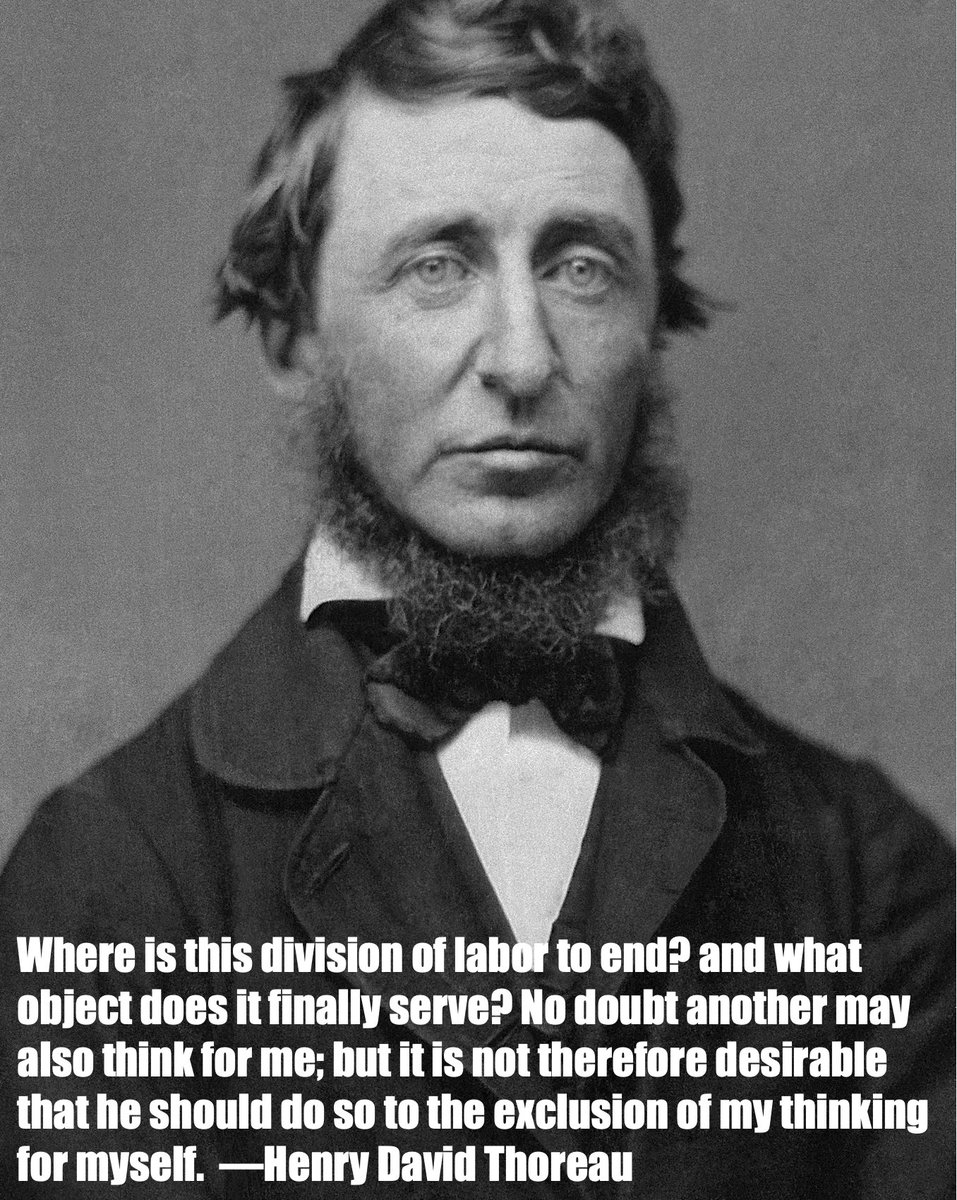
In the age of AI, Thoreau as relevant as ever.
"Where is this division of labor to end? and what object does it finally serve? No doubt another may also think for me; but it is not therefore desirable that he should do so to the exclusion of my thinking for myself." —Thoreau
🌟 Day 1 at the Global AI Summit in Kigali, Rwanda! 🌍
What an inspiring start to the summit as we came together with global voices and leaders in AI to forge strategic partnerships for Africa’s AI future! Yesterday was all about collaboration to innovate and empower—laying the groundwork to transform Africa into a global hub for AI excellence.
🤝 Forging Partnerships in AI Skilling for All
By partnering with organizations, governments, and industry leaders to scale our AI training programs, we’re creating inclusive learning opportunities that ensure men, women and underserved groups are at the forefront of Africa’s AI revolution.
💼 Creating AI-Centric Jobs & Reducing Unemployment
AI isn’t just the future—it’s the key to unlocking Africa’s economic potential. Through strategic collaborations, we’re working to build AI-driven job opportunities that actively reduce the unemployment gap, fostering innovation and sustainable growth across the continent.
The energy in Kigali is electric, and this is just the beginning! Together, we’re shaping an AI-powered Africa that is equitable, dynamic, and future-ready.
🔖Get ready for what Day 2 has to offer as we conclude the Summit!
#GAISAfrica2025
#AI4Uganda
#OticFoundation
📸 Courtesy