@LisaZane15 1.Feel the Pain !
( First hand thru immersion not opinions )
2. "Habitify"
( Can your product become a habit ? )
3. "Moments"
( Can you inject more magical moments into your product workflow? )
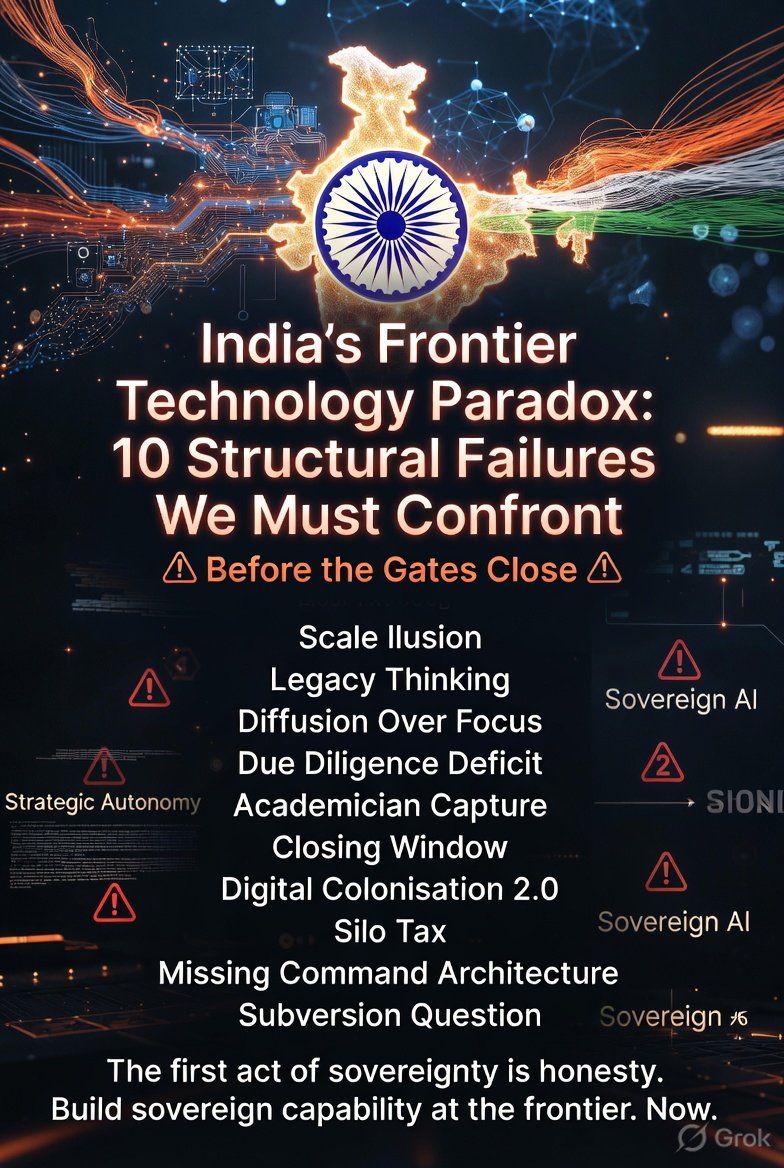
India's Frontier Technology Paradox:
10 Structural Failures We Must Confront Before the Gates Close
We have nearly 80 startup schemes, PLI for targeted sectors, the Research, Development & Innovation (RDI) scheme, ANRF, the National Quantum Mission, the IndiaAI Mission — and some genuinely brilliant minds administering them.
Yet something is fundamentally broken. The people running these programmes know it.
Many accept it privately. Some even confess it openly.
The problem is not intention.
The problem is architecture.
Here are 10 structural failures India must confront.
1. The Scale Illusion
Add up every rupee committed across every frontier technology scheme — AI, quantum, semiconductors, deep tech — and it amounts to less than 1% of what the nations leading this race invest. We announce schemes with great fanfare, but the numbers do not survive comparison. Strategy without commensurate resource allocation is not strategy. It is theatre.
2. Legacy Thinking for a Post-Legacy Era
We are attempting to govern the AI and Quantum era with methods, processes, and institutional reflexes designed for a different technological epoch. The world moves in quarters. We are still moving in Five-Year Plans.
3. Diffusion Over Focus
India's instinct — born of democratic compulsions — is to spread resources across domains, geographies, and institutions. In normal times, this is equitable. In a technology arms race with closing windows, it is strategic self-harm. We are distributing when we should be concentrating ruthlessly.
4. Due Diligence Deficit
Even at the highest levels, our ability to perform genuine technical due diligence on frontier technology proposals remains alarmingly weak. Public money flows to proposals that look credible on paper but lack the depth to deliver at the threshold that matters.
5. The Academician Capture Problem
Most governing bodies and review panels are populated overwhelmingly by career academicians who have never delivered a single system at industrial scale. When theory-only gatekeepers dominate, bloated egos become national bottlenecks.
6. The Closing Window
AGI is not a distant theoretical milestone. It is an active engineering programme in multiple countries and corporations. Once it crosses certain thresholds, the asymmetry will be near-permanent. Nations without sovereign cognitive infrastructure will become permanent dependents. India is racing against a clock it has not fully acknowledged.
7. Digital Colonisation 2.0
The next colonisation will be cognitive — intelligence systems, decision architectures, knowledge substrates. If our national security, governance, and strategic decision-making become dependent on foreign AI platforms, we will have surrendered sovereignty more completely than any military defeat could achieve — and we will have done it voluntarily, calling it "partnership."
8. The Silo Tax
Every rupee invested in inconsequential show projects is a rupee stolen from the missions that actually matter. Silos do not just waste money. They waste time — the one resource we cannot print.
9. The Missing Command Architecture
Every successful moonshot in history had centralised orchestration, convergence of effort, and unity of command. India has multiple ministries, multiple missions, multiple committees, and multiple egos — all optimising for different metrics. This is not a governance model for a moonshot. It is a model for managed mediocrity.
10. The Subversion Question
When a nation of 1.4 billion people with one of the world’s oldest traditions of knowledge consistently outsources its technology strategy and thought leadership to foreign consultancies and frameworks, something deeper than incompetence is at work. Policy capture is real. The possibility that India’s technology policy has been subtly shaped to keep us a consumer rather than a creator deserves serious institutional scrutiny
#SovereignAI #IndiaAI #DeepTech #DigitalSovereignty #StrategicAutonomy #AGI
Things that seem important if you’re building software right now:
1. You can write code quickly now
2. Competitors can too
3. So can your users
4. If it takes more than a few clicks an agent should be able to do it
5. Users probably want to use their own agents
@prukalpa 1. Owning Exclusive access to high value dataset
2. Owning a Decision mode in workflow
3. Owning entire workflow and orchestrating across fragmented platforms
@GabbbarSingh Indian renaissance is underway.
Right time for right B2B ideas bay area doesn't build. We built an industrial ai company when there were zero bay area startups. Got fortune 500 customers. Got funded in India. Exited too.
Listen to your inner voice 😊
World's first autonomous delivery of a car!
This Tesla drove itself from Gigafactory Texas to its new owner's home ~30min away — crossing parking lots, highways & the city to reach its new owner
@khamenei_ir Peace 🕊️ , not violence 🔫.
Such a beautiful culture and people.
Sad to see the choices the leadership is making. 🔀
May good sense prevail
🙏
Meet the man with 27,500 daughters
That’s what they call him – Appa.
His real name? KP Ramaswamy. Owner of KPR Mills, Coimbatore. A textile baron by profession. A father figure by choice.
While corporate honchos talk about employee retention, cost-cutting, and bottom lines, this man is busy transforming lives.
How? By turning mill workers into graduates. By making education their stepping stone to a better life.
It all started with a simple request. A young girl at his mill once told him –
"Appa, I want to study. My parents pulled me out of school because of poverty, but I want to study further."
That one sentence changed everything.
Instead of giving his workers just a paycheck, he decided to give them a future.
He set up a full-fledged education system – right inside the mill.
📌 Four-hour classes after an eight-hour shift.
📌 Classrooms, teachers, a principal, even a yoga course.
📌 All fully funded. No strings attached.
And the result?
🚀 24,536 women have earned their 10th, 12th, UG, and PG degrees.
🚀 Many are now nurses, teachers, police officers.
🚀 20 gold medallists from Tamil Nadu Open University this year alone.
Now, you’d expect a businessman to worry about attrition. What if these women leave? What about workforce stability?
Here’s what KP Ramaswamy says –
"I don’t want to keep them in the mill and waste their potential. They are here because of poverty, not by choice. My job is to give them a future, not a cage."
And that’s exactly what he does….
They leave. They build careers. And then? They send more girls from their villages to the mill. The cycle continues.
This isn’t just a CSR initiative. This is Human Resource Development in its truest sense.
At a recent convocation, 350 women received their degrees. And KP Ramaswamy made an unusual request –
"If you or your friends can hire them, it will give other girls the hope to study further."
Think about it. A man running a multi-crore empire isn’t asking for business. He’s asking for jobs – for his workers.
How often do we see this?
This story isn’t just about KPR Mills. It’s a lesson in leadership, in corporate ethics, in nation-building.
B-Schools should teach this.
HR professionals should study this.
And the world needs to know this.
A story worth sharing.🙏(source:Unknown)
@levie 3 Moats
1. Own Vertical Workflow ( generating data exhaust to power ai model )
2. Own proprietary access to high value datasets.
3. Own Decision Execution Task
We are not ready to die for your profits.
L&T Chairman S.N. Subrahmanyan's remark advocating a #90hrWorkWeek reveals nothing but the insatiable thirst of these capitalists for profit through the ruthless and inhuman exploitation of the Indian working class.
#90HoursWork
My generation of Indians was the creation of the economic reforms introduced by Finance Minister Manmohan Singh & Prime Minister Rao in 1991. As I have said before, the two most significant years of the twentieth century for India were 1947 and 1991 - one brought political freedom and the other economic freedom. Manmohan Singh will always be remembered for announcing the Great Liberalization......
One of the most fun questions in AI right now will be how AI Agents will be priced over time.
One approach is to leverage the very clear relationship between AI Agents and traditional work, which leads to a pricing model for AI that has Agents being priced like labor but at a discount. An AI Agent performs a certain amount of work, and you pay for amount of time or units it took to do that work. Given almost any task has some variance, pricing will also vary over time as well. Generally, it’s a fair trade for the customer and provider.
As a second approach, there’s a very clear benefit of AI Agents being priced on a per-outcome basis. This model allows for a simple relationships between what the customer needs and what they’re paying to get accomplished. It also has the benefit that as underlying AI costs drop over time service providers can extract more margin for this work; equally, though, it will mean some customers have varying degrees of profitability. Further, the moment your service offers N types of value props or outcomes, you need N pricing models to go along with it.
A third approach is to price as close to the underlying AI costs as possible, which has the benefit of likely being the lowest cost for a customer. This can be great for technically-savvy customers, but has the risk of not being sufficiently abstracted from AI costs to hold value over time. Potentially good for customers, but maybe not for shareholder returns.
And finally, there’s an approach of maintaining a pure SaaS seat subscription model and offering Agents to users that do unlimited work attached to a seat. Depending on the use case - and how many seats the customer would need - this model could be quite disruptive. In areas where there are lots of seats used by end-users, it’s possibly very strategic; in areas where there’s only a small number of seats, you’re likely giving up too much value.
In all, lots of different approaches - and probably many more than the above - but fairly exciting times to watch new business models in software emerge after a decade plus of limited changed.