If you are hitting Legs 2x per week which you probably should be…
There is no need to have a Ham/Glutes day where Quads are largely neglected or vice versa
This makes very little sense compared to including both and simply using exercise priority/volume allotment to change the bias some
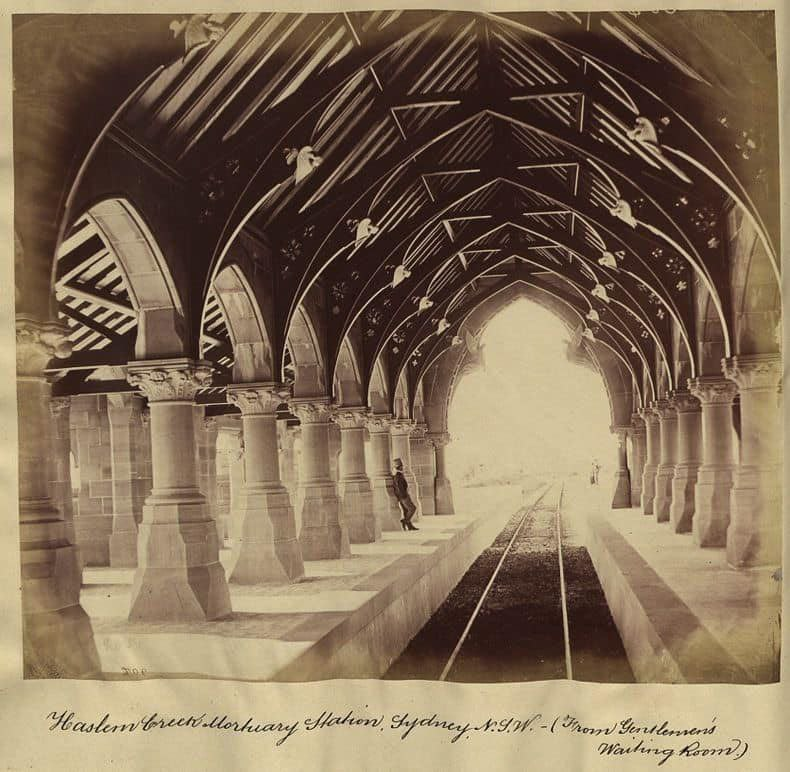
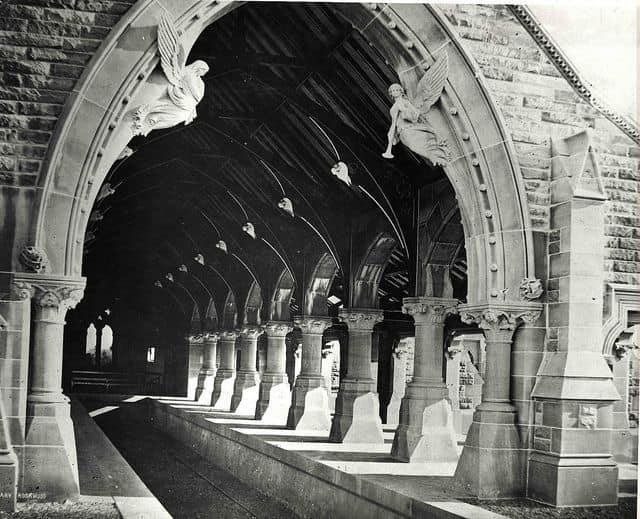
The Rockwood Cemetery railway line in Sydney. It opened in 1865.
The total population of Australia at that time was approximately 1 million. Why build a special railway line with three stations to transport the dead?
The trains ran to Rockwood Cemetery, Sandgate Cemetery near Newcastle, and Sutherland Cemetery in Sydney.
With a population of 1 million, were there really so many people who needed to be buried that they had to be transported by train? In 1860, only 100,000 people lived in Sydney.
It has arrived!
Moving Britain, by Design
a visual identity proposal for Great British Railways.
Read the full proposal here:
https://t.co/VlFOAoPmg3
or
https://t.co/JqGiD8Wvyc (Google Drive)
Let me show you some highlights - 🧵👇
In 1921, the USS R-14 left Pearl Harbor on a straightforward mission: find a missing tugboat somewhere in the vast Pacific Ocean.
About 100 miles out, the submarine ran out of fuel.
The diesel engines shut down. The batteries began draining. Radio communication went silent. The vessel sat in open ocean with limited food, no mechanical power, and no realistic prospect of anyone knowing exactly where to look for them.
Most crews in that situation would have done one thing: wait and hope.
The crew of the R-14 decided to try something else.
They looked at what they had. Mattress covers. Blankets. Spare canvas from the boat's interior. Poles. The periscope supports mounted on the deck. None of it was designed for what they were about to attempt. None of it needed to be. They were not building something elegant. They were building something that worked.
They fashioned makeshift sails from the fabric, mounted them onto poles and rigged them to the periscope supports, and turned a vessel specifically engineered to operate underwater using mechanical propulsion into something that had not existed before and has not existed since: a sailing submarine.
The wind caught the sails.
The R-14 began to move.
It was not fast. It was not graceful. A submarine is not built with hydrodynamics in mind for surface sailing, and the improvised rigging would not have impressed anyone who knew anything about seamanship. But it moved. Slowly, steadily, in the right direction.
The crew took turns managing the sails and navigating their course back toward Hawaii. They did this for five days. Five days of coaxing a submarine across the Pacific using nothing but wind, ingenuity, and the stubborn refusal to accept that they were stuck.
On the fifth day, the USS R-14 returned to Pearl Harbor under sail power.
The mission to find the missing tugboat had not been completed. But every man on board had come home, and they had done it using mattress covers and determination in roughly equal measure.
The incident was logged, reported, and largely forgotten outside of naval history circles, which is a shame, because it contains something worth remembering. The R-14 was a machine built for a specific purpose, operating in conditions it was never designed for, crewed by people who looked at what they had available and asked not whether it was adequate but whether it was enough.
Mattress covers are not sails. Periscope supports are not masts. A submarine is not a sailboat.
But 100 miles from Hawaii, with the engines dead and the radio silent and the ocean stretching out in every direction, close enough turned out to be exactly enough.
They sailed home.
Five days. One improvised rig. No fuel required.
The USS R-14 remains, by any reasonable measure, the only submarine in the history of naval warfare to return to port under sail. It is unlikely to be surpassed.
The Paris RER is one of the greatest transit systems ever constructed but it wouldn't have happened if not for a junket to Japan. Read the latest Infrastory now:
How would you perform as PM?
Prime Minister Simulator is here.
- Unscripted voter reactions
- Brutal media cycles
- Party factions ready to backstab you
- Career-defining flagship policies
Play the most realistic political simulator ever createHow would you perform as PM?
Prime Minister Simulator is here.
- Unscripted voter reactions
- Brutal media cycles
- Party factions ready to backstab you
- Career-defining flagship policies
Play the most realistic political simulator ever created
In a workshop on the outskirts of Bletchley (it had to be there, didn't it), on the 26th of March this year, a small British company called Pulsar Fusion did something that has not been done by any other company or government on Earth.
It ignited a controlled plasma inside the test chamber of a working nuclear fusion rocket engine.
The plasma held, along with the chamber. The fusion reaction was the kind of reaction that, contained inside a sufficiently engineered magnetic bottle, will one day take a crewed British vehicle to Mars in 30 days rather than 8 months, and that will, within the working lifetime of the engineers presently building it, make the outer planets of the solar system accessible to anyone with a British passport.
The geography of the achievement deserves a longer moment of pause. Bletchley, in 1942, was where Alan Turing and his colleagues broke the Enigma cipher and almost certainly shortened the war in Europe by two years. Pulsar Fusion's headquarters sits roughly 600 yards from the Hut where they did it.
The country that did the maths inside that hut has just, less than a mile down the road, ignited the plasma that could power the next century of human space travel. There is a continuity of British scientific lineage here that is, on the face of it, almost embarrassingly providential, and it is almost completely unreported in the British press.
It's not quite Kitty-Hawk-to-the-moon in 61 years, but it's close.
Like so many great companies of profound importance, Pulsar Fusion is pretty small. It was founded in 2013, and employs around 50 staff. Its chief executive, Richard Dinan, is a working British physicist who has spent the last decade quietly assembling the team and the capital to do what the world's national space agencies have been promising for 60 years and consistently failing to deliver.
The competing American programmes, principally at NASA's Glenn Research Center and at the Princeton Plasma Physics Laboratory, are years behind on the propulsion side. The competing Chinese programmes are obscure but, on what is known publicly, also behind. The European Space Agency is, as ever, organising a workshop. Pulsar fired its plasma in March and has been preparing the next-stage tests in the months since.
What this kind of capability means, when commercialised, is genuinely vast.
The economic argument for getting a payload to Mars in 30 days rather than 8 months is not principally about the human passengers, though there is one. It is about cargo. Given a 30-day transit, Mars becomes a logistically tractable destination for the kind of infrastructure-build that turns it from a flag-planting science mission into a working industrial site.
The argument for the outer planets is even larger. The asteroid belt alone, on conservative mineralogical estimates, contains more economically viable platinum-group metals than the entire crust of the Earth has been mined for in industrial history. The first country with reliable fusion propulsion is the first country with reliable access to that supply. The country that holds that capacity, fifty years from now, will be holding the most consequential industrial advantage of the 21st century, and there is no obvious second prize.
The standard British response to this kind of thing is to either ignore it entirely, sell the company to an American buyer at series B (the DeepMind path) for fire-sale prices, or fund it at the level of a Whitehall departmental tea and coffee budget (the Skycutter and Orbex paths).
The standard British response will not be sufficient. Pulsar Fusion needs the kind of patient capital that turns a working demonstration into an operational engine, and that, in turn, into a manufacturing capability. The British state, on present form, is structurally incapable of providing it, British pension funds are structurally incapable of investing in it, and the British political class will, on present form, only notice if it somehow manages to swing a leadership election.
I wantt= Pulsar Fusion treated as a national-strategic asset, and beyond that as a potential subject of national destiny.
The Sovereign AI Fund that backed Ineffable Intelligence has a clear template. The Prosperity Zone programme we designed at Progress that anchors heavy industry at SaxaVord and Teesside has the geographic flexibility to include a fusion-propulsion cluster in Buckinghamshire, six miles from the most evocative site in modern British scientific history.
The procurement architecture of every major British defence and space agency should, from this autumn, be writing offtake contracts contingent on Pulsar's milestones. There's nothing extreme about these ideas. We could have been doing it decades ago.
I always conceived of Britain as being as much among the stars as it is on Earth. To buy into the idea of Britain as a culture and polity is necessarily to buy into the concept of the human being as an illimitable force. Our history is littered with happy instances of people of great fortitude hitting upon obstacles and, with a cry of "This will not stop us", clearing the way for our brothers and sisters to follow through.
A small British company in Bletchley has, while nobody was looking, extended that arm of our tradition, by accomplishing one of the most important pieces of scientific engineering of the decade.
The country that produced them is, in a measurable sense, the same country that produced the Bombe, the Colossus, the jet engine, the structure of DNA, and the World Wide Web. The capacity is intact. The political class capable of recognising it must catch up, and will.
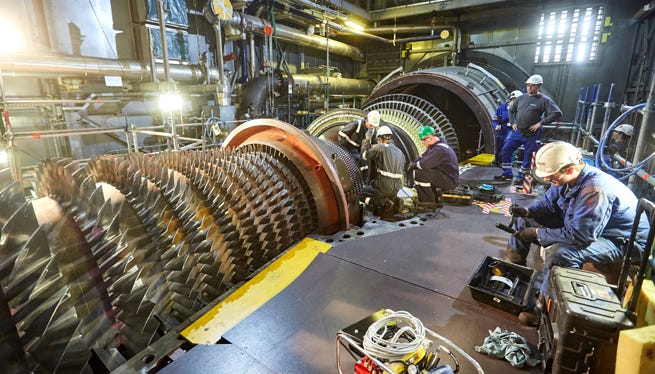
The gas turbine is the miracle machine that will save our climate. Yes, I know, it's a fossil fuel. Boo, hiss, “he's behind you!” etc. But bear with me.
Methane gas is one of the cleanest fossil fuels out there, emitting far less carbon dioxide per Megawatt-hour than coal, oil or wood and with none of the particulates and complex toxic byproducts that those villains gift to the locals. So if you're going to replace the dirty stuff, you could do worse than burn gas.
And gas turbines are far more of a standard product than bespoke and tricky nuclear power; even the aristocrat of the breed, the combined cycle gas turbine (CCGT). This is a dual loop power generator that takes the waste heat energy of a methane-burning gas turbine and uses it to boil water and rev up a steam turbine for a second swing at things. CCGTs are among the most efficient machines humanity has ever created, with thermal efficiencies of 60%-64%, and even up to 68% for the best of the best.
That's basically wizardry.
Furthermore they've been an enormous environmental gift to the world, despite their mucky fossil-fuel credentials. The advanced economies of the West have spent much of the last few decades gently flattening, and then sharply reducing their gross carbon emissions, and much of that is thanks to the replacement of coal-fired heating and generation with gas.
Is it perfect? Hardly, and the hard missile rain in the middle-East, and soaring gas prices, paints a very clear picture of what can go wrong. It's an unfortunate moral bargain that so much of civilization's fossil energy is inextricably bound-up with well armed authoritarian regimes. Is it pure chance, or is the resource curse a deadly reality?
Hard to say. But gas-fired generation and the gas turbine that enables it deserves its place on the podium of power.
Through the last 15+ years of managing projects, I've collected these 10 Truths about decision-making in Real Estate Development.
1. Execution is not effort.
Showing up, working hard, and staying busy are not the same as moving a project forward. Execution is the outcome of good decisions made at the right time.
2. Decision-making is **the** core competency.
Underwriting, design, and contractor management all support the decision framework. Teams who cannot make thoughtful decisions under uncertainty do not last long regardless of technical skill.
3. Most people focus on the wrong decisions.
Picking a brand identity or a paint color feels like decision-making. It is not. The decisions that determine project outcomes happen earlier, are harder to reverse, and carry much higher stakes.
4. The most consequential decisions reinforce positioning.
Zoning strategy, capital stack structure, phasing logic, and partnership terms either open or foreclose future options. That is where your attention belongs.
5. Optionality is a tool, not a goal.
Preserving flexibility has real value, but only to a point. Structuring everything to keep every door open means committing to nothing, which is its own form of risk.
6. Delay is a decision.
Every day you do not decide, the set of available options tends to narrow. Waiting for perfect information rarely produces better outcomes.
The exception is when delay is deliberate. Knowing the difference between that and just avoiding a hard call makes a big difference in execution.
7. The cost of a bad decision is almost always lower than the cost of no decision.
Most bad decisions can be corrected or absorbed. Delayed ones rarely get easier and often define the team's decision-making cadence.
8. Good decision-making requires a clear hierarchy of priorities.
When a project's objectives are undefined, every decision becomes a debate. This is one of the biggest mistakes I see teams make.
9. Decision speed is a competitive advantage.
In development, slow decision-making has a direct and negative effect on carrying costs. The two most common examples we've seen: entitlement timelines stretch because no one has a grasp on the project strategy and contractor relationships deteriorate while the team debates scope.
10. Accountability and decision-making are inseparable.
When a team does not know who owns a decision, the work drifts. People hedge, defer, and wait for someone else to go first. Clear ownership does not necessarily mean top-down control. It means everyone knows who is responsible for what.
Architectural oasis in the heart of Berlin! This 1900 photo captures the inner courtyard of Alt-Bayern, a commercial and residential complex on Potsdamerstraße. Designed by Wilhelm Walther, the building is a masterpiece of the German Renaissance Revival style. It was tragically destroyed during WWII.
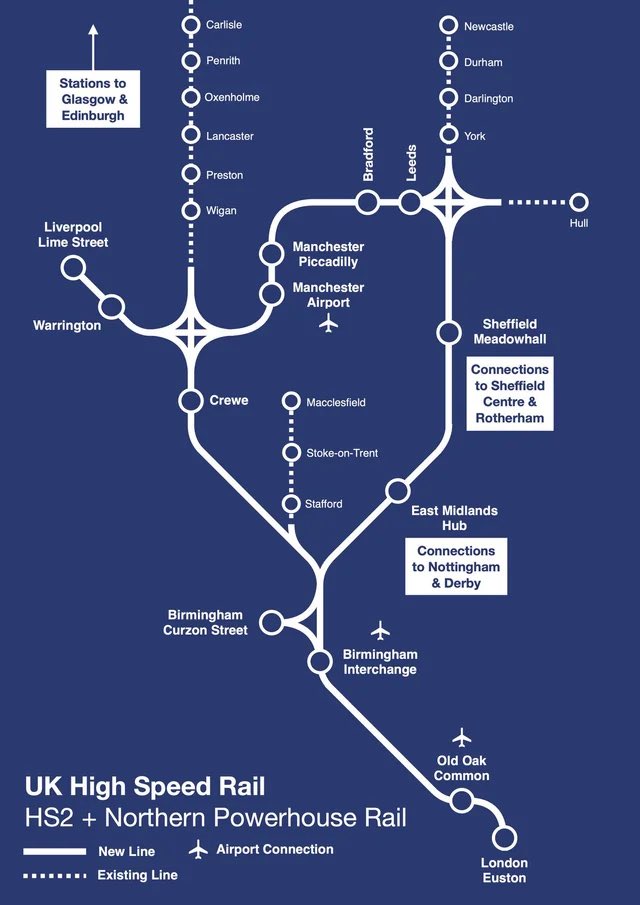
19th century railway architecture meets 21st century railway architecture. The total design catastrophe of modern railway stations, almost impossibly, just got worse...