The talent pool in crypto feels perpetually thin.
There are only ~50-100 top people on the market at any given time -- and everyone is fighting for the same people.
In parallel, some of the best talent with experience in crypto has either (1) retired or (2) started their own company.
Meanwhile, the influx of new talent into the space is relatively low. We're starting to see it from payments/TradFi world, but these folks are learning crypto from 0 to 1 and it'll take a few months to ramp.
The net result: a very thin, competitive talent pool. Max pain.
Has been this way for 2-3 years and will continue unless we find a way to expand the pool and/or attract more folks from web2 tech.
The exodus of crypto talent to AI is accelerating.
Have talked with 5 candidates in the last week who are pivoting. Talked with 3 the week before. Almost every strong recruiter is looking outside the industry.
The crypto industry has huge growth & adoption via stablecoin/payments, yet only a handful of companies are hiring at a legit pace. And 70% of them are in NYC/SF.
Institutional & enterprise adoption takes time... so most of the industry is waiting to see what additional services are needed as adoption plays out.
In the meantime, the money and talent are flowing to where there's opportunity: AI research, products, and infrastructure.
If we're going to keep our talent, we need to give them a reason to stay.
We just shipped stablecoins on @CashApp.
Everything runs from your existing USD balance - no separate wallet, no managing multiple chains, no extra setup, and importantly no fees.
Send and receive USDC on SOL, ETH, POL, and ARB.
The most seamless integration in the world imo.
Almost every founder we work with (including myself) goes through this.
Executor —> Manager —> CEO
And 60% of a CEO’s time goes into recruiting A players.
That’s the only way to really scale
As a CEO you only have three modes:
Managing people
Recruiting people
Doing the work yourself
You choose the mix
But most CEOs don't choose. They fall into the Founder Mix and never leave.
Founder Mix: 90% doing, 10% managing, 0% recruiting
This is where every company starts. You're building the product, closing deals, answering support tickets, fixing the website at midnight. You might approve a contractor’s work, but the management is minimal
This is where I spent my first year as CEO of AppSumo
This is the right mix at $1M. It's the wrong mix at $3M
But founders get addicted to doing. Because doing feels like progress. You can see it, touch it, ship it. So they keep doing even after they can afford to hire
Then something shifts. The company grows. People show up. And the founder slides into the next trap
Manager Mix: 80% managing, 20% recruiting, 0% doing
Back to back meetings. Reviewing every decision. Approving every expense. Sitting in on every standup
I thought leadership meant being in every room. I thought if I wasn't managing it, it wasn't getting done right
The reality? I was micromanaging a team that could've run without me. And I had zero time to recruit because I was too busy managing the B players I'd already hired
The Manager Mix is the most dangerous because it feels responsible. You look busy. You feel needed. But the company is slowly dying because you're spending all your energy maintaining what exists instead of upgrading it
This is Manager Hell
Time to upgrade to CEO Mode:
CEO Mix: 60% recruiting, 20% managing, 20% doing
This is where everything changed for me
I stopped going to most meetings. Started spending the majority of my time finding, interviewing, and closing A players
Within 12 months, half the problems I was "managing" disappeared. Because the right people were handling them
And when something critical broke, I didn't delegate it to a committee. I worked with the leader and we fixed the problem together the first time so they could fix alone the second time because I had the time. Because I wasn't trapped in meetings all day
60% recruiting. 20% managing. 20% doing
That's the mix that took AppSumo from $3M to $80M
Most CEOs are stuck in the Founder Mix or the Manager Mix and don't even know it
Ask yourself what percentage of your week goes to each mode. If recruiting isn't the biggest number, you already know what to fix
How engineering teams get constructed going forward will be one of the great debates for the next 2-3 years … love the apprenticeship model at @NotionHQ@ivanhzhao
The talent shortage of 2030 will be caused by companies not hiring and training juniors in 2026.
@ivanhzhao shifted to a barbell 🏋️♂️approach for hiring on the Engineering team at @NotionHQ: junior ICs paired with very senior architects.
-The senior architects provide direction the model can't
-The juniors are AI-pilled by default.
-A senior managing 2–3 juniors managing 2–3 agents each compounds way better than a senior managing 4–6 agents directly.
Links below👇 for the full episode
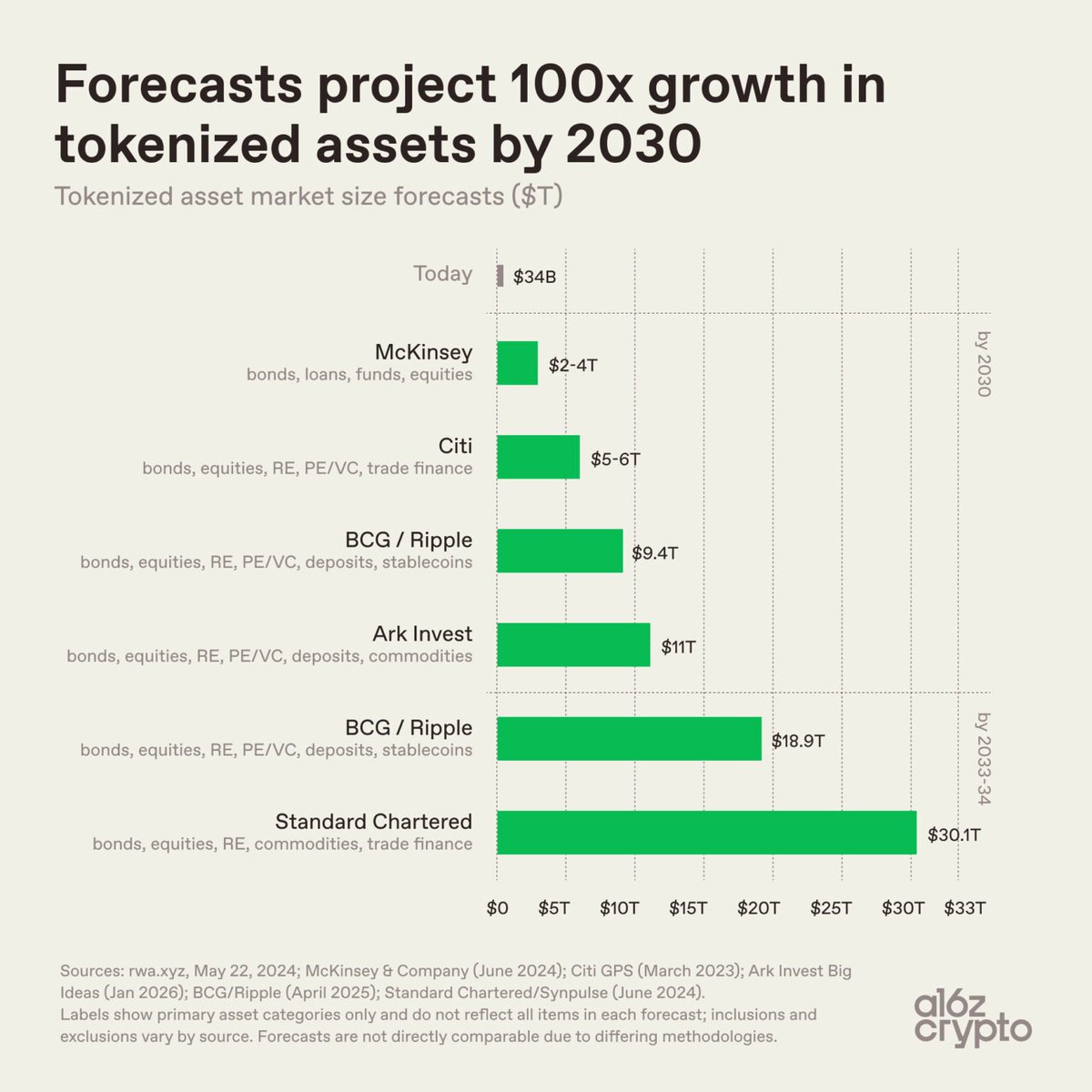
Looking ahead, forecasts for tokenized assets vary a lot but they all point in the same direction: growth.
McKinsey: $2–4T by 2030.
Ark Invest: $11T by 2030.
BCG/Ripple: $9.4T by 2030, $18.9T by 2033.
Standard Chartered: $30T + by 2034.
The gap between $2 trillion and $30 trillion is more about definitions than adoption.
Different institutions are measuring different things. McKinsey focuses mostly on bonds, loans, funds, and equities. Standard Chartered adds commodities and trade finance. BCG and Ripple include deposits and stablecoins alongside more traditional asset categories.
Despite these differences, the broader trend is consistent: Asset tokenization is expected to expand.
Compliance officers are one of the fastest growing occupations in America.
Compliance is a bigger business than you'd think. Every dollar that leaves or enters a business: paying employees, reporting revenue, and moving capital are subject to compliance.
As AI clears the "good enough to trust" bar and sales cycles speed up, there may finally be an opening for startups.
Full piece from a16z's @jamdac and @astrange: https://t.co/niRB3jPioN
Stripe has reached $223M in stablecoin volume on EVM chains @0xPolygon, @ethereum, and @base.
The majority of the volume flows through Polygon and Ethereum.
Given this trend, it is entirely realistic to expect $600M to $1B in cumulative volume by the end of 2026.
And that’s a conservative estimate - if @stripe begins to more actively push stablecoin payments into its core product, the numbers could be significantly higher.
When the best companies in the world poach your rising stars, you know you’re doing something right.
Find hidden gems, given them lots of opportunity and scope, provide enough coaching and mentorship, and then let ‘em rip
@willwarren@abandeali1 I feel super fortunate to have entered crypto under your leadership! Incredible vision, values, and conviction in the space + historic impact 🙏 thanks for everything!
Welcome home @Ronin_Network! Ronin is the chain that Axie Infinity, Pixels, Cambria, Angry Dynomites, and many other games call home. Today, they have completed their migration to Ethereum.
We seamlessly led and executed Ronin’s state migration from a sovereign L1 to an OP Stack chain, the largest in history.