Facts to confront.
I’ll reiterate my view that it would be great if we had a norm of announcing and committing to human writing, for those who want to choose that. Readers would benefit and the return to writing would rise. I called it Dogma-26 and it would be a first footnote.
1/4 🚨 PUBLIC GOOD ALERT 🚨
Finding data for research on India often means searching across government portals, papers, repositories and word of mouth.
I built Guide to Indian Data, a public catalogue to make discovery easier:
https://t.co/wtcqCxWidW 🧵#econ#opendata
Always knew the day @tuomov returns to proper academia it would be with Chris Polk. New paper “Purifying the Equity Premium” is pure joy: the clean stock-minus-TIPS premium isn’t puzzling at all — 'decent' Sharpe, covaries with consumption. All the action (and mystery) is now in
New paper…
Purifying the Equity Premium
Abstract
The equity premium has conventionally been defined as the return on stocks minus the return on bills. We decompose this conventional definition into two components: the pure equity premium, defined as stocks minus duration-matched inflation-indexed bonds, and the real term premium, defined as duration-matched inflation-indexed bonds minus bills. Empirically, we find that the pure equity premium has no “puzzling” features, as it not only has a relatively low Sharpe ratio, but it also has high correlation with measured consumption growth. However, challenges remain: The real term premium is much more volatile than stock returns, and realizations of the pure equity premium and real term premium are very negatively correlated.
The JFE has published a special issue in honor of its founder, Michael Jensen. The issue features review articles that explain his many important and lasting contributions to the field of finance
https://t.co/UXjsuZuSrd
Lot's of activity below while I was on a long flight to Korea. Looking forward to delivering together with @JesusFerna7026 the Lunchtime Plenary on Geoeconomics at the Econometric Society World Congress: https://t.co/dzcJFR4wtn
Here are my slides: https://t.co/x3tzteetED
With Jesus we aim to explore the topic relevance to today, the connection to history and the history of thought in both econ and political science. Well...in the 30 min we each have. Jesus' slides posted below are excellent and I look forward to his delivery.
I'll focus on a formal theory of power, tradeoffs between security and the gains from trade, measurement using sufficient statistics approach and/or artificial intelligence. Explaining work done with @chris_d_clayton @JSchreger@acoppola4@GCAProject. Links to papers are in the slides.
Indeed @chris_d_clayton and @acoppola4 will be presenting two of the papers in regular sessions today and tomorrow, and if you are in Seoul you should go see them.
I have also included a longish reading list of pieces across fields that I found useful, for those of you who might want a place to start.
From my last slide: "Cannot think of a more pressing global challenge that economists should be studying"
I think the task of providing policymakers with data-driven options for fostering social equilibrium is perhaps one of the goals that all applied social science, including finance research, should strive for. It's especially relevant in this day and age. Good luck with your work!
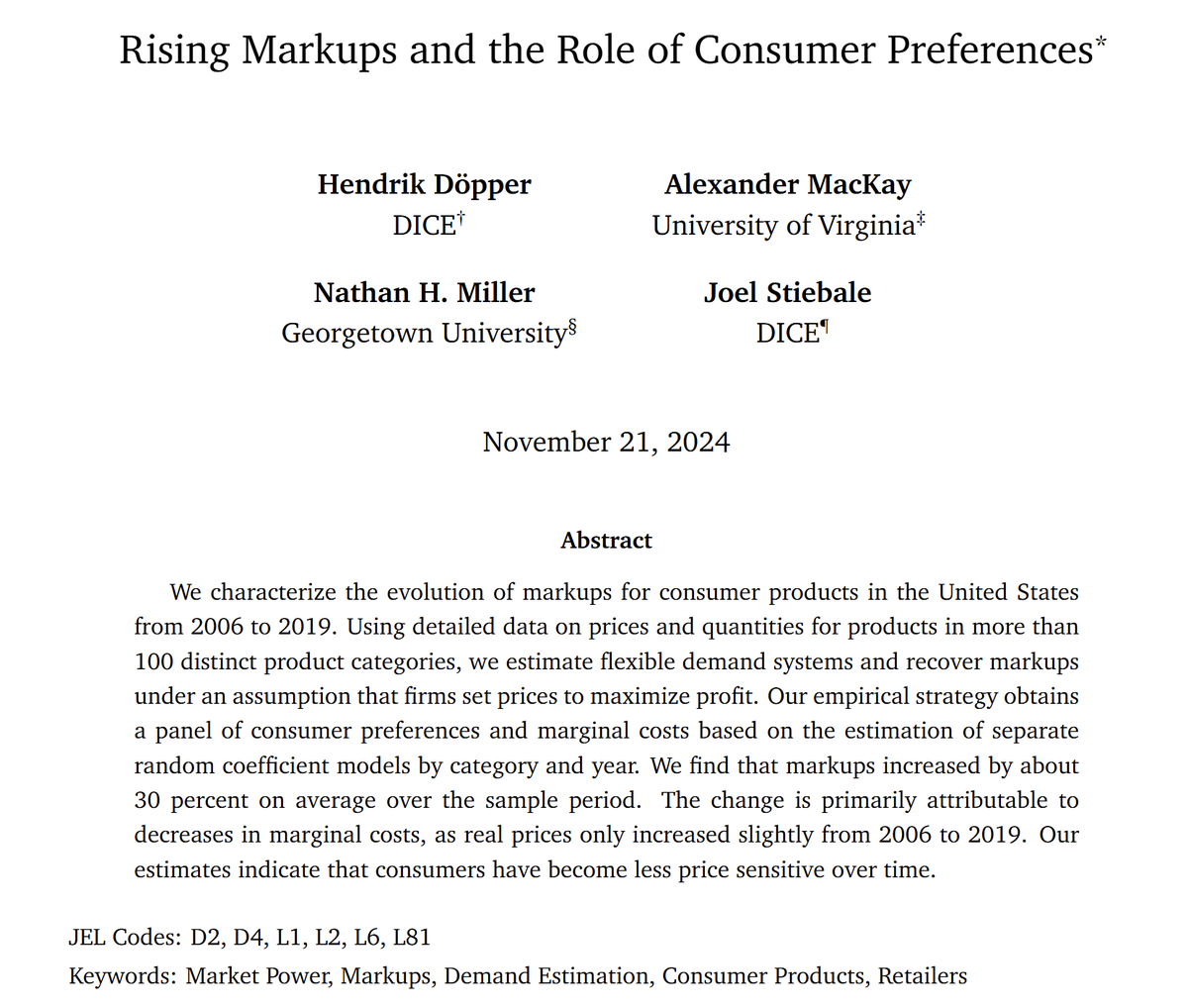
Forthcoming at the Journal of Political Economy: We find that consumer product markups increased more than 25 percent from 2006 to 2019.
One contribution is an approach to estimate IO-style models at scale, yielding flexible consumer preferences and estimates of marginal costs.
Interesting note by Krugman. But is it true that fast growing economies typically attract capital inflows and run trade deficits? A 🧵 on a recent literature challenging this notion, and on why China's trade surpluses could be a problem for global productivity growth.
This is an amazing 4-page paper by Jay Ritter about how he, a famous finance professor, lost a lot of money trading futures to Fischer Black, another famous finance professor.
It should be required reading for anybody trading derivatives. @bennpeifert
h/t @alz_zyd_
This handbook chapter presents the major advances made in the field of economic geography over the past decade.
NEW in @nberpubs, by @TrebAllen (@DartmouthEcon) & Costas Arkolakis (@Yale): https://t.co/WPtrqMIBXB
1/X: 🚨New paper - Pricing Inequality with Mike Waugh (@tradewartracker) 🚨. Working on this for a while, great to finally have it out there (https://t.co/tOKrYym9A3). We combine workhorse models in macro and industrial organization in general equilibrium.
This looks like a very cool paper incorporating key empirical findings on consumer+firm heterogeneity into a GE model: high-income consumers have low demand elasticities and tend to buy from larger firms with higher markups that produce higher quality.
The JPE is pleased to announce that the Robert E. Lucas Jr. Prize for 2025 has been awarded to Chris Edmond, Virgiliu Midrigan, and Daniel Xu for “How Costly are Markups?”
Read about the prizewinning paper here: https://t.co/Mb0EIscY9j.
@chrisedmond@virgiliu79@DanielYiXu
When you study statistics, people just start talking at you like you're supposed to understand the difference between "probability" and "likelihood."
If you're confused, you're not alone: these words have an *identical* meaning in English—but an important distinction in math.
Hi #EconTwitter!
For economists interested in the #economics of inequality and matching markets:
Check out this conference to be held at @UniofExeter, @UofEBusiness, on June 20-21, 2024!
Aim: to bridge diverse research fields, focusing on market design, labour economics, family economics, and education.
Great opportunity for collaboration and insight. Don’t miss it! ⭐️
Link: https://t.co/KlPBu5mCmz
Hi #EconTwitter! 📈
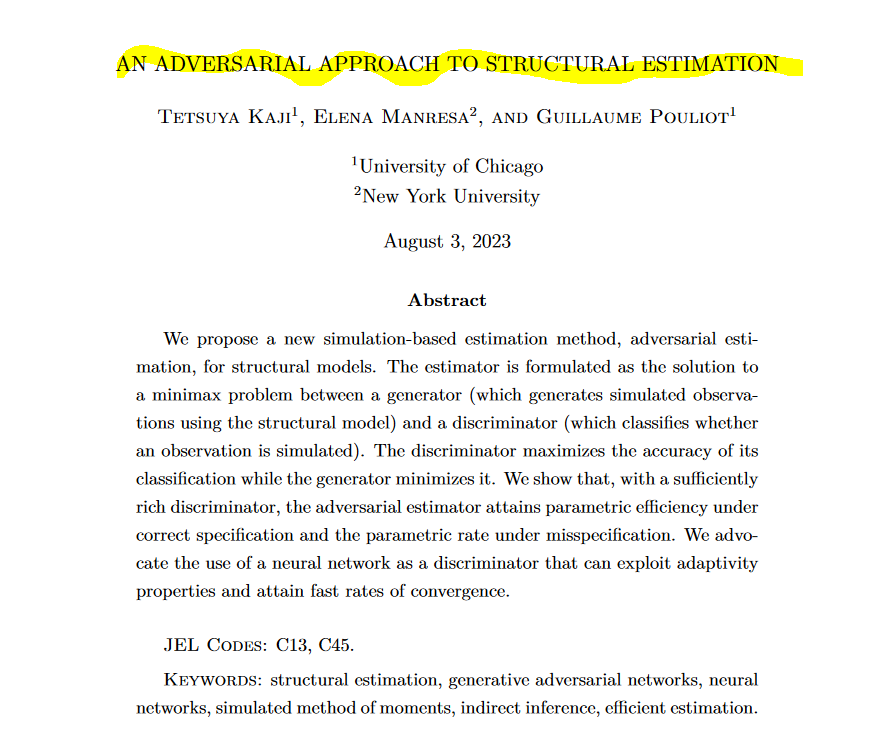
Ever wondered about a fresh, simulation-based approach to structural econometric models?
Check out this forthcoming #Econometrica paper by @emanresa82 (@nyuniversity), Kaji & Pouliot (@UofC).
Their adversarial approach - a minimax game between a discriminator & generator - is brilliant!🤖
Highly recommended to econometricians and applied economists! 🌟
Link: https://t.co/0wwHZ5tcPf
#econometrics