After many years and countless sleepless nights, I’ve successfully defended my #PhD thesis on Learning-Based Search Control for Policy Tree Search, which is also being nominated for best thesis award! I’m grateful to my supervisors and the committee for their invaluable feedback. Time for some 😴
It seems like LLMs could optimize coding style by exploring ways of structuring code so weaker and weaker models can still successfully perform tasks in a codebase.
There are surely stylistic quirks that are peculiarly impactful to transformers, but I bet there would be a lot of overlap with human capabilities.
Optimizing for understanding should help even the top frontier models, allowing them to understand things “at a glance” without having to explicitly explore. There will remain “better” and “worse” ways to code.
@ericjang11 For those curious, I have a C++ implementation of muzero that includes Arcade Learning Environment (ALE) support and links against pytorch from a normal conda install! Feel free to check it out https://t.co/8fAgguDTFe
Reviewers & ACs for #ICML2026 have been recognized for their service!
- Reviewers: 4439 Gold (free registration), 4437 Silver. 17749 total reviewers were assigned >= 1 paper
- ACs: 1647 receive free registration, out of 1691 who were assigned >= 1 paper
TY for your hard work!
There are only two honest metrics when it comes to benchmarking intelligence: novelty and efficiency.
You don't need intelligence to solve a known problem (only memory). And you don't need intelligence to solve a problem via brute force. But to solve a novel problem efficiently, intelligence is the only way.
Ahem, back to business...
Decision notifications are being released on OpenReview. There were 23,918 submissions that entered review, roughly double last year. 6,352 papers were accepted, for an acceptance rate of 26.6%. 536 papers (2.2% of submissions) are "spotlights." 1/3
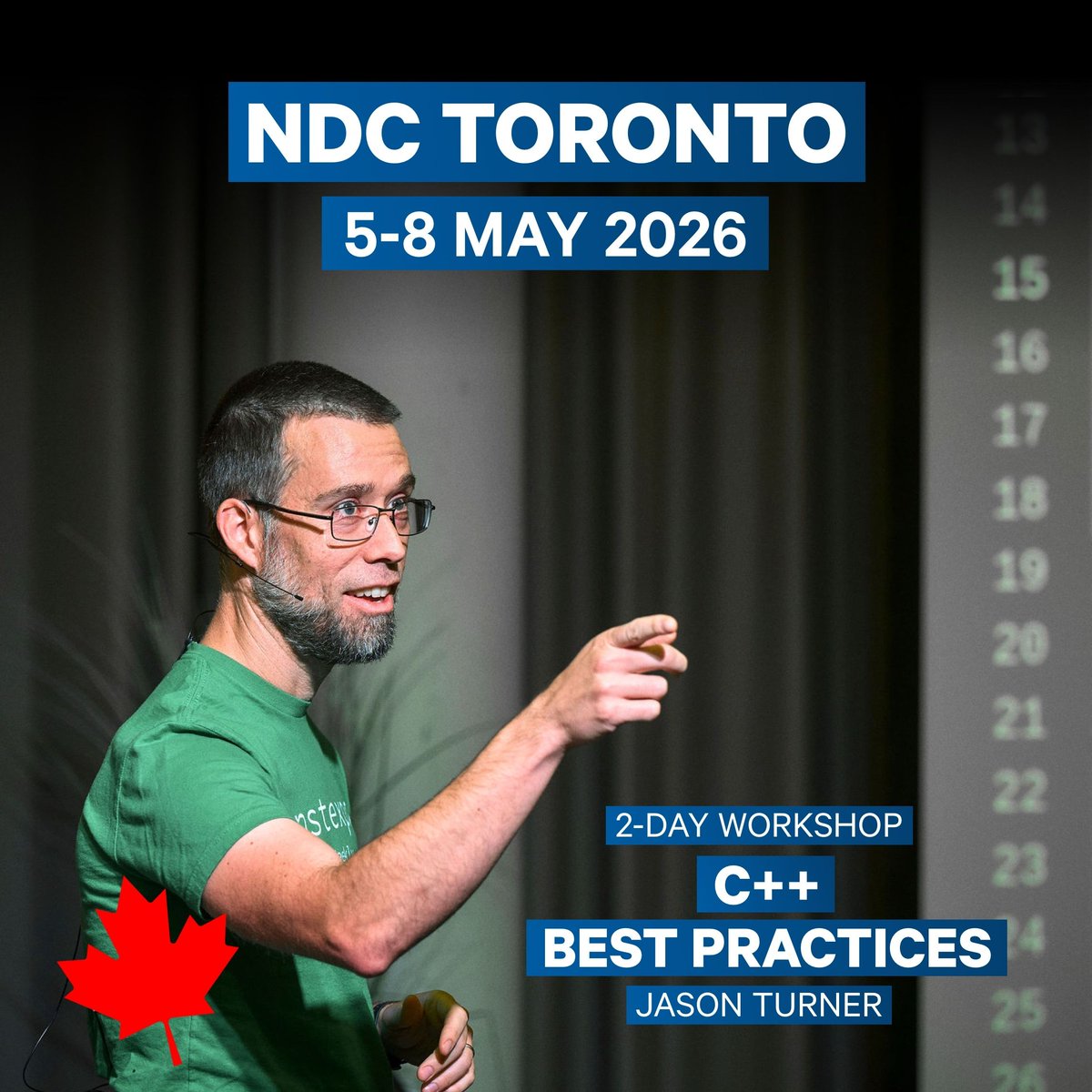
See you in Toronto in a couple of weeks at NDC Toronto for a bunch of great C++ content and workshops! May 5-8 https://t.co/fS1aGMB143 CODE: JASONS20 for 20% off
For 40+ years, building a robot that could rally with an elite human table tennis player at full speed was an unsolved problem. Sony AI's Ace research project set out to change that—and the results are now accepted for publication in @Nature and featured on the cover.
There's a broadly held misconception in AI that methods that scale well are simple methods -- even, that simple methods usually scale. This is completely wrong.
Pretty much none of the truly simple methods in ML scale well. SVM, kNN, random forests are some of the simplest methods out there, and they don't scale at all. Meanwhile "train a transformer via backprop and gradient descent" is a very high-entropy method, easily 10x more complex than random forest fitting. But it scales very well.
Further, given a simple method that doesn't scale, it is usually the case that you alter it to make it scale by adding a lot of complication. For instance, take a simple a simple combinatorial search-based method (not scalable at all) -- you can make it scale by adding deep learning guidance (which blows up complexity). Scalability usually belongs to high-entropy, complex systems.
C++26 finalized.
Reflection, Less UB, Contracts, std::execution.
Both GCC and Clang have already implemented two-thirds of C++26 features. Today, GCC already has reflection and contracts merged in trunk, awaiting release.
https://t.co/BIqfW7tyVc
Thanks for taking the time to write this up! I’ve been working on my own C++/Cuda autograd/NN library for learning (https://t.co/e4kqh40lha), and when I took a peak into the PyTorch internals to see how inplace was being handled I said to myself “maybe another day 😅”. But this will be a helpful learning tool, so I appreciate it!
I'm pretty excited to be giving one of the keynotes at this year's C++Now!
We're about to finalize C++26 next week, which will include reflection. But that's already old news. I wanted to talk about what could (should?) come next!
I'm giving workshops at upcoming conferences!
The next two coming up are C++Online (April 9) and NDC Toronto (May 5-6). Check out this session preview of my style: https://t.co/RnKSoS5jkg
C++Online: https://t.co/Aqv0pP60N7
NDC Toronto: https://t.co/W0o8AR90gB