We've published our annual rail industry finance #stats for April 2023 to March 2024.
Bringing together data from across the UK, we set out total income, expenditure and government funding for the rail network.
Details ➡️ https://t.co/s9OUVhHAlH
Watch the video overview 👇 📊
Interested in the non-breeding season distribution of loons/divers and how they relate to stable isotope signatures? Read our new paper in Ecology & Evolution!
https://t.co/ACVhVIFzzm
@SEG_UL@JNCC_UK@ACCE_DTP
(1/2)📢 So excited to share my first ever paper! 📢
"Applying remotely sensed habitat descriptors to assist reintroduction programs: A case study in the hazel dormouse" (fully open access!)
It was a pleasure to work with @CheshireWT, @PTES & @MBE_liv.
https://t.co/LlPJHK2FlP
💥How might heatwaves & cold snaps influence behaviour?
💥In sea anemones, temperature extremes caused varied unpredictability in behaviour.
💥In a warming world, energetically taxing unpredictability could be detrimental.
💥New in @AnimBehSociety https://t.co/aQOAAL0SxJ
Check out our new paper on the foraging behaviour of red-throated divers during the breeding season! A cool look at how foraging effort and behaviour change as the season progresses!
https://t.co/0plYiviRHO
1/6 #BOUsci20#Brk5 Harsh conditions in the #Arctic, mean biparental care is often obligate & breeding #seabirds may coordinate care (partners take foraging trips of similar lengths) to maintain body condition, promote equal effort & protect future reproduction opportunities.
See you in 10 minutes, for our science comedy event & quiz for the #ACCEconf20 away day, hosted by @EmerMofficial - it's sure to be a lot of fun!
https://t.co/NGmgzOS3QR
4/4 #WSTC6#Forsesh2
Next step for my PhD is to look at how offshore #windfarms could be impacting the overwinter #behaviour of RTLs. We will look at behaviour and energetic budgets and see how displacement from #windfarms could impact energy expenditure.
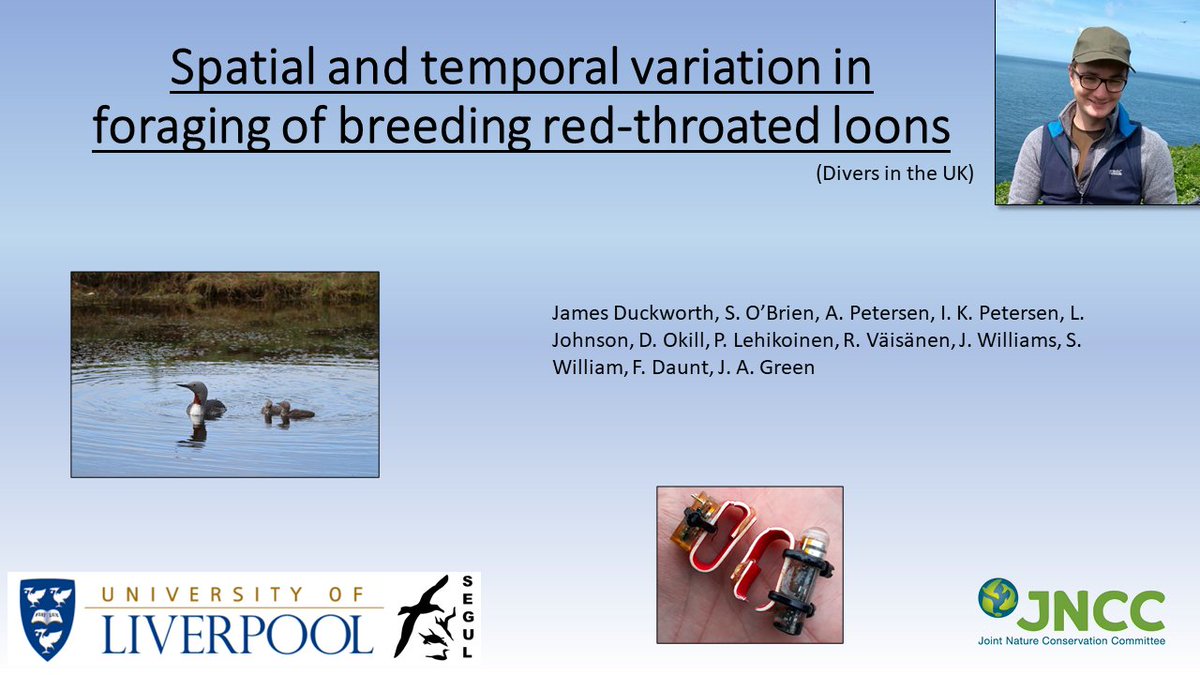
1/4 #WSTC6#Forsesh2
Red-throated #loons (RTLs or #divers) are a species of much interest due to their negative interactions with #renewables. We looked at RTL #foraging across 3 sites in the breeding season, using saltwater immersion #loggers and time-depth reorders #TDRs.
3/4 #WSTC6#Forsesh2
Foraging effort increased slightly through the breeding season and dives became less benthic, reflecting the changing demands of the chicks. Site level differences in these foraging characteristics are likely driven by #foraging habitat differences.
@Knomealone@ArcticEcology The lake was likely around 25 metres deep. So there are certainly deeper depths they could use, but prefer the shallower areas!
Love loons and desperate to see what goes on underwater? Read our new paper detailing the behaviour of an individual in the beautiful lakes of Finland!
https://t.co/1xrdMaVQDv
Want to see the FIRST EVER NON-BREEDING SEASON time/depth recorder data for #RedThroatedDiver? Look inside this @Jamduck1#DiverEnergetics report for dive profiles, and so much more... https://t.co/lbki7JdFxg
It’s a big week for the #diverenergetics project! @Jamduck1 is in the office working on diver foraging behaviour, there are two reports in the offing AND there is a red-throated diver outside the office