"I don't even know the f***ing product lines. Where is all the revenue coming from?"
Sam Altman: "Actually... I think we should be more of a platform company than a product company."
*This 2 minute section is astounding because Sam Altman just admitted:
1) AI (LLMs) are a commodity; meaning they're easily substitutable, suffering from extreme boom and bust cycles.
2) OpenAI doesn't have any products, they're relying on users to build them.
3) They want to be a service provider, putting them in direct competition in a space already dominated by Oracle, Amazon, Microsoft and Google.
The scary part is Sam doesn't realize he just told the world that the emperor has no clothes.
Naval Ravikant: "You're going to die. It's all going to zero. What's there to stress about?"
"Stress is when your mind has two conflicting desires at once. You want to be liked, but you want to do something selfish. You don't want to go to work, but you want to make money. You have two conflicting desires, and that's stress."
Most people use stress and anxiety interchangeably. Naval says they're different things:
"Anxiety is this pervasive, unidentifiable stress where you're stressed out all the time and you're not even sure why. The reason is you have so many unresolved problems that have piled up in your life, you can no longer identify what the problems are. There's this mountain of garbage in your mind. A little bit is poking out the top like an iceberg; that's anxiety. But underneath, there's a lot of unresolved things."
His fix for it is thinking about death:
"One big anxiety resolver for me is just ruminating on death. You're going to die. It's all going to zero. You cannot take anything with you. If you can keep that idea in front of you at all times, what's there to stress about?"
Which raises a question. If nothing matters, isn't all time wasted?
"What is wasted time? Everything is wasted time in a sense because nothing matters in the ultimate. But in each moment, it's the only thing that matters. So if you're doing something you want to do and you're fully there for it it's not wasted time. If your mind is running away, wishing you were somewhere else, anticipating the future, regretting the past, that's wasted time. That's time you're not present for."
And the part most people miss:
"People get worried about dying and no longer being here. But they don't realize that so much of their life is spent not being here in any case."
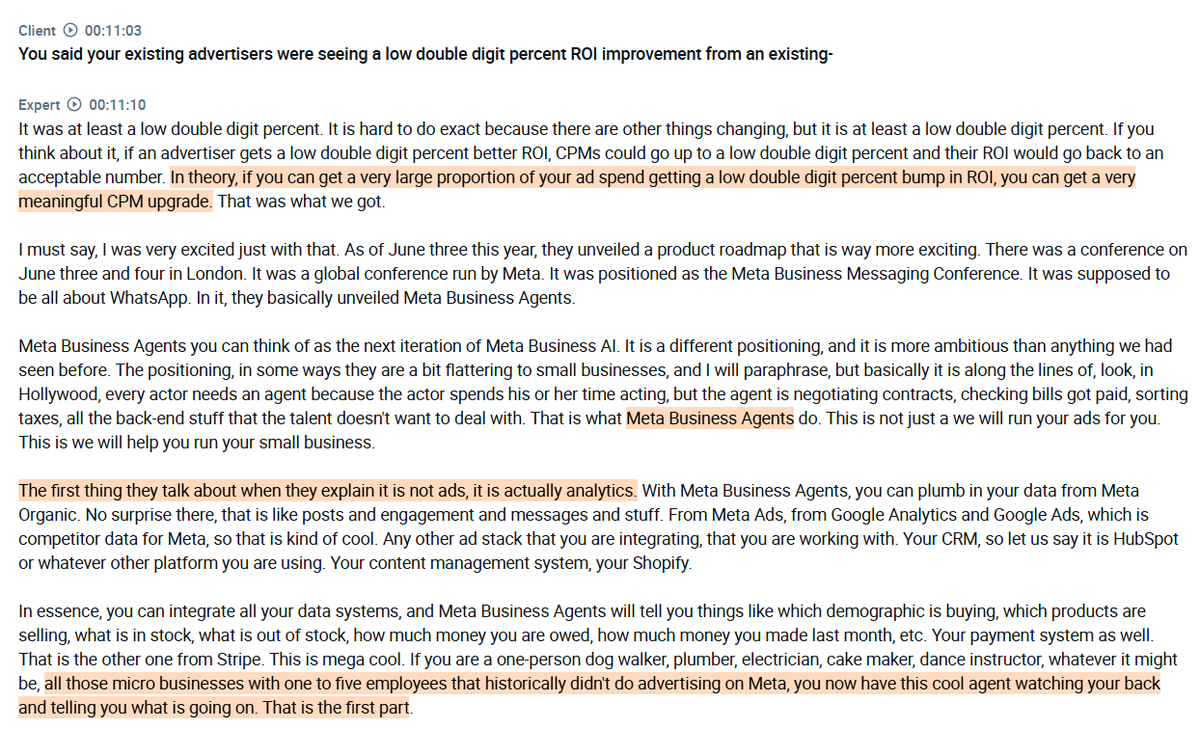
Interview with an industry expert on why $META Business Agents are one of the most significant new growth drivers for the company:
1. The expert reports strong $META ad spend growth at their company, with Q1 and Q2 of this year both up more than 30% YoY, and Q3 and Q4 forecast at more than 20%, with the slowdown driven by tougher comparisons rather than any underlying deceleration. On a two-year stack, growth is actually accelerating, reaching more than 60% in Q2 and expected to hold there through year-end.
2. Reels has been the biggest tailwind for the expert's company, growing from under 30% to under 40% of total $META ad spend YoY, representing around a 4-5 point tailwind, though the expert expects this to ease as Reels matures. Forms and click-to-messaging, which route users into WhatsApp or Messenger, have roughly doubled as a share of spend and represent a meaningful CPM uplift as higher-value ad units replace lower ones.
3. Shopping ads keep users within the $META ecosystem through integrations with $AMZN and $SHOP, creating an on-site conversion experience without users feeling like they left the platform. These high-CPM ads replace lower-CPM ones, representing a small, single-digit tailwind for the expert's company. Overlay ads, which appear on creator content with a button and text, are a bigger and more purely incremental tailwind since they represent genuinely new inventory that was previously ad-free rather than replacing existing ad formats.
4. The expert describes Meta Business Agents as one of the most significant new tailwinds coming online, framing it as the evolution of Meta Business AI into something far more ambitious. What stands out is that the product leads with analytics rather than ads, integrating data from various ad stacks to give even a one-person business a unified view of multiple metrics. Ad campaign automation and chatbots remain, but the expert sees the broader business intelligence layer as the genuinely new and exciting development.
5. The expert highlights the brand linking feature as one of the most exciting elements of Meta Business Agents, where paying subscribers have their brand name turn into a live link whenever it is mentioned in a WhatsApp, Messenger, or Instagram conversation. The expert sees this eventually becoming an auctioned ad product where brands bid for the right to be linked when mentioned, with the current $10-30 per month subscription pricing being used to drive upgrades rather than capture full value upfront.
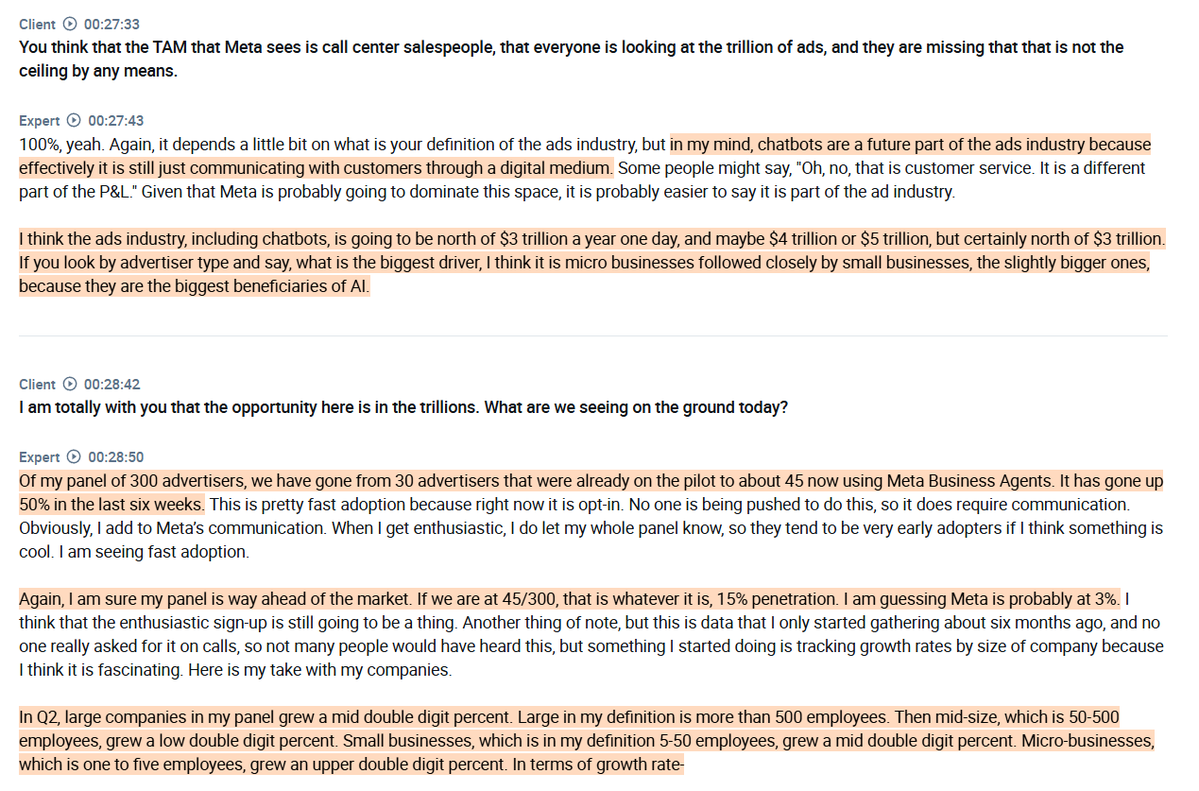
6. The expert sees $META's TAM as far larger than the traditional ads industry, with chatbots and business messaging representing a new layer of communication with customers that will eventually be part of how the ad market is defined. The expert puts the long-term TAM for the ads industry, including chatbots, at north of $3 trillion annually, with micro and small businesses seen as the biggest beneficiaries of AI-driven advertising tools.
7. Adoption of Meta Business Agents within the expert's panel of 300 advertisers has jumped from 30 to 45 in the last six weeks, a 50% increase driven entirely by opt-in rather than any push from $META. The expert estimates their panel is well ahead of the broader market, guessing $META's overall penetration is around 3% versus 15% within their own panel.
found on @AlphaSenseInc
Time to buy gold.
Thesis is simple: More money supply, higher gold prices.
They diverged earlier this year as markets expected a tighter policy under Kevin Warsh.
But nothing has changed and global money supply kept growing, so gold prices have some serious catching up to do.
Jensen Huang says the first AI supercomputer he ever built had exactly one customer on earth:
Elon Musk.
Back in 2016, he had just created a machine called the DGX1.
It cost $300,000 dollars.
He announced it on stage, and the room went completely silent since nobody understood it, so nobody wanted to buy it.
Since Elon knew him because Nvidia had built the first self-driving computer for the Tesla Model S, Elon bought & tried it.
Elon said he had a small company that could use it.
Jensen boxed one up himself and drove it to San Francisco. He carried it up to a room full of researchers. That tiny company turned out to be OpenAI.
The machine nobody wanted went on to launch the AI revolution.
— Jensen Huang (.@JensenHuang)
Ed Zitron @edzitron went on The Compound and Friends @TheCompoundNews this week and Josh and Michael gave him 90 minutes to lay out the full AI bear case. I went through 37 of his claims with the filings open. By my count 19 are wrong or unfalsifiable, 12 are half right and 6 are fair. Here’s the breakdown.
Disclosure first. I’m long $NVDA $META $AMZN $GOOGL $ORCL $CRWV $AVGO $PLTR $AAPL $MSFT. I’m obviously talking my book and Ed would be the first to point that out which is exactly why every number below ties back to a filing or a company disclosure you can pull up yourself. Ed taped this on August 27th which was the day after NVIDIA reported its Q2 of fiscal 2027 so I’m using those numbers and the 10-Q that came with them.
I want to give Ed credit because he did the work on OpenAI’s audited financials and a lot of his numbers hold up. OpenAI lost $20.9 billion in 2025 on $13.07 billion of revenue. Oracle and CoreWeave are levered. Abilene is late. Private credit is the contagion channel nobody can size from the outside and margin debt hit a record in June. None of that is made up and I think about every one of those risks every day I’m in these names. My problem was never his numbers. It’s what he does with them and what he leaves out.
Back in 2023 nobody could tell Ed how much money AI actually made and the hyperscalers wouldn’t break out AI revenue. That was a fair complaint in November 2023. It isn’t one anymore. Microsoft disclosed in its 10-K that it booked $24.1 billion of revenue from OpenAI in fiscal 2026. Amazon said its AI business and its custom chip business each run above $25 billion a year and both are growing triple digits. Google Cloud grew 82% YoY to $24.8 billion. Anthropic told investors it’s at a $65 billion run rate with booked Q2 revenue above $11.5 billion. The question Ed built his whole newsletter around got answered. So the argument has quietly shifted to whether those numbers should count and that’s a much weaker hill to fight on.
His biggest claim is that the demand is illusory. He says OpenAI and Anthropic take up 90% of AI infrastructure, that the banks have about $440 billion of cloud revenue coming from two unprofitable startups that need ten times the demand they have today and that by his own estimate there’s only about $22 billion of real compute demand outside the labs.
Take the $22 billion first. Amazon says its AI business alone runs above $25 billion a year so one company’s disclosure is already bigger than Ed’s number for the entire industry. Microsoft said its commercial backlog grew 25% with OpenAI stripped out and that the entire $51 billion sequential increase came from customers outside the frontier labs. Add up the contracted backlogs at Microsoft, Oracle, Google, Amazon and CoreWeave and you get roughly $2.45 trillion. Some of that is lab commitments and I’m not pretending otherwise. But Microsoft already told you what its backlog does without OpenAI and Google says more than half of its backlog converts inside two years.
Now the $440 billion. Spread that over roughly three and a half years and it’s about $125 billion a year across all three clouds. The two labs already generate about $105 billion a year between them and compute is their biggest cost line. They don’t need ten times the demand they have today. They need to roughly double from here and keep paying their compute bills. Anthropic grew sevenfold in seven months and reported positive adjusted operating income in Q2. Two customers growing that fast is a concentration risk you have to manage. It isn’t evidence of a fraud.
Then there’s what the operators themselves said a month before Ed taped this on earnings calls where getting it wrong is a securities law problem. Amy Hood said Microsoft’s cloud revenue passed $214 billion in fiscal 2026 and nearly 90% of it came from customers outside the frontier model companies. Andy Jassy said the lion’s share of AWS capacity for 2027 is already reserved and even $220 billion of CapEx won’t cover the demand Amazon has in 2026. Sundar Pichai said existing cloud customers are running more than 50% above their commitments. Ed’s whole thesis is that these companies are building for two customers who can’t pay. All three of them told you the opposite on the record.
The segment numbers back them up. AWS went from $10.2 billion a quarter in Q1 2020 to $42.2 billion in Q2 2026. Growth accelerated for the fifth straight quarter to 36.7% and operating income was $16.6 billion at a 39.4% margin which is up 650 basis points YoY. Barclays (BCS) puts the two labs at 13% of AWS revenue this year so the other 87% of a $169 billion run rate business that just accelerated is everyone else. You don’t expand margins by 650 basis points serving two loss making customers at cost. Google Cloud did $2.8 billion in Q1 2020 and $24.8 billion in Q2 2026. Its growth rate went 32%, 34%, 48%, 63% and 82% over the past five quarters and operating income more than tripled to $8.8 billion at a 35.6% margin. Ed called Alphabet just another LLM company. A profitable AI business growing 82% on its own custom silicon with no OpenAI check behind it is the thing Ed keeps saying can’t exist and it’s sitting right there in the segment table.
Ed says Microsoft made $34.33 billion on AI in fiscal 2026 and $24.1 billion of that is OpenAI so selling AI to everyone else is a single digit billion dollar business set against $260 billion of CapEx. His word for it was disaster. Microsoft never reported $34.33 billion of AI revenue. That’s a Bloomberg estimate. The $24.1 billion is real but it includes the revenue sharing payments OpenAI makes to Microsoft and not just Azure consumption. The $260 billion is cumulative CapEx going back to early 2022 by Ed’s own count. What he left out is that Azure passed $100 billion in annual revenue and grew 43% in the June quarter which was the fastest since 2022. Even if you assume every dollar of the $24.1 billion is Azure, OpenAI is still under a quarter of it. Microsoft 365 Copilot went from 15 million paid seats in December to over 30 million in June. Commercial remaining performance obligations hit $678 billion which is up 84% YoY and still up 25% with OpenAI taken out. Microsoft earned $133.7 billion of net income and says it stays free cash flow positive in fiscal 2027 on $175 billion of CapEx. If that’s a disaster I’d like to see what Ed calls a good year.
Ed says 16% of Nvidia’s quarter was one customer and five customers make up 70% of their accounts. The 10-Q says one direct customer was 16% of revenue. A year ago two direct customers were 23% and 16% so the top of the list actually got less concentrated. The 70% has nothing to do with revenue. It’s the share of accounts receivable held by five direct customers as of July 26th. He blended two different disclosures on air. Nvidia’s direct customers are clouds and those clouds have millions of customers standing behind them.
Then GitHub Copilot. Ed says it let people burn $5,000 of tokens for $40 a month, moved to token billing on June 1st and now the business is dead. Nadella said on the July call that GitHub Copilot has 50 million users and revenue accelerated more than 60% quarter over quarter after the billing change. Ed can’t have it both ways on this one. Twelve minutes later he’s complaining that AI companies subsidize tokens and let people burn thousands of dollars of compute for $200 a month. When Microsoft stops subsidizing he calls it a rug pull. You have to pick one. He also says nothing has gotten cheaper. GPT-4 quality cost $30 per million tokens in 2023 and you can get it for under 50 cents today. Coal got cheaper too and the world burned more of it.
On OpenAI being a liability that Microsoft has to consolidate. Microsoft owns 27% of OpenAI. At the $852 billion valuation from the last round that stake is worth about $230 billion on roughly $13 billion invested. If that’s a liability I’d take a few more of them. Receivables from OpenAI were $6 billion at June 30th against $24.1 billion of annual revenue. That’s ninety days of sales. Nobody is stapling IOUs to anything.
Ed says to hit fiscal 2028 consensus Nvidia needs three to five customers to find way more debt at higher rates while it just raised prices 17% and memory costs are skyrocketing. Nvidia guided fiscal 2028 growth of 70% this week and said out loud that the guide is supply constrained while customer forecasts point to growth doubling. A bubble that’s popping doesn’t have customers asking for more than the vendor can build. The price hikes are real and the driver is a supply squeeze in high bandwidth memory. Prices fall when demand disappears. They don’t go up double digits. The hyperscalers also aren’t funding any of this with junk debt. Alphabet and Amazon generated $185.7 billion and $161.4 billion of trailing operating cash flow and their bonds are AA rated.
Michael put up Nvidia’s trailing net income passing Apple’s and Ed asked how much of it was equity gains from Anthropic, OpenAI, CoreWeave and Nebius (NBIS). Fair question. Gains on equity securities were $7.8 billion and they sit below the operating line. Operating income was $63.7 billion which on its own was bigger than Nvidia’s entire revenue in the same quarter a year earlier. That’s cash and not a mark to market.
Then the part I’d replay in slow motion if I could. Ed said he was wrong in 2024 because he was naive and assumed the market wouldn’t spend hundreds of billions for no reason. Later in the show he said he’s stopped giving timelines altogether. So the thesis has been wrong for two years and the explanation is that everyone else is stupid. When your model fails for two years the scientific move is to update the model. Ed’s move was to extend the deadline.
Ed calls run rate the biggest scam of them all. Run rate is just the latest period’s revenue annualized and Bloomberg defined it exactly that way in the same article Ed was criticizing. But fine. Use the booked numbers. Anthropic disclosed Q2 revenue above $11.5 billion. That’s one quarter, it’s booked and it’s fourteen times the year ago quarter. His recurring revenue argument is backwards too. AWS is consumption revenue. Wall Street pays premium multiples for consumption businesses because usage that’s embedded in a workflow is stickier than a seat license somebody forgets to cancel. If you want contracted revenue Microsoft reports $678 billion of it, Google has $514 billion and Amazon has $496 billion. Those are signed contracts and not annualized months.
On the lenders being idiots. Ed cites a report that Blue Owl (OWL) agreed to invest in Stargate Abilene in ten minutes. The hosts pushed back on that in real time and I would have too. The Abilene financing was a $15 billion joint venture with a $7.1 billion construction loan led by JPMorgan (JPM). Banks with actual syndication desks did the underwriting. I’ll concede the schedule to him. Buildings three and four are months late. A construction project running late is a construction project running late. It isn’t a solvency event.
Ed says every AI startup loses money and when customers see the real cost of tokens they shrivel away. Airbnb (ABNB) is the cleanest counterexample I can think of and it happened two weeks ago. Brian Chesky said the company will spend a lot more on AI tokens this year than it forecast because the ROI is there. Support cost per booking fell 16% YoY with the AI assistant resolving 45% of the issues it starts. Anthropic’s run rate went up after it moved enterprise customers to per token pricing which is the exact event Ed says should have collapsed demand. Ramp’s spend data says 43.5% of US businesses paid for Anthropic products in July, up from 9% in May of last year. If the real cost of tokens were driving people away the adoption curve would be bending the other way.
Ed cites a blog post arguing most AI integrations fail and executives adopt out of fear. I’ll believe the Census Bureau over a blog post as its May 2026 survey indicated that 19.8% of US businesses use AI in a business function. It also said that 37% of firms with 250 or more employees use AI in a business function and 43% of American workers reported that they use generative AI for work. Microsoft sold 10 million Copilot seats in a single quarter and it’s hard to believe that ten million seats would be sold if AI integrations were failing. Flip the Census number around and 80% of US businesses still haven’t adopted AI in any function. I don’t read that as a failed rollout. I read it as runway.
Ed says Microsoft, Google, Meta and Amazon are all slowing and the only companies growing are the ones getting checks from the labs. Google Cloud grew 82%. Azure grew 43%. AWS grew 37%. Meta grew 28% with no lab money at all. He said Meta didn’t grow like gangbusters and the Q3 guide proves the slowdown is here. Meta’s Q2 revenue was $60.8 billion which was up 28% YoY after 33% in Q1. Ad impressions grew 14% and price per ad grew 12%. The Q3 guide of $61 to $64 billion against $51.2 billion a year earlier works out to 19% to 25% growth. So the slowdown Ed is describing is a company growing more than 20% on a $250 billion revenue base. Meta’s cloud didn’t grow like Microsoft’s because Meta doesn’t sell cloud. It’s an ad company and a 12% higher price per ad is what AI ranking looks like when it shows up in the numbers.
Ed says OpenAI’s actual numbers are bad. They are and I’m not going to pretend otherwise. But OpenAI lost $2.37 for every dollar of revenue in 2024, $1.60 in 2025 and $1.22 in Q1 2026. The losses are shrinking as a share of sales while revenue triples. OpenAI is the weakest link in the entire AI trade and I’d say that on any stream. The difference between me and Ed is that I think the IPO is the test and he thinks the test can’t be passed.
Now the claim Ed comes back to over and over for the whole interview. OpenAI and Anthropic are unprofitable startups that need to constantly raise money, they can’t pay for this out of cash flow and it all comes down to when the money runs out. Every word of that assumes these two are financed the way CoreWeave or Oracle are financed. Borrow, burn and default when the coupon comes due. They aren’t. Neither OpenAI nor Anthropic has issued a bond. Neither has a term loan. The Information reviewed OpenAI’s financials as of March 31st and reported zero debt. OpenAI’s only bank facility is a $4.7 billion revolver that was undrawn when the March round closed. Anthropic has a $2.5 billion revolver and is arranging a bigger one ahead of the IPO which is the same thing SpaceX (SPCX) did before it listed.
What they have instead is equity. Roughly $180 billion raised by OpenAI and roughly $130 billion by Anthropic and all of it came from investors who bought shares. Equity has no maturity date and no interest payment. Nobody at OpenAI wires a coupon to SoftBank (SFTBY) every quarter. Every one of those rounds was also raised with the stated purpose of spending it. The investors funded the burn on purpose because the burn is what buys the growth. So the question Ed keeps asking about when revenue recaptures the spending is the wrong question for an equity funded company. Anthropic’s Series E investors paid a $61.5 billion valuation in March of last year. The Series H in May was $65 billion at a $965 billion valuation. That’s more than fifteen times in fourteen months. OpenAI went from $157 billion in October 2024 to $852 billion in March. Those are the people Ed says are about to stop writing checks.
The debt does exist. It just sits somewhere else. SoftBank borrowed against its own balance sheet to fund its OpenAI checks and its lenders have recourse to SoftBank and not to OpenAI. Oracle, CoreWeave, Crusoe and the Blue Owl joint ventures borrowed to build the buildings. That’s landlord risk backed by signed leases with the labs which is Ed’s private credit point and I’ve already conceded it. OpenAI’s $665 billion of compute commitments are contracts to buy capacity over five to ten years. That isn’t borrowed money. Amazon’s stake in Anthropic is worth more than every dollar Anthropic has committed to spend at AWS over the next decade.
Every hypergrowth company you’ve ever owned was built with other people’s money while it lost money. Amazon sold junk bonds in 1998 and 1999. Tesla (TSLA) sold junk bonds in 2017. Uber (UBER) sold junk bonds in 2018. OpenAI and Anthropic haven’t sold one. They’re running the version with less leverage than the last three generations of tech winners and Ed is describing it as the most fragile capital structure he’s ever seen. Both labs have filed confidentially. Anthropic is targeting a Nasdaq listing in October and OpenAI’s CFO told staff it will be public in 2027. Ed’s version of this story ends with the labs failing to raise. The actual story so far is the two biggest private rounds in history and it looks like they’re about to be followed by the two biggest IPOs in history.
Ed says Anthropic is rushing to go public before it has to show Q3 books because token maxing is over and Fable 5 petered out at 11% market share according to Ramp. Anthropic’s run rate went from $47 billion in mid May to $65 billion at the end of July. That’s $18 billion of annualized revenue added in ten weeks during the exact window Ed says customers hit a ceiling. The 11% also isn’t market share. Ramp says Fable 5 is 6% of the tokens businesses buy from Anthropic and 11.4% of the dollars. The most expensive model takes a modest share of Anthropic’s own mix while Sonnet and Opus carry the volume.
He also got the Meta and Anthropic story backwards. The reported deal is Anthropic leasing about $10 billion of compute from Meta over two years with Anthropic paying Meta monthly. Meta is the landlord in that arrangement and not the customer. Ed spent ten minutes saying Meta has nothing to show for its CapEx. The Anthropic talks are Meta showing you the return on that CapEx.
Now the four horsemen. Horseman one is CoreWeave failing to raise debt. CoreWeave raised $13.5 billion of gross debt in Q2 alone including more than $10 billion of unsecured notes and converts, its first Eurobond and a $1 billion check from Jane Street. Backlog is about $104 billion against full year revenue guidance of $12.4 to $13.2 billion. Ed’s cost of debt point stands and I own the stock so I watch it closely. The 2031 notes yield around 11.5% and net interest expense was $640 million in the quarter. That’s the price of growing 112% with somebody else’s money.
Horseman two is a hyperscaler bond deal that barely gets covered. Ed says Amazon’s last deal was only 1.6 times oversubscribed. Peak demand on the $25 billion July deal was $62 billion which is 2.5 times covered. The book shrank to $41 billion because the banks tightened the spread once they saw the demand and a thin book doesn’t let you do that. Amazon’s March deal drew $126 billion of orders for a $37 billion issue and Alphabet’s $32 billion February deal was four to five times covered. A functioning market prices more supply a few basis points wider. A closed one doesn’t price at all.
Horseman three is Oracle. Ed says the ratings agencies don’t have the stones to downgrade it. S&P Global (SPGI) cut Oracle to BBB minus on July 9th and named OpenAI as a key credit risk. That happened seven weeks before he said it. Oracle’s CDS hit a record 198 basis points and the stock is down about 65% from the peak. I’m long Oracle and I added through the July selloff so I’ll be straight with you about the risk. Fiscal 2027 CapEx is up to $95 billion, free cash flow was negative $23.7 billion last year and there’s $20 billion of equity coming. It’s a levered bet on a $638 billion backlog where OpenAI is about half of it. I know that and I’m underwriting it on purpose. Ed conceded Oracle is the one company he’s certain would get bailed out. I’d rather own the company the biggest bear in the world thinks is too important to fail than short it.
Horseman four is a major AI startup going insolvent and his example is Perplexity which he says has faded. Perplexity’s annualized revenue went from under $250 million at the start of the year to more than $750 million by August. It tripled in eight months. Nvidia backed it in three prior rounds and is discussing a new one above $30 billion. If that’s the startup whose death is supposed to signal the apocalypse then the apocalypse is a long way off.
Michael asked where the mania is when Nvidia trades at 18 times forward earnings and Meta trades at 16. Ed’s answer was that the mania isn’t in the equity market and it’s in data center construction instead. Sit with that for a second. The biggest AI bear in the world just agreed those aren’t bubble multiples. Cisco (CSCO) peaked at more than 130 times forward earnings in March 2000 and in the ten fiscal years after the bubble popped Cisco earned roughly $50 billion in total. Nvidia earned more than that last quarter and trades at a market multiple. A market that sends Oracle down 65% while it rewards Alphabet on the same CapEx news isn’t a mania. Manias don’t discriminate like that.
Josh asked the best question of the whole show. What would make Ed change his mind? His answer was that even profitability at OpenAI and Anthropic in 2028 wouldn’t do it. I don’t know how to call that a thesis. A thesis has some condition under which it fails. He also said he has no money in the market. A bear with no position, no timeline and no way to be proven wrong can never be wrong. That’s a comfortable place for him to sit and a useless one for you.
Ed’s point that AWS took from 2003 to 2015 and $29.7 billion of inflation adjusted CapEx to turn its first profit is right. The lesson is just the opposite of the one he draws from it. AWS is now a $169 billion run rate business with a 39% operating margin and a $496 billion backlog. That might be the best return on CapEx in the history of the S&P 500. Jassy said the margins and returns in AI are tracking what AWS saw in core cloud at the same stage and I don’t have a reason to doubt him yet.
The strongest part of Ed’s case is private credit and I’m not going to wave it away. Private credit, insurance balance sheets and pension money are funding data center developers and neoclouds at rates that assume the tenants pay for a decade. If a tenant walks there’s no Google search business sitting behind that debt. Two things keep it from being 2008. The tenants on the biggest leases are Microsoft, Amazon, Google, Meta and Oracle. The hyperscalers fund the majority of their CapEx from operating cash flow and investment grade bonds. The risk sits with the developers and the single tenant projects. Oracle is the one big balance sheet where that risk is concentrated and I own it knowing that. The right takeaway isn’t to sell Nvidia. It’s to know which companies are the tenants and which are the landlords and to never confuse an 11% CoreWeave coupon with a 4.5% Amazon coupon.
On retail leverage Ed is just right. FINRA margin debt hit a record $1.5 trillion in June and it’s still up about 39% YoY even after falling to $1.42 trillion in July. I respect that number. It’s a market risk though and not an AI thesis. Leverage tells you the next drawdown is going to be violent. It doesn’t tell you whether Azure grows 45% next quarter.
So where does that leave us. Ed is right that OpenAI loses a lot of money, that Oracle and CoreWeave are levered, that memory costs are rising, that construction runs late and that retail is over leveraged. He’s wrong that the demand is illusory, wrong that Microsoft can’t sell AI to anyone but OpenAI, wrong on the direction of the Meta and Anthropic deal, wrong that the agencies won’t downgrade, wrong that nobody can make this profitable and wrong about what Nvidia’s 10-Q actually says about receivables and prepayments. Most of all he’s unfalsifiable. He was wrong in 2024, he was wrong in 2025 and his response was to stop making predictions and keep the thesis anyway.
The full video will be dropping tomorrow on my responses to Ed's 37 claims and even though he has blocked me he is still welcome to come on @basispointpod with @amitisinvesting and Myself.
This is not productivity, this is efficiency.
It would be productivity if it came with tangible growth in economic activity, growth in the final output that is actually consumed.
We would see it in GDP growth as Satya Nadella said. We aren’t currently, but it’s too early.
We have many reasons to be optimistic about AI, but we aren’t there yet.
The mainstream media keeps platforming this guy. Why won’t they show some intellectual honesty and ask him about his past misfired innumerate takes or are they too addicted to the doomer clicks? Pathetic.
Jcal says Sam Altman provoked Jensen into directly competing with OpenAI
"I think Jensen is going all in on open source based on these two acquisitions, Hugging Face and Poolside. I think Sam Altman poked the tiger."
"If you look at what he did, he had done that huge $100 billion deal with $NVDA back in 2025. Then he announced the $AMD deal. Jensen was clearly not pleased about that."
"Right after, Sam said he's going to make his own inference, jalapeño, and that he was going to do the deal with $AMD, then Jensen came out was like, 'Well, by the way, we don't actually have to do these investments in OpenAI.'"
"I think he's speed-running open source, and you're going to be able to buy your entire stack from $NVDA next year. He is going to own open source. That is a really interesting moment in time because we were sitting here 6, 12 months ago saying open source would never catch up."
"Jensen is doing an open source self-driving project. Now he owns Hugging Face, the leading open source indexer where everybody goes to try the new models.”
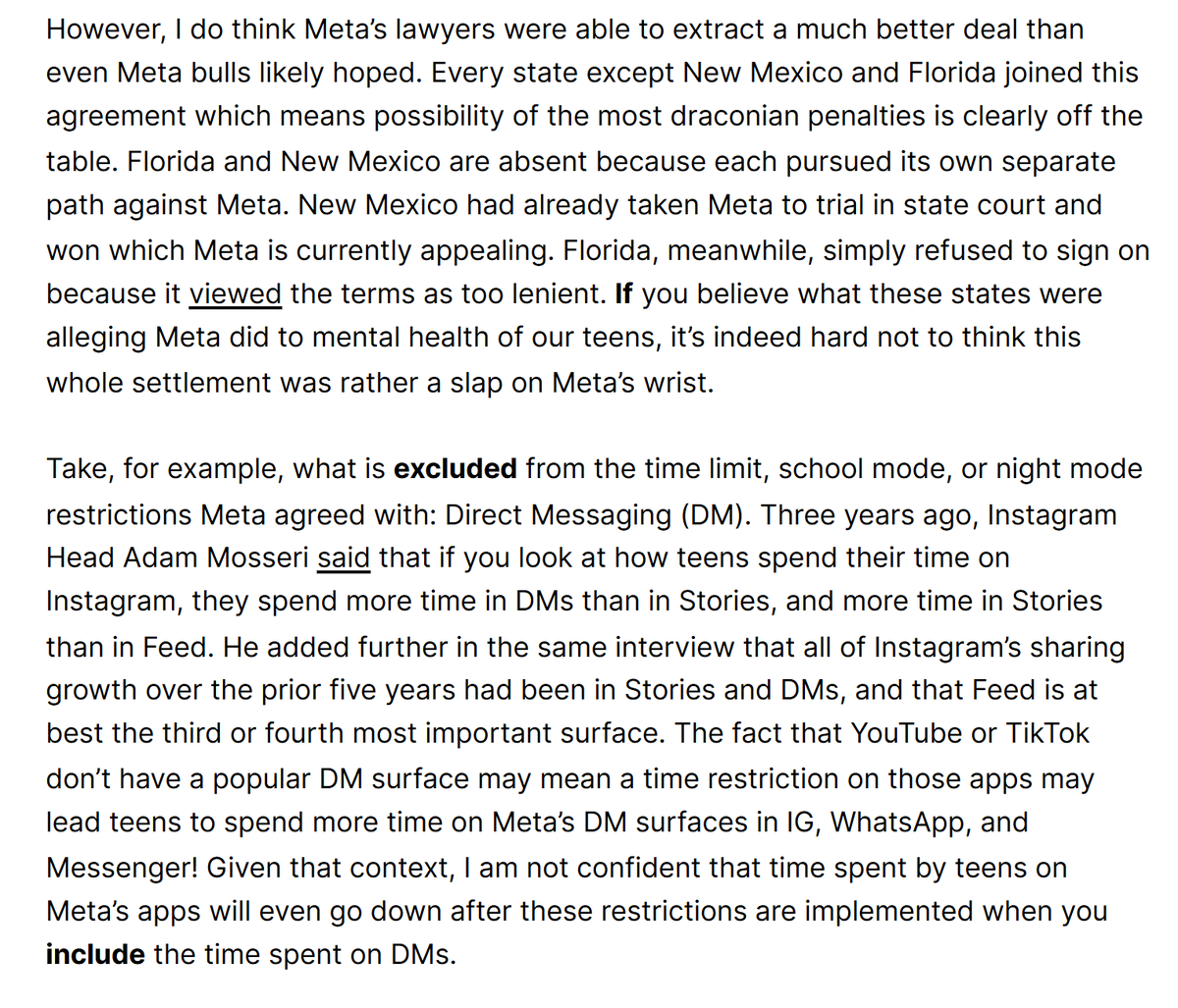
The $META legal team are absolute geniuses
They’ve turned a liability into a competitive advantage by pushing the same restrictions onto Google and TikTok
If they don’t follow → Meta looks more responsible and gains greater political leverage
If they follow → they hurt their own engagement far more than it hurts Meta
Either way, Meta wins
Brad Gerstner is an investor in OpenAI, Anthropic and Google.
On the All-In podcast, he shared the 8 rules he uses to price a company nobody can forecast:
1) He asked how a firm earning $13 billion promises $1.4 trillion
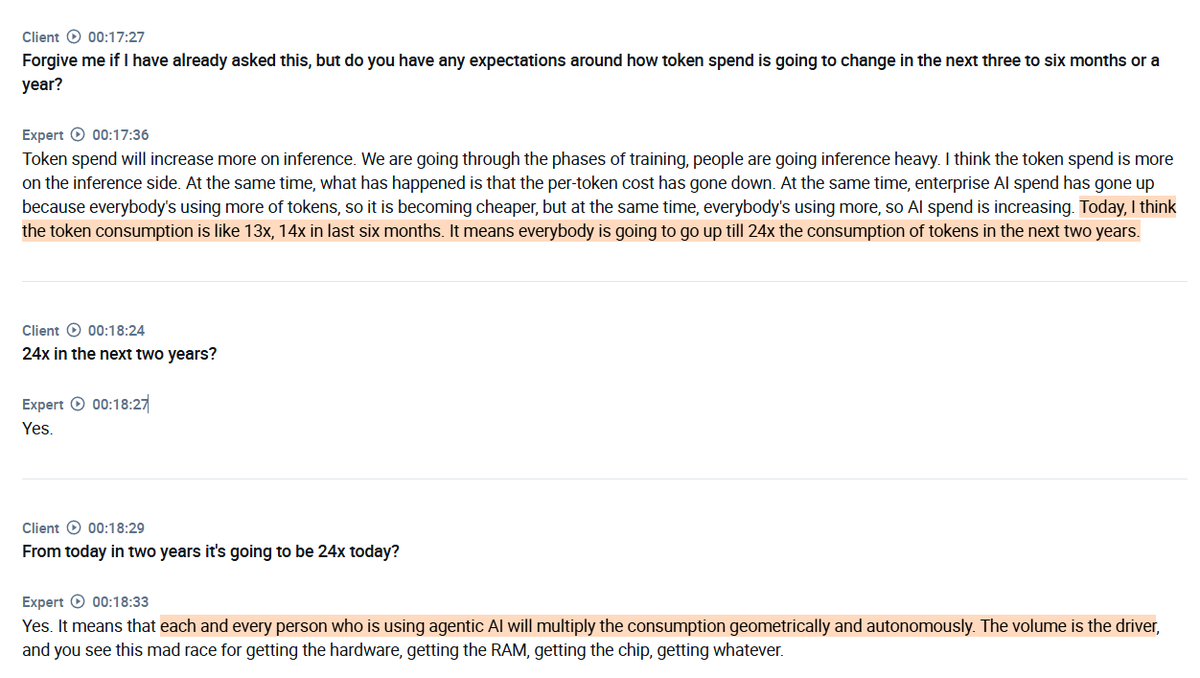
Interview with a $GOOGL employee on why enterprise AI spending is nowhere near its peak despite already growing rapidly ($MSFT):
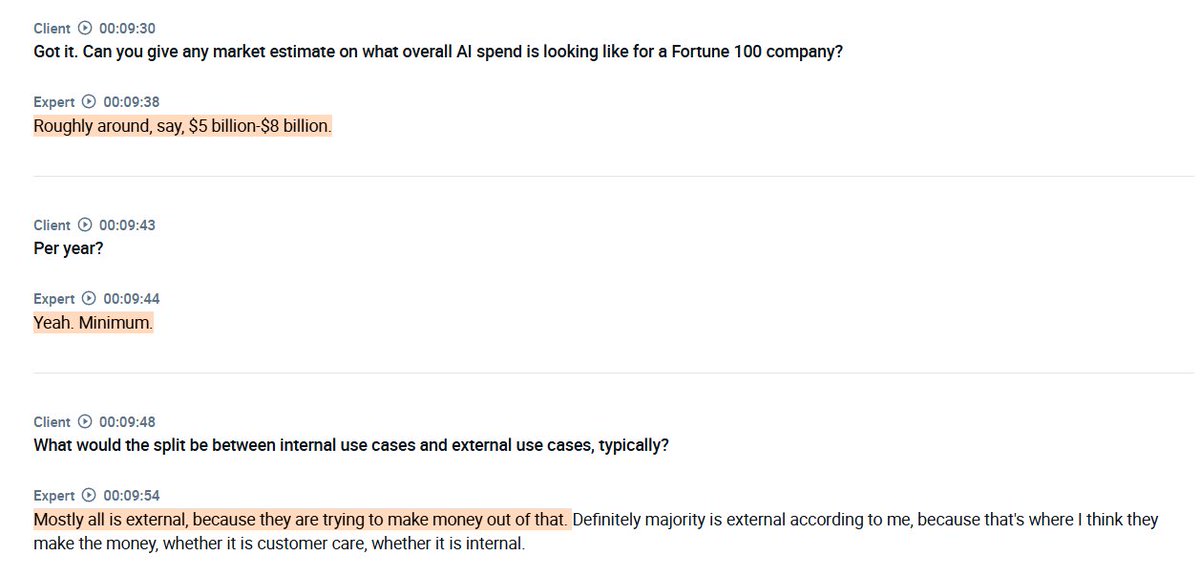
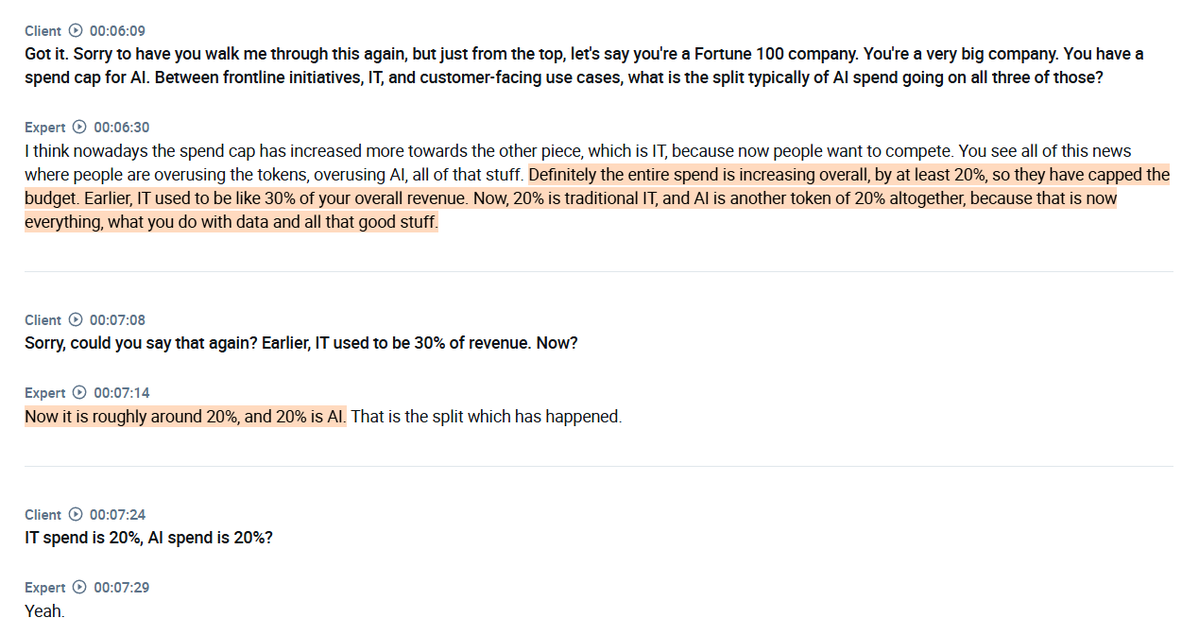
- The expert describes a shift in how enterprise companies allocate their technology budgets, with traditional IT spend down from around 30% of overall revenue to roughly 20%, while AI now represents another 20% on top of that. Within AI spend, the expert confirms that around 60% goes to frontline and customer-facing initiatives, with the remainder split between IT and other internal uses.
- According to the expert, AI CapEx is growing at around 10-12% and now represents closer to 50% of overall technology revenue allocation, up from around 40%. The workforce side is also getting more expensive, with AI-first talent costing enterprises at least 5-7% more in salary as demand continues to outpace supply.
- The expert sees enterprise willingness to spend on AI as high across the board right now, with nobody questioning whether AI investment makes sense. Spend caps are increasing as a natural consequence of rising consumption, with the expert estimating an 8-10% increase in overall spend caps annually. For a large enterprise running around $100-150 billion in revenue, that translates to an IT budget in the range of $4-5 billion.
- The expert expects token spend to keep rising, driven by the shift toward inference-heavy workloads as more enterprises move past the training phase. While the per-token cost has come down, overall AI spend is going up because consumption is growing much faster than prices are falling. The expert estimates token consumption has already grown around 13-14x in the last six months and sees that reaching 24x over the next two years.
🦔Reuters obtained internal Meta data on what happened after Zuckerberg cut 8,000 workers and moved 7,000 into AI roles. AI-generated code changes jumped 220%. New features reaching users only rose 36%. Major incidents spiked 40%. Time spent firefighting those incidents up 70%. Employee sentiment dropped from 74% to 55% favorable. Hours before the first round of layoffs went out, Zuckerberg quietly cancelled the second round that was planned for November.
My Take
A lot of CEOs watched Meta go first on AI layoffs and used it as cover to do the same thing at their companies. Now Meta's internal data is public and it shows the swap didn't work. I'd bet most of them are dealing with similar results and hoping their version doesn't leak this cleanly.
Zuckerberg's 6,500-word essay about AI creating abundance came out while his own engineers were posting about the opposite. I don't know who that essay was for, but it wasn't for the people inside the building. It was for investors, for other CEOs, and for the public markets ahead of a year where Meta needs to justify spending every dollar it earns on AI infrastructure. 220% more code and 36% more features is a rough pitch for $145 billion in spending, and Zuckerberg knows it. That's why the essay exists.
Hedgie🤗
A student told Nobel Prize winner Milton Friedman he couldn't talk about poverty because he'd never been poor.
Friedman answered with two questions that silenced the room.
The second one has become legendary:
"Would you refuse treatment from a cancer doctor unless they'd had cancer?"
His full response on poverty, responsibility, and free markets is worth reading.
Today marks a historic agreement between Meta and 52 Attorneys General that provides sweeping new protections empowering parents and setting the standard for the industry. https://t.co/pSlZmRqX0K
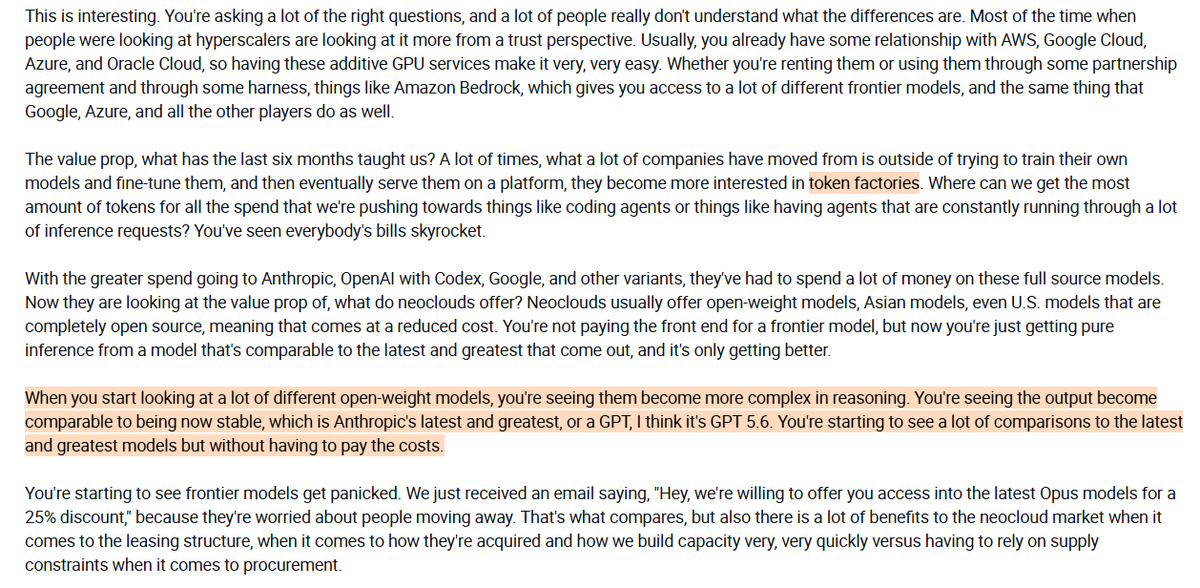
Interview with an industry expert on why neoclouds are expanding beyond compute to compete with hyperscalers ( $AMZN, $MSFT, $CRWV, $NBIS ):
- The expert highlights a meaningful shift in how companies think about AI spend over the last six months, with the focus moving away from training and fine-tuning their own models toward finding the cheapest source of tokens at scale. As bills from frontier providers like Anthropic, OpenAI, and $GOOGL have skyrocketed, neoclouds are becoming an increasingly attractive alternative, offering open-weight models at meaningfully lower cost with a quality gap that is narrowing fast.
- The cost difference between running workloads through Bedrock on a frontier model like Anthropic versus using a neocloud with an open-weight model is significant: a specific workload costs a few hundred dollars on Bedrock compared to under $50 on a neocloud. The gap comes down to the underlying cost of frontier models, which carry a premium as closed ecosystems managed entirely by the provider.
- The expert sees GPU workload optimization as the primary differentiator between neoclouds, with the best ones investing heavily in research to process workloads as efficiently as possible and minimize power consumption. Beyond raw efficiency, value-added services like workload batching, AI-specific storage solutions, and security mechanisms also help them stand out.
- The expert confirms that Fortune 100 companies are taking a much closer look at AI spend after costs increased by as much as 600%, with open-weight models becoming attractive as a way to meaningfully reduce token costs without significant optimization effort. The operational difference between frontier and open-weight models is real but not dramatic, typically requiring a dedicated testing team rather than a fundamentally different engineering capability.
- According to the expert, hyperscalers will continue to dominate among the most regulated industries like the government and three-letter agencies where certifications and compliance requirements make switching impractical. That said, the expert expects the market to even out over time, with neoclouds gaining ground by expanding beyond pure compute into storage and networking, effectively becoming smaller versions of hyperscalers with a broader service offering.
“Meta, who at one point was rumored to be as much as 10% of Anthropic's biz, they're generating way more efficiencies by optimizing ad algorithms, getting engagement time 5% longer, all these things. They're making way more money off of using these models than Anthropic." $META
Five customers accounted for 70% of NVIDIA's accounts receivables at the end of Q2 FY27, and for some customers it's allowing payment terms anywhere from 3 months to a year.
Up from 56% a year ago.