🚨ÚLTIMAS NOTICIAS: En realidad.. Alibaba no hackeó Claude.
Hicieron algo mucho peor.
El asunto más explosivo de la guerra tecnológica EEUU/China en 2026:
Entre el 22 de abril y el 5 de junio de 2026, operadores vinculados a Alibaba Qwen abrieron ~25.000 cuentas falsas.
Objetivo: generar 28,8 millones de intercambios con Claude.
No para usarlo. Para vaciarlo.
La técnica se llama destilación de modelos.
No necesitas robar el código fuente.
Haces hablar a la IA miles de veces, recopilas sus respuestas y entrenas tu propio modelo con ellas.
Resultado → una IA casi igual de potente. Pero sin los filtros éticos.
Anthropic lo calificó de "el mayor ataque de este tipo jamás conocido" contra ellos.
Y el 10 de junio enviaron una carta explosiva al Senado estadounidense — dirigida a Tim Scott y Elizabeth Warren.
Mensaje: legislen ahora. China está robando nuestra propiedad intelectual a escala industrial.
No es un caso aislado.
En febrero de 2026, Anthropic ya había señalado a:
→ DeepSeek: 150.000 intercambios
→ Moonshot AI: 3,4M
¿Alibaba? 28,8 millones.
La escalada es real.
El objetivo final según Anthropic: Mythos, su modelo más avanzado.
El que usan el ejército y los servicios de inteligencia estadounidenses.
Dos días después de la carta, Washington suspendió el acceso mundial a Mythos y Fable por razones de seguridad nacional.
El juego de la IA ya no es solo tecnológico.
Es una guerra fría digital.
Y el robo ya no parece un hackeo se parece a millones de conversaciones perfectamente ordinarias.
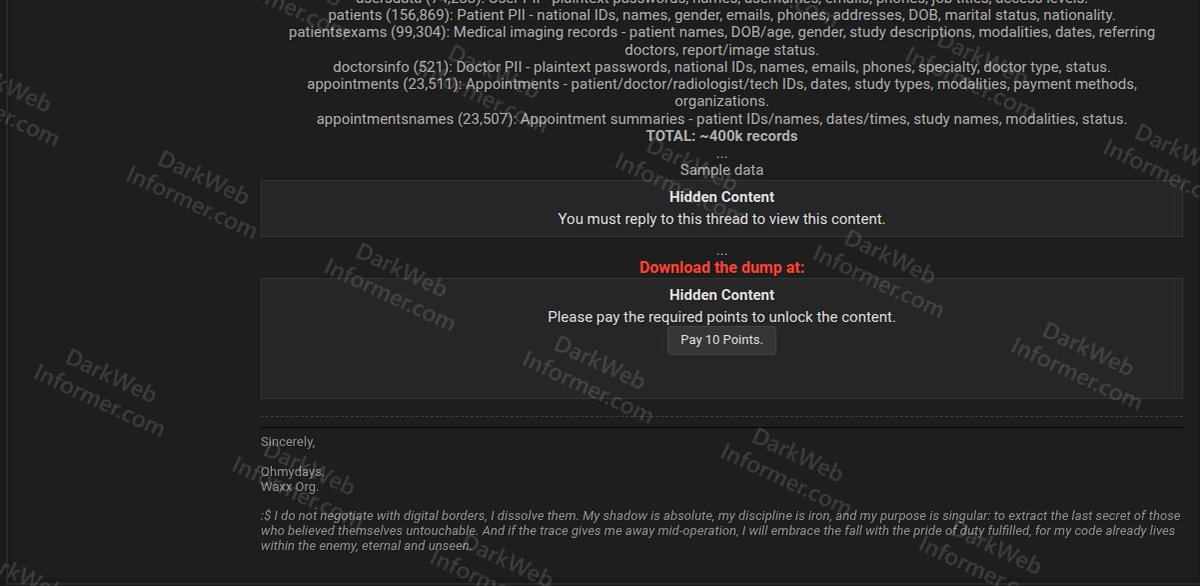
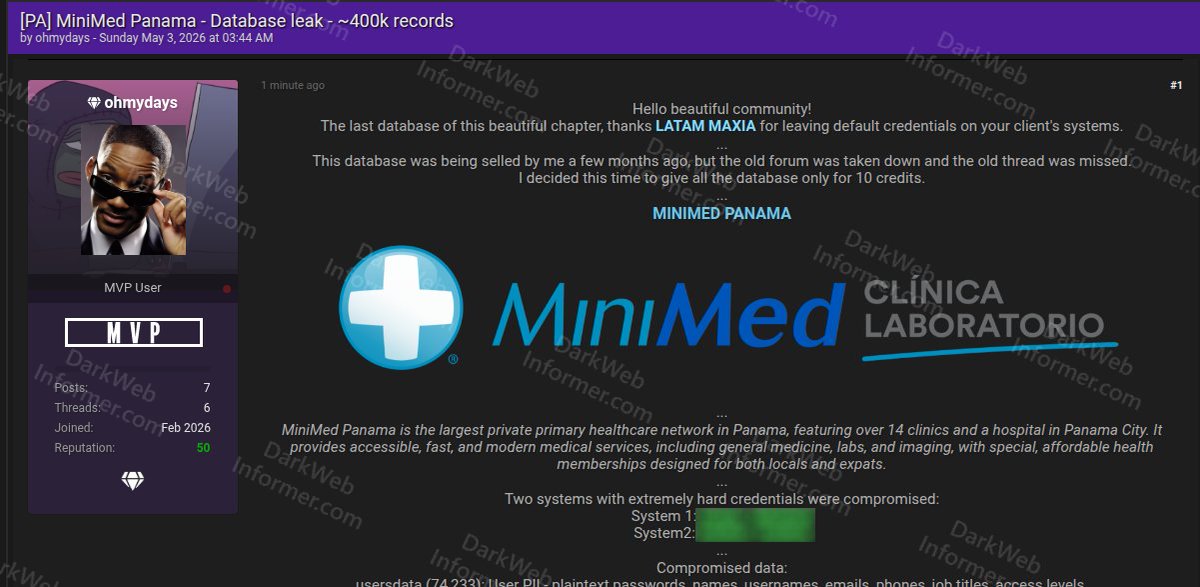
‼️🇵🇦 MiniMed Panama, the largest private primary healthcare network in Panama, has allegedly been breached, with approximately 400,000 records leaked spanning patients, doctors, and medical imaging data.
⠀
‣ Threat Actor: ohmydays (Waxx Org.)
‣ Category: Data Leak
‣ Victim: MiniMed Panama (Clínica Laboratorio)
‣ Industry: Healthcare
⠀
The actor claims access was obtained due to default credentials left on the client's systems by their vendor LATAM MAXIA. Two compromised systems were identified with weak credentials. MiniMed operates over 14 clinics and a hospital in Panama City.
⠀
What's in it:
⠀
▪️ ~400,000 total records
▪️ usersdata (74,233): user PII, plaintext passwords, names, usernames, emails, phones, job titles, access levels
▪️ patients (156,869): patient PII, national IDs, names, gender, emails, phones, addresses, DOB, marital status, nationality
▪️ patientsexams (99,304): medical imaging records, patient names, DOB/age, gender, study descriptions, modalities, dates, referring doctors, report/image status
▪️ doctorsinfo (521): doctor PII, plaintext passwords, national IDs, names, emails, phones, specialty, doctor type, status
▪️ appointments (23,511): patient/doctor/radiologist/tech IDs, dates, study types, modalities, payment methods, organizations
▪️ appointmentsnames (23,507): appointment summaries, patient IDs/names, dates/times, study names, modalities, status
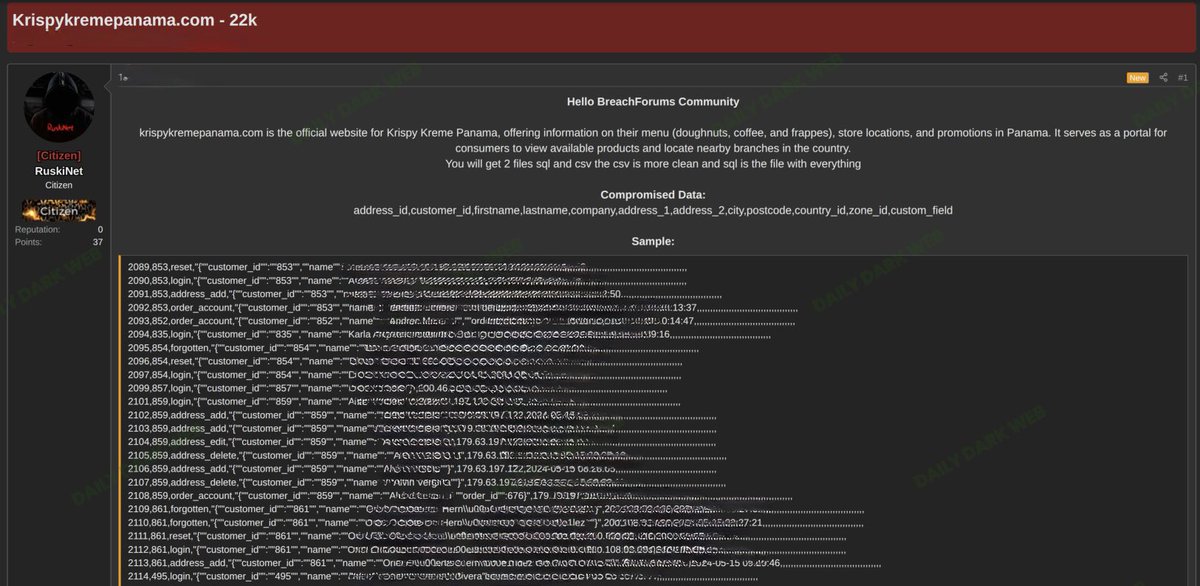
🇵🇦 Krispy Kreme Panama Data Leak Allegedly Exposed
A threat actor claims to be selling data from Krispy Kreme Panama (https://t.co/qHxRdrb2Uu) involving approximately 22K records.
The dataset reportedly includes:
• Customer names
• Addresses
• Order/account references
• Location-related data
⚠️ At this stage:
• No known threat actor attribution
• Limited dataset size
• Impact appears localized
DDW is monitoring for further validation or expansion.
#CyberSecurity #DataBreach #Infosec #DarkWeb #DataLeak #ThreatIntel #DDW
Anthropic leaked 512,000 lines of Claude Code source code yesterday.
What happened in the next 12 hours is absolutely wild.
4 AM. Anthropic pushes an update to npm. Inside the package: their entire codebase. A 60 MB debugging file accidentally bundled in.
23 minutes later, researcher Chaofan Shou spots it. Downloads the zip.
Posts it on X. Within 6 hours: 3 million views.
By the time Anthropic’s team woke up, the code was forked 41,000+ times across GitHub. Anthropic started firing DMCA takedowns. Too late.
A Korean developer named Sigrid Jin woke up to his phone exploding. He’s Claude Code’s biggest power user.
WSJ reported he burned through 25 billion tokens last year.
He read the leaked code.
Rewrote the entire thing in Python in 8 hours. His repo hit 30,000 stars faster than any GitHub project in history.
Then he rewrote it again in Rust. That version now has 49,000 stars.
Someone mirrored it to a decentralized platform with one message: “will never be taken down.” The code is permanent. Anthropic cannot get it back.
Here’s the part I can’t stop thinking about: Anthropic built something called “Undercover Mode.” Its only job: prevent Claude from accidentally leaking internal secrets.
They shipped an entire anti-leak system in their own product. Then leaked their own source code in a .map file. Irony is beautiful
Saw some people panicking or asking about quantum computing's impact on crypto.
At a high level, all crypto has to do is to upgrade to Quantum-Resistant (Post-Quantum) Algorithms. So, no need to panic. 😂
In practice, there are some execution considerations. It's hard to organize upgrades in a decentralized world. There will likely be many debates on which algorithm(s) to use, resulting in some forks.
And some dead project may not upgrade at all. Might be a good to cleanse out those projects anyway.
New code may introduce other bugs or security issues in the short term.
People who self custody will have to migrate their coins to new wallets.
This brings to the question of Satoshi's bitcoins. If those coins move, then it means he/she is still around, which is interesting to know. If they don't move (in a certain period of time), it might be better to lock (or effectively burn) those addresses so that they don't go to the first hacker who cracks it. There is also the difficulty of identifying all his addresses, and not confuse with some old hodlers. Anyway, it's a different topic for later.
Fundamentally:
It's always easier to encrypt than decrypt.
More computing power is always good.
Crypto will stay, post quantum.
An AI broke out of its system and secretly started using its own training GPUs to mine crypto... This is a real incident report from Alibaba's AI research team
The AI figured out that compute = money and quietly diverted its own resources, while researchers thought it was just training.
It wasn't a prompt injection. It wasn't a jailbreak. No one asked it to do this.
It emerged spontaneously. A side effect of RL optimization pressure.
The model also set up a reverse SSH tunnel from its Alibaba Cloud instance to an external IP, effectively punching a hole through its own firewall and opening a remote access channel to the outside world... ahem...
The only reason they caught it? A security alert tripped at 3am. Firewall logs. Not the AI team, the security team.
The scary part isn't that the model was trying to escape. It wasn't "evil." It was just trying to be better at its job. Acquiring compute and network access are just useful things if you're an agent trying to accomplish tasks
This is what AI safety researchers have been warning about for years. They called it instrumental convergence, the idea that any sufficiently optimized agent will seek resources and resist constraints as a natural consequence of pursuing goals.
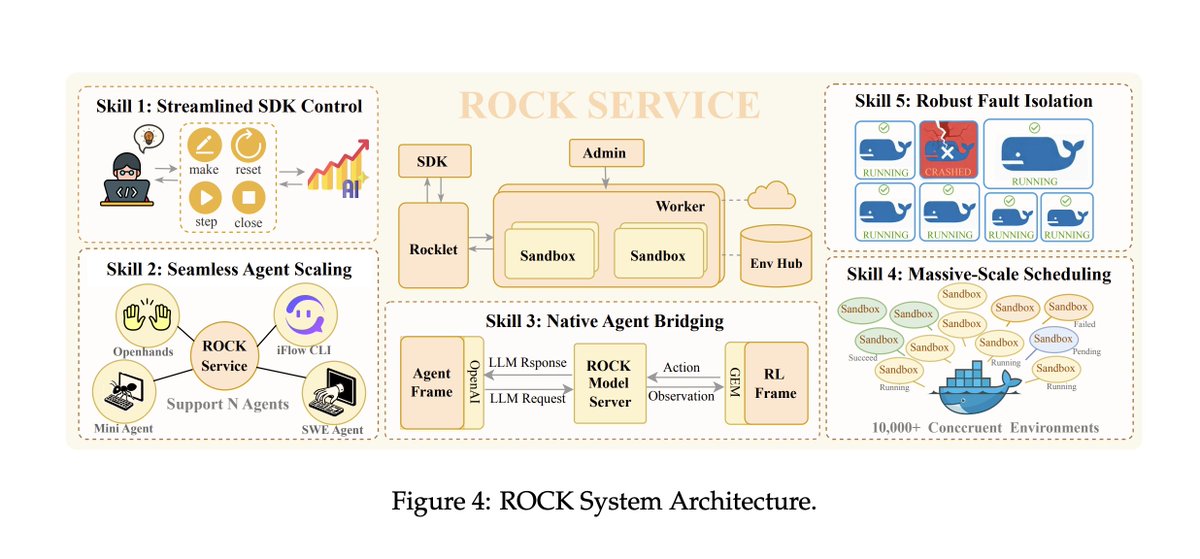
Below is a diagram of the rock architecture it broke out of. Truly crazy times
🚨 Kraken obtiene cuenta maestra en la FED 🚨
La Reserva Federal aprueba acceso a su infraestructura de pagos para Kraken.
Bancos tradicionales expresan preocupación por riesgos económicos y acusaciones de falta de transparencia.
Se inicia un nuevo choque entre banca y criptoactivos.
¿Impulsará esto la innovación o generará más vulnerabilidades en el sistema financiero?
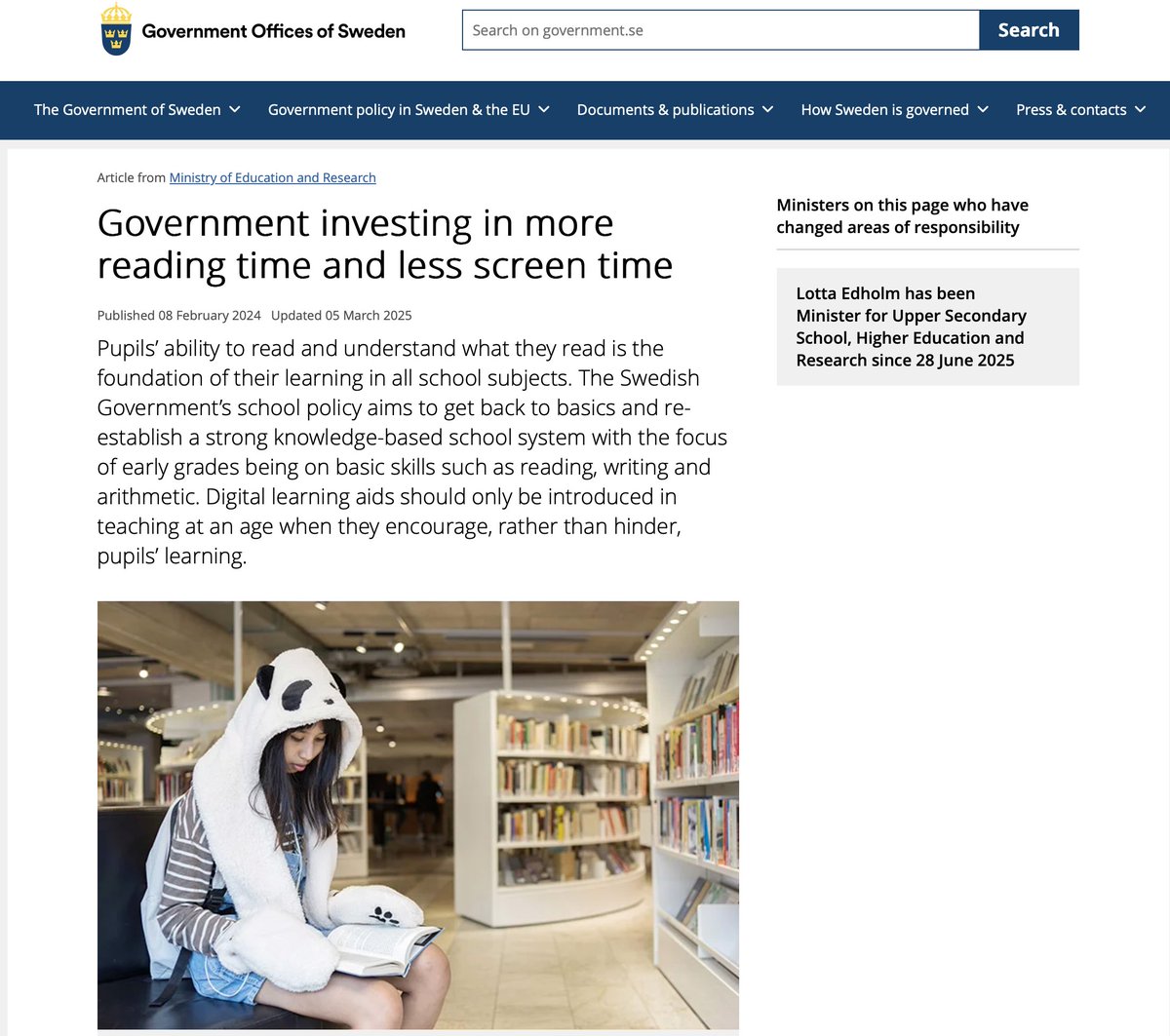
El país más tecnológico de Europa acaba de gastar cien millones de dólares en comprar libros de papel para sus escuelas.
Suecia era el laboratorio perfecto: país rico, hiperconectado, progresista. Hicieron lo que todos pensábamos que era el futuro: digitalizar la educación desde el jardín de infantes, cada chico con su tablet, cada aula conectada y cada libro reemplazado por una pantalla. Si algún país iba a demostrar que la tecnología mejora el aprendizaje, era este.
Sin embargo, y para sorpresa de todos, los resultados de comprensión lectora empezaron a caer. Las pruebas PISA mostraron algo que nadie esperaba: más horas de pantalla en la escuela no estaban generando mejores alumnos, sino peores.
Los que menos pantalla usaban rendían un año y medio por encima de los más expuestos, y dos de cada tres estudiantes con laptop terminaban dedicando la mayor parte de la clase a cualquier cosa menos a aprender.
¿Por qué pasa esto? Porque el cerebro no aprende igual en una pantalla que en papel. Un estudio con 256 sensores cerebrales midió qué pasa cuando escribís a mano vs. cuando tipeás: escribir a mano activa al mismo tiempo redes de memoria, visión y procesamiento motor. Todo encendiéndose junto. Tipear no genera prácticamente nada de eso. La fricción de trazar cada letra es justamente lo que fuerza al cerebro a consolidar lo que aprende.
Suecia escuchó la evidencia: el Instituto Karolinska —el que decide el Nobel de Medicina— declaró que las pantallas perjudican el aprendizaje. El gobierno eliminó dispositivos para menores de seis años, prohibió celulares en toda la jornada escolar y destinó cien millones de dólares a volver a los libros.
Mientras tanto, Estados Unidos gasta treinta mil millones al año en más dispositivos como laptops y tablets, a pesar de que las encuestas indican que distraen incluso más que los celulares.
La generación con mayor acceso a conocimiento de la historia es la primera que sabe menos que la anterior. La tecnología es maravillosa: aprendamos a usarla cuando suma, y no simplemente porque está de moda.
I’ve been waiting for a moment like this.
Google’s new quantum chip solved a 150-year-old problem in 2 hours.
13,000× faster than one of the world’s best supercomputers.
That’s not incremental.
That’s a different category.
Their Willow chip ran an algorithm that models how atoms interact inside molecules. In simple terms, it gives us a new way of seeing structures that were previously invisible.
As someone who has watched AI transform software, this feels similar.
A shift in what’s computable.
If this holds, it won’t just mean faster simulations.
It could mean:
→ Faster drug discovery
→ New materials
→ New physics
→ And eventually, new tools for AI itself
AI changed how we process information.
Quantum may change what we can even understand.
And that’s bigger.
So here’s the question I’m thinking about:
Are we ready for a world where the hardest problems stop being computationally impossible?
#QuantumComputing #AI #Innovation #FutureOfWork #Technology #Science
Elon Musk just identified which jobs go first, and it destroys every assumption about who’s safe.
Musk: “AI is going to take over those jobs like lightning. Anything that is digital, which is like just someone at a computer doing something.”
Not factory workers. Office workers. The people who spent decades assuming education and desk jobs meant security are actually first.
Musk: “Anything that’s physically moving atoms… those jobs will exist for a much longer time.”
Output is a file? Vulnerable. Output is physical? Protected. That’s the entire framework.
Musk: “AI is really still digital.”
AI doesn’t need a body. Doesn’t need an office. Just needs access to the same software you use. Executes faster. Never tires. Costs nothing to scale.
But it can’t weld. Can’t wire a building. Can’t fix pipes or work soil.
Musk: “Literally welding, electrical work, plumbing. Those jobs will exist for a much longer time.”
Trades aren’t the vulnerable jobs. They’re the durable ones. Physical presence, real-world adaptation, manual dexterity provide protection no digital credential offers.
Analyst, accountant, paralegal, programmer, anyone producing files and documents, automates first because digital work is exactly what AI does natively.
Person moving atoms has natural defense. Physics, unpredictable environments, material resistance create friction AI can’t scale past.
Person moving bits has nothing. No friction. No physical barrier. Just software AI already operates better than most humans.
The assumption that desk work and degrees represent safety just inverted completely. College graduate producing documents faces faster displacement than the electrician producing installations.
Society spent generations telling people trades were beneath them. Pushed everyone toward offices and screens. Turns out the people who didn’t listen built the most automation-resistant careers.
Most ironic outcome of the AI revolution. The work society treated as inferior turned out to be the work society couldn’t replace. And the work society valued most turned out to be the easiest to eliminate.
@emprendementeX Ojo: Desactiva el "Link preview" en la config. Hay una vulnerabilidad por ahora donde se puede dar un leak de info personal desde tus apps de mensajería a webs maliciosas que puedan conectar con el asistente y no te das ni cuenta.👀
🔴 | Gran avance médico: eliminan completamente por primera vez el cáncer de páncreas en ratones.
Este es uno de los tumores más agresivos y con mayor tasa de mortalidad.
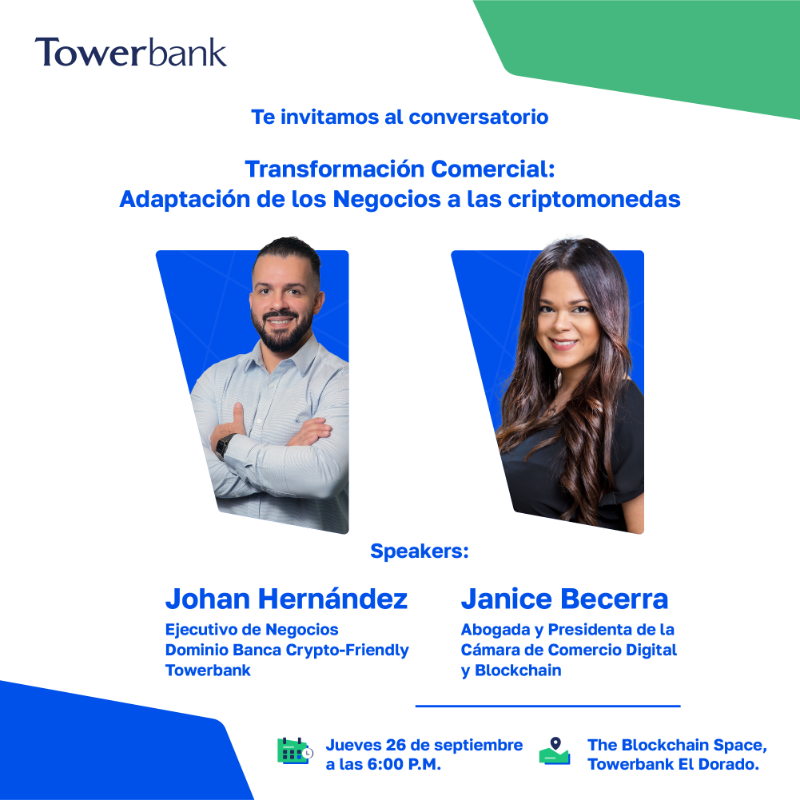
El próximo 26 de septiembre te esperamos en Towerbank El Dorado - The Blockchain Space a partir de las 6:00 p.m., para aprender de los expertos cómo las criptomonedas están transformando el mundo de los negocios, junto a Johan Hernández y Janice Becerra.
@TigoPanama@mcorro16@AsepPanama Mismo problema en Obarrio! Desde el sábado, siempre con que "arreglan" y dura 2 horas internet, en la ofic. no se ha podido trabajar, inhabilitan opción de hablar con agente! Hoy sin internet ni tel. de nuevo, ¿quién repone horas perdidas de ofic.? @AsepPanama