Der 100-Jahre-Plan für den Aktienmarkt
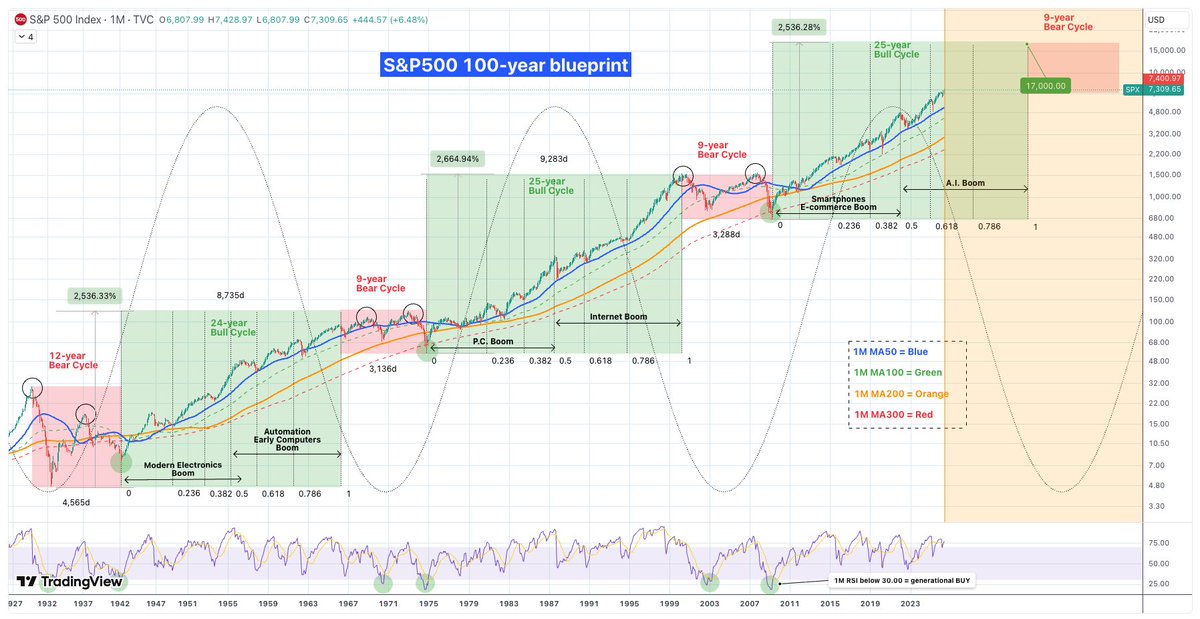
Wenn du dir die letzten 100 Jahre anschaust, siehst du ein klares Muster: Der Markt wiederholt immer wieder die gleichen Zyklen. Seit der Großen Depression 1930 gab es drei große Abwärtsphasen und drei Aufwärtsphasen .
Wir stecken gerade mitten im dritten großen Bullenmarkt.
Die schlechten Zeiten (Bärenmärkte)
Diese Phasen dauerten meistens etwa 9 Jahre (die Weltwirtschaftskrise von 1930 war mit 12 Jahren eine Ausnahme). Ein typisches Zeichen war, dass der Markt zweimal oben und zweimal unten „anklopfte“, bevor es wieder aufwärts ging. Oft krachte der Kurs bis zu einer bestimmten langfristigen Linie (dem 300er-Schnitt im Monatschart) und startete von dort aus neu durch.
Die guten Zeiten (Bullenmärkte)
Die ersten beiden großen Aufwärtsphasen dauerten jeweils 24 und 25 Jahre. Das Spannende: Sobald der Markt einmal Fahrt aufgenommen hatte, fiel er fast nie unter eine bestimmte grüne Linie (den 100er-Schnitt). Die blaue Linie (50er-Schnitt) war dabei immer die beste Chance, um günstig nachzukaufen, wenn es mal zwischendurch ruckelte.
Warum steigt der Markt so extrem?
Hinter jedem Bullenmarkt steckt eine neue Technologie:
Früher waren es industrielle Durchbrüche.
Dann kam der Internet-Boom.
Heute erleben wir den E-Commerce- und Social-Media-Boom.
Klar, irgendwann platzen diese Blasen immer, weil die Leute übertreiben. Aber die Technik bleibt! Das Internet ist nicht verschwunden, nur weil die Kurse im Jahr 2000 abgestürzt sind – es wurde zum Fundament für alles, was wir heute nutzen.
Der KI-Boom
Wir sind jetzt im zweiten Teil des aktuellen Aufschwungs, und der wird von der Künstlichen Intelligenz getrieben. Wahrscheinlich wird diese Blase um das Jahr 2034 platzen. Das wird wehtun, aber danach wird KI das feste Rückgrat unserer gesamten Wirtschaft sein.
Im Grunde sind die letzten 100 Jahre eine Kette von Erfindungen, die die Kurse immer höher treiben. Die Abstürze zwischendurch sind nur dazu da, die heiße Luft rauszulassen und Platz für neues Geld und die nächste Technologie zu machen.
Was bedeutet das für dich heute?
Wenn dieser Zyklus so läuft wie die letzten beiden, könnte der S&P 500 bis auf 17.000 Punkte steigen.
Es wird zwischendurch immer wieder Korrekturen geben. Der Zoll-Crash Anfang 2025 war so ein Moment, hat aber die wichtige blaue Linie nicht ganz berührt.
Schau auf den RSI-Anzeiger. Wenn der unter 30 fällt, ist das eine Chance des Jahrzehnts. Das ist in 100 Jahren erst sechsmal passiert – und jedes Mal war es der perfekte Zeitpunkt zum Kaufen.
Liken, Folgen, Speichern, Kommentieren, Teilen.
Danke für den Support 🫶😊🫶
This is it.
Everything learned spending millions on longevity.
From: Your Immortal Unc and Auntie.
To: Our Immortal nieces and nephews.
0. Sleep is the world's most powerful drug.
1. Be in your bed for 8 hours
2. Same bedtime every night, any time before midnight
3. Don’t eat right before bed
4. Calm foods for dinner
5. No screens 1 hour before bed
6. Avoid added sugar (be aware it’s in everything)
7. Avoid all things in an American convenience store
8. Avoid fried foods
9. Shoes off at the door
10. Eat whole foods, particularly veggies fruits nuts legumes berries
11. Walk a little after meals or air squats
12. Get your heart rate high routinely
13. Lift heavy things
14. Stretch daily
15. Water pik, floss, brush, tongue scrape, morning and night
16. Make an effort to drink water
17. Get sunlight when you wake up (UV is low)
18. Protect skin in midday sun
19. Stand up straight
20. See at least one friend once a week
21. Avoid plastic where you can (in all things)
22. Circulate air in rooms
23. When stressed, breathe, learn to calm your body
24. Go to the dentist
25. Avoid sitting for long times
26. Protect your hearing, the world is too loud
27. Alcohol is bad for you
28. Finish coffee before noon
29. Avoid bright lights after sunset
30. If obese, look into a GLP
31. Sleep in a cold room
32. Texting while driving is dangerous
33. Turn off all notifications
34. Limit social media use
35. Don’t smoke anything
36. If you struggle to sleep, read a physical book before bed
37. 1 hour before bed have a calm wind down routine: bath, read, light walk, listen to music
38. The body is a clock and loves routine. Have a daily morning and evening schedule.
39. Avoid long distance travel where you can
40. Baby steps first: incorporate new things slowly
41. Do less… most things don’t work.
Bonus points if you get your blood checked.
Start here, it will change your life.
In my opinion we are in the blowoff phase of this cycle
Traditionally, as crypto participants we are used to compressed life cycles. 2-4y cycles with a 2-6month blowoff
Traditional equity cycles 10-15y with a 1-2y blow off
I will be shopping yolo calls all week on data/energy names
shill me tickers
𝐚𝐧𝐠𝐞𝐥 𝐧𝐮𝐦𝐛𝐞𝐫𝐬 𝐜𝐡𝐚𝐥𝐥𝐞𝐧𝐠𝐞 𝟖𝟖𝟖𝟖𝟖𝟖 𝐭𝐨 𝟖𝟖𝟖𝟖𝟖𝟖𝟖
swapped 70353 $USDC for 1090508 $CHIP
mc at time of buying: 127m $
i like the vision. this interview with one of the founders made a really good impression on me: https://t.co/ALrNyeUuB1
very interesting concept with a clear crypto fit. and with the inevitable -60% drawdown after initial hype overshoot and bad MM choices now complete and Larry Fink forecasting the advent of new financial markets centered around buying and selling compute futures makes me think its a good time to buy.
𝐡𝐨𝐥𝐝𝐢𝐧𝐠𝐬:
650000 USDC
330m ASTEROID
2665 shares HIMS
1090508 $CHIP
239k POD
3.03m SR
646838 vamp asteroid (hedge)
𝐭𝐨𝐭𝐚𝐥 𝐀𝐔𝐌 𝐢𝐧 𝐝𝐨𝐥𝐥𝐚𝐫:
970000
𝐩𝐫𝐨𝐠𝐫𝐞𝐬𝐬 𝐛𝐚𝐫 (𝐫𝐞𝐚𝐥𝐢𝐳𝐞𝐝):
▮▯▯▯▯▯▯▯▯▯▯▯▯▯▯▯▯▯▯▯ 7.31%
𝐩𝐫𝐨𝐠𝐫𝐞𝐬𝐬 𝐛𝐚𝐫 (𝐢𝐧𝐜𝐥𝐮𝐝𝐢𝐧𝐠 𝐮𝐏𝐧𝐋):
▮▮▯▯▯▯▯▯▯▯▯▯▯▯▯▯▯▯▯▯ 10.91%
Write about your worst memory for 15 minutes a day, four days in a row. Six months later you'll go to the doctor half as often as people who didn't. James Pennebaker first ran that experiment at SMU in 1986. He's been trying to figure out why ever since.
Two years later he ran it again with two scientists who study the immune system. The writers' T-cells came back stronger. Way stronger than everyone else's. Those are the cells your body uses to fight off infections.
In 1999 the same idea got tested on people with asthma and arthritis. Twenty minutes a day, three days in a row. Four months later the asthma group was breathing better, and the arthritis group had fewer symptoms.
A 2004 study in New Zealand tried it on 37 people with HIV. The writers' CD4 counts went up. That's HIV's main target. The other group, who wrote about boring everyday stuff, didn't budge.
By 2006 someone had pulled 146 of these studies together. The same effect kept showing up across cancer patients, prisoners, college kids, and people with autoimmune diseases.
Researchers in the UK pushed it further in 2008. They split 36 people into two groups and gave each person a tiny circular cut on the inside of the arm, the kind you get from a skin biopsy. The first group had spent three days writing about something painful before the cut. The other wrote about their day. Two weeks later the writers' cuts had closed up faster on ultrasound.
Different angle, 2024. A team in Norway put EEG caps on people while they wrote. 256 sensors picked up brain activity. When you write by hand, wide stretches of your brain start talking to each other. The parts that handle movement and memory fire in patterns tied to learning. When you type, that doesn't happen.
Forty years in. The simplest version still works. Sit down for 15 minutes, write about what's bothering you. The "crazy gift" yimika is talking about shows up in blood draws, biopsy ultrasounds, and brain scans.
the most profitable trader on @HyperliquidX with an all time PnL of 180m has printed 6.3m from funding doing the carry trade for his $4.3m worth of staked $HYPE.
this is why i will continue to constantly shill this trading method.
data from @HyperTracker
i can admit when i was wrong.
so there's good news and bad news:
bad news: sniping modern pateks/rolexes on ebay is not a thing. it's an ~efficient market
good news: passing unidetified manhattan estate liquidation lot images through a vision model to find mispricings appears to be a thing
the core of the thesis has evolved to: find auction pools where the clearing price is structurally depressed for reasons unrelated to what the item is, and value it against the current bid
you thought C-tier perp DEX RWA flow was soft?
how about regional pickup-only estate liquidation listings
that busted up old japanese paper divider that sat next to Gramps' writing corner? it's worth $12,000 to a collector, but the top bid is for $30, and the seller just wants it gone
Maw Maw's favorite brooch listed for $120? it's tiffany and it's worth $25,000
but nobody knows these valuations except a few thousand people in the entire USA per niche category. and the odds that they are going to sift thourgh hundreds of thousands of random listings daily that are mislabeled (or, more commonly, unlabeled) to find all mispricings is ~0
so i (claude) built a tool to scrape nyc tri-state area estate liquidation sales, price listings, and surface the gems
first pass does a claude haiku 4.5 valuation. 2nd pass (manual) is an opus 4.7 valuation for the high ticket items with low bids. on many thousands of listings per day
manhattan is a particularly good sub-market for this (although probably more efficient than some) because of the concentration of wealth
but any major metro will have some inefficiency / insane deals
--
to expand on the thesis a bit
edge comes primarily from the venue, not the query. we are trying to stack multiple qualifiers from the following list to determine likely 'soft' venues for listing discovery
A. limited bidder pool - small venue, obscure platform, in-person, local-only
B. wrong bidder pool - charity gala, corporate event, room full of non-specialists
C. friction - pickup only, wire/cash only, old bad website
D. non-monetary motivation - tax deduction > price, speed > price (estate, divorce, bankruptcy)
E. information asymmetry - seller doesn't know what they have
F. time-boxed release - court deadlines, closeouts, lapsed reservations
scraping currently on estate liquidations in the tri-state area but i think there is probably softer flow out there. maybe charity auctions or court-ordered liquidations
----
good side project, will continue
my full conversation today with @cobie
01:04 offering to work at Coinbase for free
06:05 the K-shape crypto thesis
10:33 thoughts on Saylor
14:39 why UpOnly hasn't come back
22:37 the last 10 years of Crypto
44:52 trillion dollar IPOs
57:02 Cobie's legendary buy wall
1:02:57 top 5 Crypto traders of all time
1:21:20 reasons to be optimistic on Crypto
𝐚𝐧𝐠𝐞𝐥 𝐧𝐮𝐦𝐛𝐞𝐫𝐬 𝐜𝐡𝐚𝐥𝐥𝐞𝐧𝐠𝐞 𝟖𝟖𝟖𝟖𝟖𝟖 𝐭𝐨 𝟖𝟖𝟖𝟖𝟖𝟖𝟖
swapped 50000 $USDC for 1630 shares $HIMS
price at time of buying: 30.74$
been observing that for a while. i think peptides are gonna be a big meta. and its nowhere near as inflated as AI is atm. am interested in the space. LLY and Novo Nordisk are the producers, hims & hers is the distributor. wanted to build a whole portfolio around this but decided imma just go with hims because it has the most mememtic potential, is most talked about. best memetic exposure to peptides meta.
was waiting for a pullback that never came. price now overbought, but also still down -50% from the highs. i have little experience in stock market pa and i don't know what the best thing to do is in such a situation. so i decided to go middle grounds and deploy partly. if it goes down imma buy more, if it keeps continuing i can average higher.
𝐡𝐨𝐥𝐝𝐢𝐧𝐠𝐬:
870000 USDC
114m ASTEROID
1630 shares $HIMS
𝐨𝐩𝐞𝐧 𝐩𝐞𝐫𝐩𝐬 𝐩𝐨𝐬𝐢𝐭𝐢𝐨𝐧𝐬:
none
𝐭𝐨𝐭𝐚𝐥 𝐀𝐔𝐌 𝐢𝐧 𝐝𝐨𝐥𝐥𝐚𝐫:
958000
𝐩𝐫𝐨𝐠𝐫𝐞𝐬𝐬 𝐛𝐚𝐫 (𝐫𝐞𝐚𝐥𝐢𝐳𝐞𝐝):
▮▯▯▯▯▯▯▯▯▯▯▯▯▯▯▯▯▯▯▯ 9.78%
𝐩𝐫𝐨𝐠𝐫𝐞𝐬𝐬 𝐛𝐚𝐫 (𝐢𝐧𝐜𝐥𝐮𝐝𝐢𝐧𝐠 𝐮𝐏𝐧𝐋):
▮▮▯▯▯▯▯▯▯▯▯▯▯▯▯▯▯▯▯▯ 10.77%
Listened to a pretty interesting podcast, guest is a mid-frequency trader describing all the stupidity and his edges from that in the market.
His core argument is simple: crypto has the worst counterparties in the world, by design.
In equities humanity's full effort goes into correct pricing. Best math kids, best unis, best training, million $ salaries, multi-million bonuses. Competing against that as a trend follower gets you Sharpe 0.2 on a good day. Barely worth doing.
And in crypto you're choosing between the XTX autist from Holland or the guy with an ape pfp in a boomer Facebook group who thinks Bitcoin replaces fiat. > Hist words.
"There's no second-worst counterparties than crypto."
Then 3 structural reasons the dumb money stays dumb:
1) Sticky capital. Money comes in, goes up 20-30%, now you've got a bunch of guys on house money playing loose at the casino. That money sloshes around within crypto but almost never leaves. Pull 100 friends who are in crypto, ask how many have an off-ramp plan. Vast majority don't.
2) Siloed capital within chains. Once you're in the Phantom wallet on Solana you're not bridging back to MetaMask and paying ETH fees. That capital is trapped in the ecosystem, sloshing between whatever horses are running, creating massive reflexive swings.
3) Price insensitive buyers and sellers on both sides. Bitcoin cultists buying at $120k because today is always the best day. That's your edge on the long side. VCs who got in at $5m valuation and are sitting on a $400m coin, slowly bleeding exit liquidity into thin markets for 90 days. That's your edge on the short side. North Korea who just hacked a bridge and needs to sell before anyone freezes the funds - doesn't care what price they get. Short that too.
Now his edges, just simple stuff I think most of us know here but probably the majority doesn't execute on well or systematically.
- Top 20 momentum
Buy anything in the top 20 by market cap within 5 days of making a 20-day high. Sell when it goes 5 days without a new 20-day high. Equal weighted. Sharpe 1.3 through bull, bear.
- Stack three things together
That trend system plus cross-sectional momentum (rank everything, long top 50%, short bottom 50%, market neutral) plus carry (long highest funding rate coins, short most expensive to hold). Equal weighted. Daily execution from a spreadsheet. Comes out Sharpe 2.
- Volume predicts price (volume attention price loop)
Rank all coins by volume after stripping market noise. Long increasing volume, short decreasing volume. "Well over Sharpe 2." Known effect, reflexive, provable statistically. Higher volume predicts higher prices. Lower volume predicts lower prices. Sounds like nothing.
- Short small caps that pump
Momentum works on large caps. Flips negative by the third or fourth decile. Bottom 20% of Binance perps makes a 20-day high - short it. Strong edge because it's the market maker Dubai pump and dump lifecycle playing out mechanically every single time.
- New Binance listing short
Market maker contract is 90 days. Strike price set off 7-day VWAP after launch. From day 7, delta hedging mechanically pushes the coin down. Short it for 90 days. Every time. Edge comes entirely from understanding how the game is structured, not from any signal at all.
Another case of simplicity winning. Will drop the podcast in the replies, worth listening.
I guess the coins I like the most going into the new cycle are these:
1. $HYPE (perps, L1)
2. $TAO (AI, L1)
3. $NEAR (AI, L1, privacy)
4. $LIT (perps, the best bet on perps after HYPE)
5. $PUMP (memecoins, speculation)
6. $ZEC (L1, privacy)
7. $MON (new L1)
8. $MEGA (new L2)
New coins good, old coins bad. HYPE, LIT, PUMP, MON, MEGA has never been in a bull. Well, you could argue HYPE launched at the tail of the bull, but not a full cycle. TAO and NEAR are clear tokens in the AI narrative. ZEC is the "VC-privacy coin".
But tokens are not stocks, they have no value. Yes, and no. I think this is one of the hardest "dilemmas" of the new cycle. Betting on tokens in 2023 felt like a no-brainer. We all had hopes that our coins would make a comeback at some point. Now, in 2026, with an infinite number of tokens, it's harder than ever to pick something. There is a huge difference between a good product and a good token, and since most tokens are governance tokens, do we really need them? Maybe not, but it remains the main vehicle for speculation.
What about BTC, SOL, ETH? BTC should always be a part of a core portfolio, maybe SOL and ETH also, but I think the ones above will outperform compared to them.
Anyway, my gut feeling says that there will be something else that takes the spotlight, and that "the new thing" will outperform all of the 8 I listed. These are my thoughts today. Next week or next month I could already have changed my mind, so NFA and do your own research.
Just learned about Ken Isaacs' "Superchair" (1967).
Built-in book rest, shelves, lamp, drink tray, and a seat back that folds into a bed.
A place for "inventive work and the individual search for peace of mind", as he put it.
It was meant for people to build it themselves, hence the almost unfinished look. Blueprints were published in Popular Science in 1968.
$BTC's upside over the past year has only come from Monday's and Wednesday's.
Thursday has been a big red day on average which is something that has been going on for several years already.
Even though these are just averages, it is still good to be aware if you're trading these intra-day moves. I do find it quite useful myself at times.
NADO x INK — Best Airdrop Opportunity for 2026
The best airdrop opportunity in crypto right now isn't on a new L1 or AI chain. It's on INK — Kraken's L2 — and the flagship perp DEX on it, NADO, is where the math gets very interesting.
There’s really only one thing to farm in the market right now and its NADO (INK).
You only have a small window until everyone realizes alpha and starts piling in - read it first here:
https://t.co/0FrrXHR1bS
I’ve also added access code with plenty of seats for those wanting to join.