This week we welcome here at @Stanford a remarkable cohort of students from all the over the world for our hands-on course on human brain #assembloids and #organoids!
Amazing energy as they learn methods and approaches developed in the lab over the years, and as we discuss and troubleshoot the projects they are building back home.
I am incredibly grateful to my entire lab for teaching this course with such dedication every year, and especially to the 3 superstars directing it: Merve Avar & Sabina Kanton & Rebecca Levy!
This free-of-charge, annual course organized by our Stanford @BrOrganogenesis Center has helped hundreds of laboratories around the world adopt human stem cell models to study evolution, development, and disease.
This week we are introducing neuromodulatory assembloids
Over the past few years, many circuits and cell-cell interactions have been modeled in assembloids, but these systems have not systematically incorporated neuromodulation.
In this new @biorxivpreprint, we first generated #organoids containing neuromodulatory neuronal populations, including raphe nuclei-like neurons that produce and secrete serotonin, and then integrated them with cortical organoids.
The resulting neuromodulatory #assemboids allowed us to monitor serotonin release using genetically encoded serotonin sensors & its modulation of activity in cortical networks. We also used it to identify defects in assembloids from 22q11.2 deletion syndrome, and found that they can be modulated by SSRIs.
More needs to be done, but this is a first step toward understanding how neuromodulation shapes aspects of human development and disease.
This work was led by a incredible group of scientists in lab: Sabina Kanton, Xiangling Meng, Chunyang Dong, Fikri Birey.
Video below depicts responses to serotonin of neurons in human cortical organoids captured with the PsychLight2 sensor.
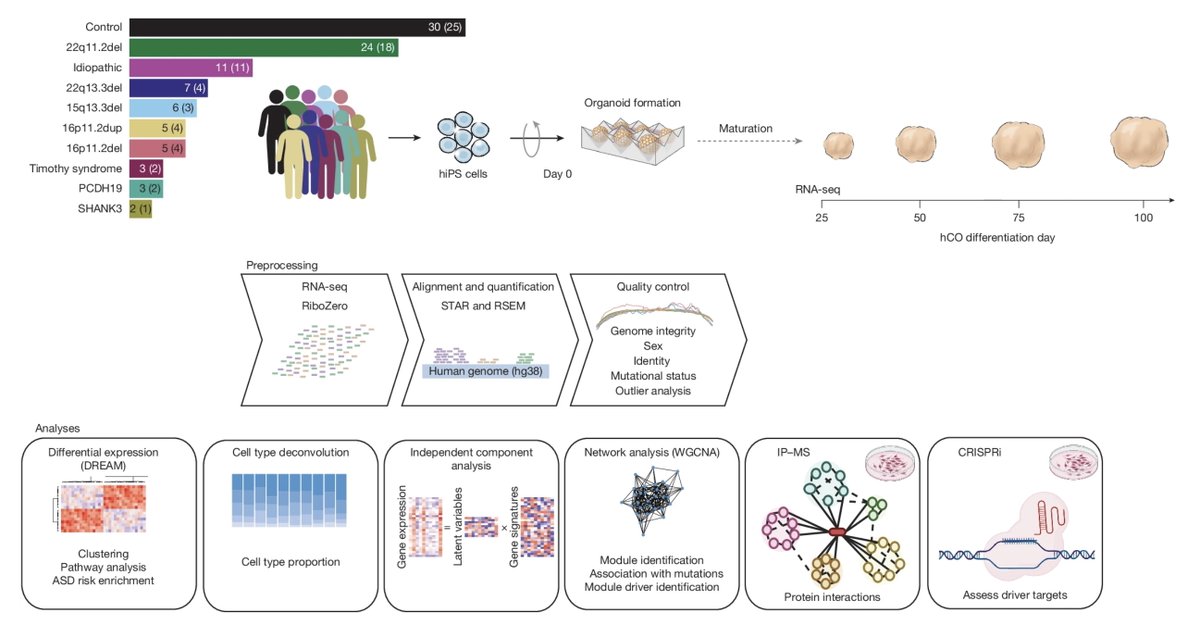
This week, we report in @Nature our effort to identify molecular convergence and divergence in #autism spectrum disorder (ASD) using human stem cell models.
In this collaborative study with Dan Geschwind's lab, spanning almost a decade, we derived 96 hiPS cell lines representing 8 genetic forms of ASD, idiopathic patients, and 20 controls, and after rigorous quality control differentiated 70 lines in more than 150 experiments into human cortical #organoids for 100 days.
Interestingly, early time points harbored the largest mutation-specific changes, but distinct mutations converged on shared transcriptional changes as development progressed.
This is just the beginning: we will need larger cohorts and more advanced cultures that capture cell diversity and interactions, such as #assembloids.
Still, this initial study illustrates how risk associated with genetically defined forms of ASD can propagate through transcriptional regulation, leading to convergent and divergent signaling defects.
This work was spearheaded by the heroic efforts of Aaron Gordon and Se-Jin Yoon, together with Lucy Bicks!
By popular demand — the next edition of our hands-on @Stanford@BrOrganogenesis course is coming in 2026!
This year, the focus turns to neural #assembloids, reflecting the growing movement toward modeling circuit-level and complex cell-cell interactions in brain disease.
The course remains free (including lodging) and is taught by my lab for a full week.
We look forward to welcoming another cohort of 20 participants from all over the world selected from hundreds of applications each year.
Organized by an amazing trio of scientists: @RebeccaJLevyMD, Sabina Kanton, and Merve Avar.
Supported by @BrOrganogenesis, @StanfordBrain, @StanfordBioX, and @NIH_NINDS.
🧠 Deadline: mid-December
Our latest work is out today in @ScienceMagazine: a self-organizing system that models organizer-driven patterning and commissural axon guidance in human neural development.
This was achieved with human midline #assembloids by combining floor plate and spinal cord #organoids from pluripotent stem cells.
A key advance is the three-part configuration (a floor plate squeezed in between two spinal cords), which enables human axons to cross the midline (and the subsequent synchronization of activity between the two parts seen in the video below).
This platform opens the door to many applications; here, we used it to screen and identify human-enriched midline crossing regulators.
Work led by @massimo_onesto with Neal Amin
Researchers led by Dr. @Sergiu_P_Pasca have developed a scalable cerebral cortical #organoid platform by screening biocompatible polymers that prevent the fusion of organoids cultured in suspension. 🧠
Read the @natBME study: https://t.co/C8wDmtBIn6
Today in @Nature, we report human sensory #assembloids—the most complex 3D assembloids to date—comprising four integrated parts to recapitulate aspects of the spinothalamic pathway that processes pain stimuli. We use this model to investigate cellular/early circuit level features of genetic pain syndromes. More details to follow.
Work pioneered in the lab by the brilliant Ji-il Kim and Kent Imaizumi, and in close collaboration with @GregScherrer25!
Link below 👇
As stem cell-based modeling of the human nervous system and disease advances, we recently shared a group-effort framework in @Nature on designing experiments with #organoids, #assembloids, and transplantation
Here a few key takeaways in 6 slides👇
In this week’s @Nature, we publish a group effort to outline a framework for studies with neural #organoids, #assembloids and transplantation.
More details below 1/n
Today we introduce human neural loop #assembloids created from 4 parts derived from stem cells to study the cortico-striato-midbrain-thalamo-cortical pathway and to model neurodevelopmental disease
Work led by the remarkable Ji-Il Kim
and Yuki Miura in the lab. Also in collaboration with the @marius10p lab at @HHMIJanelia
Video shows a four-part neural assembloid displaying emergent synchronized activity after a couple of hundred days of integration
Congrats to my friend @OsmanSharifi3 on completing his thesis! The team used longitudinal single-nucleus RNA sequencing with Rett syndrome mouse model, uncovered stronger transcriptional dysregulation in females, and identified key disease-related changes
https://t.co/Wkyv2OZaff
Step into the world of *Avatar*! Congrats to my colleague @XiaoYang63 on this exciting new journey. A brilliant and meticulous scientist, offering a fantastic opportunity for anyone passionate about BMI and biomaterials for neural research.
Thrilled to share that I will join @JohnsHopkins@JHUBME as an Assistant Professor in 2025! The Yang Lab will develop novel bioelectronics and biomaterials for brain-machine interfaces, regenerative medicine, and the study of human neural development and diseases.
Today we present precise detection of endogenous opioids using genetically encoded biosensors. Multiple early variants have been validated in labs, and we have now optimized, determined, and benchmarked the first-gen opioid sensors for both in vitro and in vivo applications.
New paper out in @NatureNeuro!
Collaborating with several labs, we developed genetically encoded biosensors to track opioid pharmacology in the brain & provide powerful new tools for dissecting complex circuit-specific dynamics 🔧🧠
https://t.co/d1p1lh9J8O