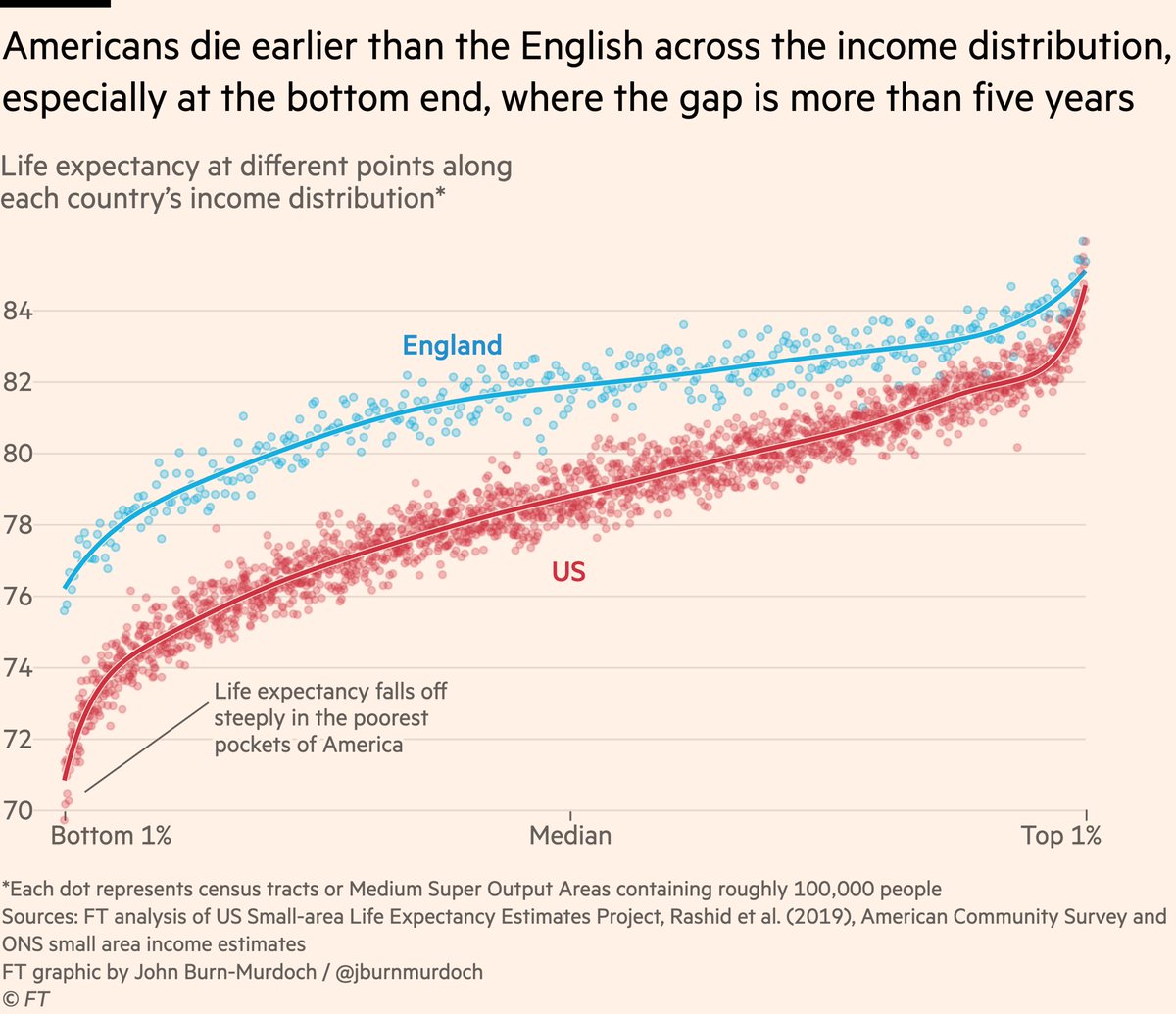
NEW: I’m not sure people fully appreciate how dire the US life expectancy / mortality situation has got.
My column: https://t.co/dBIhT9eZLv
And some utterly damning charts.
1) at *every* point on the income distribution, Americans live shorter lives than the English.
There is no good reason for mosquitoes to exist in wealthy countries today.
New technologies can get rid of the mosquito species that cause diseases like dengue, yellow fever, and malaria; and others can prevent them from carrying those diseases.
https://t.co/CddUFByGZA
So why do mosquitoes still exist?
In a new article for Works in Progress, Maya Rosen explains how state incapacity and risk aversion led to over a decade of delays and billions of unnecessary bites in the United States.
Oxitec, for example, engineered an Aedes aegypti mosquito in such a way that its female offspring would die before adulthood. Through sustained releases, they showed they could reduce local mosquito populations by 80% or more, in field trials.
They sought approval from the USDA in 2010, which then passed it to the FDA, which passed it to the EPA. In 2020, the EPA allowed them to conduct limited field trials in the Florida Keys. Two years ago, their experimental permit expired, and they still need another review before it can be used routinely. Their proposed field trial in California was withdrawn after public opposition.
Another company, MosquitoMate, developed a technique involving Wolbachia, which also suppresses local mosquitoes. They then spent over fifteen years working through the system before finally receiving commercial registration nationwide in 2024.
It seems that, sometimes, the barrier to getting rid of diseases isn’t technology at all. It’s policy and political will.
New products shouldn’t get stuck in regulatory review for so long, especially if the delays are about basic questions like which agency has oversight over the product, rather than testing for safety.
Though some of those uncertainties were being addressed, the broader changes haven’t materialized. After Biden’s 2022 executive order, the agencies planned to update how their coordinated framework was implemented. But Trump rescinded the order last year.
Meanwhile, the EPA unit that reviews new mosquito control products is still a small office backlogged in reviewing a wide range of products.
Mosquitoes are a policy choice. We can get rid of them. Will we choose to?
https://t.co/CddUFByGZA
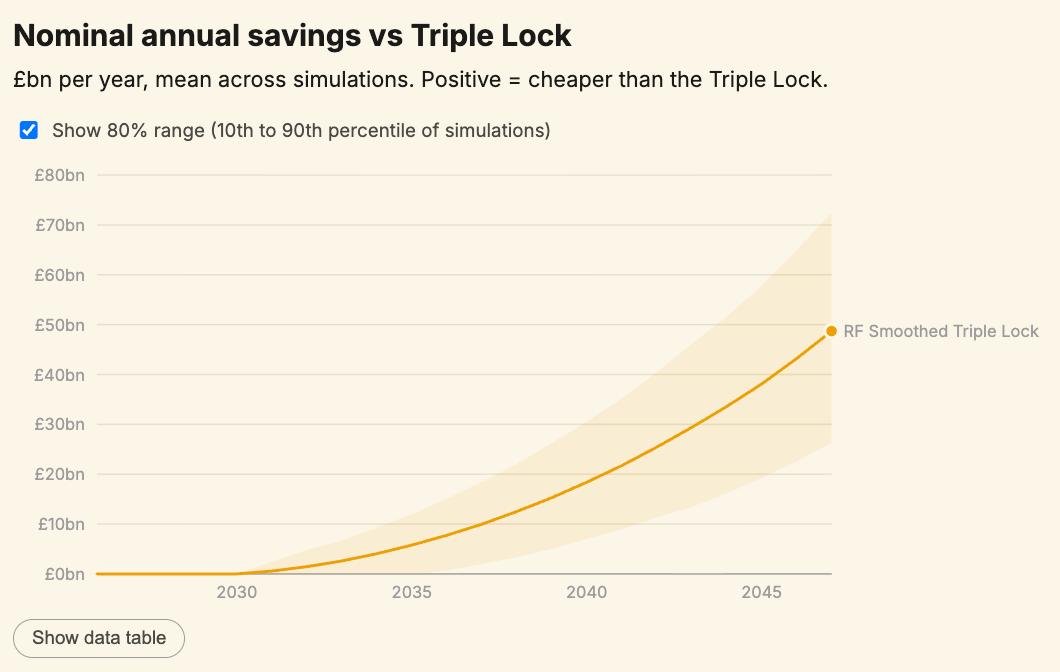
The Prime Minister has announced the @resfoundation smoothed earnings lock to replace the Triple Lock from 2030.
According to the @BritishProgress calculator, this raises £20bn each year by 2040.
https://t.co/T1eqsqRWel
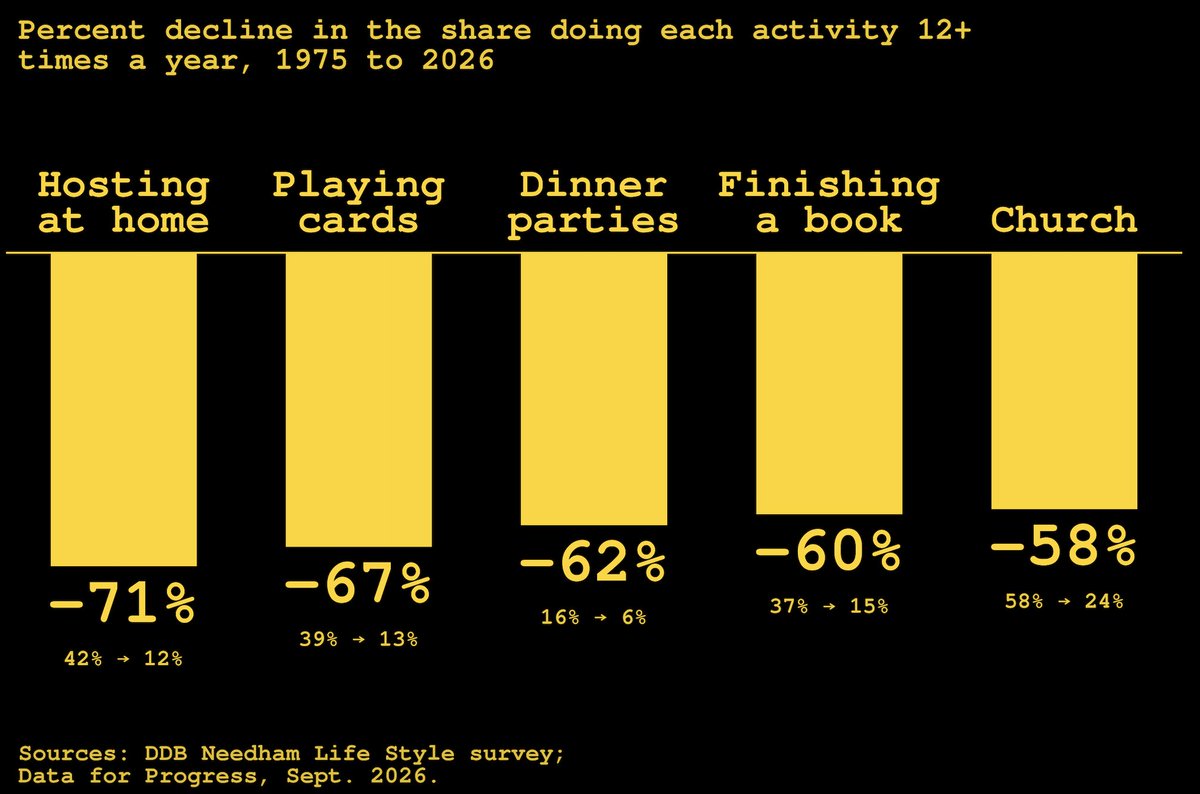
New newsletter: THE DEATH OF THE AMERICAN HOST
The share of Americans who say they host friends or family at their home at least monthly has declined by 70 percent in the last 50 years.
https://t.co/pfubF2qz1v
NEW from me:
Over the last four years, America has lost more than 200k jobs in creative fields like publishing, film, TV, or graphic design. It's the worst stretch for arts jobs outside of major recessions.
How much is AI to blame? And can the arts' business model survive?🧵
I just presented a new paper at @BrookingsInst on the "Vanishing Advantage of Specialization (new paper)". It explains why this will be the age of the generalist.
We all understand that the key determinant of the economics of airlines is the utilization of the aircraft. The fuller the plane, the lower the cost per seat.
The same mechanism explains the value of specialization. Acquiring a piece of knowledge is very expensive in terms of our cognitive effort. A specialist is a person who uses this knowledge sufficiently often to spread that cost over many uses.
This explains outsourcing of "non core" capabilities in firms. A firm handles frequent problems internally and buys expertise outside for problems it encounters too rarely to justify maintaining the knowledge in-house.
For instance, Microsoft has a large legal department, but it hired a corporate law firm to advise it in its purchase of Activision Blizzard. It is not because Microsoft lacks lawyers that it relies on outside service providers, but because it does not use sufficiently often the specialized knowledge of mergers to justify an entire department.
Artificial intelligence reduces this fixed cost of acquiring knowledge and therefore also reduces the advantage of specialization.
Suppose a capability (such as merger law) costs $100,000 a year to maintain, a firm faces the problem 10 times a year while the specialist sees it 1000 times, and suppose that briefing an outsider costs $2,000 per case. Since the specialist's advantage due to utilization is $9,900 per case, the firm buys the service from the specialist.
Now suppose AI reduces the annual cost of maintaining the capability to $10,000 for both. The utilization advantage of the specialist is reduced to $990, less than the cost of asking for help across the boundary, so the firm prefers to acquire the capability itself.
The specialist still spreads the cost over more uses; the saving from doing so is now less likely to cover the cost of crossing the boundary because the fixed cost is lower.
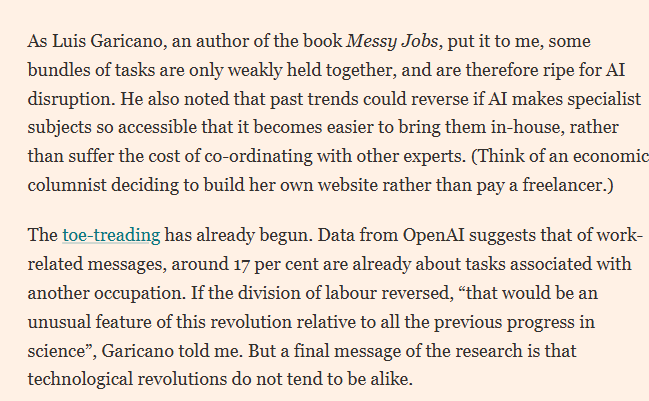
Recent evidence shows workers using AI to cross their occupational boundaries. Chin and Richmond (2026) classify more than 800,000 work-related ChatGPT messages from users whose occupations are known. Each message is assigned to the occupation whose historical tasks look most similar. Most of the usage is generic, including what one would expect: help in writing, editing and planning represents 61.5 percent of all messages. But 16.8 percent of all work messages, and 43.5 percent of the ones which are specific to one occupation, concern tasks usually undertaken by a different occupation. Among the ones that cross occupational boundaries are calculating financial data, troubleshooting software, drafting promotional messages, and writing to government agencies.
Note that the fall in the cost of acquiring a given capability did not begin with generative AI. Google and databases had already lowered these costs. Generative AI greatly accelerates this process.
Consider lawyers, accountants, consultants and software workers: of the 337,000 jobs created between 2022 and 2025 by the four professions, 335,000 were outside their main specialist industries-- law is still being done, but you need less of a specialist law firm to do it.
Professional-service firms can be squeezed in the middle between model producers and their clients. The experts can be squeezed from above, by model makers or labs who supply the general knowledge at scale, and from below, by their clients who can apply this cheaper knowledge themselves. The specialist's comparative advantage lies in expertise that clients use too rarely to maintain internally and that remains costly to acquire even with AI, including the expertise required to check and verify a solution.
Thanks to Jan Ebberly and @JonSteinsson for inviting me to do this:
Summary and links to paper and slides here: https://t.co/pggrJ1pMxD
Paper: https://t.co/8LkDZKK0wy
Throughout Europe, school results for children of migrants are worse than natives
Only in UK are they actually better
In fact, UK 2nd-gen migrants do better than ANY Euro cohort: native or immigrant
If demography is destiny, UK's doing ok.
My column:-
https://t.co/qzgwbwcSdo
So, to recap:
- Productivity estimates were woefully off
- Immigration estimates too
- Inflation/GDP stats not great
- Private rent data was wrong
- Labour Force Survey is broken
- Population estimates, employment statistics, business population statistics all broken too
(1/2)
In the @ft today, I gave @SoumayaKeynes a sneak preview of the work I will be presenting at the Brookings Institution (still under embargo) next week, on how cheap knowledge reverses the long term trend towards specialization: "The Vanishing Advantage of Specialization: AI, Knowledge Utilization, and the Boundary of the firm."
https://t.co/pZWkKc7TKQ
I feel like I'm taking crazy pills with how many smart people I read and respect are saying stuff like this.
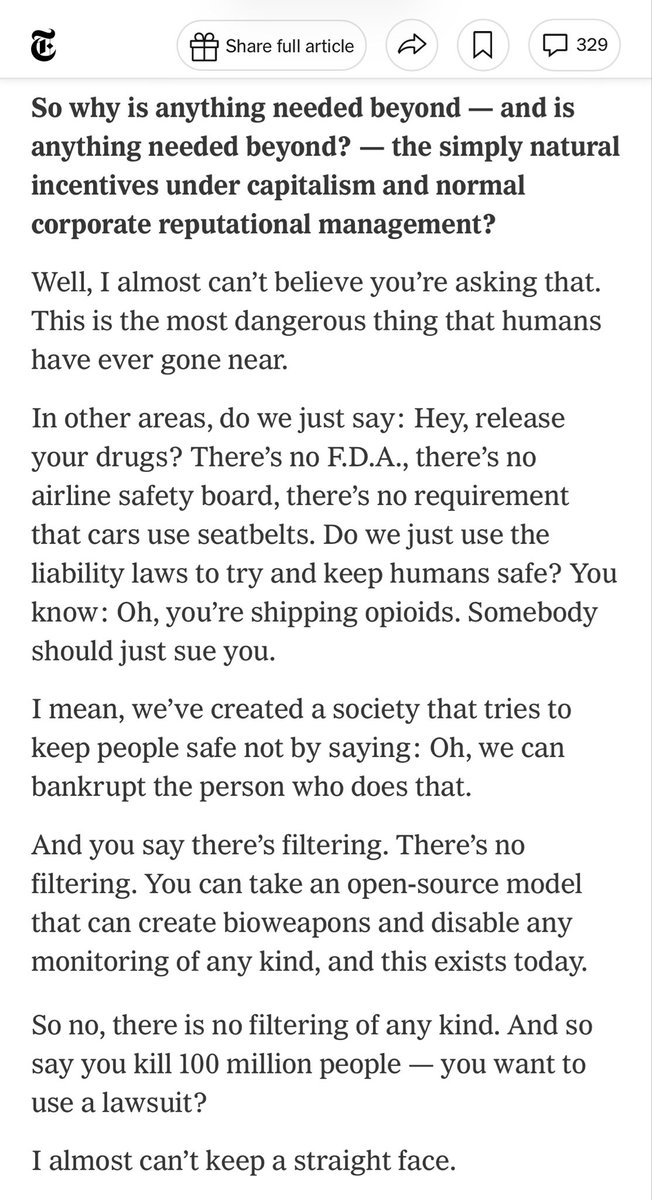
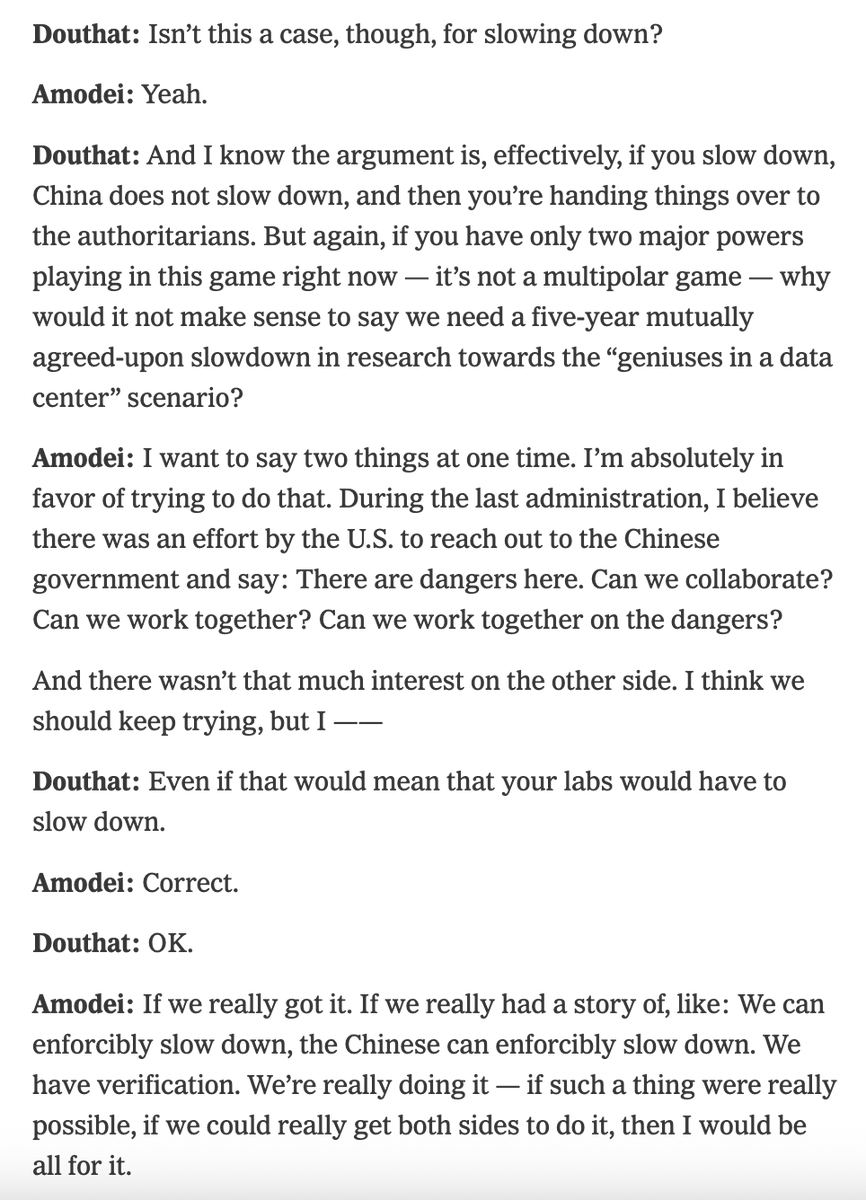
The idea that the AI labs are suddenly, only now, just in September of 2026, advocating for AI safety, and that they just came around to this position bc of sudden financial precarity, is just completely, utterly, conclusively, 100% wrong.
Here's Dario Amodei telling Ross Douthat in February that he agrees with the case for slowing down; that he's in favor of "collaborating" internationally to organize a slowdown; that "I would be all for" a global slowdown. This was 7 months ago, when Anthropic's annualized recurring revenue was rising faster than any company in modern history. He's been saying stuff like this for years, when Anthropic was worth millions of dollars and when Anthropic was projected to IPO for trillions.
Thanks for all the feedback on the post. One reaction we've been getting is "so you're saying nothing much will change." It's worth clarifying this because that is not at all the point of the post—it's actually quite the opposite.
What it's saying is that the economy and society can change profoundly, to become almost unrecognizable, while still resulting in measured GDP growth of "only" 4–5% (which already implies doubling living standards in 15 years). We can get cures for major diseases, agentic transactions can explode, and we could have massive agent-to-agent marketplaces, but this will not show up as double-digit GDP growth precisely because of how GDP is calculated.
This is the hallmark of our Assumption 2: the automation of agriculture had absolutely profound societal implications. Before this, people routinely died of starvation and malnutrition—a concern that largely vanished in the developed world. The increase in living standards and the precipitous drop in child mortality had huge welfare consequences, but because automated agricultural goods became so much cheaper, the sector actually shrank as a share of GDP. The same applies to agentic interactions: GDP only counts final output sold to human consumers, not intermediate transactions. Unless agents are counted as humans (final consumers) in the economy, massive agent-to-agent marketplaces net out as intermediate inputs—and even where agents serve humans directly, falling prices shrink their weight in GDP.
This is all to say: I expect AI's impact on society to be nearly unprecedented, particularly with respect to human welfare. But you should not be looking at GDP growth numbers for evidence, precisely because some of the biggest welfare improvements will not show up there.