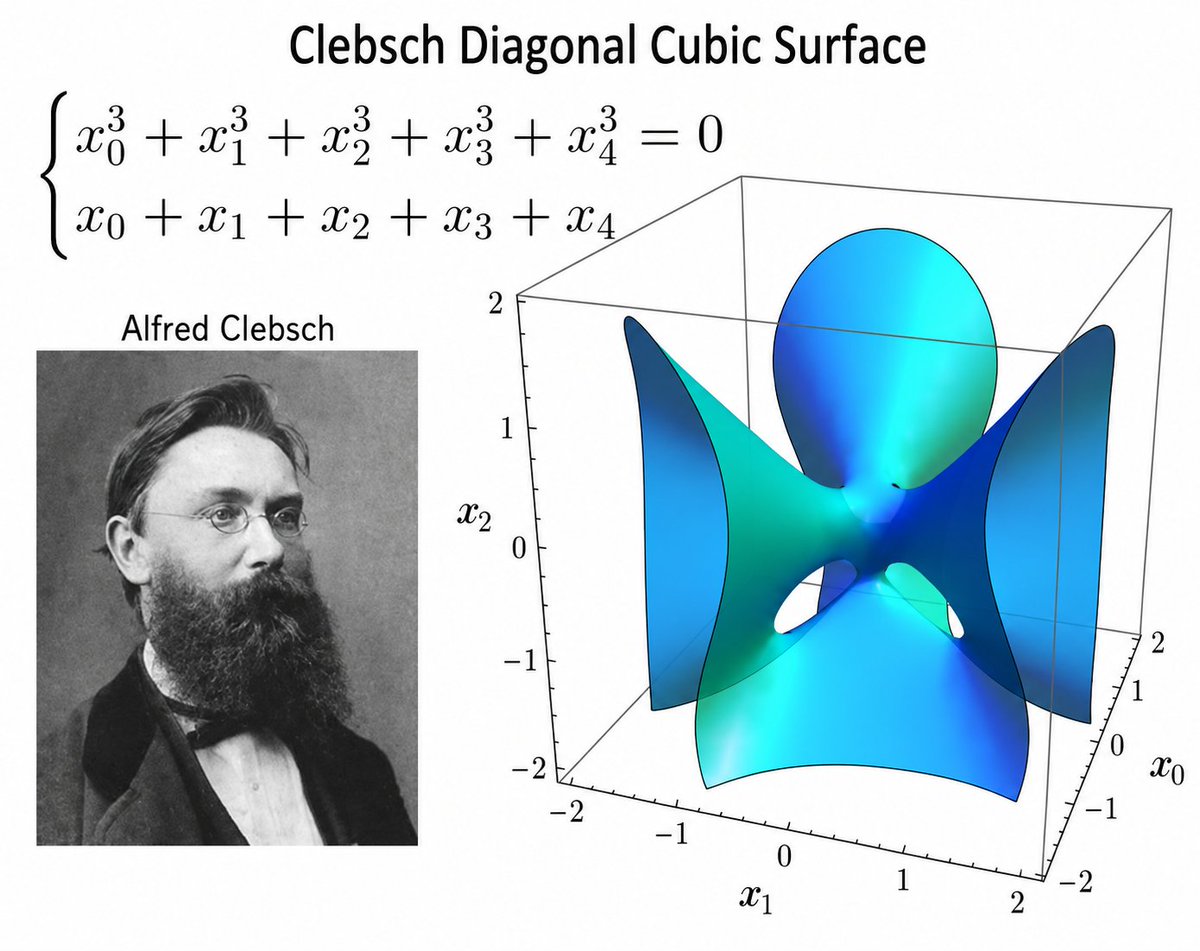
A landmark in algebraic geometry: the Clebsch diagonal cubic surface.
Defined by the equations
x₀³ + x₁³ + x₂³ + x₃³ + x₄³ = 0
x₀ + x₁ + x₂ + x₃ + x₄ = 0
in five homogeneous coordinates, this smooth cubic surface was introduced by German mathematician Alfred Clebsch in 1871. The image shows his portrait beside a 3D rendering of its real locus in affine coordinates x₀, x₁, x₂.
Such cubic surfaces guide algorithms in computer-aided design, robotics path planning, and cryptographic systems.
Biological neuron compared to the artificial neuron used in neural networks.
- The top shows a biologic neuron: dendrites receive signals, the cell body processes them, the axon transmits the signal, and terminals pass it onward.
- The bottom shows an artificial neuron: inputs x₁ to xₙ are weighted by w₁ to wₙ, summed with bias B, then passed through activation function f to produce output. This model is the basis for artificial neural networks.
It drives applications such as image classification in social media and voice recognition in virtual assistants.
On a first read, this paper seems far ahead of the pack in terms of (1) understanding some reasons why a task might stay difficult even in the face of gradient descent, and (2) distilling out propositions they'd need to somehow verify before they started expecting nice things.
🌌🔶 What’s it like to be a telescope working the night shift?
This timelapse from the @GeminiObs South telescope in Chile follows several hours of observations as the GMOS System sends its laser into the sky.
📹: @GeminiObs /NOIRLab/NSF/AURA/M. Paredes
Dennis Ritchie invented C in 1972, co-built Unix in 1969, and his code is running inside every device you are reading this on right now and the colleague who announced his death had to do it through a Google+ post because no journalist thought to check.
He worked at Bell Labs in New Jersey for 44 years. He never gave a keynote. He never ran a company. He never appeared on a magazine cover. He just wrote code that became the invisible foundation everything else is built on.
Here is what he actually built, and why it matters more than almost anything that happened in tech.
In 1969, Bell Labs had just walked away from one of the most ambitious computing projects in history. The Multics project, a joint effort between MIT, Bell Labs, and General Electric, had collapsed under its own weight. Too complex. Too expensive. Too slow. Bell Labs pulled out.
Ken Thompson and Dennis Ritchie refused to let the ideas die.
Working in a small office in Murray Hill, New Jersey, Thompson wrote the first version of Unix in three weeks during the summer of 1969. One week for the file system. One week for the process management. One week for the command shell. Ritchie was working alongside him, and when the system needed a language that could express what they were building, he built one.
In 1972 he completed C.
C was not just another programming language. It was a different philosophy about what a programming language should be. Before C, most systems code was written in assembly, which meant every program was tied to the specific hardware it ran on. You could not move code between machines. You rewrote it from scratch every time.
C changed that. It sat close enough to the hardware to be fast, but abstract enough to run on anything. When Thompson rewrote the Unix kernel in C in 1973, it became the first operating system that could be picked up and moved to a completely different machine without starting over. Portability was a new idea. Ritchie made it real.
The branching that followed is almost impossible to overstate.
Unix spread from Bell Labs to universities. At Berkeley, it became BSD. BSD became the foundation of macOS and iOS. Unix influenced Linus Torvalds, who built Linux in 1991. Linux now runs every Android phone, every major web server, every supercomputer on the Top500 list, and the overwhelming majority of cloud infrastructure at AWS, Google, and Microsoft.
C became the parent language of C++, Java, JavaScript, Python, and Objective-C. Rob Pike, who worked across the hall from Ritchie at Bell Labs for 20 years, said it plainly: "The browsers are written in C. The Unix kernel that the entire internet runs on is written in C. Web servers are written in C, and if they're not, they're written in Java or C++, which are C derivatives, or Python or Ruby, which are implemented in C."
Ritchie won the Turing Award in 1983. He won the National Medal of Technology in 1998, presented by President Clinton. He was head of System Software Research at Bell Labs for decades.
He answered emails from strangers with technical questions until the end of his life. His home address stayed listed in the phone book. His colleague Brian Kernighan, who co-authored the definitive C textbook with him, said Ritchie was a private person who did no self-salesmanship. That was not false modesty. It was just who he was.
He died on October 12, 2011, at his home in Berkeley Heights, New Jersey. He was 70. He had been ill for some time. The world did not notice until Rob Pike posted a quiet announcement on Google+, and the news spread through the programming community in hushed tones.
No front pages. No tributes from heads of state. No candlelight vigils outside corporate campuses.
The device you are reading this on runs code that traces directly back to what he built. So does the server that delivered it to you. So does the browser or app you opened to get here.
Most people will never know his name.
The ones who built everything you use every day do.
This is the last completely Christian village in the Holy Land. This is what Israel just did to it. Are you going to do anything about it, Ambassador Huckabee? @USAmbIsrael
Astronomers have discovered a faint, bilobed nebula surrounding T Coronae Borealis (T CrB), a recurrent nova system comprising a white dwarf and a companion star.
This nebula, referred to as a "super-remnant," is believed to result from repeated nova outbursts over time. Despite being only the second known super-remnant associated with a recurrent nova, its detection supports the hypothesis that such systems can produce expansive remnants spanning dozens of light-years.
The nebula's low density suggests it may not visibly illuminate during T CrB's anticipated next outburst.
Astronomers suggest keeping an eye on the nebula after the next outburst, using the @NASAHubble and #JWST to see how it evolves.
👉 https://t.co/em9kI9dbU2
@mathelirium@skdh Another way to generate a cycle would be to switch the conductivity of the plates on and off (by some process TBD), which would require energy input from outside the system.
@mathelirium@skdh I can see how energy could be extracted as the plates came together, but the plates would have to be pulled apart to generate a cycle, but pulling them apart would require an energy input from outside the system.
@skdh I work with quantum systems: boundary changes cost energy. The Casimir force is conservative; vacuum thermodynamics permits no net extraction, plasma or not.
You don't have to believe me when I say the Casimir effect does not allow you to extract energy from the vacuum. You could just do the maths. You must first change the boundary condition which, guess what, requires that you put in the energy which you can then extract again.
Miriam Adelson, Paul Singer, and John Paulson should be expelled from the U.S. for conspiracy to commit treason. They are trying to buy Kentucky-4's congressional seat for "israel."