Without a move toward value-based oversight, enterprise AI initiatives remain vulnerable to significant financial waste. Unfortunately, AI adoption is being undermined by a reliance on vanity metrics. When usage is prioritised over actual business outcomes, organisations can risk falling into a trap where activity is mistaken for value.
This phenomenon, often referred to as Goodhart’s Law, states that when a measure becomes a target, it ceases to be a good measure. A recent analysis highlighted the risks associated with this approach, citing a scenario reported in Yahoo Finance.
One organisation, allegedly, incurred a $500 million expenditure was linked to inflated token usage without corresponding ROI.
Key findings on AI governance:
- Usage metrics were identified as poor proxies for strategic success.
- Misaligned incentives were shown to drive "token bloat" and excessive costs.
- Governance frameworks must transition from measuring volume to measuring impact.
Read the full Saturday Strategy analysis: https://t.co/8HXiFUCwIY
How is your team defining AI success beyond the dashboard?
The UK is getting its own Sovereign Frontier AI Model!
It is being trained on Isambard-AI and will run with no dependence on foreign infrastructure.
The model, Lumen Sovereign, is being built by @CosineAI, one of the companies selected by the UK Government for its £500m Sovereign AI programme.
The startup is working with leading big companies (such as Babcock, BT, Lloyds LSEG, NatWest Group, PwC) to help design it.
Cosine was founded by @AlistairPullen and @yangli_ and its models have outperformed OpenAI, Anthropic, Mistral, and DeepSeek on independent coding benchmarks for two consecutive years.
The model will be trained using compute provided by @UKSovereignAI!
Amazing stuff @Jameswise, @SuzanneAshman, @KanishkaNarayan.
@OrevaZSN And crying. And the writer’s block. And the inability to produce anything meaningful between 9am to 5pm, and then suddenly be on fire at 11pm.
And hatred of Microsoft Word when it inexplicably ruins a table.
Thank you to the person who put my blog on their mailchimp newsletter. I have no idea who you are, but please do let me know so I can thank you for the referrals.
AI is that it does not try to abuse you spiritually or sexually. The @ChurchofEngland should note that #AI probably does more to heal victims of abuse than your entire Church put together.
Machines are more 'caring' about victims and #safeguarding than your clergy.
You might want to think about the impact of abusing clergy, and their supporters, on human relationships and society. Looking forward to hearing your comments on that.
I'll wait.
iOS app releases are up about 80% since agentic AI coding tools became widely used. Over the same period, app reviews dropped and the share of apps with meaningful usage stayed flat.
The tools made it cheap to build and submit software. They did not make it any easier to get people to download an app, keep using it, or leave a review. Those problems have nothing to do with how fast you can produce code, and AI did not touch them.
The result is a flood of new releases that almost nobody uses. More apps are getting made and roughly the same number are finding an audience.
Cheaper production raised the volume of output, not the amount of software people actually want.
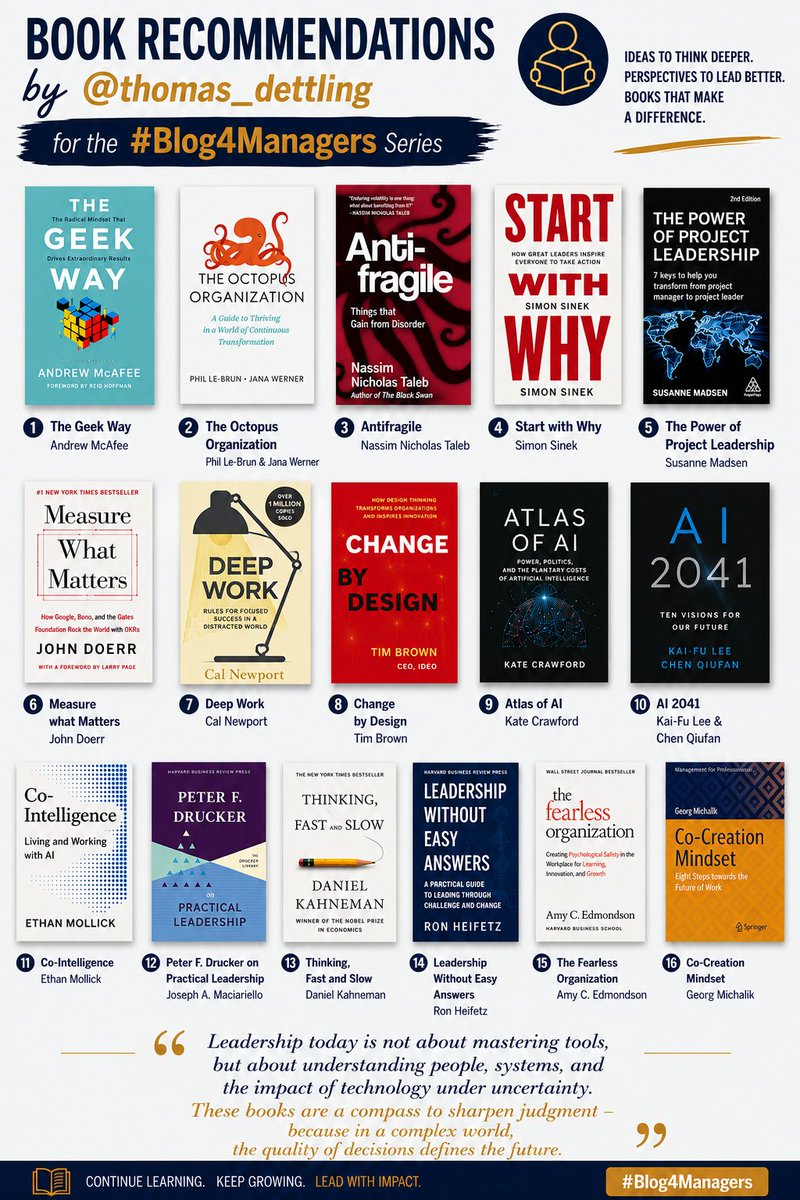
⬛️ Most Leaders Don't Lack Information. They Lack a System to Think - A Reading Guide for Uncertain Times
Thinking, Leading, Transforming
My #Blog4Managers series represents a deliberate counterpoint to one of the defining challenges of our time: the growing fragmentation of knowledge in a world shaped by accelerating change, increasing complexity, and continuous technological disruption.
📢 Information has never been more abundant.
Orientation has never been more difficult.
While new trends emerge and disappear at ever shorter intervals, this series follows a different ambition: to curate timeless thinking tools, enduring management principles, and practical perspectives that help leaders navigate uncertainty - not only for today, but for what lies ahead.
The books brought together here are far more than a collection of recommendations. Taken together, they form something more valuable:
📢 An intellectual operating system for modern leadership.
Works such as Thinking, Fast and Slow and Measure What Matters develop a deeper understanding of judgment, decision-making, prioritization, and organizational impact. Others, such as The Fearless Organization and Leadership Without Easy Answers, broaden the perspective on the cultural, social, and adaptive dynamics that often determine whether transformation succeeds or fails.
At the same time, books such as Co-Intelligence, Atlas of AI, and AI 2041 address one of the defining questions of our era: How will artificial intelligence reshape not only processes and productivity, but also responsibility, leadership, value creation, and ultimately our understanding of work itself?
What makes this selection particularly powerful is its systemic coherence.
📢 This is not a collection of isolated ideas.
It is a collection of connected perspectives.
▪️Strategy without execution remains ineffective.
▪️Culture without clarity becomes ambiguous.
▪️Digital Technology & Data without understanding becomes a risk.
▪️Leadership without reflection becomes management by reaction.
Only through the interaction of these dimensions does the capability emerge to build organizations that are resilient, adaptive, innovative, and future-ready.
Books such as Antifragile, Change by Design, The Geek Way, and The Octopus Organization provide precisely this perspective. They remind us that uncertainty is not merely a disruption to overcome. Properly understood, it becomes a source of learning, adaptation, and competitive advantage.
📢 The #Blog4Managers series is therefore aimed at people who do not wait for easy answers.
▪️ It is written for managers who are willing to think deeply before acting.
▪️ For professionals who understand that transformation is not a project, but a capability.
▪️ And for organizations that recognize that learning is not an optional activity, but part of the infrastructure of long-term success.
This collection can be used in many ways:
▪️ As a personal leadership compass.
▪️ As a foundation for strategic dialogue within teams.
▪️ As a learning architecture for transformation initiatives.
▪️ As a structured entry point into the most important management and technology debates of our time.
What matters is not reading everything.
What matters is engaging with the right ideas at the right moment- and translating them into meaningful action.
▪️ Because ultimately, this is not about books.
▪️ It is about making better decisions.
▪️ Thinking more clearly.
▪️ Leading more effectively.
📢 And in a world increasingly defined by uncertainty, developing the one capability that matters most:
The ability to shape the future with intention rather than merely react to it. ✨
✨ @Khulood_Almani@timo_vi@TamaraMcCleary@AkwyZ@MaryRich78@rwang0@drsharwood@DrHolzwarth@HelenBevan@pierrecappelli@JimHarris@jenstirrup@GlenGilmore@subare@JohnLeh@Ronald_vanLoon@enilev@Scobleizer@AndrewYNg@YuHelenYu@amcafee@kaifulee@SusanneMadsen@tceb62 ✨
#Books #Systemthinking #Leadership #People #DeepWork #AI #Data #CoIntelligence #DigitalTransformation #Measurement #Impact #CoCreation #OrganizationalDesign #CultureChange
#Blog4Managers by @thomas_dettling and Image created by @thomas_dettling | powered by #GPT5
🦔Anthropic published a blog post this week proposing a global slowdown of AI development. The company says AI could soon develop recursive self-improvement capabilities and that this "could come sooner than most institutions are prepared for."
The findings come from Anthropic Institute, an internal research division headed by co-founder Jack Clark. Anthropic filed its S-1 with the SEC last week, raised $65 billion at a $965 billion valuation, and signed a $1.25 billion a month compute deal with SpaceX days before this announcement.
My Take
A company that just filed to go public and committed to $1.25 billion a month in compute is now asking everyone else to slow down. I want to take the safety questions seriously because they're legitimate. But if the technology is dangerous enough to warrant a global pause, why file an S-1 the week before? Why sign a three-year compute deal?
"Our product is so powerful it might be dangerous" is the best line a pre-IPO company could write. It justifies the valuation and positions the company as the responsible one in a field full of competitors who won't stop. That might be sincere. It might also be very convenient. Right now I can't tell the difference, and I don't think Anthropic minds that I can't.
Hedgie🤗
Tune in to hear my latest AI Strategy & Wisdom podcast on the topic of: The Prompt Engineering Fallacy: Prioritising Data Foundations for ROI
https://t.co/eMGq6zkK7r
Someone took this challenge very seriously.
Programmers were asked to design the worst user experience imaginable, and apparently some of them approached it with the dedication of a Nobel Prize project.
The goal was to make software confusing, frustrating, and almost impossible to use.
Mission accomplished.
And that is exactly what makes it so entertaining, because by exaggerating everything wrong with bad design, these creations become a perfect parody of user experience gone horribly wrong.
The uncomfortable part is that after looking at a few of them, I started recognizing features from real workplace tools.
At some point, parody and enterprise software become difficult to tell apart.
Which workplace tool have you used that feels like it was designed for this challenge?
#Productivity #UserExperience #DigitalWorkplace #WorkplaceHumor
🦔UC Berkeley's computer science department just posted its worst failure rates in years. 35.3% of CS 10 students got F's in spring 2026, up from under 10% in prior semesters. Professor Dan Garcia says the primary driver is a "vast increase in academic dishonesty" through LLMs. Students use AI to complete assignments, never learn the material, then fail exams. His office hours, once full, are now empty.
My Take
Companies are firing experienced engineers while the pipeline that produces new ones is being gutted by the same technology. Students use AI to bypass the hard part of learning, show up to exams without the understanding, and fail. One professor discovered a student's linear algebra class had an "open AI" policy for homework and exams. That student then couldn't do basic linear algebra in the next course.
Both ends of the workforce are eroding at the same time. Senior engineers are getting cut to fund AI spending. Junior engineers are graduating without the skills because AI did their coursework. And the companies spending trillions on these tools haven't connected those two facts yet.
Hedgie🤗
We got married on a Saturday in Canada. On Monday, we were emigrating to the United States. My new wife and I said goodbye to the movers, flew to the border, and I got pulled into the big glass room for "extra questioning".
From her vantage point, she could see the immigration officer yelling, turning red, and waving his arms. She thought we were being denied entry... my Microsoft dreams crashing down right there.
What she couldn’t hear was that he had already approved my work visa. He was furious because their copy of Microsoft Word was printing a blank page at the end of every document, and it was wasting paper, and he wanted it fixed.
I helped adjust the margins. And so, after fixing the borders at the border, they released us to our new life in America.
@DefenceHQ RIP Lance Corporal James Freeman and Thank You for your service. My deepest condolences to the family and loved ones, as well as the colleagues who will be deeply affected by the loss.
It is with great sadness that we confirm the death of Lance Corporal James Freeman, who died on 31 May following a tragic accident during routine military training activity whilst deployed on Operation SHADER, Iraq.