Online now: Simulation-based assessment of covid-19 outbreak responses and postpeak strategies. Originated in March (data < May 15), unfortunately its points remain as relevant (eg on policy interdependencies & need for/challenge of proactive interventions)https://t.co/ELBhoRWp4x
⏰ "Big breakthroughs might help in the long run. But even if joyful shouts of “Eureka” came from our labs tomorrow, it would take a decade or more to commercialize and begin to scale them. That’s time we don’t have," says John Sterman in @TheTech. https://t.co/cZAoFH61YO
The French government has just approved financing for a 3-month research stay for Ukrainian researchers, including doctoral students. The program is called PAUSE.
https://t.co/miNnOJfD1n
Great to see the release of the Handbook on Business of #Sustainability, providing insights on theory, practice and impact. I enjoyed contributing a chapter with my co-authors Brandon Lee and @panikosgeor on sustainable entrepreneurship & market formation uncertainty.
Handbook on #Business of #Sustainability is now out! Covers organization, execution, measurement of #impact featuring 30 chapters from the world's best scholars on sustainable business research with @anitamcgahan Paul Tracey, Havovi Joshi, Martine Haas
https://t.co/PoENDEjHTp
Fantastic:@climateinteract released new visualization of sea level rise, integrating @ClimateCentral's maps. 2 map types: end of 21 century and long-term equilibrium. Just more reasons for more ambitious #climateaction!
Check it out: https://t.co/4DxVTZOaq8
A nice @QuantaMagazine read on the vital (half century old) work providing the first sound frameworks for detecting human-caused warming signals, and, more generally, novel routes for extracting insight about the behaviour of complex dynamic systems.
https://t.co/vHHA55CItF
Excellent article discussing the urgency of climate action during this decade. Yes the only way to succeed is to "put all cards on the table" (ex.: @Fridays4future ) and to "get all actors involved" (ex.: @climateinteract's #EnRoads). By @guardiansicence interviewing @jrockstrom.
Looking forward taking part in this @S_D_Society event with colleagues @msjalali, @navid3001, Hazhir Rahmandad, and Jack Homer discussing our work in this domain and in particular exploring the question "what makes a COVID-19 model useful?".
During our #COVID19 panel, panelists Jeroen Struben (Emlyon Business School), Hazhir Rahmandad (MIT Sloan), Jack Homer (Homer Consulting), and Navid Ghaffarzadegan (Virginia Tech) will then share their work. Join us - complimentary! https://t.co/1sIoX2xOVC
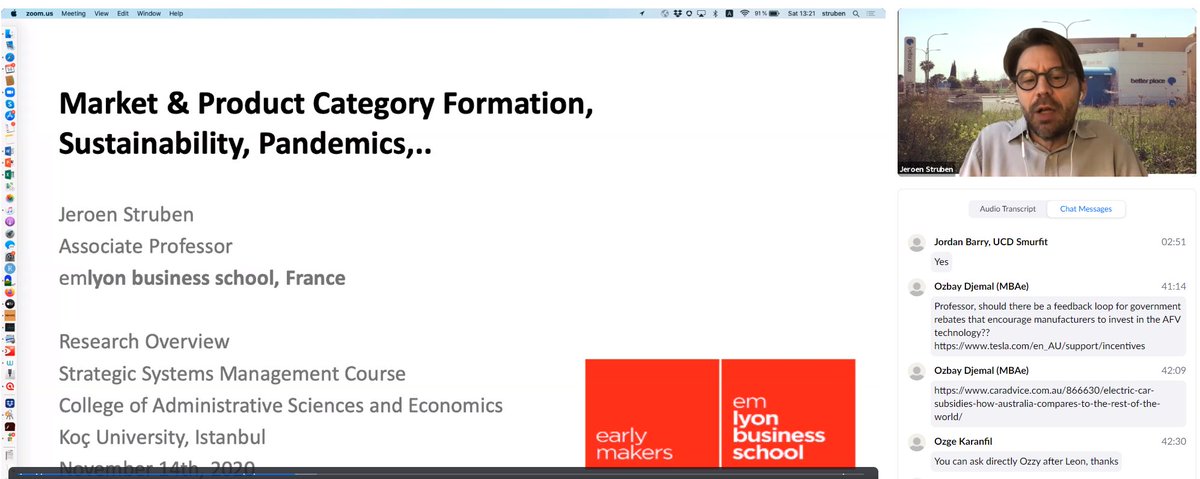
A big thank you to @JeroenStruben for presenting his fantastic research portfolio on market formation with us last weekend! Another thank you goes to our TECH 517-Strategic Systems Management MBA students for the fruitful discussion. @kocuniversity@kocgsb
Als het testbeleid niet het probleem is maar ons gedrag, waarom maken we dan geen gebruik van de kennis van gedragswetenschappers? En waarom zitten die dan niet in het Outbreak Management Team? https://t.co/aXB0FQfxQy
My article, w/ Brandon Lee and Chris Bingham, on market formation problems resulting from actors underallocating resources that make the market work, is now online:
Collective Action Problems and Resource Allocation During Market Formation|Strategy Science https://t.co/IdaC0FlGdK