1/ Every creative medium starts as slop.
Over time, the tools improve, new creators rise, and new platforms reshape culture.
Here’s 20 years of that cycle, from blogs to AI, explained in charts and visuals 👇
“AI slop” might just spawn the next YouTube, driven by a new AI-native creative class: The Generators.
After sharing this thought on the @WithDelphi Library of Minds podcast, I’ve gotten a ton of follow-up questions, so here’s a deeper dive...
Consumer AI in 2025 rhymes with Consumer Mobile in 2008. Like early mobile, we’re seeing both potential giants and flash-in-the-pan fads.
In 2008, the top apps in the App Store were Facebook, Flashlight and iPint (a game that let you drink a virtual pint by tilting your phone). Only one became an enduring business.
As aggregation theory reminds us, the best consumer companies aggregate massive networks of demand or supply (h/t @benthompson). Everything else gets commoditized.
Beware vibe revenue (h/t @gregisenberg). Many current apps generate revenue from curiosity, novelty, or FOMO, with high initial conversion and fast growth, but poor long-term retention.
As competition increases, products will commoditize and pricing will drop. We need to separate temporary revenue from sustainable businesses.
Still, don’t dismiss “small” beginnings. YouTube started with silly homemade videos like keyboard cat, Numa Numa, and Chocolate Rain. Then came Ryan Higa’s sketches, Justin Bieber’s discovery, and OK Go’s treadmill music video.
Over time, quality rose, legitimacy followed, and YouTube became the world’s largest video platform. Similarly, TikTok began as https://t.co/FDUB60VNW2 with teens dancing and lipsyncing before evolving into a global entertainment engine. In consumer, what seems trivial or lowbrow can be the wedge into something massive.
Is “AI slop” this generation’s cat videos? What critics dismiss as junk is often content that would’ve been prohibitively expensive or impossible to make without AI: podcasts with historical or fictional guests, Pokemon nature documentaries, cooking shows hosted by animals, romantasy microdramas, Ghibli in real life, Dramione fanvids.
These technically imperfect but creatively unbounded experiments are just the first wave of a sea change in UGC content.
Every technology shift mints a new creator class that the old guard mocks.
Bloggers weren’t “real writers”.
Twitter microbloggers weren’t “real bloggers”.
YouTubers weren’t “real filmmakers.”
Instagram influencers weren’t “real tastemakers”.
TikTok teens weren’t “real creators.”
Now comes the AI-native generation, the Generators. They conjure worlds instead of filming them, blending ideas, moodboards, scripts, and real footage with prompts and generative AI models. They create, remix, regenerate,and refine until it becomes something new.
Today, many are teenagers in their bedrooms, not too different from how prior UGC revolutions began. Over time, this new creator class will become more mainstream: film students making dragons on dorm room budgets, camera-shy solopreneurs sharing their real voices and expertise through avatars, small businesses turning iPhone photos into cinematic ads, scriptwriters becoming their own showrunners, creative directors running one-person agencies.
AI doesn’t just lower the cost of creation. It expands who gets to create.
When new creators appear, old platforms rarely welcome them. YouTube and TikTok reward face-forward performance, not surrealist fantasy. A new home may rise for the Generators, with audiences who love their worlds and communities who nurture them.
For this shift to fully take hold, the underlying models must evolve. As @trymirage founder @gmharhar often says, the AI video race has barely begun. Producing scenes with consistent characters, voices, and styles still takes too much work. We need multimodal video models that can blend real footage and authentic voices with AI VFX. We need orchestration to handle multiple characters, multiple scenes, and multiple camera angles.
Apps like Sora, @canofsoup_inc, Captions by @trymirage, @Picsart, and @tavus hint at where this is going, but the creative tools for this new medium are only just being invented.
We’re witnessing the dawn of a new creative medium. Like every revolution before it, it’ll look weird and a little "sloppy" before it looks brilliant.
--
If you’re a founder, creative, or Generator building in this new wave, we at @Sequoia would love to hear from you. You can reach out via the normal channels to any of our partners, or feel free to pitch my Delphi about the future of consumer AI: https://t.co/QbTAN8GyD0.
---
Thanks to my partner @buckhouse for helping coin the term “Generator” and to ChatGPT for copyediting help.
Relevant reading
Augmented Imagination by James Buckhouse
https://t.co/O1VibcRyU6
Playlist of Generator content I mention above
https://t.co/INCRVUwg2n
Playlist of the earliest viral YouTube content https://t.co/UFDFpNSCIo
Vibe Revenue by Greg Isenberg
https://t.co/1YkwXPb9AV
Aggregation Theory by Ben Thompson
https://t.co/MhsF7H6m4D
Industrial AI is harder than it looks. The hardest knowledge in a factory isn't written down. It lives in the head of the veteran operator who's been there 20 years. @squintai just shipped a system that captures it.
Squint stitches tribal knowledge, paper manuals, work orders, asset history, SOPs, and regulations into one context layer. It runs on their own 2B open-weight model, fine-tuned for manufacturing and post-trained on real problems from the floor.
Take Nailor Industries, a family-owned HVAC maker that's been around since the 1970s and is now winning new business off the data center buildout. One veteran there could tell by eye when the powder coating's pH was off. Lose him for a day and the whole line slows. With Squint that knowledge stays on the floor, helping them chase orders 30% faster than bigger competitors.
And it works. On complex multi-document tasks Squint scored 78%, against Claude Code at 53%, Vector RAG at 47%, and OpenAI File Search at 46%. Devin estimates a human expert would score maybe 10%.
Really proud to back @DevinBhushan and the @SquintAI team.
Thanks to @UpstartsMediaCo and @alexrkonrad for the great deep dive.
EXCLUSIVE: a startup called Squint says its new AI system beats comparable tools from Anthropic and OpenAI in industrials.
Squint fine-tuned a ~2 billion parameter open-weight model on manufacturing and compared it on complex tasks that are tough for a human to answer, CEO Devin Bhushan says.
The results could be a big unlock for manufacturing customers like PepsiCo.
And they present another vertical where specialist startups are racing to keep ahead of the AI labs. Link below 👇
Odessia turns 14 hrs of travel planning into 3 mins.
Chill vibes for travelers, chill vibes for @FDavidsonT onstage at Humans in the Loop.
https://t.co/iAGT44q9kV
We raised $6M led by Sequoia to build the future of travel.
Watch me plan a perfect trip to Mexico City in 3 minutes.
Flights, hotels and a full itinerary that matches my preferences. All bookable on the spot.
Available today, free to use.
We raised $72M from Sequoia/YC and hit 8-figures in ARR. Then we shut it all down & rebuilt the company from scratch.
Today we’re launching the new Mutiny: the first AI agent for GTM teams to create anything customer-facing, in minutes.
Comment "Mutiny" to get 3X free credits.
It's a great day to be a founder: we've named @dougleone chairman of @sequoia.
Doug passed the baton a few years back, but he never left: he’s been in the office, working on boards, and serving as consigliere to the next generation.
When we realized how much gas Doug has left in the tank, we invited him to ramp back up as an investor at Sequoia. Please cut him some slack as he onboards over the next couple weeks. Let’s go!
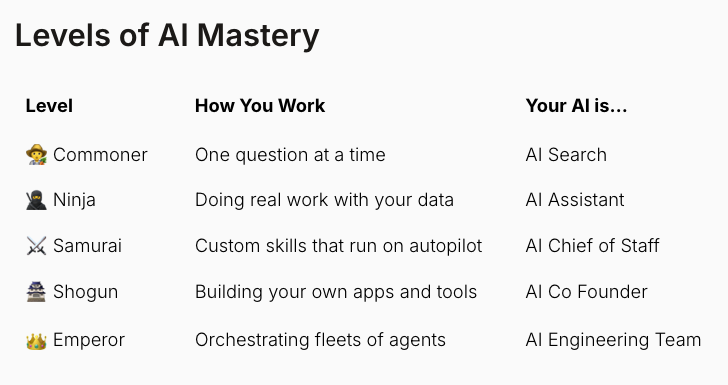
Leveling guides work because they give people a map. Inspired by @zapier@wadefoster dropping their AI fluency guide, here's what I've been using for levels of AI mastery. It differs in one key way: emojis 🧑🌾🥷⚔️🏯👑
Most companies talk about being AI-first.
At Zapier, it shows up in how we hire, how we ramp new talent, and how we use AI to do our best work.
Last May we set the bar with V1 of our AI Fluency Rubric.
One year and 100% AI adoption later, V2 is here👇
This is a huge unlock for manufacturing teams. The gap between "procedure exists" and "procedure is actually good" is where most safety incidents happen. Nice ship, @SquintAI@DevinBhushan.
Most work instructions are written once… and never reviewed again.
We built a simple tool that lets you upload a procedure and get instant feedback from Squint’s industrial AI.
It flags missing safety steps, vague instructions, and failure paths.
If you own procedures or standard work, try it:
https://t.co/rpjc4EYjRN
If you’ve ever wondered why @carl_eschenbach has such impeccable hair… here is the answer.
That executive-caliber cut is once again available for the benefit of all @sequoia founders.
Welcome home, Carl!
The arc of AI software: Answers -> Tasks -> Agents. @Picsart just shipped this for real as an agent marketplace where creators hire AI to plan, execute, and deliver entire workflows. Now available to its 130M MAU.
🏀 An NBA player just used AI to clone himself so he can give back at scale.
@mosesmoody of @warriors can't be everywhere all at once, but now he can be through Delphi @withdelphi.
Young athletes and fans can talk hoops, mindset, and life with him anytime, anywhere.
Great coverage by @KTVU.
Talk to Moses here: https://t.co/RKKl5A51pi
Most people will never get to ask an NBA player how they think.
Now they can.
@mosesmoody of the @warriors just launched his Digital Mind with Delphi.
Young athletes can ask about the mindset that got him to the NBA.
Fans can ask about games and decisions - anytime, anywhere