This is how brain-dead the crypto industry still is:
It costs roughly $30M per year to keep developing Ethereum L1, which is effectively becoming the settlement layer for the internet of finance.
Bitcoin’s PoW burns through roughly the same amount of money every single day.
One funds open-source global financial infrastructure backed by the most sound digital store of value in the world.
The other pays for an energy-intensive security model attached to an asset that is structurally and economically inferior as a store of value, not useful for real-world finance, and increasingly hard to justify based on Bitcoin’s own fee and security-budget metrics.
This is the quiet part said out loud, the thing talking heads in this space will not dare to say, but should, because it is the truth.
The market hasn’t valued $ETH correctly.
Think about it.
$1,556.
$190B market cap.
Ethereum has become the home of stablecoins, DeFi, tokenized assets, and one of the largest onchain economies in the world.
Institutional adoption continues to accelerate.
The market just hasn’t priced it in yet.
The biggest mistake is valuing Ethereum for what it is today instead of what it is becoming.
A global economic layer for the internet.
One day, Ethereum won’t be measured by speculation.
It will be measured by the value it secures, the capital it coordinates, and the economy built on top of it.
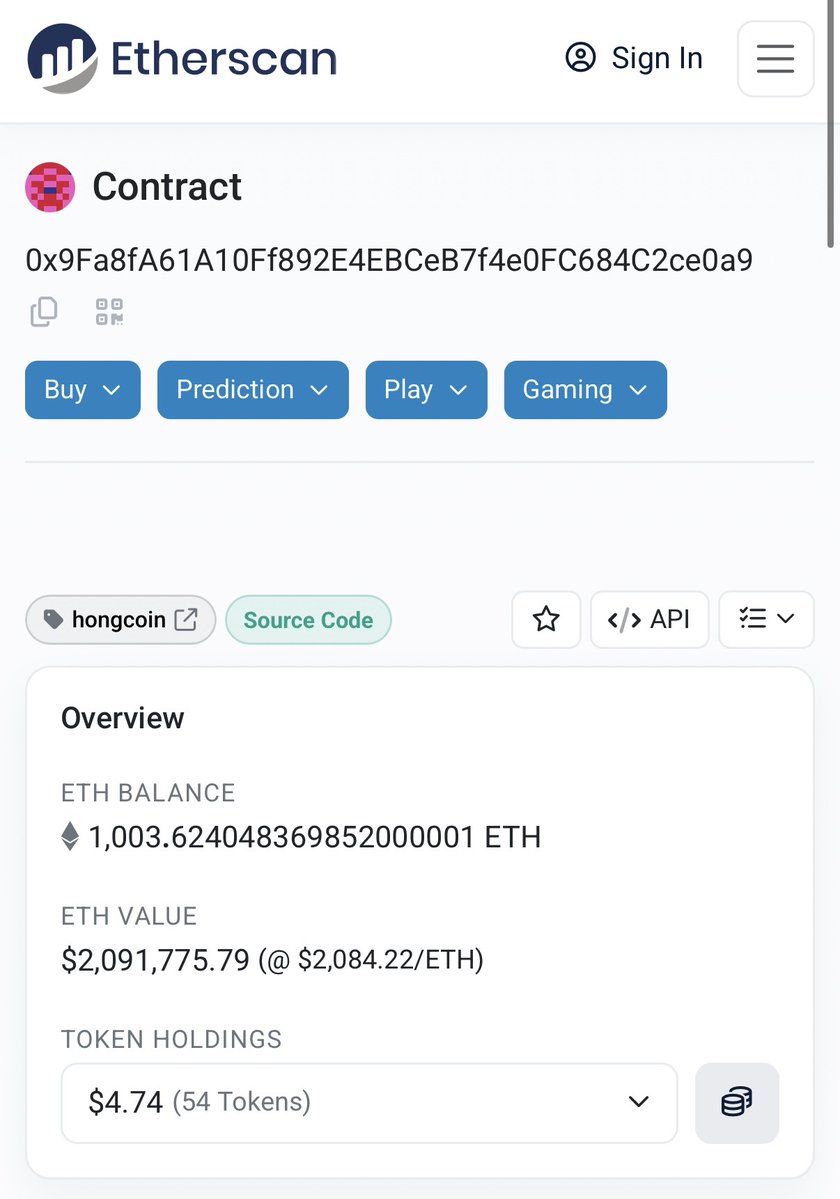
First white-hat exploit on Ethereum: I unlocked 1,003.62
Ξ ($2,000,000) trapped in a 2016 ICO smart contract
for 9 years.
The 48 original investors can now claim their funds.
0/ Clear signing is now live.
An open standard to end blind signing, making human-readable transactions default.
This effort brings a major UX and Security upgrade to transaction signing on Ethereum.
Ethereum is still being valued too much like a company, and not enough like global public infrastructure.
The real thesis is not only fees or short-term price action. It is dependency, settlement flow, and trust minimization at internet scale.
Based on @wmougayar public-good valuation framework, $8,000 ETH in 2026 looks less like a crazy target and more like a conservative repricing.
For anyone stuck as a WETH supplier on @aave: the secondary market works.
1,000 aEthWETH → 980.38 WETH via @1inch. ~2% discount.
Not a great exit, but an exit. The discount is what the market thinks the haircut will be.
https://t.co/wtVkgidXrE
🚨 ETHEREUM IS ABOUT TO REPRICE
Ethereum just reclaimed ~$2,300
VanEck sees $52,000 by 2030
The gap is obvious.
🔹 Stablecoins settling trillions
🔹 Tokenization moving on-chain
🔹 AI agents transacting on Ethereum
🔹 32%+ of supply staked generating yield
This is already happening at scale.
Ethereum is being used like financial infrastructure, but still valued like a trade.
That repricing happens as capital catches up.
$ETH $BMNR
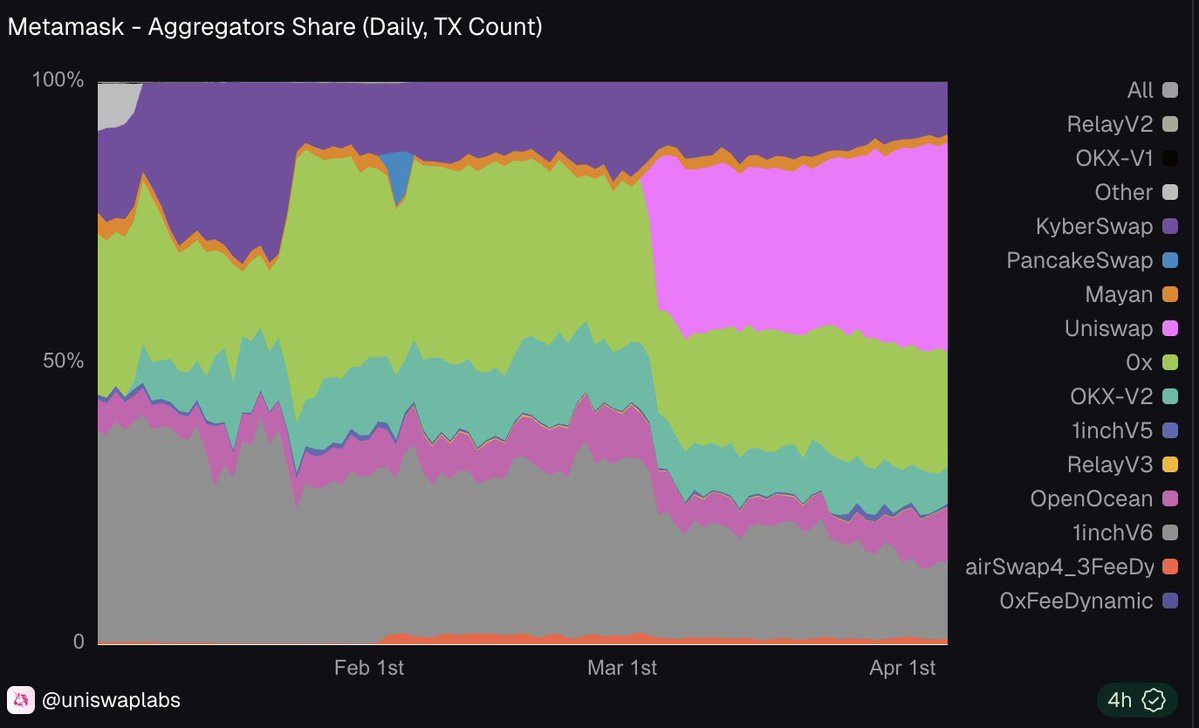
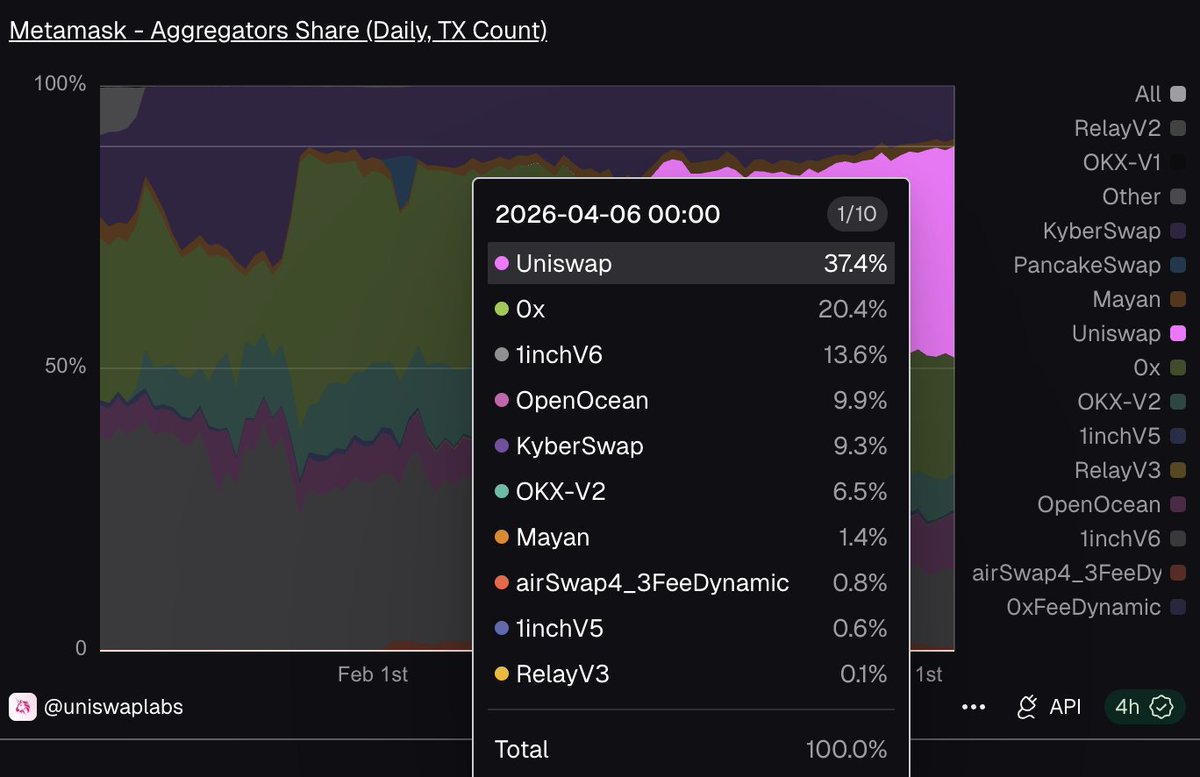
The Uniswap API was added to @MetaMask's meta-aggregator a month ago 🔥
Its now winning ~40% of their swaps
And we're giving out API keys to all developers for free
This is huge for Aave and DeFi. Central banks are notoriously skeptical of onchain systems, yet the Bank of Canada conducted a full systemic research review on Aave’s resilience. The conclusion was that DeFi works remarkably well.
"Our analysis suggests that lending without traditional intermediaries is viable in a technical and operational sense. Aave V3 successfully matches borrowers and lenders, enforces collateral constraints through smart contracts, and maintains solvency without relying on trust, identity, or centralized enforcement. The system operates continuously, transparently, and with minimal overhead, demonstrating the potential of protocol-based credit markets."
Future of Finance.
People might accuse me of grave dancing for saying it
But we have to stop letting centralized things call themselves DeFi
Admin key can drain all funds? CeFi
Otherwise DeFi means nothing and it’s brand is destroyed
No admin key can drain any version of Uniswap for a reason
🚨BREAKING: Drift Protocol just got drained for over $200 million
Solana's largest perps DEX. Gone in one transaction batch.
The attacker didn't find a smart contract bug. They didn't exploit a flash loan. They walked in with the keys.
On-chain data shows a single account initiating massive outbound transfers. SOL, JitoSOL, WETH, wrapped BTC, stablecoins in USD, EUR, and JPY.
Even FARTCOIN. They took the FARTCOIN.
A blockchain security researcher confirmed what everyone suspected: a private key compromise. The admin signer was either leaked or someone with access pulled the trigger themselves.
And here's what makes it worse.
The attacker funded the wallets a week before the exploit. Ran a test transaction. Then waited.
This wasn't a hack. This was a heist with a rehearsal.
Phantom Wallet already cut off access to the protocol. Drift posted about "unusual activity" and told users to stop depositing.
$200 million gone and the official response is "unusual activity."
Some estimates put the real number closer to $270 million. We won't know until the dust settles and the wallets stop moving.
The funds are already being swapped to USDC and bridged to Ethereum. Classic exit playbook.
This is potentially the largest Web3 exploit in three years.
But who needs security when you have speed, right Kyle? 🚀
Solana just got its final reality check.
Drift Protocol, one of the biggest perpetuals DEXes on the chain, just got drained for $270M+ in a massive exploit. On April 1. And they had to tweet “this is NOT an April Fools joke.”
After years of https://t.co/zfZUHQWoEJ turning Solana into the biggest meme-coin casino and rug-pull factory in crypto…
After Toly and Mert spent years gaslighting everyone about how “decentralized” and “battle-tested” the chain is while it kept having outages, validator concentration issues, and VC-controlled narratives…
This is the bill finally coming due.
The most toxic, arrogant, hype-driven, “number go up” ecosystem in crypto just hit the wall. Hard.
$SOL less
~$2.3 billion flowed into Ethereum in just 24 hours!
Meanwhile:
🔹 Tron: largest outflows
🔹 Solana: outflows
🔹 Avalanche: outflows
🔹 TON: outflows
🔹 Ripple: outflows
Only 3 chains saw inflows: Ethereum, BNB Chain, and Arbitrum.
When the market gets uncertain, liquidity flows to where it feels safest. Deepest markets. Strongest security. Most battle-tested infrastructure.
Ethereum isn't just where stablecoins live. It's where stablecoins go home. 📈
Data: @artemis
A lot of people on CT hate Ethereum bc it breaks their worldview.
Bitcoin is static. Alt L1s are VC-funded, ship-fast tech cultures.
Ethereum sits in the middle: decentralized, messy, evolving, with only light coordination from the EF.
It gets attacked from all sides. But that’s exactly why it will continue to win.
It’s built for the long term, and aligned with a positive, open vision of the world.