We released a guide for those who want to build worlds with the mask paradigm. The five stages are presented in the figure.
More details are in the following tweets.
Paper: https://t.co/wfEGfsHG1z
Github: https://t.co/BA3uMom7TB
Thanks to all my amazing collaborators!
Finally wrapped up my work at @AdobeResearch, and excited to share FLARE: Diffusion for Hybrid Language Model🔥
Hybrid attention is having a moment.
Recent releases such as Qwen3.8 and Kimi K3 reinforce a compelling direction for efficient LLMs: combine linear attention with periodic full attention. Bounded recurrent states make long-context processing economical, while full-attention layers retain direct global interaction.
With FLARE, we asked whether this increasingly important architecture could also support diffusion-style multi-token generation—without rebuilding the model from scratch or giving up the capabilities of its pretrained checkpoint.
FLARE transfers Qwen3.5 hybrid-attention checkpoints into diffusion language models with a cheap budget of around 10B training tokens. We release FLARE-2B, FLARE-4B, and FLARE-9B.
The key is to train two complementary views of each document: a clean causal stream that preserves next-token behavior, and a noisy block-bidirectional stream that learns diffusion denoising. The resulting checkpoint supports two inference paths:
> AR-Trust verifies parallel drafts through the clean causal stream
> Diffusion-Trust denoises multiple tokens within an active block
Making this transfer work revealed a broader lesson: conversion quality depends on more than the diffusion objective.
First, transfer data sets the capability ceiling. Under the same source checkpoint and token budget, changing the balance of reasoning traces, mathematics, code, and instruction-following data reshaped which capabilities survived conversion. A data mixture that helped one capability could hurt another; the best overall transfer came from preserving coverage across them.
Second, the clean stream is what anchors the converted model to its source behavior. Clean causal context recovered most of the loss from diffusion-only training, and retaining next-token prediction closed much of the remaining gap. Meanwhile, training across partially completed noisy blocks preserved the flexibility needed for Diffusion-Trust decoding.
Hybrid diffusion is also a systems problem. During training, small blocks multiply the number of recurrent-state boundaries that would otherwise be materialized in GPU memory. We developed a fused two-stream route that keeps chunk computation Tensor-Core friendly, stores only strided checkpoints in HBM, and reconstructs boundary states in registers. This makes small-block training substantially more practical and brings its efficiency closer to conventional causal training.
Inference requires a different form of state discipline. Paged KV cache and recurrent GDN state must remain synchronized while tokens are still provisional. Our SGLang-based stack commits state at the accepted offset for AR-Trust, keeps denoising rounds read-only for Diffusion-Trust, and updates the causal state only after a block becomes final.
Across reasoning, knowledge, instruction following, and coding evaluations, FLARE models preserve a strong capability profile while enabling diffusion-style multi-token generation. With the optimized serving stack, FLARE reaches up to 4.8× higher decoding throughput in our evaluation setup.
Everything is open now: the training code, the inference stack, and the FLARE checkpoints.
We hope FLARE makes it easier to explore diffusion-style generation on modern hybrid backbones. Try the models, reproduce the results, or use the code to build fast language models of your own. We’re excited to see where the community takes it.
This was joint work with @ChongjianG30781, @HaoTan5, @Xu_Arthas, @ZhuWanrong, Jason Kuen, @koustavagoswami, @YongxinChen1, @MoleiTaoMath, and more importantly, with support from my beloved mentors Jiuxiang @ethan_jxgu and Jing @Jingorz at Adobe Research.
📄 Paper: https://t.co/2KETkkrzJU
🌐 Website: https://t.co/IbndtibCDm
💻 Training & inference: https://t.co/lrSiDFm66q
🤗 Checkpoints: https://t.co/tTHZLQfcJe
awesome work led by @utkarshm0410@maojiayuan on world action models! It reveals an OOD generalization gap in WAM albeit video model itself has OOD generalization capability. It conducts a comprehensive design space analysis and provides one possible solution to mitigate this gap
LLM-assisted search in verifiable domains is incredibly exciting right now. The model matters, but so does the algorithmic harness used to explore the search space and iterate toward better solutions.
We’re excited to describe a new search algorithm that makes this exploration process more effective, leading to the results below with open-source models:
✨ Mathematics: new state-of-the-art constructions for the Erdős Minimum Overlap Problem
⚛️Quantum computing: improved quantum circuit compilation, reducing SWAP overhead by 24.5% on IBM Q20.
⚡️ AI infrastructure: designed a highly efficient TriMul Triton kernel, improving on prior human- and AI-designed implementations.
More details in the blog: https://t.co/h4lMnYHM4I
Great collaboration by WILL, @Stanford, @PKU1898, @Tsinghua_Uni, and @HKUSTGuangzhou.
🏆Announcing the #ICML2026 Awards! 🏆
Including Outstanding Papers (research paper & position paper, winner & honorable mentions) and the Test of Time Award!
Check out the blog post for all winners (or read on), laudatio, & description of the processes.
https://t.co/jiUEsUpxws
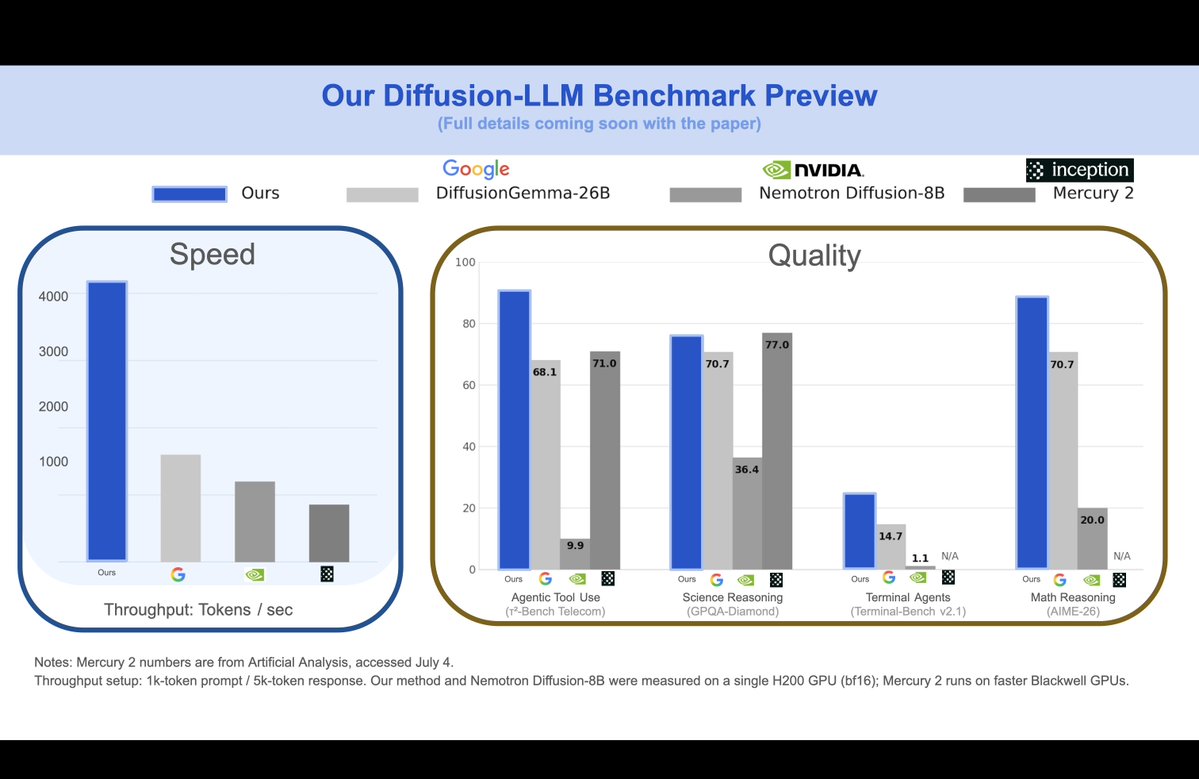
Sneak peek at the Diffusion LLM that will be released soon
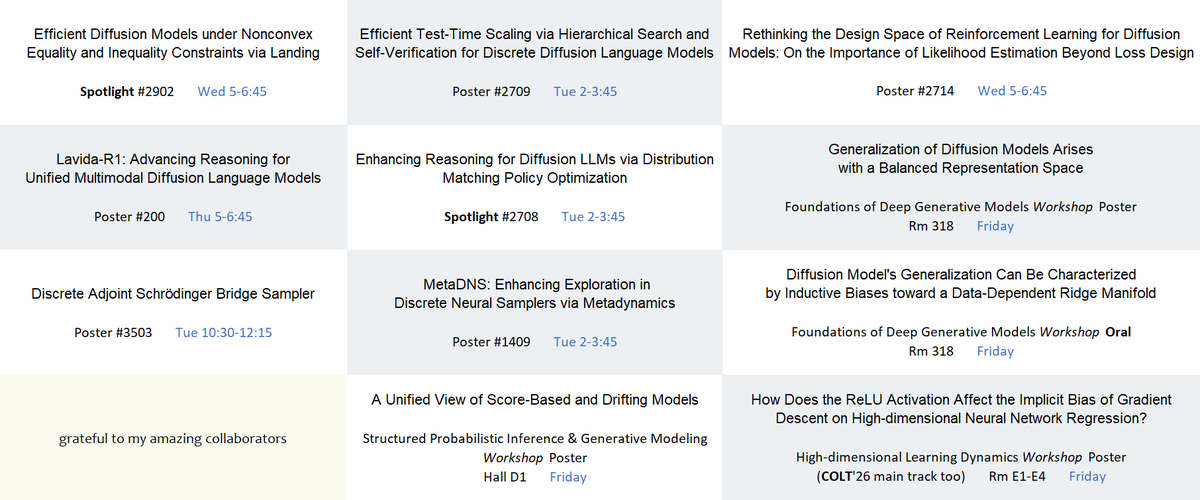
I’m at #ICML2026 in Korea presenting two papers (details in the comments) and joining a panel discussion at the SPIGM workshop.
Drop by my posters or DM me if you’d like to chat more.
(1/n) We’re sharing Nemotron-Labs-Diffusion-Image: a masked discrete diffusion model for high-resolution text-to-image generation. It iteratively unmasks visual tokens in parallel, giving strong quality and fast inference.
I’ll be at ICML in Seoul 🇰🇷!
I’m mainly interested in RL post-training, self-improving AI, long-context / long-horizon generation, and improving autoregressive video models.
If you’d like to exchange ideas or grab a coffee, feel free to shoot me a DM!
Attending #ICML2026? Plz consider visiting us to discuss what we're passionate about -
GenAI (from📚the very theoretical end, all the way to🚀the very applied end), neural sampler, and more.
We'd love to learn from you! Thank you.
🧚Progressive Distillation of ELF🧚
We pushed ELF, a continuous diffusion language model, even further toward few-step generation ⚡️
ELF already generates 1,024-token sequences in just 8–32 steps without distillation.
Now, with progressive distillation, ELF+PD scales all the way down to few-step and even one-step generation!
Blog: https://t.co/AX6nfu0VAK 🧵
Great to see the growing ecosystem of diffusion LLMs, with the recent DiffusionGemma model from Google Deepmind. This is just the beginning -- Mercury 2, DiffusionGemma, and many others will redefine the LLM frontier for speed and quality in the coming years.
Check out our latest work A2D2 🔮on RL post-train for variable length discrete diffusion models. If you enjoyed PepTune and TR2D2, you shouldn’t miss this one!Amazing effort led by Sophia🙌
Today we're bringing Mercury 2 to @Baseten.
Mercury 2 delivers over 1,000 tokens per second for customers on @NVIDIA GPUs with the reliability and scale enterprise teams need.
Read more to see how @augmentcode is using Mercury 2 in production reducing costs by 90% and latency by 82%. More customer stories across coding agents, real-time voice, and enterprise search dropping soon.
Huge congrats to the team, D4RT is a team work and all the authors have been working very hard on this in the past one year. Very well deserved. 🍻 and thank you Award Committee Members for the recognition.