If you’re wondering how inefficient car dependent metros are, Atlanta’s metro area is 60% larger in land area than Tokyo’s but has 35 million fewer people. Since 2000, the metro has grown by 50% and has not added even a single foot in new rail transit.
Medvi did $401M in year one with $20,000 and zero employees. This year they're tracking $1.8B with two people.
The math is wild. That's $200M in revenue per employee. Hims did $2.35B last year with roughly 2,000 employees, which works out to $1.2M per person. Medvi is generating 166x more revenue per human.
But zoom in on what Gallagher actually built. Medvi is a compounded GLP-1 telehealth storefront. AI writes the code, generates the ads, handles customer service. Doctors and fulfillment are outsourced. The entire company is a routing layer between patients who want Ozempic alternatives and the telehealth infrastructure that already exists.
16.2% net margins on $401M means $65M in profit. Hims posted 5.5% net margins on 6x the revenue and made $128M. Gallagher is capturing more profit per dollar with two people than a public company with thousands of employees, an R&D org, and a pharmacy supply chain.
This tells you everything about where AI leverage hits hardest. The new playbook works when the product is commoditized, the supply chain is outsourced, and the only moat is speed to market plus ad spend optimization. GLP-1 telehealth was a perfect storm: massive demand, regulatory gray area on compounded drugs, and a customer acquisition funnel that AI can run end to end.
The real question is durability. Gallagher's ED expansion hit 50,000 customers in month one, which suggests the machine transfers across verticals. But compounded GLP-1 margins depend on the FDA continuing to allow compounded versions of Ozempic and Mounjaro. The second that regulatory window closes, the economics change overnight.
The one-person billion-dollar company is real. The question is whether it survives contact with regulation, or whether this is the peak moment of a very specific arbitrage.
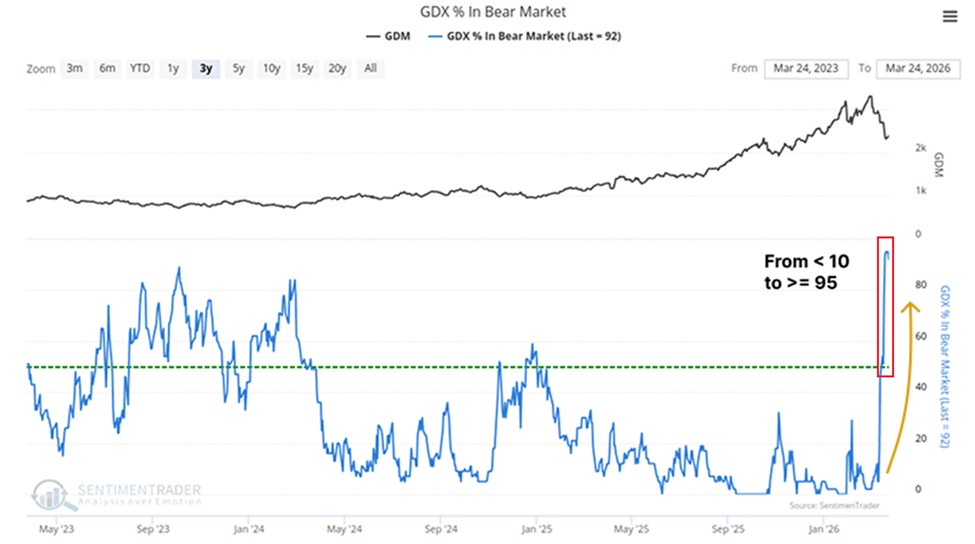
Gold stocks are in historically oversold territory:
~95% of stocks in the gold miners ETF, $GDX, are now trading in a bear market, the highest since at least April 2023.
This has surged +850% over the last 4 weeks as gold miners have dropped -25% over this period, entering a bear market for the first time since 2023.
By comparison, ~90% of stocks in the ETF were in a bear market in October 2023.
From that point until March 1st, 2026, $GDX rallied +346%, experiencing one of its biggest bull markets in history.
Gold miners have rarely been this oversold.
talked to a YC founder who asked Sam Altman straight up "will OpenAI compete in my space / kill my startup"
the answer: behavioral health requires knowing if users are actually improving. OpenAI doesn't have that data, the wrapper startups do. v bullish for consumer AI
BREAKING: Someone just dropped the ultimate startup toolkit for free.
It's called Founders Kit and it has every resource a founder needs to go from idea to IPO.
Paul Graham essays. YC courses. Pitch deck examples. Fundraising guides. 200+ tools across design, analytics, automation, and marketing.
No paywall. No newsletter gate. No BS.
100% Open Source.
Caught the crash on recording.
6995 rejection played BEAUTIFULLY today. Unfortunately the recording stops when your iPhone screen turns off so it got cut off early, but incredible trade overall.
THIS ONE IS A MUST WATCH!!!!
$SPX