Energy and sustainability nerd. Nuclear Engineer. Supports transit, walkable cities, clean energy, social justice. Opinions are my own and subject to change.
Finally got some time today to get into the data. I'm mostly using the US EIA, the IEA, and BP. Ourworldindata draws from BP a lot, but it corroborates with the other sources closely. I first looked into your claim of US being at 1990s levels. For just electricity, I found this:
@JohnDaySlay How much of that is the developing world adopting fossil fuels as it industrializes?
Europe and the US have seen significant drops in coal use. American emissions are at 1990s levels.
@powerbottomdad1@cornoisseur@tszzl What if we had good bus and train systems that took a bunch of people off the road and left more space for people who prefer to drive?
@drunkenbird@cornoisseur@LionHirth This take never made sense to me. Isn't the plan with 100% RE to use the excess output to charge batteries? Nuclear on the grid doesn't mean you need to turn down the REs. You just start charging batteries sooner. It gets you to your goal of 0 fossil sooner. Am I wrong?
Chicken sandwiches are too slow to make and far too expensive to be a realistic option for our dining future. We need to eat now, not in 6 months. Nevermind all of the chicken sandwiches made in the past. This is the most up to date information.
Remembering the guy who made a chicken sandwich truly from scratch (including growing the wheat for the bread etc) and found it took 140 hours of labor over six months
@CleanPowerDave@sideen_dan Data for all of last year. There's a lot of coal and gas to replace. The point OP fails to make is how much storage you would need to bridge the gap of RE production and energy consumption.
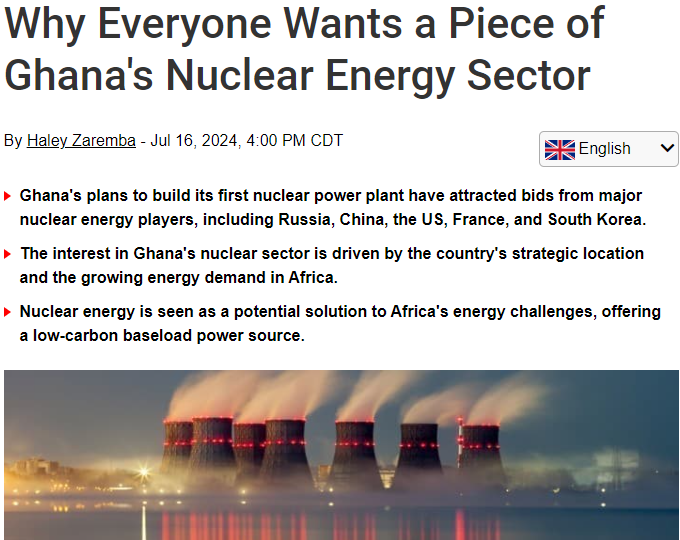
Ghana is accepting bids for its first nuclear plant. All of the world's nuclear supplier nations (US, France, Russia, China, and Korea) are bidding. Article link in reply.
African electricity (and energy) demand is expected to soar in the next few decades due to population and economic growth. There is hope that nuclear (and renewable) generation will allow Africa to "leapfrog" over the development stage of massive fossil fuel use.
Given this, winning/dominating Africa's coming nuclear power market is of strategic significance for the world's major players. The West is keen to avoid Russian and/or Chinese dominance.
@cvictordus@LLBroadwell Not sure "transferring" is the right word. Nuclear plants do generate a lot of wealth. A single plant might employ 1000 workers, each making a good wage. Virtually everyone inside the fence of a nuke plant in the US makes 100k per year. Those workers support the local economy.
@fred47454@vass_and_ Ok, so purely conceptual. There's no sense comparing "paper reactors" to actually operating designs. Even licensed designs like the bwrx-300 can't predict how much it will cost to operate and maintain the reactor. MSRs are much more complicated from an operating standpoint.
@LLBroadwell@jasonandrade Virtually every major nuclear build out ever, INCLUDING GERMANY, has been more than 1GW per year. I would hazard to guess that the majority of nuclear power plants built globally since 1970 were part of >1GW/year national build outs.
According to this Korean article, NuScale won a $37 billion job to supply 24 SMR reactors to an IT infrastructure company, Standard Power. Korean company Doosan Enerbility will supply many of the main components. Article link in reply.
"According to nuclear industry sources, Nuscale Power has agreed to supply 24 SMRs to Standard Power, an information technology (IT) infrastructure company, starting in 2029 and is coordinating details."
Relying on Korean companies is a good call, IMO, as they have the best nuclear plant construction record.
@DriveBikeWalk@WAPolicyGreen@RogerPielkeJr@joerogan Lifecycle is going to depend on a lot of assumptions, especially if it's not plant-specific. May as well just call them all low-carbon and move on to replacing the actual high-carbon sources.
Nuclear engineers will calculate something like integrate interactions of particles in multiple energy groups over alternating days and measure it in SNORTs