Most financial firms focus on investments only & have strict minimums
At One Bridge, we can be flexible
While investments are key, so too are taxes, planning for huge mkt drops, & costs
We work w/ clients who are serious about growing their portfolio, retiring on it, or both
WARNING: Longer post (but worth reading or bookmarking for later).
Your life has seasons.
Each one is unique. Characterized by its own distinct desires, struggles, opportunities, and identity.
But one reflection I've had recently is just how easy it is to completely disassociate with the present season.
To give all your time and energy toward a longing for some nostalgic memory of a prior season or an anticipation for some beautiful state of a future season.
You look back at the past and all you see is sunshine. Because it all worked out. You forget (or glaze over) the struggle you endured. You're here today. You made it. You're alive. You're doing fine.
You look forward at the future and dream on what could be. You'll have so much more. More freedom. More purpose. More health. More deep connection. More everything.
The past is beautiful and the future feels limitless. So, logically, you slowly start to treat everything about the present as the bridge. A dash connecting your past and your future. A gap to be crossed as quickly as possible.
Everything you do today is in anticipation of some eventual end state.
I'm doing this now, so that I can have that later.
Unfortunately, the danger of that dissociation with the present is significant. You may spend your entire life living for a future that has a decidedly mirage-like property. You inch closer, but when it's right in front of you, it disappears and reappears on the horizon.
You may spend your entire life skipping through the present, deferring your presence, your joy, and your very humanity to a future that never comes.
In a classic French fable, a young boy is gifted with a magic ball of golden thread. He's told that if he simply pulls on the thread, time will leap forward. The catch, of course, is that once it's pulled, it can never be put back.
The young boy takes advantage of the newfound powers. Each time he's faced with a boring day at school, a frustrating set of chores, or a scolding from his parents, he pulls the thread, skipping through to the good parts.
As an adult, he continues, leaping through mundane struggles in his marriage, the friction of having a newborn, and the boredom at work. He finds himself pulling on the thread more and more, avoiding even the most minor inconveniences of his life.
But when he wakes up one day and sees an old man looking back at him in the mirror, he's filled with regret. He realizes in that moment that as he chose to skip through the boredom, struggles, and friction, so too did he miss the real texture of being alive.
How often do we all do the same? How easily do we default into this disassociation? Disconnecting from the present in anticipation of some future.
A mentor recently asked me this:
"Where are you going and why are you in such a rush?"
It hit me hard.
And to be honest, I haven't stopped replaying those words since he said them.
Why are you in such a rush?
The world wants you to rush into everything. Rushed decisions. Rushed conversations. Rushed relationships. Rushed timelines.
In doing so, you slowly relinquish your agency. You give up your claim on your own life. Surrender authorship to a pen that was never even yours.
In a world that wants you to rush, the ultimate act of rebellion is presence.
Be in the season you're in. Don't romanticize the past, don't fantasize the future. Be here. Be now. Be in this. All of its texture, depth, and struggle. All of its joy, tension, and pain. Sit with the uncertainty. Become friends with it. Fall in love with it.
Because every single thing you do today is something your younger self dreamed of and something your older self will wish they could go back and do.
The good old days are happening, right now.
And the next time you find yourself skipping through the present, remember these words:
Where are you going and why are you in such a rush?
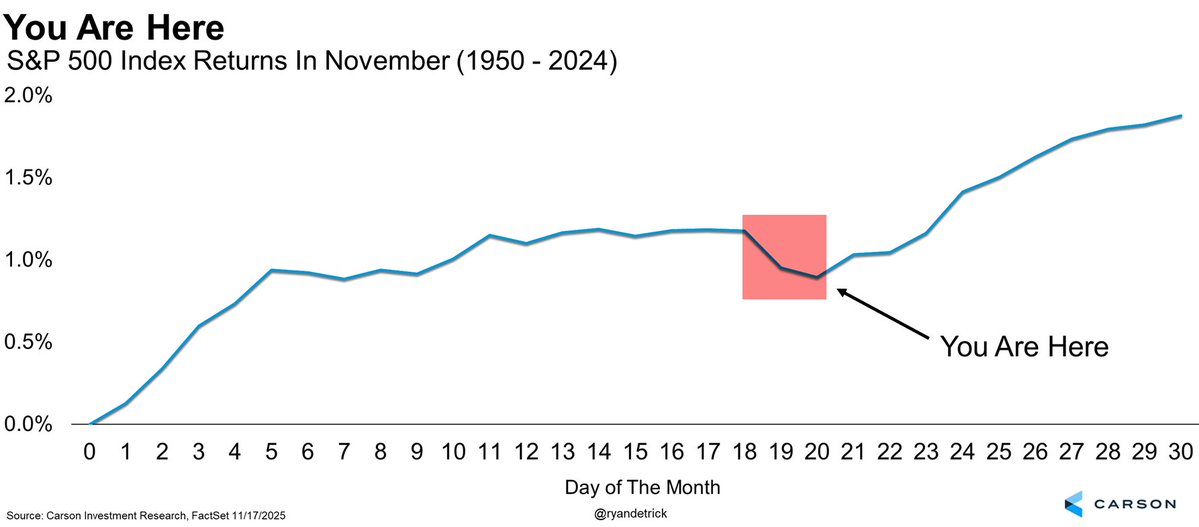
November historically bottoms on November 20th before the seasonal late month rally.
What is more interesting is one the weaker parts of the year is Nov 18-20. Looks to have played out this year, now will the rally?
These were YTD returns as of 4/8/25:
S&P 500 -15.0%
Nasdaq 100 -18.5%
R2000 -20.7%
EAFE -3.5%
EM -7.8%
Now the 2025 YTD returns thru Monday:
S&P 500 +17.9%
Nasdaq 100 +23.3%
R2000 +14.2%
EAFE +28.8%
EM +34.5%
Staying the course worked (again):
https://t.co/wxSDxOowlT
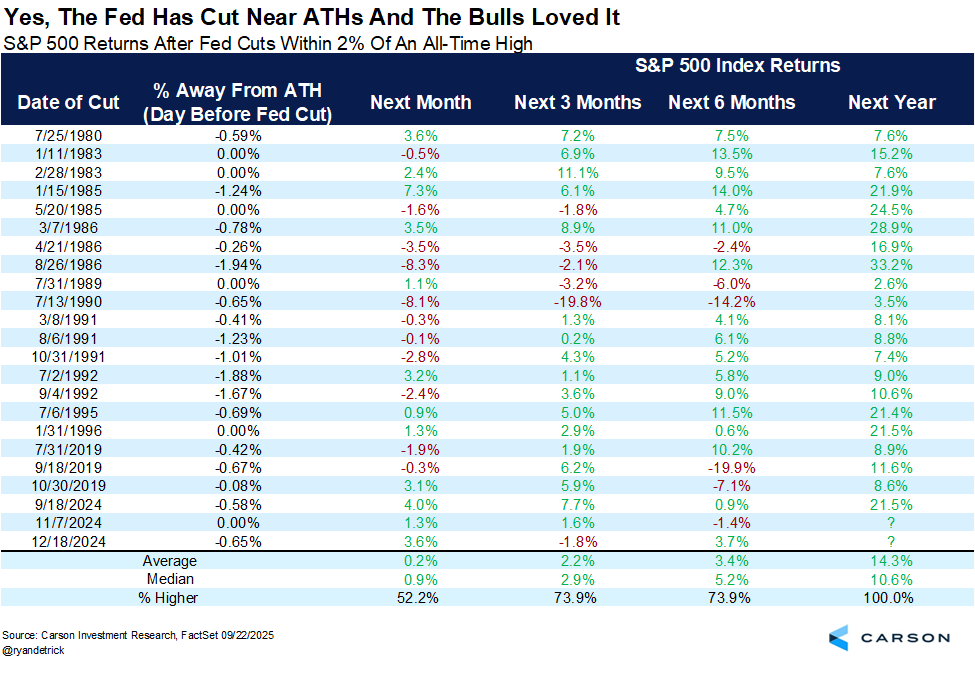
The past 21 times the Fed cut interest rates with the S&P 500 within 2% of an all-time high (like what we probably see on Wednesday), stocks were higher a year later 21 times.
Want to make your favorite perma-bear mad? 🐻
The S&P 500 is about to be up five months in a row.
A year after 5 month win streaks? Higher 28 out of 30 times and up 12.6% on avg. 🐂
When the Fed cuts interest rates within 2% of stock market all-time highs, the S&P 500 has gone on to finish higher over the next 12 months 20 out of 20 times (100% hit rate) 🚨🚨🚨
The S&P 500 is about to be down 4 days in a row (but all were minor dips).
Still, this is in the potentially worrisome part of the post-election year calendar.
The law increases this limit to $20,000/year for elementary or secondary education, while also expanding the list of eligible expenses.
This could help families access more funds tax free for these costs.
The effective date is for tax years beginning after December 31, 2025.
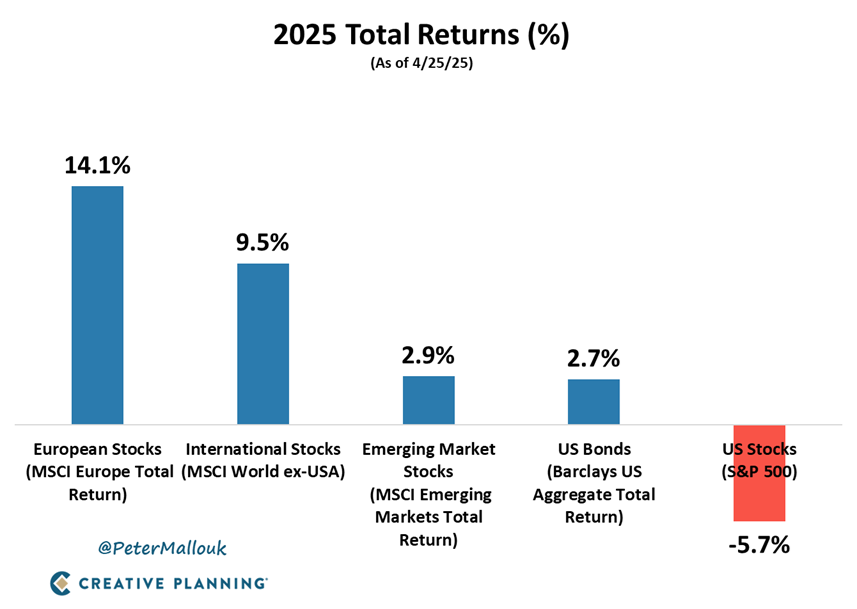
“Why should I own anything other than the S&P 500?”
That was the most common question investors were asking at the start of the year.
Now they have the answer…
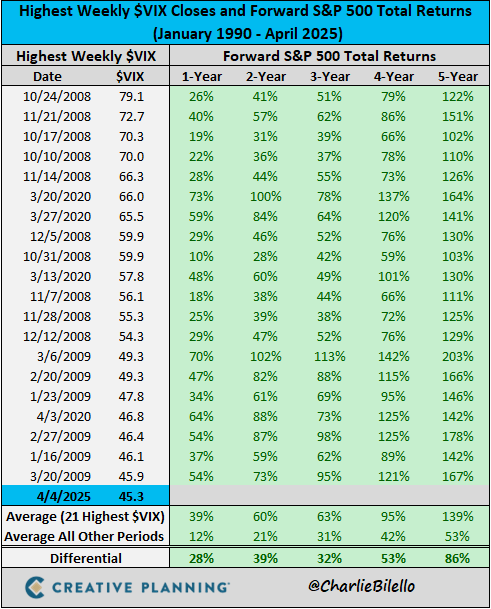
The $VIX ended the week at 45.3, among the highest weekly closes in history.
What has happened in the past following the highest $VIX levels?
Stocks rallied 100% of the time over the next 1, 2, 3, 4, 5 years with returns far above historical averages.
https://t.co/l5IYmkeySJ
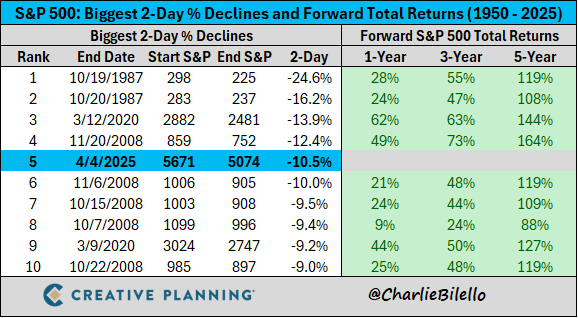
The S&P 500 fell 10.5% over the last 2 trading days which was the 5th biggest 2-day decline since 1950.
What has happened in the past following the biggest 2-day declines?
Stocks were substantially higher over the next 1, 3, 5 years every time.
https://t.co/l5IYmkeySJ