@SamGuichelaar@SteveNomadic if "this guy" = the student pilot then yes he does not understand how LLMs work, but I can't help thinking, he's pretty much using them as advertised.
@hecubian_devil Oh, sweet summer child...open can, watch worms wiggle etc. Whoever can change rules retroactively or mid-course, which inevitably favors some outcomes and factions over others, has the real power, not the voters or delegates.
@nickgillespie Interesting, but lines like "In some ways, conservative Catholic networks in Washington function like the Communist Party in China." scream 'I told my AI to tweek this analogy and failed to realize it was just mashing together two things I don't like'
@Yakki224@sentdefender The US has an effective on the ground force that can be deployed and supported anywhere on the globe. The US even deployed a small portion of it (MEUs and airborne brigades, approximately 10,000 soldiers and marines) to the area near Iran. The US just decided not to use it.
@WimCos@nntaleb In the US most health care, expensive or affordable, is private. The exception is the greatly vexed Veterans Health Administration (VHA) for which only veterans are eligible.
How statistics became propaganda. New @reason Interview with Wrong Number author Aaron Brown, former risk manager at @AQRCapital and a @business columnist. Learn how to see thru misleading media abt everything. https://t.co/0IWleVIfRf
The editors of the world's most prestigious medical journals are sounding the alarm, and nobody is listening.
"We have peer reviewed, high impact editors in most of the journals that are the most high impact, saying that they don't believe what is being published in those journals is trustworthy anymore."
"The BMJ, The Lancet, all of those editors have come out and said, we have a huge problem. We can't replicate this research and we actually don't even know who did the research."
"Everywhere we've looked for corruption, we've found it."
Emily Kaplan, co-founder of the Broken Science Initiative.
@broken_science
How much useful information is missing from the scholarly record?
Every few years, scholarly publishing becomes a little more transparent.
Research papers now routinely include DOIs, ORCID IDs, funding statements, conflict of interest declarations, data availability statements and, increasingly, disclosures about the use of AI. None of these change the research itself, but they make the scholarly record richer and more useful.
________________________________________
What about the publishing model?
One piece of information is almost always absent.
We often describe a paper as being "Open Access", but that description can hide significant differences. Gold, Green, Diamond and Hybrid publishing all operate differently, with different implications for authors, institutions, funders and publishers. Subscription publishing is, of course, another publishing model.
Yet, in most cases, the publishing model is immediately visible.
________________________________________
The information already exists
This is what makes the situation interesting.
Publishers already know how every article has been published because it forms part of their publication workflow, indeed it underpins their business model. The information already exists. It simply isn't presented consistently on the article itself or captured in a standard way that makes large-scale analysis straightforward.
That seems like a missed opportunity.
________________________________________
Why does it matter?
If every article clearly stated its publishing model, researchers would immediately understand how it had been made available. Institutions could better analyse their publishing strategies. Funders and libraries could gain a clearer picture of how research is being disseminated.
Researchers studying scholarly communication would also have access to a much richer source of metadata without needing to piece the information together from multiple sources.
________________________________________
A question worth asking
This is not an argument that one publishing model is better than another. It is simply an argument that, if we already know how an article has been published, why not make that information explicit?
Sometimes the biggest improvements in transparency come from making visible the information we already have.
I'd be interested to know what you think. Should every scholarly article explicitly state its publishing model?
You can read more about this in my latest newsletter:
https://t.co/oK2mXJtdJR
@BPCLimited@Vtxt21 In the US, high-ethanol mixes like E85 do in fact deliver about 20-30% lower miles per gallon compared to "regular unleaded" (<10% ethanol), as measured by the car itself not by some calorific lab test. If ethanol is so good, why does it need a massive, often hidden, subsidy?
@Vtxt21 In the US, high-ethanol mixes like E85 were priced as if they were c. 5% better than the cheapest, low ethanol gasoline (87 octane, <10% ethanol). But since the Iran crisis, E38 is finally priced where it ought to be, about 30% cheaper than the 87 octane low ethanol.
Disappointed to see this using the “conservative pounce” formulation.
I’m Gen X. All of us, including liberals like me, were there when we watched a nation filled with brilliant people put its best minds to making socialism work. It was an unparalleled disaster — not just economically, but environmentally, and certainly from a human rights perspective as well.
The fact that we now have people on both the right and the left who think Lenin was on to something, or that “real socialism has never been tried,” is mind-blowing. It represents a massive generational failure of our K–PhD system. They didn’t learn the history, philosophy, or economics that would have prevented them from falling for the same midwittery that too many of our grandparents fell for.
Sure, it sounds nice. Utopia always does. But it was a colossal disaster that we must not repeat.
So no, Axios. The news isn’t that the GOP is sounding the alarm. It’s that more genuine liberals aren’t.
@JoshuaPCohen1@asymmetricinfo US life expectancy 79.0 years, EU is 81.7 years. EU is right to be proud of that number, but the numbers aren't that far apart. Some of the difference is real, but some is likely due to different ways of measuring life expectancy, especially infant mortality.
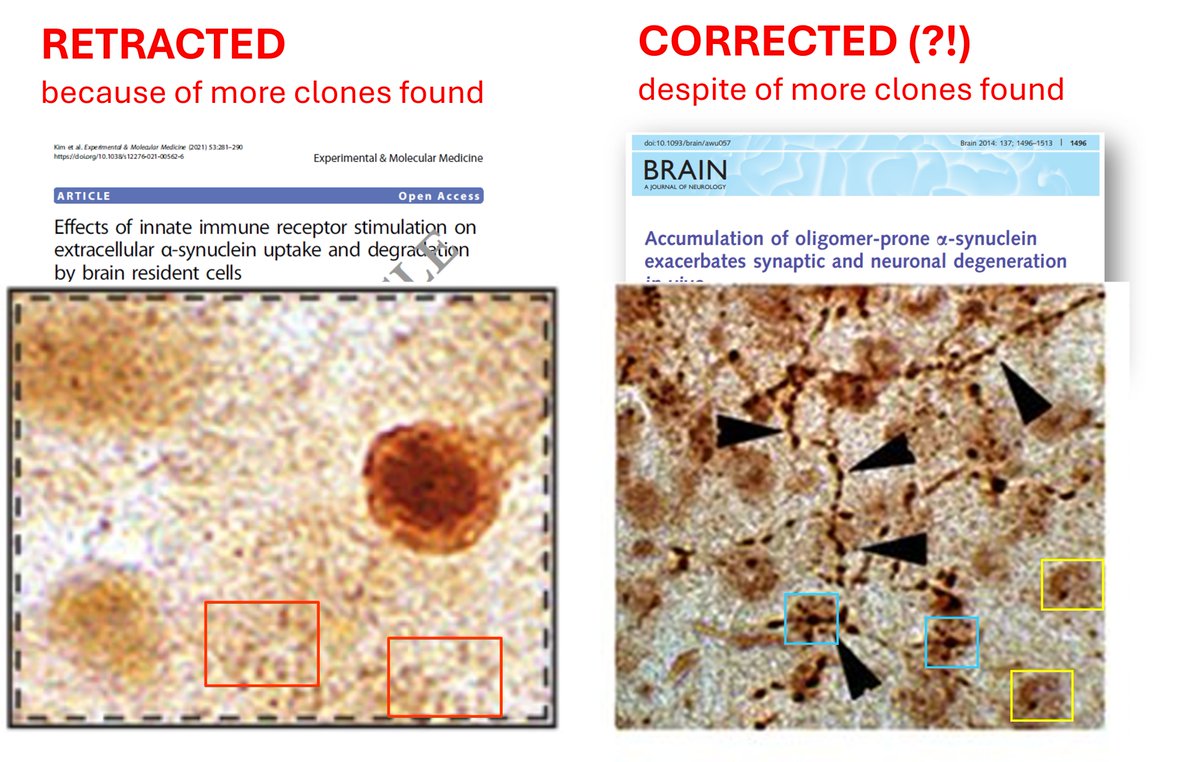
Tale of two (papers with) clones.
Left: clones found by sleuth, more by the publisher, RETRACTED.
Right: clones found by sleuth after sleuth after sleuth, “CORRECTED”. Sleuths being stone-walled. @MicrobiomDigest@arbmacip
Detection is not that hard. Authors are often opportunists in the system that is designed to protect those with fame and connections.
Author lists hidden, because this is about editorial behaviors.
RETRACTED https://t.co/By4HdZIJ3y
“CORRECTED” https://t.co/FZlkqV0BIy
Good job @SpringerNature, Bad job @OUPAcademic