Anthropic's Safety Superpower
Anthropic's belief in its own commitment to safety gives the company license to aggressively favor its business and even challenge the U.S. government.
https://t.co/4HKPlYc99i
Americans go to Europe and are inspired by the piazzas and cafes, Europeans come to Georgia and are in awe of huge houses 65 miles north of the airport.
it’s incredibly fascinating to see anthropic build & ship what is effectively an os for almost all of white collar labor.
claude code is the base layer, mcp is the linker, & each model upgrade is a flag that optimizes everything above it simultaneously.
this is what compounding actually looks like in the ai era & it’s why the gap between anthropic & everyone else might actually be wider than maybe most think.
The worst thing you can do is just dabble with AI a *little bit*. That’s the spot where you use it and see its capability but over-generalize on the use cases and how easy the automation is. You almost have to use it too much, develop psychosis, then get to the other side and realize how much care and feeding and management of the agentic workflows is required. On that other end you realize you actually need to probably hire more (or new) people to then do all the new things agents can do.
Really enjoyed the deck @loganbartlett and team just shared on the state of Software, wanted to pull out a few things that caught my eye:
1. AI-native companies are growing faster AND more efficiently
The growth rates are really staggering. And they’re doing it with very few people. The demand for AI is insatiable, like nothing we have ever seen, and is diverting budget away from traditional software. This is an existential moment for the incumbents. I’ve been saying Accelerate or Die for months. The accelerating is unprecedented, and the growth is coming at the expense of SaaS 2.0. Only death can pay for life
2. They’re doing it without going head-to-head with incumbents
This is probably the most interesting slide to me. These AI-native businesses are growing so fast by using two approaches:
A) Finding a wedge into the enterprise, scaling quickly, then trying to expand
B) Building AI-native Systems of Record from below. @arampell calls this “Greenfield Bingo.” New businesses/SMB have zero/low switching costs, so AI-native CRM/HR/ERP companies can take share and march upmarket from below
Both of these are particularly tricky for incumbents to defend against. They simply aren’t able to move quickly enough to build compelling AI point solutions, and they’re struggling to defend downmarket while also defending the enterprise (bimodal go-to-market and running multiple service models in one company is incredibly difficult)
3. Incumbents scale by throwing people at the problem
This has been the dirty little secret of SaaS for 15 years. It’s basically impossible to grow revenue faster than headcount. Some companies like Shopify did it by layering on payments. Consumption-based companies have been doing it. The AI native companies have this figured out. The incumbent, seat-based, companies simply have never been able to decouple revenue from headcount. They will have to learn or die
4. Incumbents have the right to win but they are failing to capture the moment
As I’ve said before, the CIO wants to stick with their current vendors. They WANT to buy AI solutions from the incumbents. The problem is their solutions suck. @jasonlk has been all over this. These incumbents have a shrinking window of time where they have the advantage, but that window is shrinking. Rapidly.
Agents Over Bubbles
Agents are fundamentally changing the shape of demand for compute, both in terms of how they work and in terms of who will use them. They're so compelling that I no longer believe we're in a bubble.
https://t.co/LdPu3L37Vl
Uber founder @travisk credits Dropbox's @drewhouston and Airbnb's @bchesky with pushing the boundaries of private markets in the 2010s:
"[Drew] was like the first guy in that game."
"People didn't even know what private equity was."
"Back then, private equity was like, 'I do leveraged buyouts.' [They were] bringing private equity and mutual funds into the game in a way that didn't exist before. Now it's just old hat."
“When you go from consumer to B2B, the number one mega-challenge that you must master is LTV:CAC.” - @travisk
"Yes, you can make that argument on consumer, but when you have a sales funnel that starts with 'I'm going to talk to customers, and I have to make LTV:CAC work' — versus 'My LTV:CAC is the App Store' — it's a whole different ballgame."
“LTV:CAC with a sales machine, especially if you go [after] small businesses, is life on hard mode. Anybody who’s crushed it on SMB, those guys are special individuals who've made that happen. Because life in the SMB B2B world is no joke."
Alex Karp's take on the Department of War designating Anthropic as a supply chain risk:
"In the warfighting context, the Department of War has to be the arbiter of what gets deployed."
"I want to split domestic and foreign. In this country have God-given rights [like the First, Second, and Fourth Amendments]...Adversaries trying to kill us do not have those rights. And I've never believed in extending our rights to foreign countries that are adversarial to us."
"On domestic stuff...there are real issues. I'm super sympathetic with restrictions around the use of these products in the domestic context."
"Just to give you an example, there are datasets that are publicly available in the US market that I don't think should be used against you and me in a law enforcement context with the help of AI agents and ontology."
"But if you don't use [this] on the battlefield, obviously Iran's going to use [it]. You don't think they can go online and buy those products?"
"Without going into somewhat classified data, those things in combination with other things — [they're] lethal. A lot of people who want to hurt America end up dead because of our ability to aggregate and then figure out what's going on in the battlefield before they can figure out what we're doing."
"So I'm very much in favor of it for moral reasons. But I'm also in favor of it because I don't know how else you explain this to the American people. We're going to take your job, we're going to eviscerate your ability to have money and power, but we're not going to defend you on the battlefield?"
There are a lot of people who sold the bottom in monopolistic, asset-light, resilient businesses b/c they were afraid of AI to pile into cyclical, asset-heavy, energy-sensitive industrials only for oil to double and that’s what makes investing the greatest game on earth
Unfortunately I think we'll see meaningful layoffs in software this year. And I want to explain why it's just air cover to call them "AI-driven layoffs", even though every company will do so.
Yes, AI makes companies more efficient. Developers and marketers can do more. CSMs can have a wider span of control. You can answer 70% of your tier 1 support cases with AI. But that's not really what's going on.
But two things are more elemental to the situation, and the actual driver:
1. Valuations have reset, with a totally valid and reasonable focus on free cash flow minus stock compensation. And the math simply doesn't math.
2. Many of these companies staffed up during COVID and never actually took their medicine and got fit. They thought demand would come back and it mostly hasn't. Not in the same way.
Illustrative example, to pick on two companies, Atlassian and HubSpot, that I actually really admire:
- Age: Atlassian is 24 years old. HubSpot is 19 years old - # of employees: Atlassian has 14k employees at $22B market cap. HubSpot has 9k employees at $15B market cap
- SBC-Adjusted FCF: Basically ZERO
That's right. After 20 years, the actual cash generated and available to shareholders is ZERO
I do think the owners of these businesses understand that is no longer tenable.
But they have two issues now:
1. The actual technical talent needs to get paid
2. Their stocks are down 60-70% from recent highs
So here's the situation: They need to start making actual money, they have to pay their tech talent, their dollar grants are going to have serious dilution consequences, and their cost structures are completely bloated for their current market cap, especially compared to more nimble competitors.
If they keep paying all of these people in stock, their dilution will continue and the stocks will continue to be punished. If they pay them all in cash, they will have no fcf.
TL;DR Layoffs are unfortunately the only true answer. They are coming. They will be credited to AI, and that will be air cover for the real problem.
Few thoughts on the $XYZ cuts:
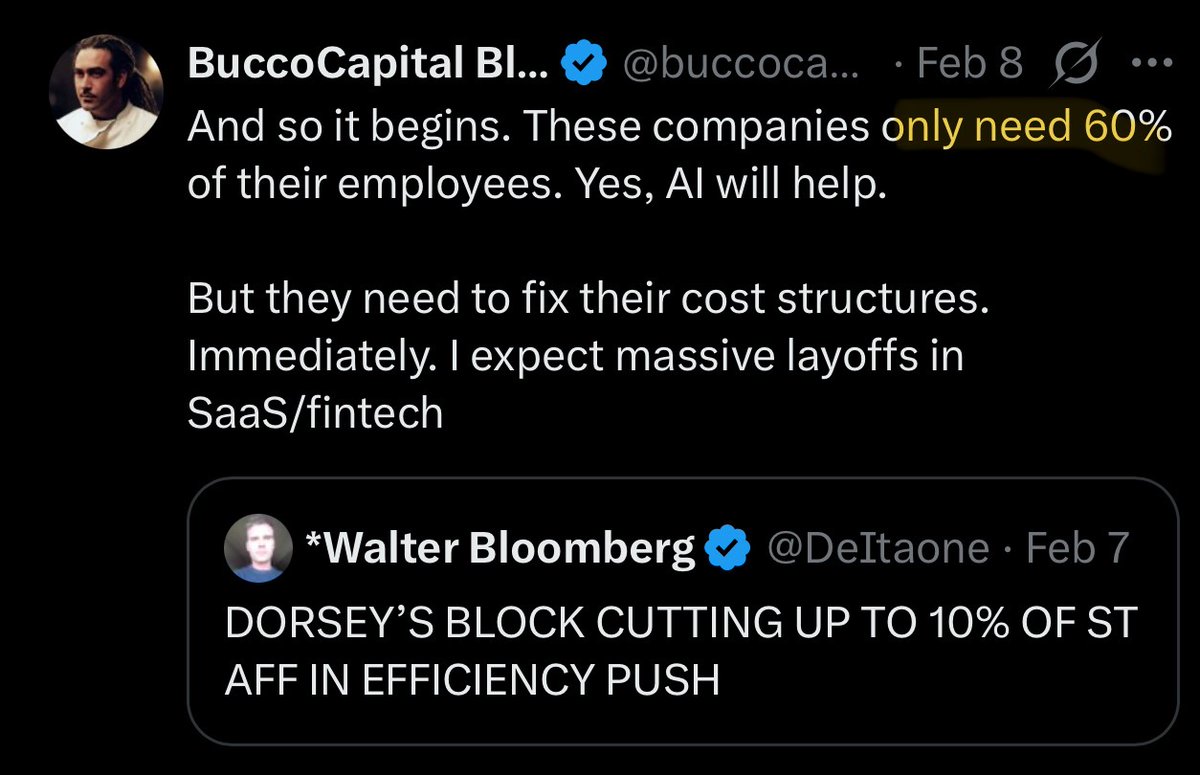
- TL:DR: Mostly about XYZ being poorly run. Not really about AI. But most other smidcap tech also poorly run. Expect many more cuts
- Below I tweeted that they only needed 60% of their company. That wasn’t a random number. Pull up any fintech/SaaS chart and you can see that employee count exploded when demand exploded in 2020. But now these companies are way too bloated
- But, fuck me. I did not expect them to cut 40% at once. I think it’s basically impossible to identify the right 40% in one go. So huge operational risk there. But maybe better for morale than multiple cuts. Who knows. Unprecedented. Fuckin a.
- We now have 2 examples of this happening with Jack, so it’s easy to say he runs a bad, bloated business. I have been vocal about this. Toast and Clover should not be anywhere near the scale they’re at. Tidal? Afterpay? Come on. Pretty sure he threw a $70M party for the team last year. There is a lot here that is just one bad management decision after another
- I *also* think it’s a mistake to define this as purely a “Jack” issue. As I said, pull up the employee charts and the revenue charts. I’d say to pull up the earnings charts but for many they are negative, which we all know. These companies are way too bloated. And they are having their clocks cleaned by smaller, more nimble startups. They have to get lean to survive. I think the realistic, average number is 20-25% for many of these companies. But there are plenty that could cut 40% too.
- I think this basically has nothing to do with AI. I bet there are some roles they can eliminate, and some where they can increase scope. Let’s call it 5%
Major new report on global trends in mental health, out today from Sapien Labs. Data from 2.5 million people across 85 countries.
Some of the most important findings:
1) Young adults used to generally have good mental health, compared to older generations. But now, in ALL countries examined, they are doing badly compared to older generations in that country.
2) "Four key factors have emerged that together predict three quarters of this effect. These are diminished
family bonds, diminished spirituality, smartphones at increasingly young age, and increasing consumption of
ultra-processed food."
3) The decline of young people's mental health is "most pronounced in the wealthier and more developed countries." They note that it is in such countries that smartphones are given earliest, junk food is most heavily consumed, spirituality is most diminished, and family ties are looser and often weaker.
4) "A younger age of first smartphone ownership is associated with increased suicidal thoughts,
aggression, and other problems in adulthood."
5) Here is their summary of findings on early smartphone ownership:
"GenZ is the first generation to grow up with a smartphone. Among this group, the younger they acquired their first smartphone in childhood, the more likely they are to have struggles as adults. These struggles extend beyond sadness and anxiety to less discussed symptoms, such as a sense of being detached from reality, suicidal thoughts, and aggression towards others. The effects arise through disruption of sleep, increased risk of exposure to harmful online content, predators, and explicit material as well as increased probabilities of cyberbullying during crucial developmental years. Excessive time spent on smartphones also diminishes the development of social cognition that requires learned interpretation of facial expressions, body language, and group dynamics. The negative impacts are particularly sharp below age 13."
The report is short, accessible, and important. Read it here:
https://t.co/hFGAyoWabs
Investor @bgurley: "If I were using cynical words, I'd say [venture capital] hijacked the growth years of early IPO companies."
"Amazon went public below a billion in market cap. It's hard to fathom that today, with what we have going on here."
JUNE 2028.
The S&P is down 38% from its highs. Unemployment just printed 10.2%. Private credit is unraveling. Prime mortgages are cracking. AI didn’t disappoint. It exceeded every expectation.
What happened?
https://t.co/JzzwCrbJgS