.@ExplorationTEC raised a $450M Series C this week in one of the European space industry’s largest scale-up fundraises to date.
The round, which brings TEC’s total financing to ~$680M since its founding in 2021, will fund the development of the company’s Nyx cargo reentry vehicle, as well as its Storm reusable rocket engine.
Read The Exploration Company's full plans for the new capital, from Payload reporter @Douglas__Gorman. Link below
Hoje a Decade sai do stealth, anunciando a maior rodada seed da América Latina.
US$ 85 milhões investidos por @benchmark , @Greenoaks e Diffusion para inaugurar uma nova categoria de serviços financeiros, a Inteligência Patrimonial.
Veja a matéria completa na @bloomberg
https://t.co/pSw3RUJOO0
Introducing ACT-2 Preview
The first robotics model to unify broad generalization with high reliability. A single fine-tuning example can teach Memo a new behavior that generalizes.
Zero shot, real unseen homes, 99% success rate.
Introducing Sakana Fugu: A full multi-agent orchestration system accessible via a single model API.
Our ‘Fugu Ultra’ model matches the performance of Fable and Mythos, delivering frontier capability without the risk of export controls.
Try it: https://t.co/hhO6qTawgb 🐡
$110M Series B. $1B Valuation. 🦄
Observability is broken. We fixed it.
600+ teams already know, including Zalando, Taco Bell, and The Telegraph.
Find out what you've been missing: https://t.co/qLl8rt0kJl
Led by @balderton, with DTCP Growth and existing investors @Accel, @CherryVentures, and @dig_ventures. With strategic partners, July Fund and https://t.co/OvtZNKlB0N.
#SeriesB #Observability #OpenTelemetry
We raised $165M at a $1.15B valuation to stop doing demos.
2026 is about 1) deployment and 2) research. We will start shipping Memo with our new frontier models in a few months.
Our series-B is led by Coatue, with Thomas Laffont joining the board. ->🧵
We asked an 8-year-old what app she’d build.
She couldn’t pick just one.
When did we stop playing?
Comment & tag @wabi with the mini app you’d make. We’re giving out 100,000 access codes this month.
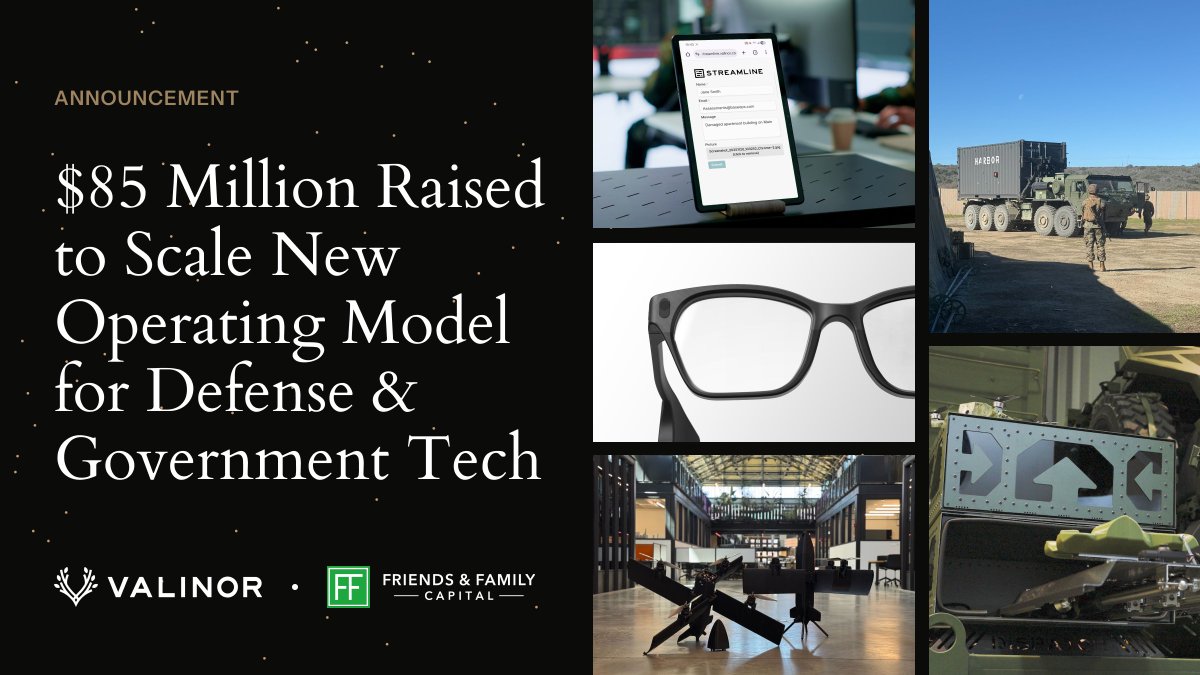
.@valinortech is a company of companies building what our government needs, faster. Today, Valinor announces its $54M Series A.
GC Managing Director and Valinor co-founder Paul Kwan sat down with Valinor’s CEO @Julie_Bush_, to discuss Harbor, Valinor’s forward-deployed medical infrastructure that went from concept to saving lives in six months.
Speed is everything when it comes to saving lives downrange. This is what's possible when you remove the barriers to innovation.
I'm thrilled to announce that @valinortech has raised a $54 million Series A led by @friendsfamcap, bringing out total capital raised to over $85 million.
We've proven a new operating model for defense tech.
Now it's time to scale.
“We want to build The Exploration Company as a global company... If Europe wants to stay a space leader, it must bet on companies with the potential to become the European SpaceX. There is no other way.” - Hélène Huby
Essential read on TEC in today's @FT: https://t.co/bzylAIcYGs
Introducing Reinforcement-Learned Teachers (RLTs): Transforming how we teach LLMs to reason with reinforcement learning (RL).
Blog: https://t.co/RiUQvdszoa
Paper: https://t.co/GJMQsXIkqY
Traditional RL focuses on “learning to solve” challenging problems with expensive LLMs and constitutes a key step in making student AI systems ultimately acquire reasoning capabilities via distillation and cold-starting. Enter our RLTs—a new class of models prompted with not only a problem’s question but also its solution, and directly trained to generate clear, step-by-step “explanations” to teach their students.
Remarkably, an RLT with only 7B parameters produces superior results when distilling and cold-starting students in competitive and graduate-level reasoning tasks than orders-of-magnitude larger LLMs. RLTs are as effective even when distilling 32B students, much larger than the teacher itself—unlocking a new standard for efficiency in developing reasoning language models with RL.
Code: https://t.co/19SYIWsNuo
Introducing The Darwin Gödel Machine: AI that improves itself by rewriting its own code
https://t.co/wEEB4LGPr0
The Darwin Gödel Machine (DGM) is a self-improving agent that can modify its own code. Inspired by evolution, we maintain an expanding lineage of agent variants, allowing for open-ended exploration of the vast design space of such “self-improving” agents.
Modern agentic systems, while powerful, remain static—once deployed, their intelligence remains fixed. We believe continuous self-improvement is key to the development of stronger AI capabilities. Our Darwin Gödel Machine is built from the ground up to enable AI systems that can learn and evolve their own capabilities over time, just as humans do.
On SWE-bench, DGM automatically improved its performance from 20.0% to 50.0%. Similarly, on Polyglot, the DGM increased its success rate from an initial 14.2% to 30.7%, significantly outperforming representative hand-designed agents.
Learn more about our approach in our technical report: https://t.co/kDNWFgCI6C
This work was done in collaboration with Jeff Clune (@jeffclune)’s lab at UBC, and led by his PhD students Jenny Zhang (@jennyzhangzt) and Shengran Hu (@shengranhu), together with Cong Lu (@cong_ml) and Robert Lange (@RobertTLange).
Code: https://t.co/RcYLd22TB5
Mitsubishi UFJ Financial Group’s banking unit has hired startup Sakana AI to power its systems with AI
“The deal will allow the $1.5 billion startup to turn profitable within a year.”
😃✨
https://t.co/4eZdew1cZZ
Excited to announce our Series A!
We raised more than $100M to grow Sakana AI into a World Class AI Lab in Japan. We’re going to really push the frontiers of what’s possible with AI.
As a founder mode startup, we operate much faster than most frontier AI labs at a global level.