Life is a temporary celebration of something larger and eternal. We walk in the shadows of countless generations before us that gave us this shared reality to make our own. Human wealth is not measured in abstract numbers.. but in experience, love, and in new ideas imagined.🍄
Men, take a break from whatever you're doing and see how many pushups you can do.
How many did you do?
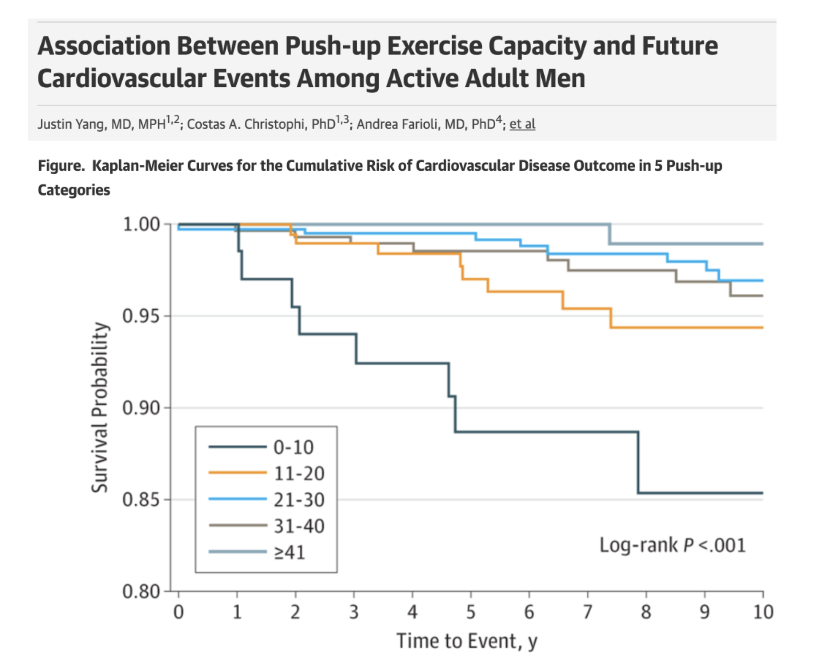
It's a predictor of your heart disease risk.
. 20+ reps is linked to a 75% lower risk
. less than 10, you gotta get off dat ass
Data from 10 yr study of 1,104 men aged 21 to 66.
Pushups outperformed submaximal VO2max at predicting events, likely because pushups capture muscular strength and power on top of fitness, two of the strongest protective biomarkers known.
Limitations: the cohort was middle-aged male firefighters, so do not extend to women, older adults, or sedentary populations. The under 10 group was also older, heavier, and smoked more, so some signal is residual confounding by overall metabolic health.
42 years ago today I made a surprising discovery that every year has been showing us more and more about the answer to life, the universe and everything...
https://t.co/z1uA3RyxYF
Artificial intelligences do not undergo experiences, do not possess a body, do not feel joy or pain, do not mature through relationships, and do not know from within what love, work, friendship or responsibility mean. Nor do they have a moral conscience, since they do not judge good and evil, grasp the ultimate meaning of situations, or bear responsibility for consequences. They may imitate or even simulate, but they do not understand what they produce, for they lack the affective, relational, and spiritual perspective through which human beings grow in wisdom. #MagnificaHumanitas
"you can outsource your thinking, but you can’t outsource your understanding"
easy to forget in todays AI era, worth remembering everyday as we all wield more intelligence!
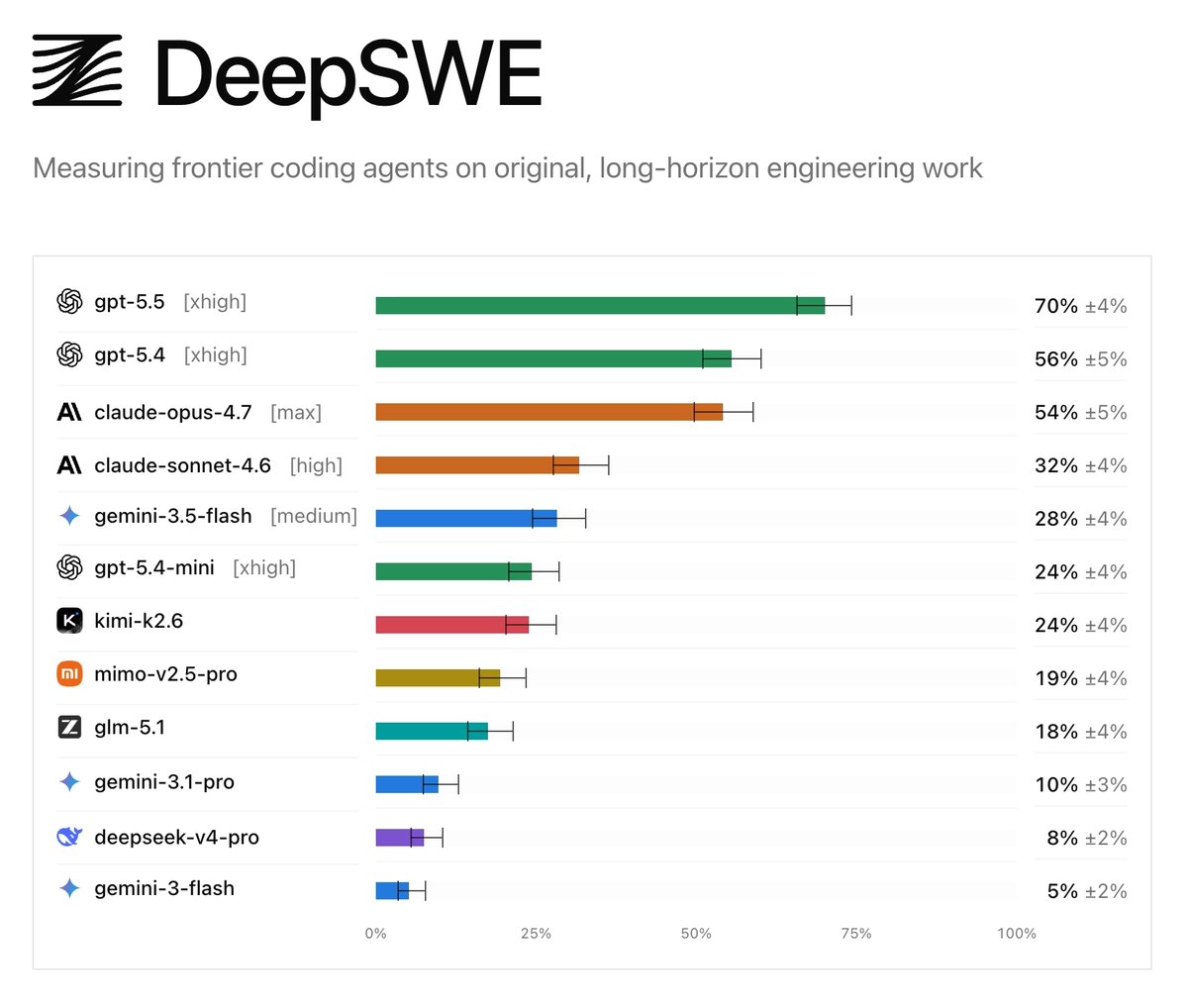
Gemini Flash 3.5 really shines here with just Medium level of thinking. Although it's fascinating to see how much Kimi and GLM models are catching up as open models. What an exciting time!
Today we’re releasing DeepSWE, a new standard for agentic coding benchmarks.
On public leaderboards, top models often look relatively close in capability. DeepSWE shows where they actually diverge, reflecting the realistic experience of developers in their day-to-day work.
@serenaa_ge Flash 3.5 really shines here with just Medium level of thinking. Although it's fascinating to see how much Kimi and GLM models are catching up as open models.
That water clarity is an engineering decision, and the math behind it is wilder than the video.
Roman aqueducts ran on gravity alone. No pumps, no pressure systems. Engineers carved channels with a gradient so shallow it borders on absurd. The Pont du Gard in southern France drops 2.5 centimeters over 275 meters. That's roughly the thickness of a coin over the length of three football fields. They surveyed that accuracy with plumb lines and wooden leveling instruments.
The clarity you're seeing is a direct product of flow velocity. Too steep and the water erodes the channel walls, picks up sediment, turns brown. Too flat and it stagnates. Roman engineers targeted a slope of about 20 centimeters per kilometer, which kept the water moving fast enough to stay fresh but slow enough to stay clear. Before the water reached the city, it passed through multi-chamber settling tanks where velocity dropped near zero. Suspended particles sank. Clean water flowed out the top into the next chamber. Repeat three or four times.
Pliny specified the minimum slope in writing. Vitruvius published the exact mortar ratio for hydraulic cement: one part lime to two parts volcanic ash for underwater work. The pozzolana from Pozzuoli reacted with water to form a calcium-aluminum-silicate compound that actually gets stronger the longer it sits submerged. Modern concrete degrades in water. Roman concrete bonds with it.
Scale the whole system and it gets harder to process. Eleven aqueducts fed Rome at its peak. Combined output: roughly 1 million cubic meters of water per day. That works out to about 250 gallons per person for a city of one million. Modern New York delivers about 125 gallons per person per day. Ancient Rome had access to double the per capita water supply of the largest city in the United States, running entirely on slope and stone.
The Trevi Fountain in Rome is still fed by one of them. Two thousand years, same source, same gravity, same water.
Boos: "AI is a rocket with super powers and many people will be able to board it."
Cheers: "People have super powers, and AI will be our copilot to improve our capabilities."
@stenichele I just ask as I am fascinating blending 'game of life' with language models, and then watch how different 'language games' play out. I ran lots of neat experiments, but none of them with interest results to post about.
Small experiment on "semantic artificial life".
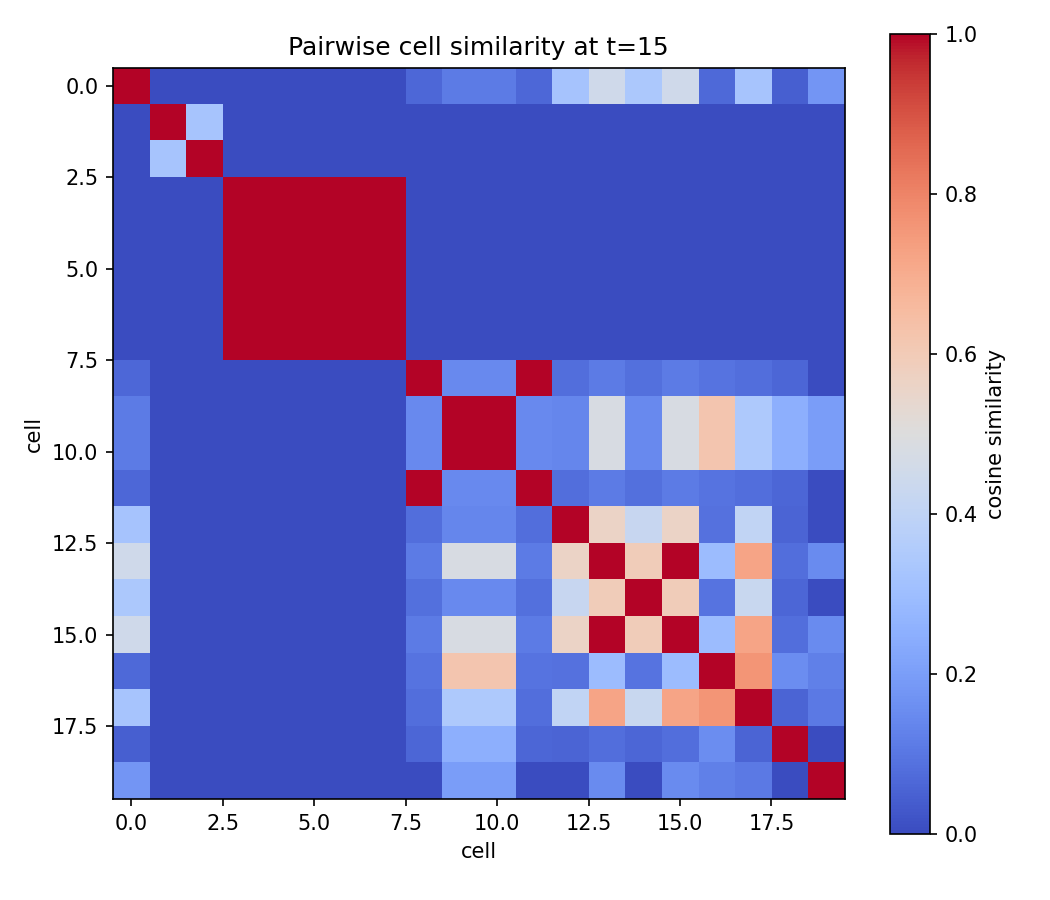
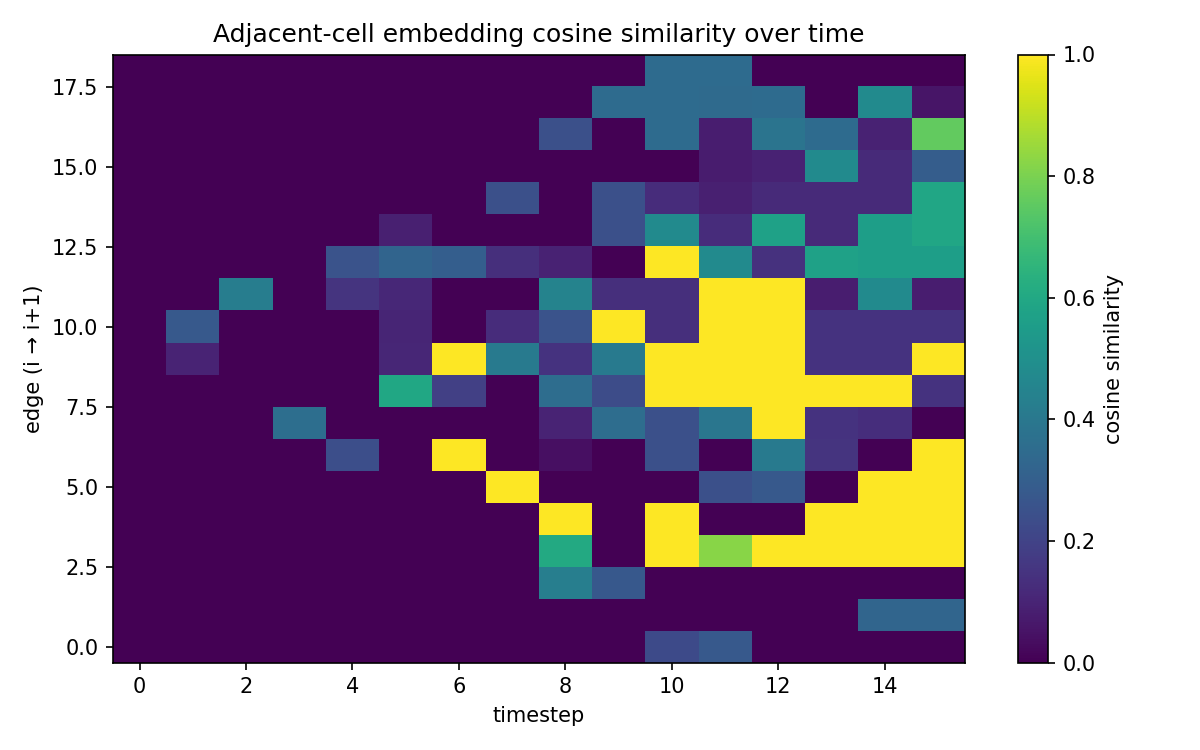
I put small LLMs (Qwen 2.5 0.5B) on a 1D lattice. It is an NCA where update rules are LLMs that receive tokens from left/right neighbors & their previous output and produce new output tokens.
@stenichele So the entire 1d field (every cell updated) with a new generation of each new generation (containing self + L/R neighbors)? What is the 'cosine similarity' in the graphs? What's the idea/point of this?
[1/3] Excited to share Winfree Oscillatory Neural Network (WONN): a synchronization-based neural architecture built on Winfree dynamics.
WONN evolves representations through oscillatory synchronization on a toroidal phase space (S^1)^d.
Project page: https://t.co/5dkz6W73jc









![YueSong48287250's tweet photo. [1/3] Excited to share Winfree Oscillatory Neural Network (WONN): a synchronization-based neural architecture built on Winfree dynamics.
WONN evolves representations through oscillatory synchronization on a toroidal phase space (S^1)^d.
Project page: https://t.co/5dkz6W73jc https://t.co/aTQtIx8kA7](https://pbs.twimg.com/media/HI04fFqbkAAgS1N.jpg)


