Congrats to @CosciaLab and his colleagues! Their Deep Visual Proteomics pipeline is one of the highlighted @naturemethods Spatial Proteomics approaches! He says "making DVP broadly accessible and advancing it to the multiomics space is a key mission in his lab at the #mdcBerlin."
So... Preprint #2.
In which InstanSeg is extended to output nucleus & cell boundaries - and also to handle arbitrary combinations of image input channels.
https://t.co/Fk3Vljt5sd
i am so excited about our open source inexpensive, sub-cellular capture, do-it-yourself Open-ST that transforms tissues into virtual tissue blocks in 3D - IDing pathways & gene programs driving phenotypes. a huge congratz to the team! https://t.co/UvyBdFGZRX
I'm super excited to share Nimbus, our algorithm for automatic classification of cellular marker expression in multiplexed image data! Nimbus is a pretrained deep learning model that works out of the box across panels with any combination of markers (1/x) https://t.co/F7qk9P5oXx
I am incredibly happy to share that we have recently started the European Society for Spatial Biology (ESSB) @SpatialBio which will be hosting its first conference in Berlin 12-13 of December 2024: https://t.co/pwoTjKKrKM
Proteomic researcher and #mdcBerlin group leader Fabian Coscia (@CosciaLab) combines mass spectrometry, #AI, #microscopy, and #robotics to search for the #proteins that drive diseases such as #cancer at the #SingleCell level.
Read more: https://t.co/OEOqkT6Vsj
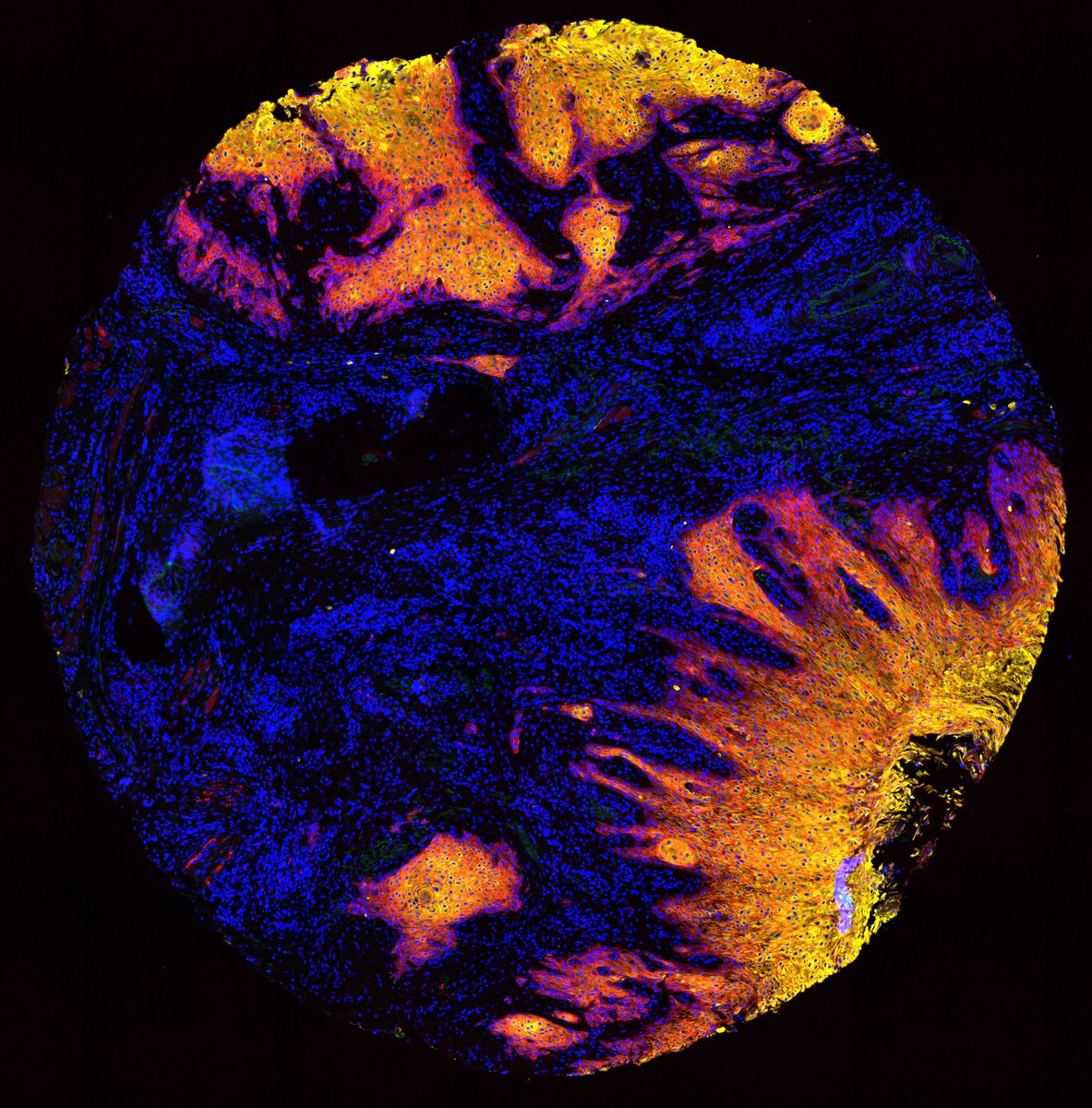
#mdcBerlin researcher @FritzscheSonja (@CosciaLab) is participating in the @helmholtz_image "Best Scientific Imaging Contest" – and YOU can help her win the public choice award!
Cast your votes (up to five) for the picture below 👇 (ID 356)! 👉 https://t.co/mcdU0FHfPO
(1/5) Attention, Cellular Imaging Enthusiasts!
Thrilled to share that our Analysis "The Multi-modality Cell Segmentation Challenge: Towards Universal Solutions" has been published in Nature Methods (@NatureMethods) 🎉🎉🎉
Cell segmentation is a critical component of microscopy image analysis, but existing algorithms are often specialized for particular types of images or demand users to manually set hyper-parameters, posing challenges for biologists without a strong computational background.
To address these issues, we organized an international challenge at NeurIPS 2022 to promote the development of novel cell segmentation methods that excel across a wide array of microscopy images, imaging platforms, and tissue types.
🌐 Homepage: https://t.co/jJRujwDDwl
📄 Paper: https://t.co/FgfqoSLI05
🔬Data: https://t.co/P8i77CF62b
🏅Competition website: https://t.co/PA0LrBH7sd
👇 👇👇👇
🚀 We've just OPEN-SOURCED a series of tutorials (over 15) on multiplex image analysis 🎉 Perfect for those venturing into spatial biology or working with CODEX, MxIF, CyCIF, mIHC, MIBI, IMC, and related data types 🧬. We hope, it contributes to your work! https://t.co/nkHEhtYgbl
Out today from the Stegle, Theis, and Moore labs! SpatialData is a user-friendly computational framework for exploring, analyzing, annotating, aligning and storing spatial omics data that can seamlessly handle large multimodal datasets.
https://t.co/ReCFeXVFoS
couldn’t agree more about the need for more computational biologists. More importantly, we must ensure they receive the recognition and support they deserve. Their work should never be dismissed as merely “just service”. Additionally, I’d like to remind everyone of the excellent paper titled ‘All Biology is Computational Biology’. 🧬 💻
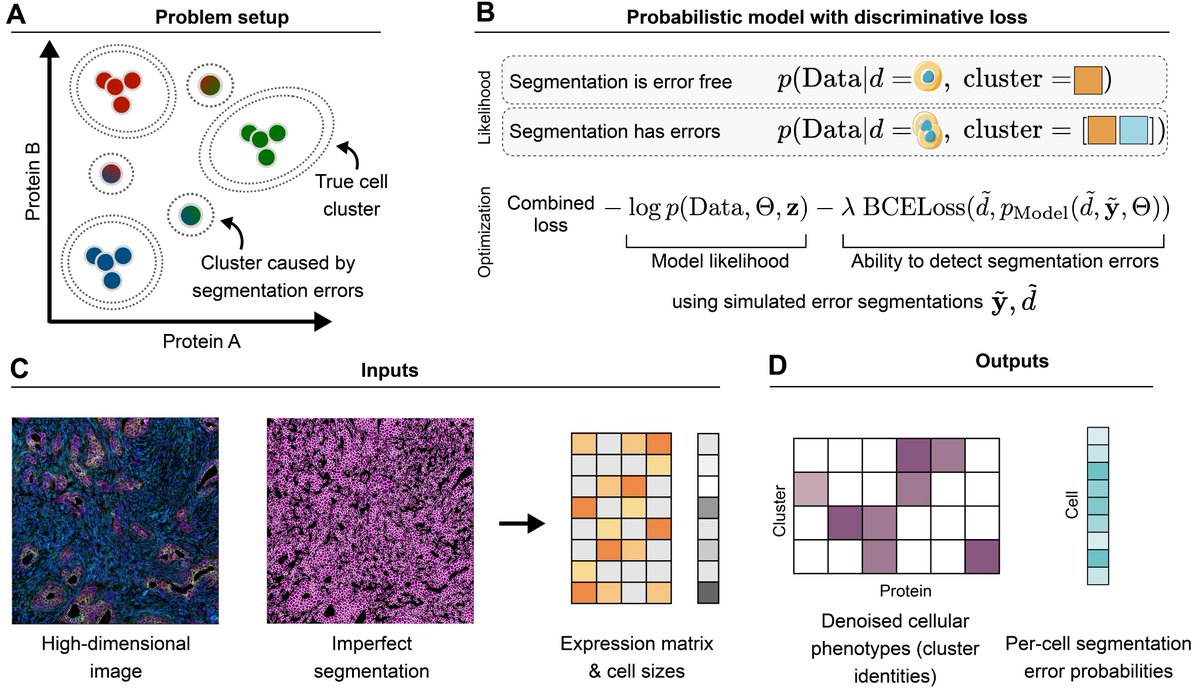
(1/n) 🔬Segmentation errors messing with your cell types in spatial expression assays?
Happy to introduce STARLING, our new method for clustering spatial data while accounting for imperfect segmentation
📜https://t.co/wazZsigPPZ
⬇️ Short thread
1/n: 🔬We introduce NicheCompass (NC) a graph learning model to build spatial atlases across millions of cells, quantitatively characterize cell niches, infer cellular communication, and map new data into these atlases. NC can be used with various spatial technologies, ranging from cellular to subcellular resolution including even multimodal approaches. We have explored interesting biology by analyzing cell niches spanning from development to cancer. Led by @SebastianBirk_ in a fun colab with @cartalop:
paper: https://t.co/cryBX0vT8Z
This is how neutrophiles, one of the human immune system's white blood cells, generate multiple pulsatile waves of swarming signal to organize the very earliest stage of the immune response
[full paper: https://t.co/Vdbm3sYe5R]
https://t.co/5w0XHduN9f
Struggling with spatial omics analysis? Try Sopa, our new technology-invariant Python library for all image-based spatial-omics!
Based on @scverse_team data structures, and built with @KevinMulder19 and @FGinhoux 🚀
https://t.co/e9XA7vHvY4
With abundant cross-condition scell data it is timely to transition from taxonomies to multicellular descriptions of tissue function
Our revised work for the unsupervised analysis of samples of scell atlases, inference of multicellular programs, and study integration is out now