🧵Indianapolis’s imposition of its transit tax does not comply with the enabling statute. The statute says that to get the transit tax @IndyGoBus's main, “fixed-route” bus system must have a farebox recovery ratio of at least 25%. According to IC 36-9-4-58(b), that is, . . .
After being fired from CBS, former “60 Minutes” correspondent Scott Pelley yesterday said that “new management has instructed me to inject falsehoods and bias into a politically sensitive story. I’ve been told to include assertions that are unverified.”
Those are remarkable claims for which Pelley presented no evidence. Indeed, it would be extraordinary for CBS to demand such things of a correspondent, either verbally or in writing, given the reputational risk to the network.
A more likely explanation is that Pelley disagreed with someone at CBS and then declared a difference of opinion to be a demand to lie. Support for this interpretation comes from the fact that he claimed Tuesday that CBS’s new management, led by Bari Weiss, was trying to kill “60 Minutes,” something for which he also did not provide evidence.
Moreover, the accusation makes no sense. CBS Editor-in-Chief Bari Weiss took the job to rebuild CBS News, not to wreck it, and a ruined “60 Minutes” would hurt her. Paramount’s owners did not pay billions for the network to burn its best asset for spite. So the simpler reading is that Pelley is the one stretching the truth.
Doing so appears to be a habit for Pelley. He told The New York Times, “I have been in combat in Afghanistan. I have been in combat in Iraq,” but being in a combat zone as a journalist is not the same as being “in combat.” The remark is yet more evidence of Pelley’s propensity to exaggerate to the point of lying.
For decades, mainstream liberal journalists have displayed remarkable levels of arrogance, even as they get major stories wrong.
Consider the case of CBS News’ former anchor Dan Rather. In the fall of 2004, two months before the election, Rather presented documents purporting to show favoritism in George W. Bush’s National Guard service. Experts called them forgeries. CBS apologized: “We made a mistake in judgment, and for that I am sorry,” Rather said. On air, he added, “I want to say, personally and directly, I’m sorry.”
But then, a decade later, Rather told Variety he still stands “100 percent” behind the report and reframed the apology.
Or consider NBC’s Katie Couric. In her 2016 documentary “Under the Gun,” editors inserted roughly eight to nine seconds of silence after she asked Virginia gun owners how to keep guns from felons and terrorists without background checks, making them look stumped. The raw audio revealed that they answered immediately.
Couric’s first instinct was to defend what she did, saying she was “very proud of the film.” Only after sustained backlash did she apologize.
In her 2021 memoir “Going There,” Couric admitted she cut Justice Ruth Bader Ginsburg’s harshest anthem-kneeling comments from her 2016 interview. Ginsburg had said kneeling players showed “contempt for a government that has made it possible for their parents and grandparents to live a decent life, which they probably could not have lived in the places they came from.”
NBC’s “Meet the Press,” in the spring of 2020, aired a clip of Attorney General Bill Barr that omitted part of his answer, misleading the public.
When Catherine Herridge interviewed Barr for CBS Evening News, she asked what history would say about his decision to drop the case against a former National Security Advisor to President Trump, Michael Flynn. The Obama administration’s FBI had illegally targeted Flynn for entrapment and prosecution. Barr replied that ”history is written by the winner. So it largely depends on who’s writing the history.”
"Meet the Press'" anchor at the time, Chuck Todd, said on air that Barr “didn’t make the case that he was upholding the rule of law. He was almost admitting that, yeah, this is a political job.’” But “Meet the Press” had left out the second part of Barr’s answer to Herridge, in which he said, “But I think a fair history would say that it was a good decision because it upheld the rule of law.”
The safeguards the journalism profession built against error did not work when it mattered. The corrections, the editors, the fact-checkers, and the standards desks all sat in place while the press got the border, trans medicine, climate, the sixth extinction, Russiagate, the Hunter Biden laptop, Covid and much else wrong. Gerth described how reporters sought to “shoot the messenger” rather than grapple with evidence contradicting the Russia collusion narrative...
https://t.co/K5tE372xGo
Please subscribe now to support Public's award-winning journalism and to read the full article!
Please arrive at your appointment 15 minutes early so you can fill out the same forms you filled out online and then be asked the same questions when the doctor actually sees you.
This is all good stuff, I’m sure. But I’d have found it more compelling if a transaction that I recently completed with J.P. Morgan hadn’t dragged out for something like four months when it could have been completed in a single morning if his employees had been more empowered.
The majority of the dozen or so personnel I dealt with seemed sincerely interested in moving things along. But responsibility was so divided and information so siloed that we could take only baby steps. More than one VP I dealt with said they shared my frustration at their being so hog-tied, and I joked that the next time they talk to Jamie they might want to ask if he could do something about it.
A "good tax" in comparison to what? Theoretically I can see its merit as a rough user fee for the abutting street, storm sewers, etc. (And, of course, I don't see why we seniors get all the breaks we do.) But what better justification does it otherwise have over, e.g., sales tax or VAT?
@indystar A significant element of those fancy BRT stations' raison d'être was the off-bus fare validators that, together with greater stop spacing, would supposedly make BRTs faster than "local" routes. Now they're being phased out.
@wil_da_beast630@bennetthaselton I'm inclined to think the Chauvin verdict was a terrible injustice. But Loury and McWhirter seem to think otherwise. https://t.co/J5s6R1ttA4
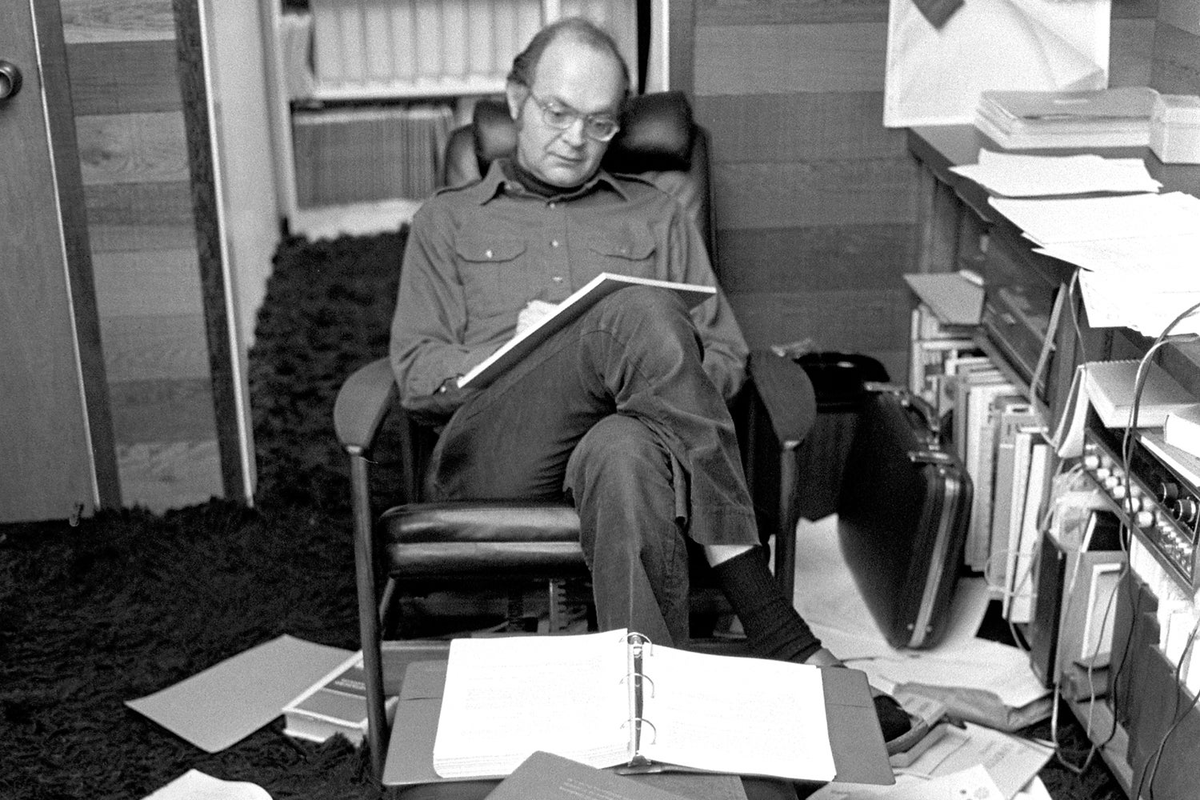
A computer scientist won the Turing Award at 36 and then walked away from almost every other project for the next 50 years to write one book that he has still not finished at age 88, and it may be the most important book in his field.
His name is Donald Knuth. He won the Turing Award in 1974, which is the closest thing computer science has to a Nobel Prize.
He was 36 years old. He had already written volumes one, two, and three of a book series called The Art of Computer Programming. He was the youngest person ever to receive the award at that point in its history.
Almost anyone else would have ridden that moment for the rest of their career. Founded a company. Sat on boards. Gone on speaking tours. Knuth did the opposite. He went back to his desk and kept writing.
He started the book in 1962. He was 24 years old. His publisher had asked him to write a short paperback on compilers. He sat down to outline it and discovered that to explain compilers properly he would have to explain the deeper algorithms underneath them first.
The short paperback became a draft outline of 12 chapters. The 12 chapters became a planned 7-volume series. The 7-volume series became the project he is still working on 63 years later.
Volume 1 came out in 1968. Volume 2 in 1969. Volume 3 in 1973. He was producing books faster than most academics produce papers. Then everything stopped.
In 1977 he received the printed proofs of the second edition of Volume 2. He looked at the pages and was so disgusted by how the publisher had typeset his mathematical notation that he could not bring himself to release the book.
The equations looked ugly. The fonts looked wrong. The spacing was off. He decided he could not in good conscience publish another volume of TAOCP until the typesetting problem was solved.
So he paused the book.
He stopped writing TAOCP and spent the next 8 years inventing TeX from scratch.
TeX is the typesetting system that every academic paper, every math textbook, every physics journal on earth now uses. Every PhD thesis in the sciences is set in TeX. Every paper on arxiv. Every equation in every paper Anthropic, OpenAI, and DeepMind have ever published. The system that the entire scientific publishing world runs on exists because one man refused to compromise on how the second edition of Volume 2 looked.
He gave the entire TeX system away for free. He never tried to commercialize it. He went back to writing TAOCP.
In 1992 he retired from Stanford at the age of 54. Most professors retire to slow down. Knuth retired to speed up. He explicitly said he was leaving teaching because he needed every remaining hour of his life to keep writing the book. He stopped using email on January 1, 1990.
He answers no calls. He takes paper mail only. He is on a personal mission to finish a multi-volume series that nobody is forcing him to write, on a deadline that only exists in his own head.
Volume 4A came out in 2011. Volume 4B in 2022. He is currently working on Volume 4C. Volumes 4D, 4E, 4F, 5, 6, and 7 are still ahead of him. He is 88 years old. He will almost certainly die before he finishes.
The thing that should haunt anyone reading this is the math of his choice.
Every modern incentive structure tells you to optimize for speed. Ship the imperfect version. Get it out the door. Iterate later. Move on to the next thing.
Knuth has spent 63 years doing the exact opposite. He pays a $2.56 reward in hexadecimal dollars to anyone who finds an error in his published books. Real checks, until check fraud made him switch to certificates of deposit. He treats every single error in every single volume as a personal failure. He revises. He rewrites. He goes back to fix issues that nobody else could have spotted.
He could have written 30 books in 63 years. He chose to write one.
The reason is the one almost nobody understands the first time they hear it. There is a category of work that loses all its value when it is done quickly.
A reference book that engineers will rely on for the next 200 years is not the same kind of object as a blog post that has to ship today. The slow project and the fast project look like the same activity from the outside. They are completely different games.
Bill Gates once said in an interview that if you can read the whole of TAOCP, you should send him your resume. He meant it. He was not joking. The man who founded Microsoft was telling the world that the rarest skill on earth is being able to finish a book that one man has spent his entire adult life writing for an audience that mostly does not have the patience to read it.
The book may never be finished.
The man writing it knows this and keeps writing anyway.
The work outlives the worker. That is the entire point.
LUNCH TIME LISTEN
It's a long one, but every second of this interview is worth watching.
@RobMKendall interviewed @IndyBain about the proposed "wheel tax increase" in Indianapolis.
Bain says it's BS and we don't have to raise taxes.
They also talk about the
-decay of the @IndyGOP
-IURC.
LUNCH TIME LISTEN
It's a long one, but every second of this interview is worth watching.
@RobMKendall interviewed @IndyBain about the proposed "wheel tax increase" in Indianapolis.
Bain says it's BS and we don't have to raise taxes.
They also talk about the
-decay of the @IndyGOP
-IURC.
Setting aside the value of actual liberal arts (those disciplines that help citizens wisely exercise the franchise), I think discussions of college value too often conflate (1) the ability to land a job with (2) the ability to perform well in that job. Consequently, people who criticize (most) college as failing in the latter are wrongly seen as logically inconsistent in taking the former into account when they counsel their kids.
There's no such inconsistency when the distinction is taken into account. At least until recently, employers who had no illusions about how much their employees' college learning benefited the employer nevertheless viewed the degree as filtering for SAT scores and sitzfleisch, which they did view as predictors of performance.