Our Special Issue on Understanding Age & Society using animal populations is now published 🎉
Intro: https://t.co/w7EOwuZfca
Full ToC: https://t.co/WahxfVSWft
A big thank you to all the brilliant scientists who have contributed such cool research to this! 🙏Please share
A new @SciRobotics study highlights how an insect-inspired leg design and control strategy allows the @Harvard RoboBee to execute safe, controlled, and accurate landings as it flies between the leaves of a plant. https://t.co/a8eK8DYJ0E
Please RT! If you/someone in your lab is still looking for a PhD for Fall 2025 due to having an offer rescinded, etc. I have funding for up to 2 PhD students in my lab at @Mizzou. Contact me if you're interested in studying California quail social behavior https://t.co/RTBOVcFSYA
...and an equal pleasure to chair #ICT4AWE in Porto 🇵🇹 with @JosephFirthUoM introducing #Keynote@JoshAFirth speaking on "Optimising social connections across the life-course in real-world populations" https://t.co/2VZ1s9GjyS 2/2
A pleasure to chair #ICT4AWE in Porto 🇵🇹 with @JoshAFirth introducing #Keynote@JosephFirthUoM speaking on "Digital tech and mental health: improving outcomes across the lifespan"
https://t.co/GMPU6Ddj3i 1/2
@BrendonStubbs23@JosephFirthUoM Thanks Brendon! Don’t worry about setting up a debate at a conference between us, you can catch us at any family gathering for the uncensored version of that 😅
Looking forward to the 11th ICT-4-Ageing Well conference in Porto Portugal next week! A first-ever ICT conference for me, and also the first-ever where me & my identical twin give keynotes on the same day (finally proving we aren’t just the same person!) https://t.co/ZE3PuIMq8c
Honored to give the Keynote at Sunbelt 2024 in Edinburgh—my first Sunbelt! 🌍🎤
📺 Watch "Network Science: From Structure to Network Resilience" here:
🔗 https://t.co/iPmKD5yQ5K
#NetSci#Sunbelt2024#NetworkScience
We are pleased to announce our new book: The World of Zero-Inflated Models: Using GLLVM. Zuur and Ieno (2025)
This book explores modern statistical methods for analyzing complex datasets, focusing on multivariate models, mixed-effects models, and latent variable models. GLLVMs integrate GLMs and GLMMs with multivariate analysis techniques, allowing multiple response variables to be modeled within a single framework.
Key topics include count data models with excess zeros and distributions such as Poisson, negative binomial, zero-inflated Poisson, zero-inflated negative binomial, and Tweedie. The book also provides practical guidance on implementing these models in R using the gllvm package.
Designed for researchers, statisticians, and analysts working with multivariate ecological, environmental, or social science data, this book is also a practical resource for R users looking to apply complex statistical models effectively. Each chapter includes detailed R code and case studies, demonstrating how to fit and interpret complex models, diagnose potential issues, and refine model performance. Emphasizing practical solutions, the book helps readers apply these methods to real-world datasets.
We're excited to announce the first Evolving Self-organisation workshop at @GeccoConf!
Submission deadline: March 26, 2025
More information: https://t.co/3ERHuljX2n
🚨 Big news everyone! 🚨
We have decided to extend our abstract deadline for #ASABSpring2025 until the 28th of February! That gives you two more weeks to send us your applications🎉
Register here: https://t.co/oRU7gjOdJ3
📦{superspreading} is on CRAN 🎉
🔍Analyze individual-level variation in disease transmission using secondary case data.
🤔What's the probability that a disease turns epidemic or goes extinct? What proportion of cases cause X% of transmission?
🌟More: https://t.co/nPRMQYCVqB
Wondering what you have to look forward to for our Spring ASAB Conference 🤔
📣 Don't forget: Registration for the ASAB grant is closing THIS WEEK, so don't miss your chance to get a grant!
#ASABSpring2025#Behaviour2025#LJMU
Don't miss this week's seminar on #urbanecology and #wildanimalwelfare — Wednesday at 3 pm GMT. Hear from experts in the field from @RoyalVetCollege, @ZSLScience, and @AAEuibk. Attendance is online and in person at the RVC in London. Register here: https://t.co/juM8s0RhjJ
We have a position available for a research assistant to join our team to test our rationally designed malaria vaccines. A fun job with a lovely team of people and an important project funded by the Gates Foundation. Come and join us!
https://t.co/m3nZQNw1jH
And here we go! First position on my ERC grant is officially open. Fully funded 3.5 years PhD position at @NUnetsi London working with me and the @NPLab_
on modeling and reconstructing higher-order systems. Application deadline: 16th February 2025. https://t.co/HuzgquFa4B
Our last contribution to understand how fish adjust their behaviour to underwater human presence. It seems that fieldwork alone is not sufficient to fully reveal the role of group size in modulating flight initiation distance 🤔...https://t.co/bSnJ8B1BEi @ICMCSIC@iMARES_group
📦{simulist} package is on CRAN! 🎉
🔍Simulate an epidemic in the form of linelist and contacts using branching process!
🛠 Use epidemiological parameters, age structure, age-stratified hospitalisation, death risk and case fatality risk.
🌟 Try it out! https://t.co/1he7yna8rb
There’s a lot of important dates coming up for #ASABSpring2025 & #Behaviour2025
ASAB Grants: https://t.co/Eikwc6So9D
ASAB Spring: https://t.co/a9eLTcrjsn
Behaviour: https://t.co/9ko4mdntOl
Make sure you also follow @ASABSpring2025 & @Behaviour2025 for updates 😄
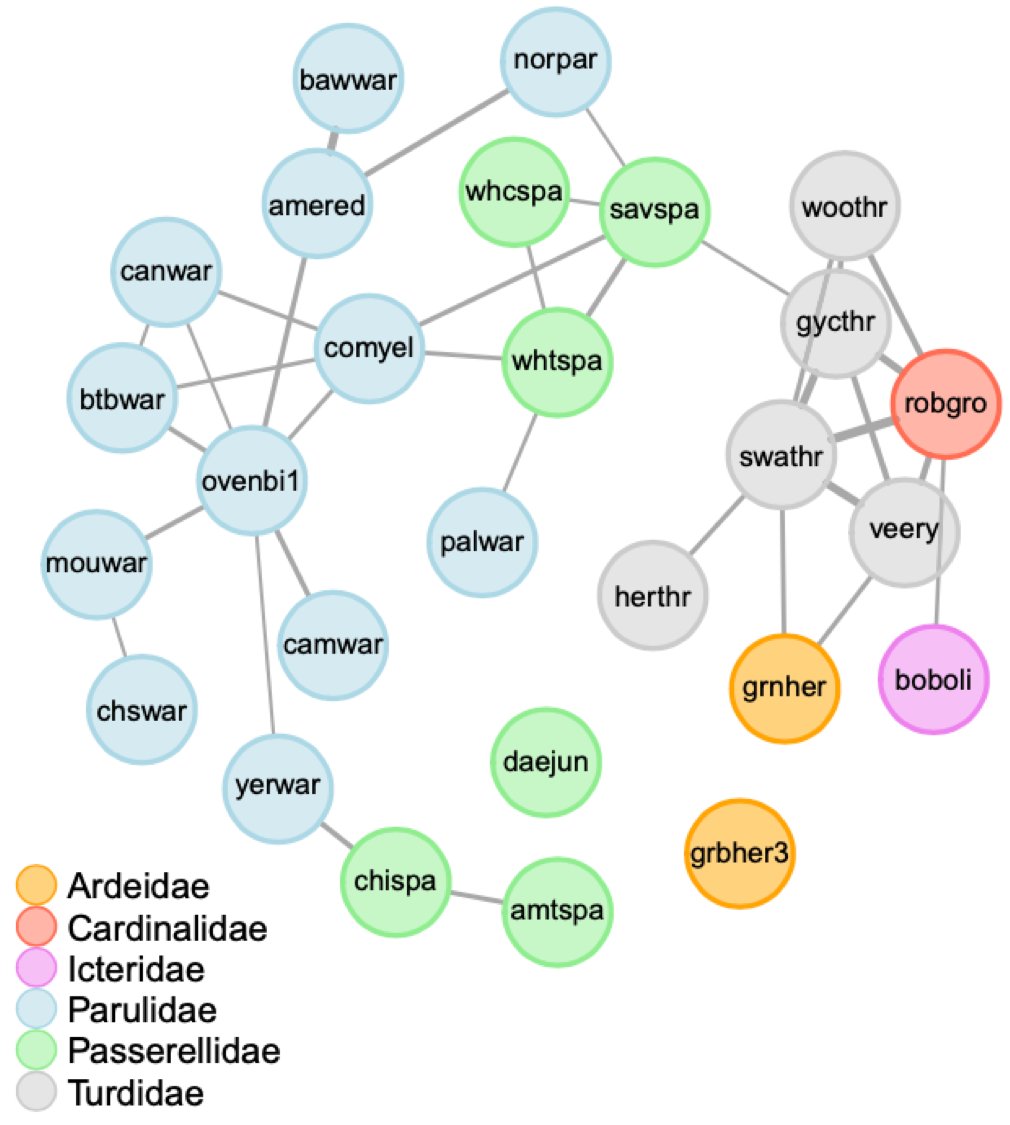
Nocturnal migration isn't as lonely as it sounds!
>18000hrs of recordings from >370nights at 26sites reveals interspecific social interactions between migrating birds 🐦
Out now in @CurrentBiology: https://t.co/zUa65B2nmb led by @bvdbirds 🐦