@spacanpanman Could you share what trading desks would be doing on a day like this? Are they continuing to degross today? And what would they be looking for as they try to identify a bottom? How does this connect to the VIX at 33?
@spacanpanman I liked this part: “Senators also raised concerns about billions in noncompetitive SpaceX contracts, proposing restrictions intended to encourage more suppliers for major military satellite programs.”
🚨 “AST SpaceMobile will one day be the largest company in the world.” — $ASTS SVP of Launch Operations (30-yr space veteran) drops a bombshell on Blacklift! 🚀👑
Mark McLaren, SVP of Program Management APAC Gateways & Launch Operations at AST SpaceMobile (and key engineering leader since 2020), just posted an unfiltered reaction to the Blacklift Unveiling Event (Build. Launch. Connect.):
When the executive leading ASTS's launch operations puts that kind of conviction in writing, the message to the market is monumental! 📈💥
#ASTS #Blacklift #SpaceTech #Launch #Telecom
Thrilled to announce J-LEO final award today alongside partner Rakuten!
~$1 billion in non-dilutive funding towards spacecraft and launch from the Japan Ministry of Internal Affairs and Communications.
Accelerates space-based cellular sovereign connectivity for Japan, while supporting additional coverage around the world.
$ASTS Huge announcement by AST. Explains the Philipines gateway in their gateway PRs.
As a reminder, this is a Lynk parner. Can this be another potential defection? Lynk recently lost Spark and Rogers to SpaceX.
https://t.co/DJg32wMLmq
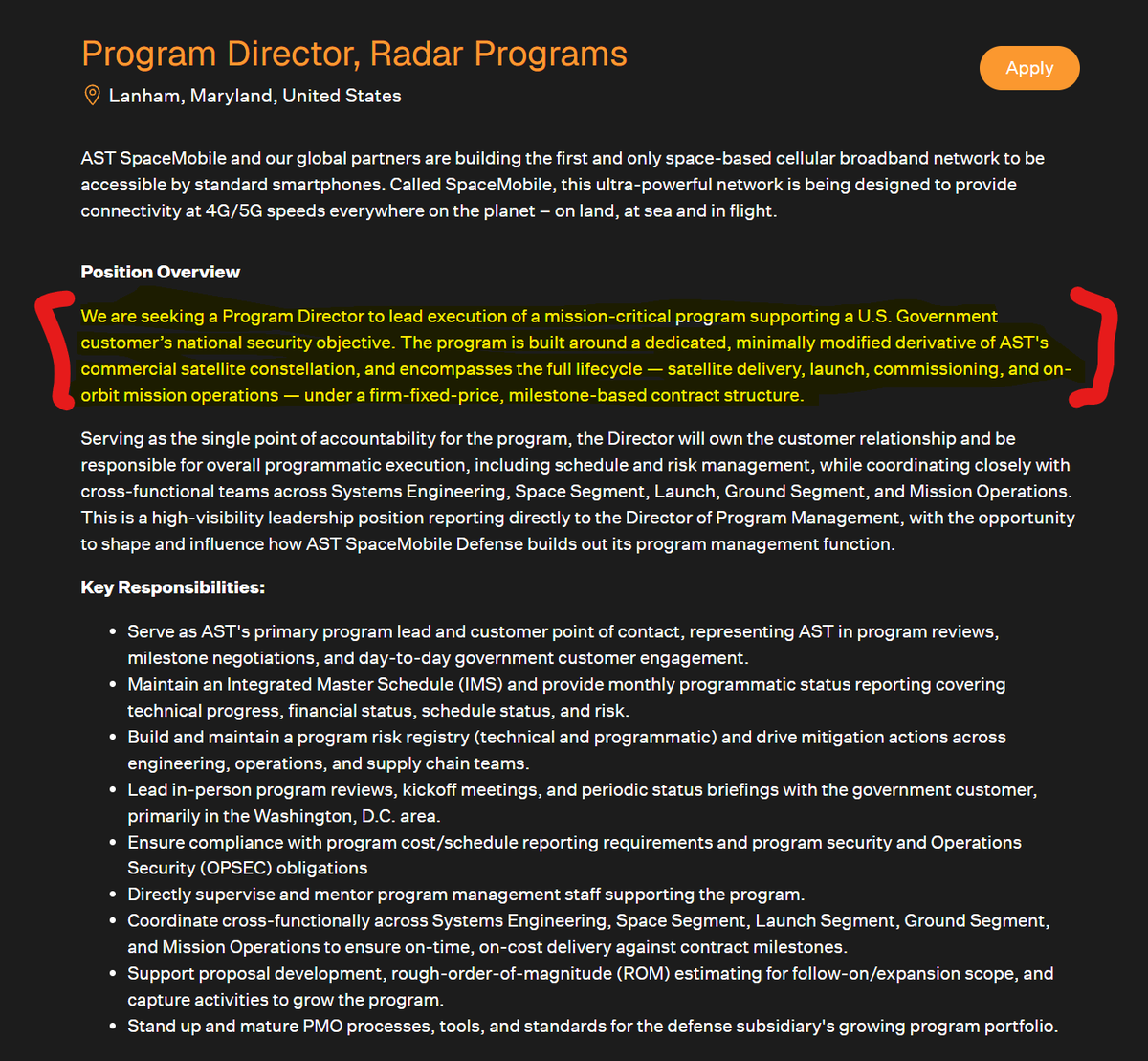
$ASTS: "Program Director, Radar Programs"
We are seeking a Program Director to lead execution of a mission-critical program supporting a U.S. Government customer's national security objective. The program is built around a dedicated, minimally modified derivative of AST's commercial satellite constellation, and encompasses the full lifecycle — satellite delivery, launch, commissioning, and on-orbit mission operations — under a firm-fixed-price, milestone-based contract structure.
cc: @Defiantclient2
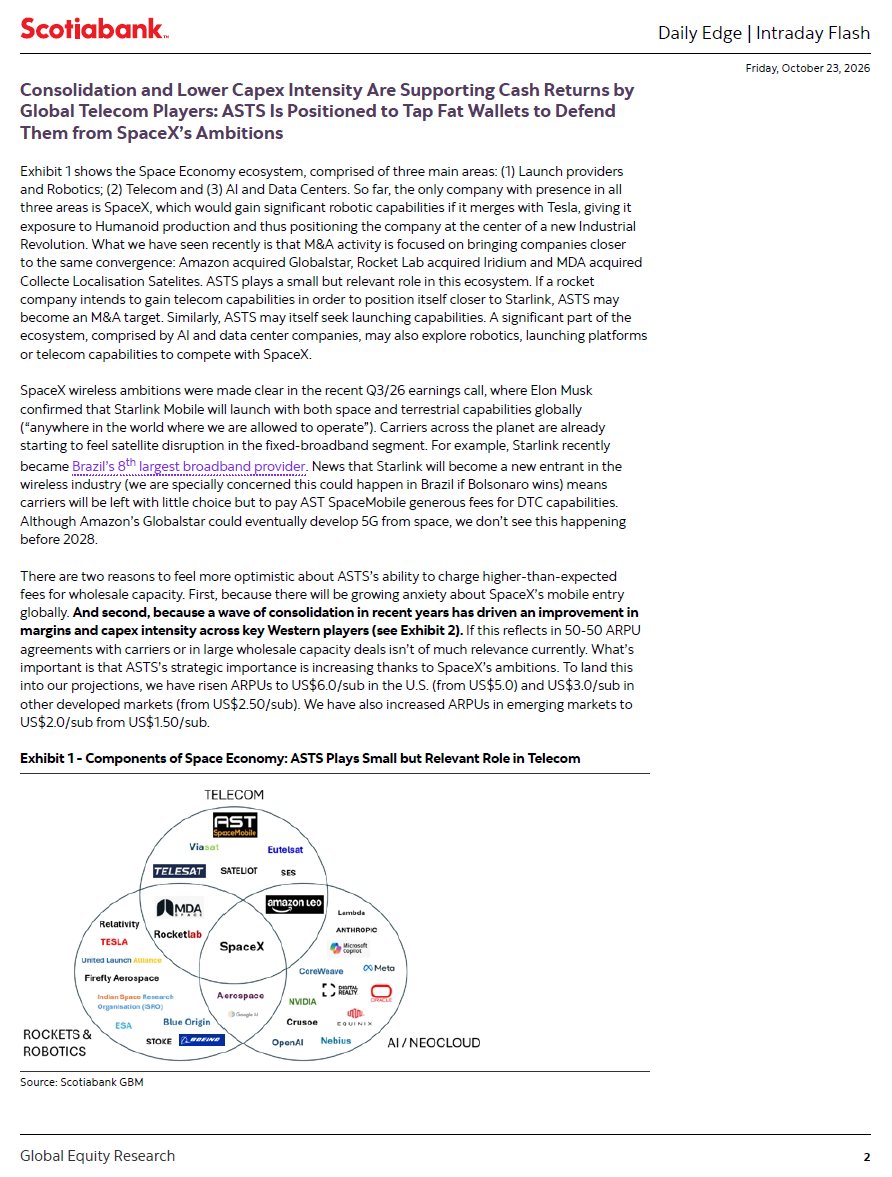
$ASTS: 🚨SCOTIA BANK UPGRADES AST SPACEMOBILE TO BUY AND RAISES PRICE TARGET TO $55.70
"SpaceX’s oversized ambitions to become a planetary carrier make ASTS’s wholesale 5G model especially valuable to terrestrial networks, which will fight to defend their business model."
"We do believe that ASTS is a top target but we don’t set our target based on M&A speculation."
$ASTS: Did you know that weak "1-bar" service accounts for 25-35% of overall terrestrial coverage?
AST SpaceMobile solves this for Mobile Network Operators
$ASTS locking up the European market (and beyond) with the 4 biggest MNO operators on the continent while the market continues to sleep.
- Vodafone: 279M. Europe and Africa.
- Orange: 321M. France, Spain, rest of Europe, Africa & Middle East.
- Telefónica: 249M. Spain, Brazil, Germany, UK, remaining Latin America.
- Deutsche Telekom: ~255M. US (~133M), Germany (75M), rest of Europe (47M).
Total: ~1.1 billion mobile customers
I have mentioned before that non-terrestrial network coverage will eventually be included in all mobile plans. Past evidence for this has been comments from Nokia, Erickson, RSPG etc (see below tweet) about 6G terrestrial and non-terrestrial network hybrid integration.
There are further hints of this yesterday with Australia, mandating universal outdoor coverage for text and voice calls. Additionally, the FCC is now allowing buildout requirements as part of spectrum sales to be met with satellite D2D. This implies regulatory comfort with persistence and minimum service levels. $ASTS is a leader in what is, at worst, an oligopoly on a new feature that will be bundled in to all plans.
$ASTS: Indeed
"ASTS' EV is currently $23B, while we estimate the spectrum rights ASTS has through its long-term lease with Ligado represent $19B in value, implying only a $4B valuation for the rest of the company, or $10 per share."
$ASTS: 🚨 DEUTSCHE BANK UPGRADES AST SPACEMOBILE TO BUY FROM HOLD WITH $93 PRICE TARGET
Upgrading to Buy
We are upgrading ASTS to Buy and maintaining our $93 PT. The stock is down ~65% from its all-time high in May. We had downgraded the stock in May after the New Glenn launchpad explosion that introduced a material delay in ASTS' launch plans, combined with valuation concerns. However, we believe now is an opportune time to become more constructive given the recent stock-price weakness, a number of positive developments/catalysts that we think have gone under the radar, and spectrum value that we estimate now comprises all but $10 per share in ASTS' EV. Furthermore, we think the -10% move on Friday was misguided since the 800 MHz spectrum SpaceX will be acquiring doesn't make SpaceX more competitive with ASTS as an MNO partner for D2D, and ASTS isn't targeting direct-to-consumer (for which SpaceX will primarily use the 800 MHz).
We see a number of positive developments/catalysts for ASTS in the near term:
➡️ We believe it is increasingly likely that T-Mobile will switch from Starlink to ASTS as its D2D partner (through the JV). Roughly coincident with the timing of the announcement that AT&T, Verizon, and T-Mobile reached a definitive agreement to form a D2D JV on Oct. 1; T-Mobile appears to have removed many (but not all) references to Starlink from its website. Furthermore, SpaceX's efforts to compete with the Big 3 MNOs in mobile continues to antagonize the Big 3 (and shrink their market capitalizations), pushing them even closer to ASTS. SpaceX's announced purchase of 14 MHz of 800 MHz spectrum from Grain Management on October 8 was the latest shot across the bows of the Big 3, leading to a 10-13% decline in their stock prices on Friday (just the latest SpaceX-driven market-cap destruction for the telcos).
➡️ The Space Development Agency (SDA) sent a letter to the National Telecommunications and Information Administration (to be then forwarded to the FCC) in September expressing support for ASTS' request for Temporary Authority to conduct testing of pulsed radiolocation capabilities in the 902–928 MHz band using its in-orbit BlueBird satellites. The letter names ASTS as a subcontractor and stresses the national security importance of testing these capabilities (which appear to be sensing related). We believe this is indicative of continued progress by ASTS in expanding its government contract base, a revenue opportunity that seems to be expanding every day.
➡️ The preliminary selection of ASTS (along with Rakuten) for the Japan LEO project took a step forward when the October 5 Joint Statement on the U.S.-Japan Technology Prosperity Deal specifically "welcomed Japan's Rakuten Group and the U.S.-based AST SpaceMobile cooperation for the development and deployment of Low Earth Orbit (LEO) satellite infrastructure". We view this as a sign that the official J-LEO authorization could be coming soon. If/when approved, it means the Government of Japan will fund up to $1B of capex for ASTS' satellite constellation in exchange for sovereign use and control of a number of satellites while they are able to provide coverage to Japan. This "up to $1B" is not reflected in our current valuation, even though it would represent essentially free capital, significantly improving ASTS' liquidity position.
Underlying Spectrum Value Means The Value of The Business Itself Is Highly Discounted
ASTS' EV is currently $23B, while we estimate the spectrum rights ASTS has through its long-term lease with Ligado represent $19B in value, implying only a $4B valuation for the rest of the company, or $10 per share. This assumes $1.09 per MHz*POP, equal to the price SpaceX agreed to pay Echostar in that transaction signed in September 2025.
We Also See Optionality From Potential Industry Consolidation
We believe ASTS could be of significant strategic value to a larger company with LEO and D2D ambitions given its spectrum position, novel satellite architecture, IP/patent portfolio, spectrum rights, MNO partnerships, engineering talent, manufacturing capabilities/facilities, and nascent government business.
Launch Is Still A Challenge, But Looks Incrementally Better Today
Our view has been for some time that securing launch and putting satellites into orbit is the most critical success factor for ASTS over the next couple years because it would facilitate commercial-service introduction and begin to accelerate revenue growth. It is also important defensively to ensure MNO partners stick with ASTS and the company's government-contract base expands. The launch bottleneck continues to be a challenge. However, Blue Origin seems to be making encouraging progress toward rebuilding the launch pad destroyed earlier this year (potentially launching again before YE), and ASTS is prepared to pay a premium for additional launch from SpaceX and others to help mitigate the impact of less Blue Origin launch availability. Thus, while we continue to have concerns regarding launch availability; (1) we think the picture is incrementally positive relative to a quarter ago given Blue Origin's progress, and (2) we think these other aforementioned catalysts will define the narrative between now and the end of the year, since the industry launch-capacity situation is already fairly well appreciated by the market.
Regarding the SpaceX/Grain transaction, I think this is moderately net positive for AST. First, the negative. Another swath of spectrum (which would have been useful in 6 months on Block 2), which the MNO’s couldn’t control due to FCC limits on amount of low band each can control, would have been a big boon to $ASTS. The biggest would be the ability to use this to kill urban area grey zones. 1:1 frequency reuse with undeployed, nationwide low band would have be a huge attraction to customers and MNOs accelerating adoption with a superior product.
Now, we have to wait for the Ligado spectrum for similar abilities. Further, Ligado is not in current phones, which Grain was. OTOH, it will share much of the same desirable propagation characteristics as it is on the lower end of midband spectrum and it includes Canada (a market w/ high ARPU and 2/3 major MNO’s locked up).
The biggest benefit, as stated by others, is that this makes AST the last bulwark against SpaceX for the MNOs that currently own 90-95% of US mobile customers. TMo probably has to sign at worse terms than ATT/VZ or be left out in the cold. Easy to forget in the bubble of X but half the US dislikes Elon. What percent of Mobile subscribers is SpaceX therefore going to get? Even if you say they eventually get 25% of total US customers, AST signs with the 3 major MNO’s because of this and has access to 75%. Some think this makes an MVNO defection by one of the big 3 more likely, to preferentially cannibalize the other two, which I don't see at all. In this instance of defection, we maintain the current status of 66% AST/33% SpaceX but doesn't get SpaceX cooperation in international markets. D2D is probably a duopoly (don't put much credence to Amazon/Lynk/Equatys) with AST getting access to all of the customers of TMo/Vz/ATT.
Ultimately, you have to decide if you think SpaceX can capture most of the world's mobile subscribers or if the MNO's maintain their lead because AST's white label, core integrated broadband service will be the partner of choice for most MNOs. It is telling that Starlink hasn't signed any Tier 1 MNO's in the past 6-12 months and Deutsche Telecom (and thus TMo will follow) has said that they are working on network integration w/ AST. DT previously said they would only include Starlink Mobile on 2GHz and it looks increasingly likely they will lose their allocation.
I think SpaceX will pull a reverse build on their new low band spectrum. They’ll put up a bunch of low band capable satellites for broad coverage (and to meet buildout requirements) and later have towers in urban areas because these will be more more spectral efficiency and high penetrance in to buildings. Some have theorized that this forces the MNO’s to make the AST service as good as possible (i.e. donating more spectrum as evidence by Abel’s tweet that they control 1000 MHz LB/MB spectrum), to negate any advantage that SpaceX has, and I agree with that. The second order effect will be that this pushes AST to be included in every single plan from the big 3, because you don’t want SpaceX picking off your subscribers with it's D2D offering. This probably lowers ARPU, but vastly increases adoption percentage. D2D was always headed to 100% adoption, with 6G making NTN-TN integration a key feature, but it is now vastly accelerated.