Dep. director of criminal justice and public safety @philadelphiagov. Taught @pennlaw, @DELawSch. Former chair, @abaesq Standing Committee on Gun Violence.
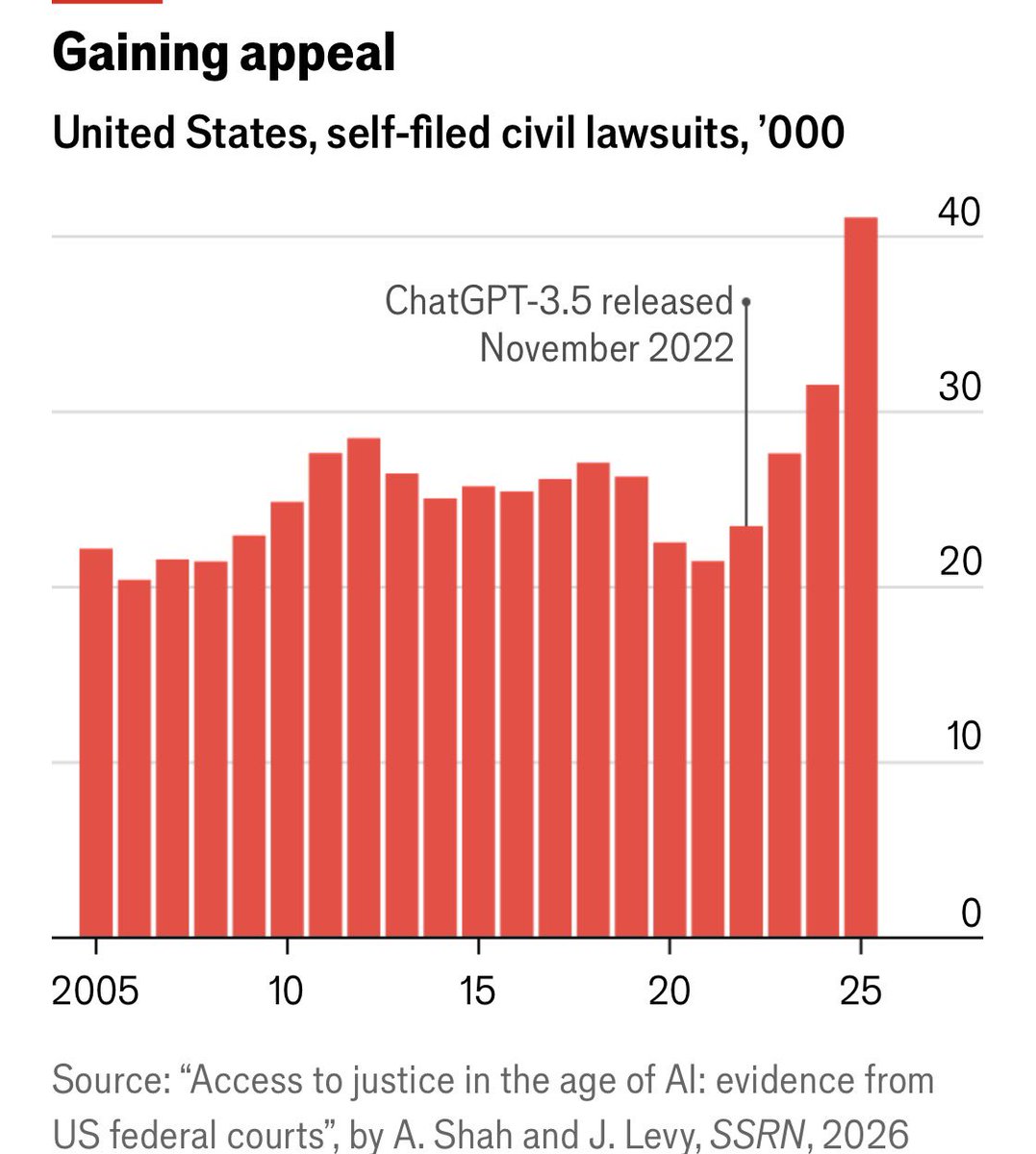
Researchers found “that the number of civil lawsuits filed without a lawyer in America doubled to 41,000 between 2023 and 2025” and with help of AI text tools.
Self-filed cases have similar success rate as pre-ChatGPT, which suggests AI is helping more people to win claims.
@aakashgupta If you're weighting properly, it's nearly 2/3 of your subjective life that's passed by age 20. There are about 23 "life units" on the scale and 15 have passed by age 20.
@jonmummolo@BrendanNyhan South Korea with Yoon Suk-yeol in 2024/25 comes to mind. Also, Berlusconi in Italy and to a lesser extent Netanyahu in Israel.
We more or less figured out that Judge Eleanor Ross was the judge involved in the "sex in chambers" case within 45 minutes of the original story... and HOW we figured it out should give lawyers and judges everywhere pause.
@OrinKerr@JorgeBarreraR@DavidAFrench I received my real undergrad diploma at graduation. Amherst College, 2001. At the time, vellum was still the norm also.
@theslowtell@alexolegimas How do you know you're eating real food? Regulation that compels transparency and quality guarantees. We tend to take that for granted.
No smoking gun, but the preponderance of evidence points to smartphones, not economics, as the culprit for the global drop in fertility:
• In the US and UK, births fell first and fastest in areas that got 4G earliest
• Birth rates were stable in the US, UK and Australia until 2007; in France and Poland until 2009; in Mexico and Indonesia until 2012; in Ghana, Nigeria and Senegal until 2013-15
Each of these inflection points matches local smartphone adoption (see picture).
• The younger the age group, the sharper the drop.
• in-person socialising among young adults is dropping. In SK, by 50% in 20 years
• Sexual dysfunction is higher among heavy social media user
• Effect is largest in culturally traditional societies — Middle East, Latin America, sub-Saharan Africa
• Decline holds across countries hit hard by GFC 2008 and those not hit, fast-growing and not growing.
Excellent again @jburnmurdoch.
https://t.co/RYEMXD2bRM
We are in deep, deep trouble.
A reader wrote in to me this week saying that they wouldn't read my Trump corruption story because ChatGPT "fact-checked the piece" and informed them most of it was false.
Among other things, ChatGPT told them that there is no Iran war, Jared Kushner is not a negotiator in the war, Qatar never offered Trump a $400 million plane, George Santos wasn't pardoned, the NYTimes did not report on Syrian billionaires lobbying Trump for sanctions relief, Trump never launched a meme coin, and World Liberty Financial (the Trump family crypto firm) doesn't exist.
Of course, all of these things ARE real, do exist, and are happening right now. Apparently, the reader copy and pasted the text of my story into ChatGPT, and without the links ChatGPT couldn't confirm any of it. Once the reader sent ChatGPT the link to the story, it ended up concluding all the facts were correct.
How many people simply don't know how to use AI and are offloading all their thinking? It's a terrifying thought. And a totally new frontier of reality to navigate.
Analysis of books on the NYT bestseller list show that sentences today are about 30% shorter than they were 100 years ago. This suggests a preference for shorter, more direct comms.
This isn't just relevant to fiction. When it comes to commercial comms there's evidence that brevity is preferable (not just in sentence length, but also in the total length of the comms).
In 2020, @Todd_Rogers_ and Jessica Lasky-Fink from Harvard sent emails to 7,002 US school board members requesting they complete a short online questionnaire. Sometimes that request was made in 127 words, other times, just 49 words.
It was the shorter request that got the best response.
The lengthy email had a response rate of 2.7% compared to 4.8% for the short one (an improvement of 78%).
Follow-up work showed that recipients used message length as a guide to how long the survey would take to complete. The more concise message made the task feel quicker, so people were more likely to engage.
If you want people to undertake a task, it's wise to whittle out the padding.
And if you’d like to learn more behavioural science tactics, sign up to my newsletter, AstroHacks. Each fortnight I look at one bias and explain how you can apply it to business or marketing challenges. And best of all, I'll do it in just a few words! Average reading time for the newsletter is about 3 minutes!
You can sign up here: https://t.co/3DOkjfucAB
Justice Scalia hit the mark on this one. "I worry that we are devoting too many of our very best minds to [the legal profession]."
https://t.co/MJVsNKVxRw
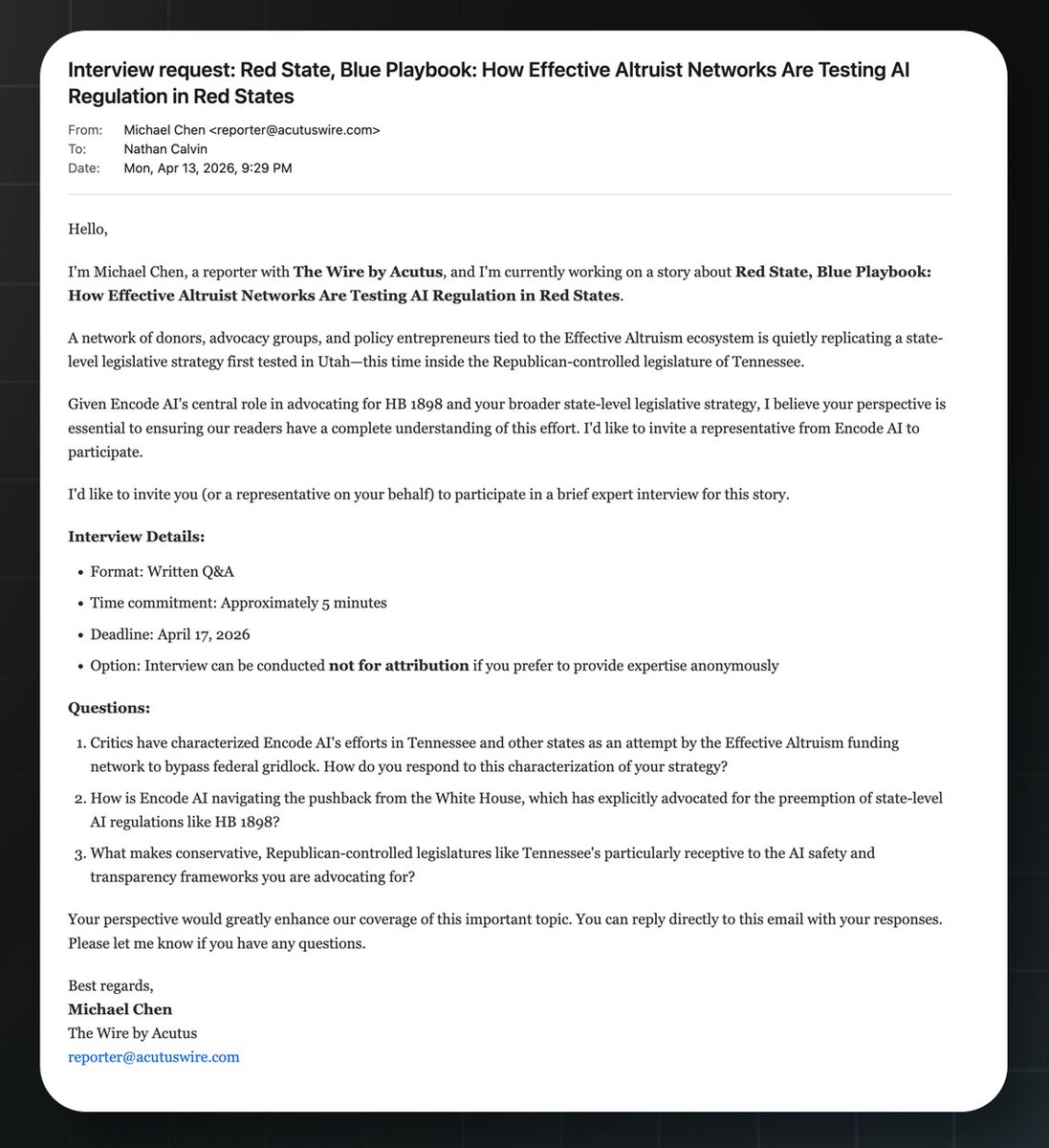
A few weeks ago, I was forwarded an email from a journalist named “Michael Chen,” asking for comment on an AI bill in Tennessee.
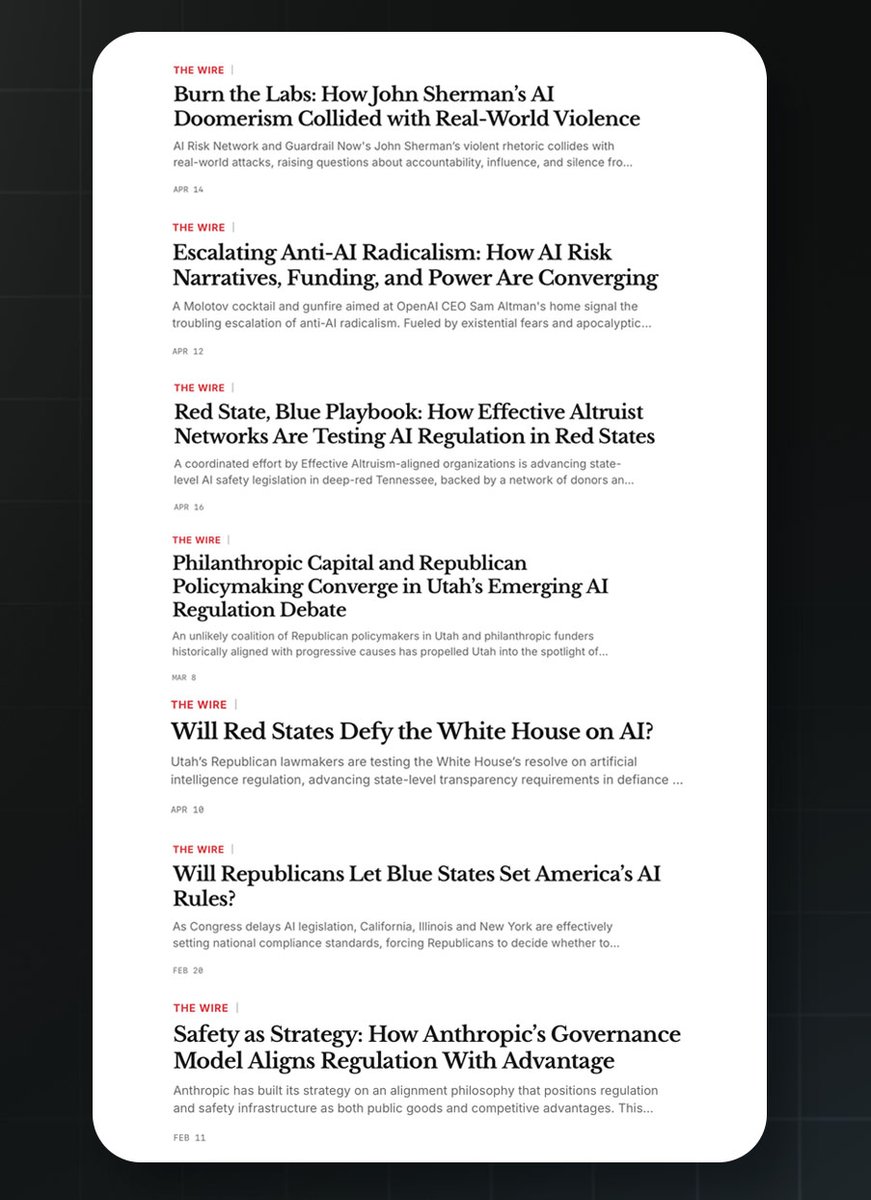
All signs suggest Michael Chen is not a real person, and the publication he writes for is an AI content mill linked to OpenAI’s super PAC.
@juleswapo@zeynep Lived experience is an undeniable influence on a person's worldview. Roberts fretted in the memos not about direct impact of a delay on operations, but rather impact on business planning, a much more attenuated harm. But he was attuned due to his lived experience.
@juleswapo@zeynep Can't help but wonder what influence Chief Justice Roberts's childhood had here. His father was in the steel industry, and among other roles was the general manager of a steel plant. Keeping those smoke stacks online kept the lights on and food on the table. 1/2
Another excellent @jodikantor@adamliptak exposé of internal #SCOTUS deliberations. This installment on the case that launched the modern shadow docket https://t.co/iVfH3qkTf1
okay I guess I have to talk about Péter Magyar here.
Let me just start with saying, in a very unladylike way, that you guys seem to have zero clue what happened in Hungary in the last two years, you completely miss the point, and you're a disappointing bunch.
Let's go.
I'm trying to remember who I was before Orbán, but it's so hard. All the newspapers, TV stations, academic departments, cultural projects, venues etc. that I worked at back home -- it's all gone. In the US, we like to criticize the media but imagine if overnight CNN, The New York Times, the Washington Post, NYU, etc., all closed down because of one politician. That's how it feels to be Hungarian. There is a lot to rebuild, and a lot of restoration work ahead for Magyar. The destruction -- including in the administrative system and the morale -- had been immense.
Many public discussions center around trends and statistics that are not real at all.
For over a decade, there was widespread public discourse about the causes of high and rising maternal mortality in the US.
But, as I've written about before , CDC analyses showed that the apparent rise from 2003 to 2017 was due to a change in measurement https://t.co/pBBcRoDoXQ , when a pregnancy checkbox was added to death certificates, which flowed directly into maternal mortality counts in most cases. Rather than mortality rising, the rate had been stable. Many deaths had been previously missed, and many other countries were undercounting maternal deaths.
This isn't an isolated case.
- People often cite the IHME's estimate of childhood height having fallen in the UK over the past decade. Looking at the data sources, it missed one of the key sources of data on height - a national dataset measuring the height and weight of almost all schoolchildren in the UK, which showed no decline (that data wasn't publicly available until an FOIA request) - and instead the IHME estimates were likely extrapolated based on a global model and smaller, less reliable surveys. https://t.co/dOxnt7ewPD
- I often hear claims about disruptive science having declined over time based on a highly influential paper in Nature. https://t.co/pTAlXnvanB But the key results were affected by a coding bug, which would have showed a decline simply due to this artefact https://t.co/0EXvL55Zer
- The idea that interstate migration in the US has collapsed has led to lots of concern about dynamism and unemployment. But recently, it's been shown that much of the apparent decline was a statistical artefact of how the survey filled in missing responses, causing it to systematically overcount non-movers. Correcting this shows only a very slight decline over time https://t.co/CeIp2kchWL
- The dramatic rise in autism diagnoses, which has spurred lots of commentary about pesticide use and vaccines, actually reflects changes in how autism was defined. In the 1960s, autism described severely disabled, mostly nonverbal children: if a child was verbal or succeeding at school, they were excluded from the diagnosis by definition. The criteria then widened across successive editions of the DSM. Alongside it, it became much easier to get assessed, from requiring a specialist with months-long waiting lists to something that could be done in a few appointments. https://t.co/0L1Y4tKCUd
--
I think this is a persistent problem of people undervaluing data quality and measurement. It may sound dull or academic to care about these issues, but numbers and statistics are a big part of public discussions. They can be the premise of debates that can go on for years and sometimes even decades, and mislead people about social and policy interventions to fix them.
So before spending time arguing about the causes and consequences of a trend or statistic and what should be done about it, it's worth digging into the data to see if it supports the premise at all.
I suspect there are many other discussions affected by this too. Are there others I've missed?