My husband spent eight months convincing his entire family that I was a terrible wife who was keeping his daughter away from him. His mother stopped calling me. His sisters started making nasty comments whenever we met, and one of them actually told me I should be grateful her brother hadn’t left me.
I had no idea what he had been telling them until his mother called me three days before our daughter’s birthday.
“Are you still refusing to let Daniel’s family attend the birthday dinner?”
I was confused. I had already booked the restaurant, paid the deposit and reserved seats for everyone.
When I told her this, she went quiet.
Then she said, “But Daniel told us you cancelled everything because you didn’t want us around your daughter.”
I immediately called my husband. He ignored my calls until he got home that evening.
When I confronted him, he sighed and said, “Can we not do this tonight? You always make me look like the bad person.”
I asked him what he meant.
He accused me of being controlling, disrespectful and difficult to live with.
That was when his mother sent me screenshots of their family group chat.
My husband had written that I threatened to leave with our daughter whenever we argued, controlled his salary and refused to let him spend time with his own child.
His sisters were comforting him.
One even wrote, “Brother, we know the kind of woman you’re dealing with. Just make sure you protect yourself.”
I was shaking when I finished reading.
But then I noticed something else. He had also told them that he was financially struggling because I controlled all his money.
That was strange because I had been asking him for months why our daughter’s college savings account had stopped receiving deposits.
I decided to ask him one question when he got home.
“Where is our daughter’s money?”
No pushback on Fin TV from:
* The most heavily owned stock of the entire parade of panelists - $NVDA (a dog was named for the company). Yes, its a dog with fleas (h/t the movie Wall Street).
* Hosts get too close to managements of Salesforce $CRM and $NVDA - favoring access over viewers' financial well being. (I have written 274 columns in a series on @thestreetpro "More Tales From Nvidia".)
* The panelists (and the strategist appearing daily in the afternoons) who were highly confident in the memory and chip stocks outlook. How can Farmer Jim (and the others) not be asked about $MU after all the other investment boners (like $ADBE $ORCL $CLF Paramount, etc)?
"The wise does in the beginning what the fool does at the end."
- Warren Buffett
It is clear that no one takes ownership, the network doesn't timestamp panelists' recommendations and there is rarely (if ever) pushback by the shows' moderators.
After all this it is clear nothing will change - not the formulaic programing and not the guests (get used to @fundstat defending ethereum/bitcoin and the markets daily, soon followed by @DivesTech.
It appears there will never be contrary discussion, discourse and debate.
The foul stench of "group stink" is pervasive.
As Grandma used to say, "Dougie, its a big fat waste of time."
@TheJudgeCNBC@HalftimeReport@KeithMcCullough@HedgeyeDJ
To anybody with a full-time W-2 and a side hustle:
You can open a solo 401(k) for your side hustle and make up to $72K in contributions/mega backdoor Roth contributions for 2026
On top of whatever you put into your company W-2 401(k) plan
Employee contributions are the only aggregate max between the two plans
Example:
Let's say I make $200K as a W-2 and contribute the full $24.5K as an employee to my company plan. Then my company matches 3%, so on $200K of wages, they put in another $6K. Total contributions = $30,500. Now let's say I also have a side hustle that makes $80K net. I could, if I wanted, open a solo 401(k) plan for this side hustle and put a full $72,000 into this plan through employer and mega backdoor Roth contributions. All mega backdoor Roth contributions grow tax-free, and the employer contribution is maxed at 20% * $80,000 minus 1/2 self-employment tax for a deduction on 2026 taxes
Such a good option as we approach a 12/31 deadline
Why is it so difficult to tax billionaires? 😂👋
Most don't earn their wealth through salaries. They own companies and stocks that increase in value, and in many countries, they don't pay capital gains tax until they sell... 😳👇
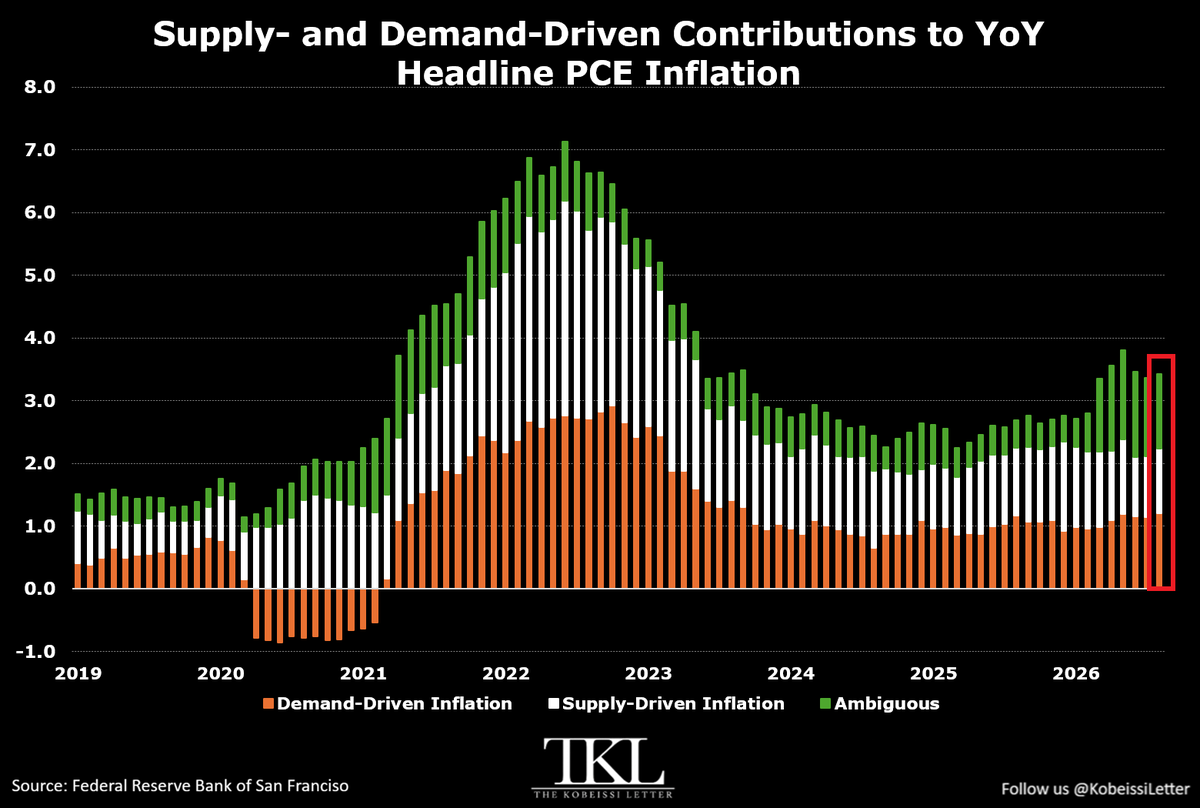
Demand is becoming a bigger driver of US inflation:
Demand-driven components contributed +1.2 percentage points to the +3.4% YoY increase in PCE inflation in August, the largest contribution since September 2023.
At the same time, supply-driven factors added +1.0 percentage point, while ambiguous factors accounted for another +1.2 percentage points.
This contrasts with the post-pandemic inflation surge, when supply disruptions were the main driver.
In 2022, supply-driven components contributed an average of +3.1 percentage points per month to headline PCE inflation, compared with +2.6 percentage points per month from demand-driven factors.
This is a key distinction for Fed policy, as rising interest rates can slow demand, while their impact on supply-side pressures is limited.
The composition of US inflation is shifting.
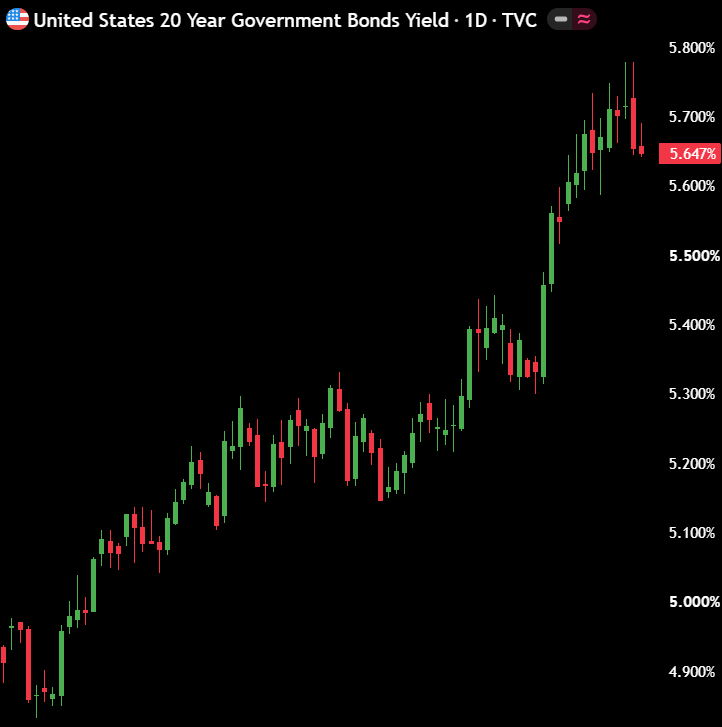
Interest rates have increased significantly this year, with long-term Treasury yields recently rising to their highest levels in more than 20 years. These rates don’t just affect mortgages and investments.
Read more: https://t.co/y0A55lQdXy
🇺🇸 The hottest inflation prints since 2022 hit last week and Treasury yields FELL... which may mean the bond market is sniffing out a 1929-style bust
The 10-year spiked to 5.33% on the CPI surprise, then dropped to 5.04% within 24 hours after a producer-price number that should have sent it the other way.
George Gammon of Rebel Capitalist says that only makes sense if the long end sees demand destruction coming, and his new comparison is the one nobody wants:
"If it's a 1929, you can't see it coming because you just get that right hook from Tyson."
The Buffett Indicator sits near 245% against 130% in 1929.
Diesel is already $6 to $7 and heads toward $10 if oil reaches $140, and an economy propped up by asset prices and AI capex has no Fed put left.
George's answer for a 401(k) is a 200-day moving average and a willingness to sit in cash, because set-it-and-forget-it investing is over.
@GeorgeGammon
“Yes, I know: Everyone’s bond yields have gone up, including Uncle Sam’s. Indeed, the U.S. 10-year Treasury yield was yielding 5.22 percent on Friday, higher than the French. And the U.S. deficit for 2027 will be about the same as the French. The difference is that the U.S. economy is growing at 6.3 percent nominal (including inflation). The equivalent number for France? It’s 1.9 percent. When growth is above the interest rate, you’re okay. When it’s the other way round, you’re heading for a crisis.” Sir @nfergus in @TheFP. (Link in replies.)
The bond crisis/riots across Europe and deficits in the U.S. along with our national economic unease all share a common root: Countries cannot ignore the realities that (1) distributions from the government cannot exceed receipts forever; (2) total taxes cannot be increased beyond 50% without enormous resentment from the taxed and (3) countries’ economies must grow or those countries will become unstable.
Thus it has always been. Thus it will always be. There isn’t any silver bullet. The vast majority of adults must work from 18 to 70 and beyond, and the work must mostly be within the private sector. The politics of the immediate future in the U.S. and abroad have to return to these realities: “Tax and spend” does not work, has never worked and won’t work next year or next decade. Elected officials have to grapple with entitlements across the globe or the unrest will grow. As Sir Niall Ferguson argues: Blame your grandparents.
(Note: If you cut almost all your subscriptions but save “News Items,” @TheFP and @WSJ, you can be fully informed about what you need to know as everything else is actually available on multiple sites for free).
With all eyes on the inflation statistics released this week, little attention was paid to the Treasury statement released on Friday. It showed the nation racked up a nearly $2 trillion budget deficit in just-ended fiscal year 2026. That’s more than 6% of GDP.
The myth that a weaker dollar will rescue the Treasury market can be easily exposed. This is far from a comprehensive assessment:
The argument assumes that depreciating the dollar will make US government debt easier to finance, reduce the real burden of debt and support Treasury prices.
But foreign investors care about their returns in their own currencies. If the dollar depreciates significantly, a foreign investor can suffer a substantial currency loss even when the Treasury bond itself rises in price.
For example, suppose a European investor buys a US Treasury yielding 4.5%. If the dollar subsequently depreciates by 10% against the euro, the investor can lose money in euro terms despite receiving the bond's interest payments.
Therefore a policy designed to weaken the dollar could therefore reduce foreign demand for Treasuries precisely when the US government needs that demand most.
The notion that dollar weakness would be accompanied by falling bond yields is also invalid. If investors interpret deliberate dollar depreciation as a signal that the US intends to seek to inflate away part of its debt burden, they will demand greater compensation for inflation and currency risk. That can raise nominal Treasury yields, particularly at the long end of the yield curve.
This creates a fundamental contradiction: a policy supposedly intended to rescue the bond market could instead undermine confidence in long-duration US government debt. A weaker dollar can coincide with falling yields under some conditions, but it is far from a reliable mechanism for producing them.
Furthermore, USTS are not simply investment securities. They are central to the functioning of global repo markets, derivatives markets, bank liquidity management and international collateral arrangements.
Their status rests partly on the perception that they are exceptionally liquid, secure dollar-denominated assets.
If deliberate currency depreciation damages confidence in the dollar's long-term purchasing power, it can reduce the attractiveness of Treasuries as stores of value, even if they remain useful as collateral.
That does not mean a weaker dollar automatically causes a Treasury collateral crisis. But it means that protecting Treasury market liquidity while undermining confidence in dollar assets is very likely self-defeating.
🚨Steve Cohen’s biggest stock is no longer $NVDA
It’s $CRDO !! Why Cohen’s book flipped:
Point72 cut $NVDA 94%. Credo took the #1 spot at $1.67B
And for the right reasons Here’s why 👇
Every AI data center has the same ‘hidden’ problem:
> GPUs are fast. Moving data between them is slow, hot, and fragile
> 100K-GPU cluster is worthless if the chips can’t talk to each other. Credo does the job
And it’s one of only three companies that connects data at every distance:
🟣 COPPER (inside the rack)
Active Electrical Cables, the famous purple cables. Copper with a Credo chip inside that cleans the signal. Cheaper, cooler and more reliable than optics over short runs.
🔵 OPTICS (rack to rack, row to row)
Optical DSPs, ZeroFlap optical modules and silicon photonics, boosted by the DustPhotonics acquisition.
⚪ CHIP-TO-CHIP (inside the server)
SerDes IP plus PCIe and Ethernet retimers that keep signals clean as speeds jump from 800G to 1.6T
The numbers:
• FY26 revenue: $1.3B (+206% YoY)
• Q1 FY27: $479M (+115% YoY)
• Non-GAAP gross margin: 68%
• Q2 guide: $525–535M
• Optical revenue target: >$600M this fiscal year, with 3 optical product lines each >> $100M
US Treasury yields are reaching levels we haven’t seen in over 20 years.
Stocks are at all-time highs. Government debt keeps growing. Inflation is still a problem.
Something is brewing.
BREAKING:
🇺🇸 US Treasury is planning to cut auction sizes for long-dated government bonds next month.
It's expected that Treasury will reduce auction sizes by $3 billion per auction for both 20-year and 30-year bonds.
Some banks are even expecting that Treasury will completely cancel the issuance of 20-year debt and shift the borrowing burden onto short-term T-bills.
After increasing long-term debt buybacks, Treasury is now trying something new to bring yields down.
people in their twenties who successfully have managed to live in their parents' house beyond 18 years of age, how the hell do u do that. this is my first time back and i have had the worst crash outs of my life