@shitov_happens Hi, if I understood correctly your reimplementation of gene activity only obtained a correlation of about 0.12 which I found surprisingly low, but I couldn't find your code for this baseline in the repo, where could I get it?
@PracheeAC There might also be less citation bias if these journals did not randomly limit the number of citations allowed (unbelievable that this is still a thing in the age of the internet)
I hate reference limits of journals so much. I'm sitting here trying to find a few more references to remove despite me knowing that I'll either remove context & evidence for scientific conclusions or not mention tools that very much deserve to be mentioned and cited.
📡 Join us for the next session in the Foundation Models for Biology Seminar Series (FM4Bio) on May 16 at 10 AM PT, featuring @jkobject.
Jérémie will introduce scPRINT, a large-scale foundation model trained on 50M single cells from the cellxgene database. The model infers gene networks and demonstrates powerful zero-shot capabilities in denoising, batch correction, and cell label prediction.
➡️ Save your spot: https://t.co/354YRl4Wyq
I am super happy to annonce that after 9 months under review the first paper of my PhD: scPRINT is finally available on Nature Comms! 🎉🧬
https://t.co/xAMMsbSYZ7
On Tuesday at 2025-02-04 18:00 CET, @jkobject will talk about scPrint, a transformer model that infers gene networks from scRNA-seq data, at our 2nd community meeting of 2025! For more information, check out the GitHub: https://t.co/1DPZAT63Zu & pre-print https://t.co/HzZ4ROUUrC
Groundbreaking work, congrats to the team!! 🎉 When I started my PhD 3 years ago, our tabular benchmark showed tree-based models miles ahead of neural networks. On the same benchmark, TabPFN v2 now reaches in 10s what CatBoost achieves in 4h of tuning 🤯
Merci pour l’opportunité d’avoir échangé sur mes recherches et mes expériences !
Merci à mes directeurs de thèse @gabrielpeyre et @RemiGribonval pour votre supervision 😊
I had the opportunity to present #HuMMuS at @ECCBinfo — amazing experience!
Huge thanks to the organisers for their formidable job. 🫶
And special mention for the food and fresh hummus! Perfectly on-point snack reminder 😋🧆
After a very constructive back and forth with editors and reviewers of @NatureComms, scConfluence has now been published @LauCan88 @gabrielpeyre ! I'll present it this afternoon at the poster session of @ECCBinfo (P296)
Published version: https://t.co/rFubNLSazy
🥳 I’m very happy to announce our preprint https://t.co/ufEtJiqvbK ! scConfluence combines uncoupled autoencoders with Inverse Optimal Transport to integrate unpaired multimodal single-cell data in shared low dimensional latent space. @LauCan88 @gabrielpeyre
🚨🚨 AI in Bio release 🧬
Very happy to share my work on a Large Cell Model for Gene Network Inference. It is for now just a preprint and more is to come. We are asking the question: “What can 50M cells tell us about gene networks?”
❓Behind it, other questions arose like: “how can we best learn networks for scRNAseq data?”, “How would we assess them?” “What are foundation models in biology actually learning about the cell and its mechanism?”
We try to partially answer these questions and present a new model: scPRINT 💫. 🏃
-> it is for now a pre-print and more is to come but here are some of our results:
scPRINT is a transformer model trained on 50M cells 🦠 from the cellxgene database, it has novel expression encoding and decoding schemes and new pre-training methodologies 🤖.
We propose to use the specificity of scRNAseq data and define a multi task pre-training composed of expression denoising, bottleneck learning and classification.
We also propose a new hierarchical classification method to work with the rich hierarchical ontologies used to label cells in cellxgene. (1/2)
https://t.co/buHUF0d4u7
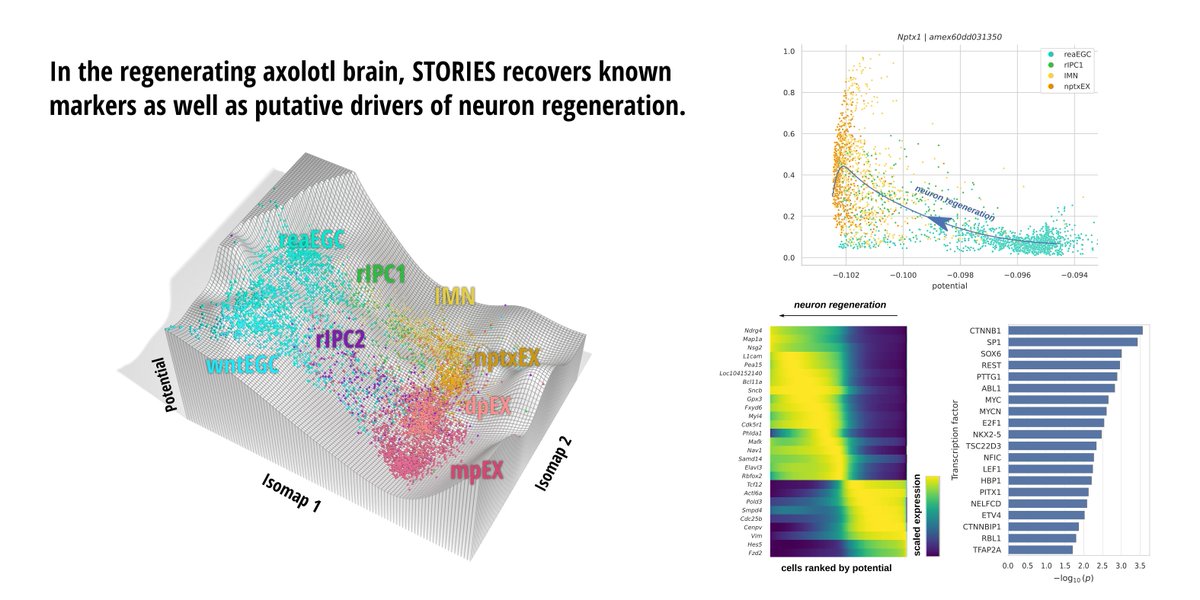
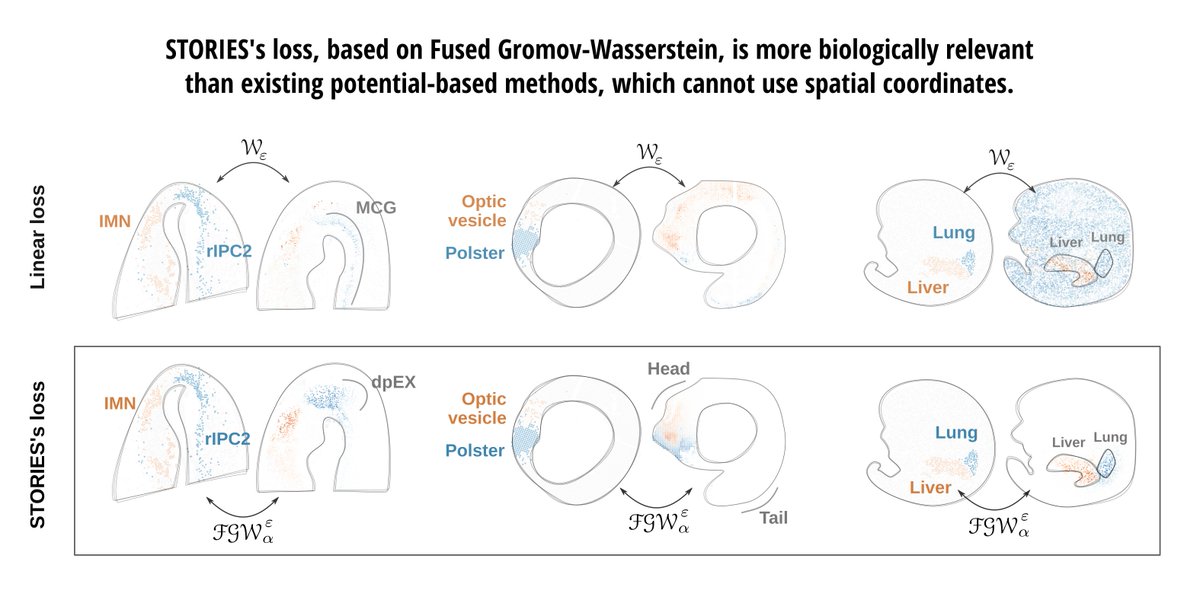
🎉 New preprint! https://t.co/XXspy6nlwX STORIES learns a differentiation potential from spatial transcriptomics profiled at several time points using Fused Gromov-Wasserstein, an extension of Optimal Transport. @gabrielpeyre @LauCan88
🚨🚨New ICML 2024 Paper: https://t.co/X0YczCtZ9k
How do Transformers perform In-Context Autoregressive Learning?
We investigate how causal Transformers learn simple autoregressive processes or order 1.
with @RGiryes, @btreetaiji, @mblondel_ml and @gabrielpeyre 🙏
Are you interested in cis-regulatory DNA interactions?
In 2018, #Cicero introduced an algorithm for inferring cis-coaccessible networks from scATAC
I’m excited to share #Circe, a Python implementation that is 100x faster and uses 5x less memory!
@LauCan88 @JulioSaezRod
1/5
There is still time to apply for this postdoc position! If you have a machine learning background and you are interested in applications to genomics/health, do not hesitate to reach out! #postdocall#openposition#recruiting
If you like ResNet and enjoy Optimal Transport, you might enjoy this paper with Raphaël Barboni and F-X Vialard. We show that infinite width/depth ResNet are ("conditional") Wasserstein flows. https://t.co/jaDmWS4Pbb
HuMMuS is finally out in Bioinformatics ! 🥳
https://t.co/LsTRgZ2yxj
We provide new insights, notably on HuMMuS robustness, and methylation data contribution in identifying driver TFs.
The revision was a very interesting journey, thanks everyone for all the great feedbacks !😊